Magical Thinking

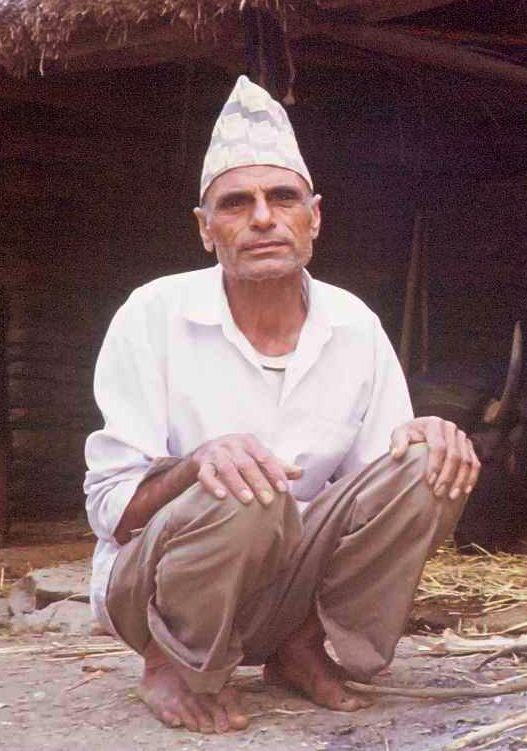
Tuesday morning, we’d only been up for a short time when Bhinaju told me that just around the corner, Shaula dai had gone in to the bathroom this morning, given a shout, and was immobile.  At first, from the way Bhinaju described it, I thought Shaula dai had somehow just stopped speaking.  But then Bhinaju went over to see what was going on, and when he came back, it was pretty clear that Shaula dai was dead.

At first I wasn’t going to do anything.  But as I finished packing for our three days in Pokhara I realized that made no sense.  To be honest, I still wasn’t sure who Shaula dai was, because I call almost all the men of a certain age simply “dai,” or “brother.”  Bhinaju had said, “The one in Deurali, with no teeth,” which could have been a lot of people, and I was sorting through them all in my mind.

It wasn’t till Bhinaju and I were walking over and we turned onto the small path that goes around Gita bouju’s house that I realized Shaula dai was Kopila and Kalpana’s father.  I chatted with him the other day while he and his wife were tilling corn.

At their house, a lot of people were crowded around the yard and in the dirt road in front of it.  Bhinaju and I made our way up to the porch, where Shaula dai had already been covered in a white piece of cloth.  I noticed a curtain was missing from in front of the house door, and for a minute I was fixated on this, the image of someone taking down the white curtain at the front door to cover Shaula dai’s body on the porch, leaving just one flowered white curtain at the entrance to the house.

Would they replace it?

At first, Ujali bouju – Shaula dai’s wife – looked bizarrely nonplussed, standing on the porch, calling out to various people in the crowd.  While she was off to the side, I asked Bhinaju if we could see Shaula dai’s face, and unfortunately just then Ujali bouju came to sit by her husband’s head, her obligation until the arrival of a son.  Before I could stop him, Bhinaju asked Ujali to pull back the sheet.  She did it gingerly, and suddenly her shock and terror were visible in the way she handled that gesture, as if the sheet was on fire.  As she tucked it back under his head our eyes locked for a long, confused moment.

I didn’t know if it was wrong to look her in the eye like that.

As we stood around, phone calls were made.  Shiva dai came over and Ujali bouju said not to call any of the kids who are living in Japan.  Especially not the girls – there was no way for Kopila and Kalpana to get here in time for the funeral rites.  So they were absolutely not to be called.  In the way that multiple experiences can suddenly collide and line up in an instant, I recognized Joan Didion’s The Year of Magical Thinking, which I read recently and have been thinking about a lot.  As if it made sense not to call the daughters, who should not know their father was dead if there was no way to get home for the funeral rites.  As if he could stay alive for them, as long as they didn’t know.

Last night, we had a guest in our house.  He had wanted to sleep in his own bed sheets, and had arrived with a white sleeping bag liner that was light and suited to the warm weather.  He fit right inside of the white liner and lay down on his back, with his legs straight together and hands folded on his chest, and put a pale shawl over the liner, and became perfectly still.  Bhinaju and I were sitting on the other bed and he leaned over to me and whispered – Laura – our guest looks exactly the way a dressed body looks – and we both shuddered and couldn’t look at the sleeping figure on the other bed after that.

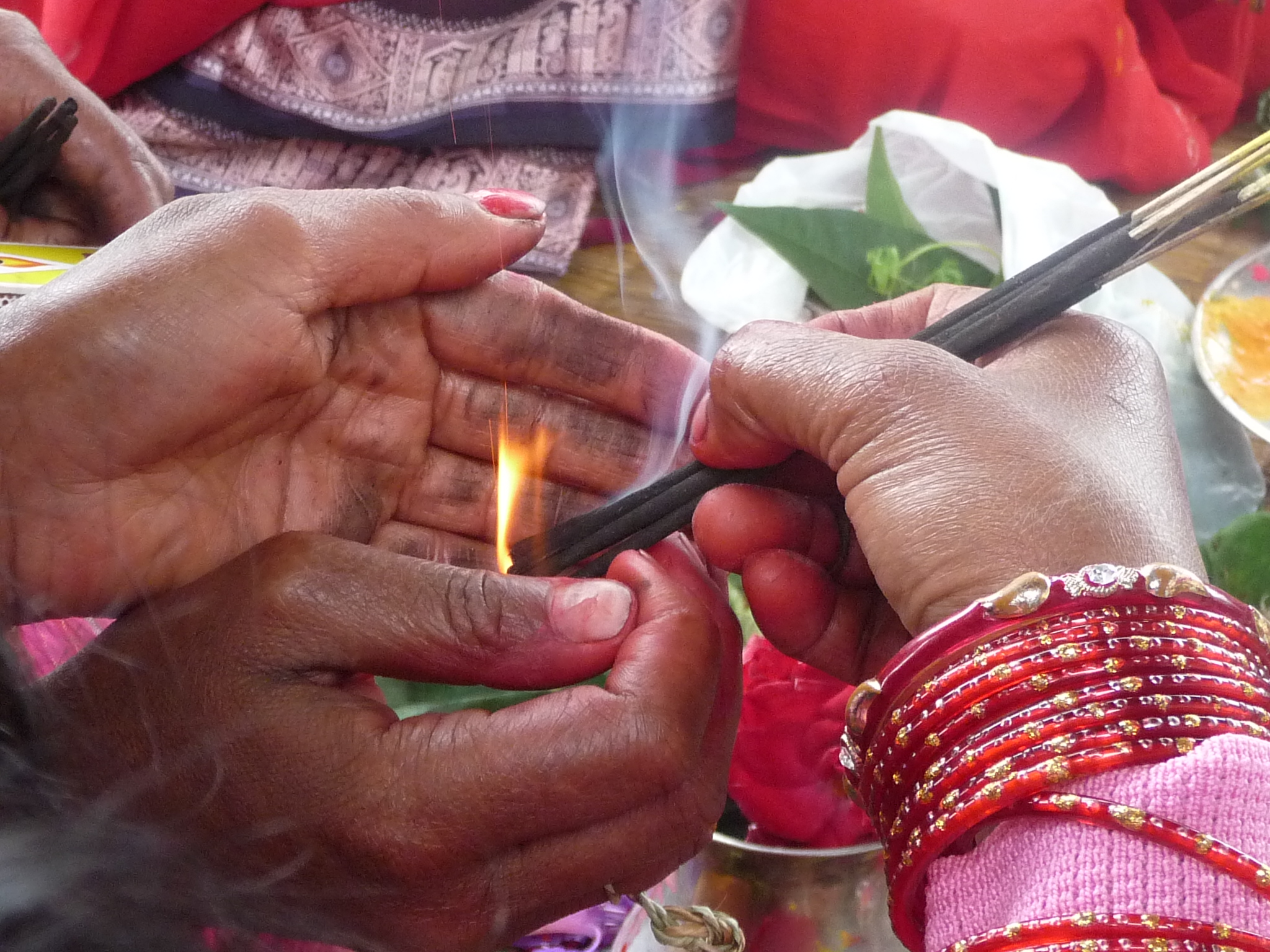
Now, the next morning, there was Shaula dai before our eyes in exactly same posture. Bhinaju leaned over to me and whispered – Laura – our guest just last night – and we both shuddered again.  And I realized that Ujali bouju, sitting by Shaula dai’s head, had not even changed out of her red sari, and it was jarring to see the red sari next to the white curtain covering Shaula dai, because white, the color of purity, is the color of death, and the celebratory color red is forbidden to widows.  In that moment, I saw Ujali bouju arrested in a transformed world, sitting in her red sari beside the still white covering.  Soon, somebody was going tell her it was time to change, and like Aamaa, she would never wear a red sari again.

.     .     .

P1030466

Playing in the Band

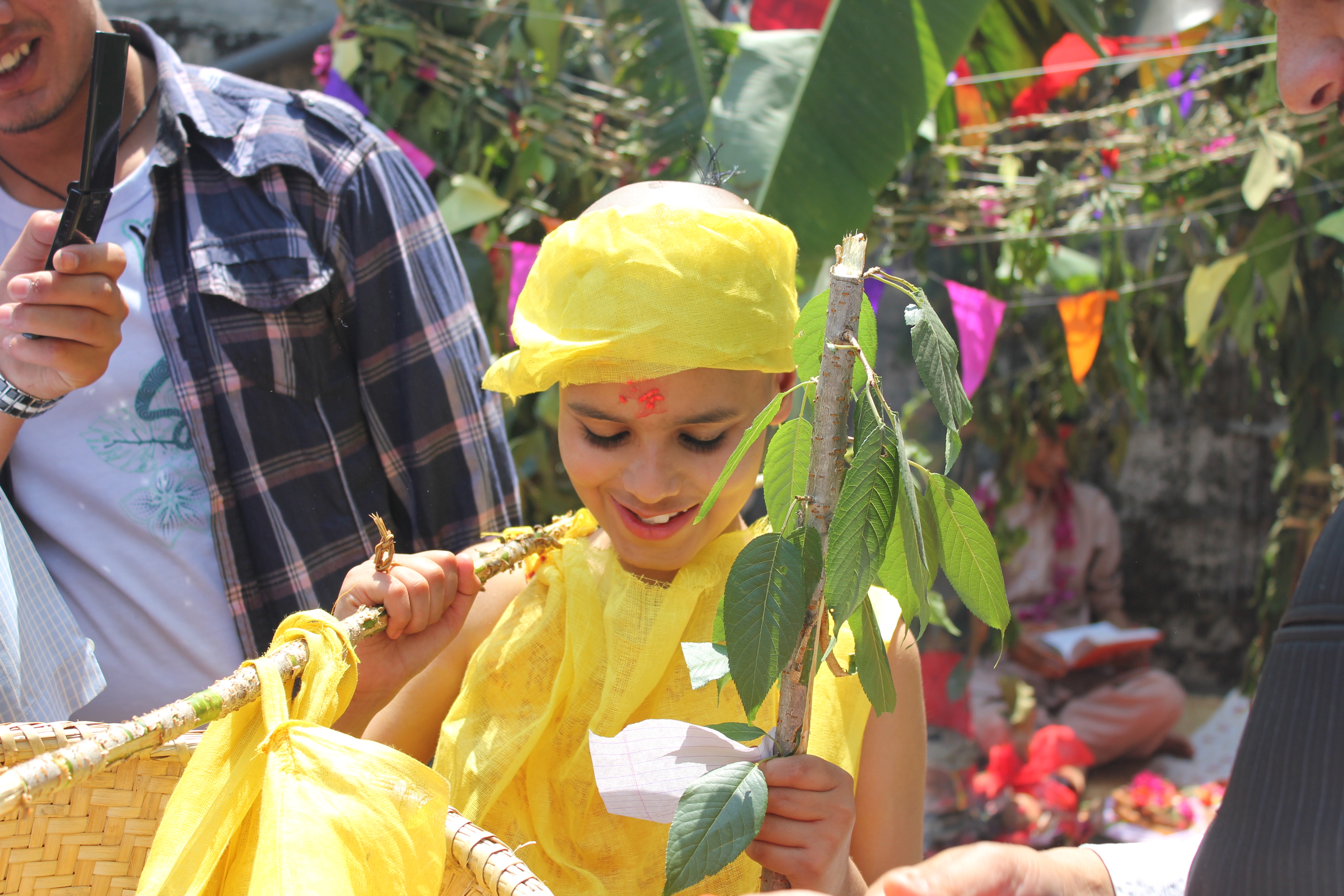
Yesterday, the boy who lives next door to Govinda dai’s house had his bartan, which is kind of like a Hindu Bar Mitzvah (except different).  In the evening, there was a bajan, drums and cymbols and chanting that create the most gorgeous and hypnotic devotional music you’ve ever heard.  So after dinner, around 9pm, Kaushik and I went over to listen.  I was actually tired and didn’t feel like heading out, but I knew that Govinda would be playing in the bajan and I didn’t want to let him down.

As we walked up the road, Govinda’s kids Sulo and Sudir came running towards us, and the sound of music followed soon after – driving, jubilant.  We turned in to the yard, which had been covered by a tarp.  Two men, one of them with a huge belly, were twirling with their hands in the air, amid a crowd of adults wrapped in shawls and children up past their bed time sitting on the ground.  The sparkle and joy of it washed over us and my heart lifted.

I sat near the bajan for a while with my recorder.  Govinda was on the symbols.  I have been coveting a recording of this wonderful music with its surrender and elation and praise all wrapped together.  Of course, Kaushik and I were both invited to dance.  But a lot of the time I was just listening, the night time around us, Sulo leaning on my bent shins and my arm across her chest, like Bishnu and I used to sit.

During a break, Govinda left his cymbols lying on the ground next to me.  I picked them up and started tinkering.  I tried to be discreet but in order to really play devotional cymbols, you just have to go for it; they don’t have a volume control and the physical movement of the hands only works out rhythmically if you play without restraint.

So soon I was just playing the cymbols while people chatted and rested around me.  But the sound started attracting attention, and them some smiles, and then a woman who’d joined the bajan picked up her cymbols too and matched my chime.  So the drummer started, and the next thing I knew, I was playing in the bajan.  I was a part of it.  The other pieces came up around me like a garden, and until I had to hand the little chimes back over a minute later, the music was coming right from me.


IMG_1576

The Value of a Dollar

This was the fastest trip I’ve ever had to Nepal – I don’t know where it went!  Apparently, my Nepal life which was once just in Kaskikot and at a little primary school has been divided in to multiple villages and cities.  On the other hand, the more time goes by, the more I find things grow in depth rather than width.  As much as I seem to run around, during the last two months I’ve been much more aware of the dimensionality that time adds to the same routines, and it seems more important than any of the cutting-edge details of this project or that.

Last week I went with Govinda to visit his father in law in Begnas, because he was Buba (Govinda's Father in Law) - Version 2diagnosed with terminal stomach cancer in August.  I first made the trip to Begnas when Govinda and I were teaching together in 2003, and it became one of our most legendary adventures – we still tell tales of how I climbed in the orange trees, and sat with Bua while he cut vegetables, and we all slept up in a tiny attic–this elderly man insisted on giving me his bed (I was a 23 year old collegiate rower) and he slept on the floor and I could not convince him otherwise.  As we were all lying there in the dark, he slowly and carefully asked me questions like, “Nani, Little One, in your country, what do they eat at weddings?” “Nani, in your country, what do the roads look like?”  I told him about elevators and the job market and hot water taps.

Bua worked as a security guard in India for five years and is not as sheltered as he sometimes pretends to be. But he is the gentlest human being I have ever met and every tiny detail of the world seems to move him.  He has a way about him that is intimate and unceremonious at the same time.  Most of his wealth from working abroad was lost to loans he made and never demanded back – how would they pay?  On that magical trip to Begnas with the orange trees, Bua asked to see a rupee from my country and I gave him a dollar bill which he folded in half and put away.

00012004050900500110In the decade since, Bua has come to visit me in Kaski every year that I’ve been here.  Each year he’s older and more frail but he takes a few bus rides and schleps all the way to Kaskikot, and we never know when he is coming; he just arrives in the yard one morning.  Aamaa and I beg him to sit and eat with us before he goes and he always says he has to get home to do this or that.  Every single time he says, Nani lai dekhna paeyo, “I got a glimpse of the Little One, I have to go now,” and then he schleps all the way back to Begnas.  Once I brought him a poster of a photo of the moon.

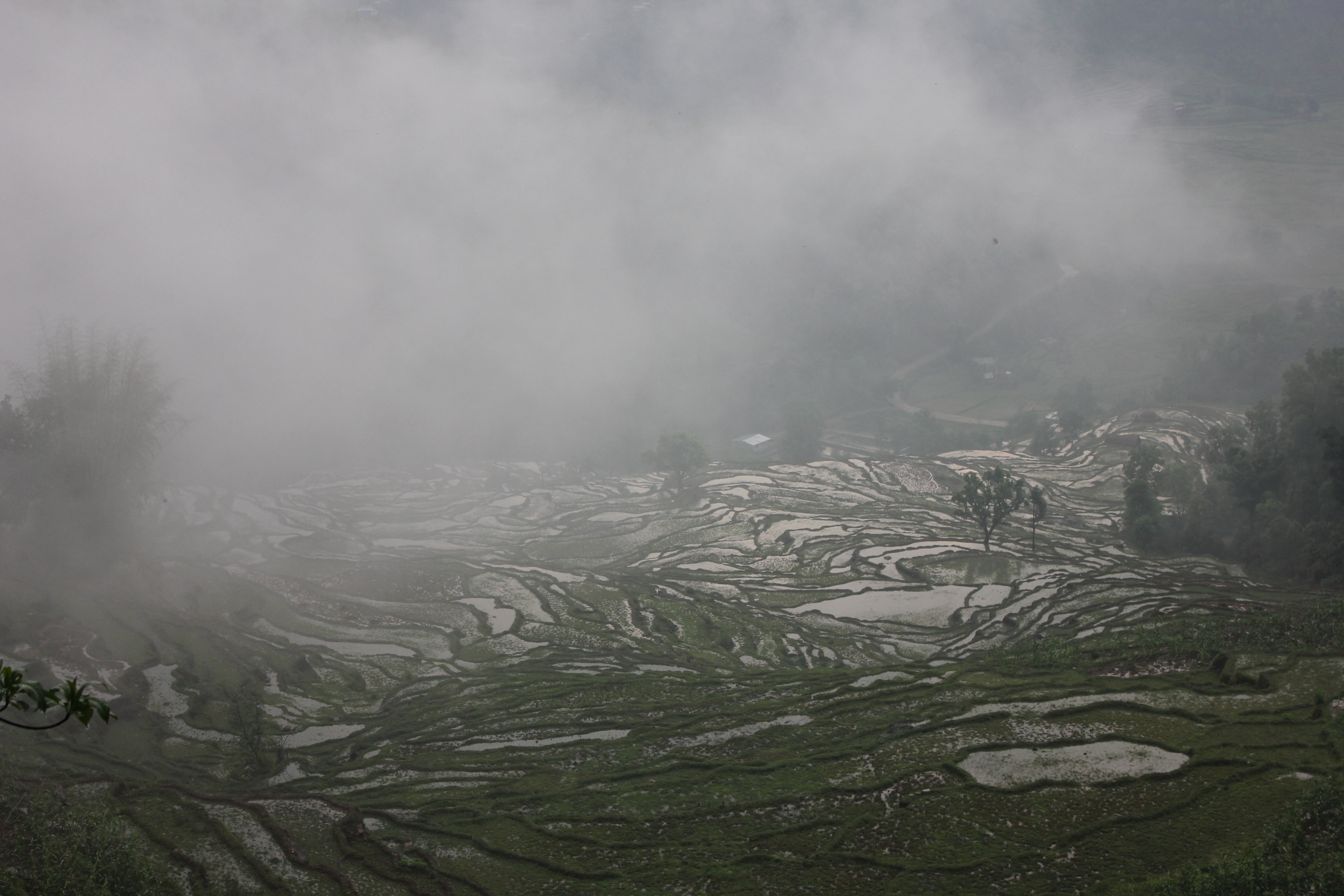
Last week Govinda and I went back to Begnas to see Bua during his last months of life.  It poured on the walk there and the rice paddies turned to mirrors under the clouds.  We spent the night at a relative’s house he has moved in to, in a space over the buffalo shed and under the slant of a corrugated tin roof, which sloped down over our heads and stopped in thin air, leaving an unobstructed drop to the ground and a view out to the hills.  The sheltered stone paths and trickling water of Begnas are quiet and patient like Bua, so different from Kaski’s dramatic himalayan perch.  He had asked for a light from the U.S. – maybe they make them better in my country – and I gave him a red metallic maglite that he tucked under his pillow.  We chatted some, about India, and then we fell asleep.

The next morning we got up to leave and Bua walked us down a path from the house to the dirt motor road.  He is barely more than the circumference of his bones, but still moves with an elegant deliberateness with no notice of my constant, automatic haste.  He stopped on a random set of descending stones in the trees and turned around.

“Nani, you won’t be back again till next year.  Me – maybe six months, who knows.  I’m in a lot of pain.  I am going to die now.”  In his unhurried way, he reached in to his breast pocket to get something.  I could hardly believe my eyes when he unfolded a dollar bill.  Ten years later, it still looked perfectly new.  He looked at it and shook his head, and in my mind I heard him say, “Nani lai dekhna paeyo–I caught a glimpse of the Little One–I have to go now.”

He put the dollar back in his pocket, and sent us on our way.

IMG_3279

IMG_3336 - Version 3


Boxes and Glass Cases

It’s been a tough arrival.  The monsoon is still clinging to the hills, thick and cloistering, and each afternoon it dumps an unremitting rain that I swear to God follows everybody inside.  The air itself is full of water; there’s no place to be dry.

And the truth is, I am also a drop suspended in mid air.  I’ve moved out of my apartment in New York, but I haven’t moved in to a new apartment in Connecticut, so all my things are in boxes in my parents’ basement.  The plan is that when I get back in two months I’m going to be working in a manual therapy clinic in Hartford…but it hasn’t actually happened yet.  It’s an idea, hovering in good faith around some boxes in a basement, waiting to be taken out and used.

That feeling has trailed me all the way to Pokhara–the hint that my life is full of theories.  Even IMG_2479though my contact with my projects in Nepal has increased a great deal in the past year through Skype and regular written reporting, and I have files and files of documents proving to me that these creations are real, they still feel like experiments when I re-encounter them on the ground.  Plus, there’s a big disappointment right off the bat: our first program director has left unexpectedly, after growing the Kaski Oral Health Care Project much less than we’d hoped since last fall.  I’m tired and frustrated and it’s enough with the freelancing.  I am ready to feel like I know what I’m doing, and some of this fits together, and it’s leading somewhere that matters.

Today it led back up the road to Kaski.  I went to Vindivasini Temple this morning to catch the bus on its way down, so I could save a seat before the bus arrived at the park, where a crowd  gathers around the door and starts pushing in to secure real estate for the ride up before people can even get out.  As I waited, I sat on a stoop with my duffel by my feet, watching a man selling vegetables across the road.  And I wondered again if this is all some kind of act.  I’m just doing the same thing over and over.  I can’t keep my grasp on what it’s about.

Other than a story.  The word comes to me again, and then again: Story.  Right out of the blue, at nine in the morning, I’m sitting on a stoop waiting for a bus, watching a man weigh a cauliflower, and the next thing I know I’m watching a story, and my identity is divorced from my soul.  Poof!  I am a character.

It must be natural that when you go through enough repetitions of something, even something incredible, it becomes unmoored from any particular episode.  And with that goes its singular miraculousness, because it’s just what it is: a cycle.  How profound would the sunset be if you only saw it once in your life?

Sometimes the sense that everything is just a series of events, with nothing transcendent to tie them together, seems like the most awful thing possible.  Even the leaves clinging to the trees look worthless.  But in certain moments, that same arbitrariness erases the perpetual burden of discerning the purpose of each passing instant, and my role in things is set free from an anchor that, in truth, may never have been there.  What a relief.

This morning I watched the vegetable vendor.  The story settled around me, like snow in its glass case, shaken from the sky.  I waited, again, for the bus to take me up to Kaski, where I knew Aamaa would be waiting.  Again.  For me.

IMG_2638

An Eclipse For Small People

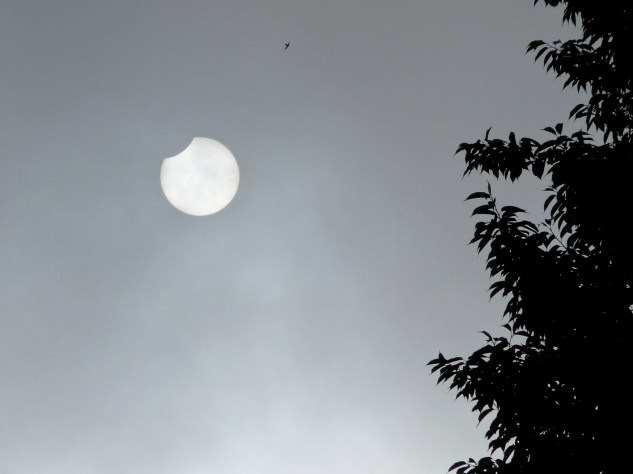
P1010918My first solar eclipse was in sixth grade.  Our science teacher, Max – I went to a progressive school where we called our teachers by their first names, so I actually had a real science teacher named Max – took us outside and we sat in the grass, next to a blacktop, near the soccer fields.  In groups, we held something up in the air and peered through it, a notecard with a hole in it, or something like that.  I don’t recall exactly.  The entire memory is just an image of us, kids, sitting by the blacktop, holding a thing up in the air and squinting.  I found it rather tedious.

My second solar eclipse fell on the festival of Maghe Sakranti.  Before the solar eclipse, there had been a number of times when Maghe Sakranti had coincided with the day of my departure from Nepal, so over time, during visits when I found myself still there for this festival, Maghe Sakranti and its associated rituals had taken on a special flavor of celebration.  We were still together.

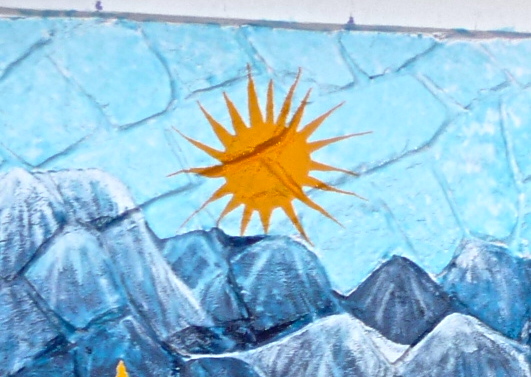
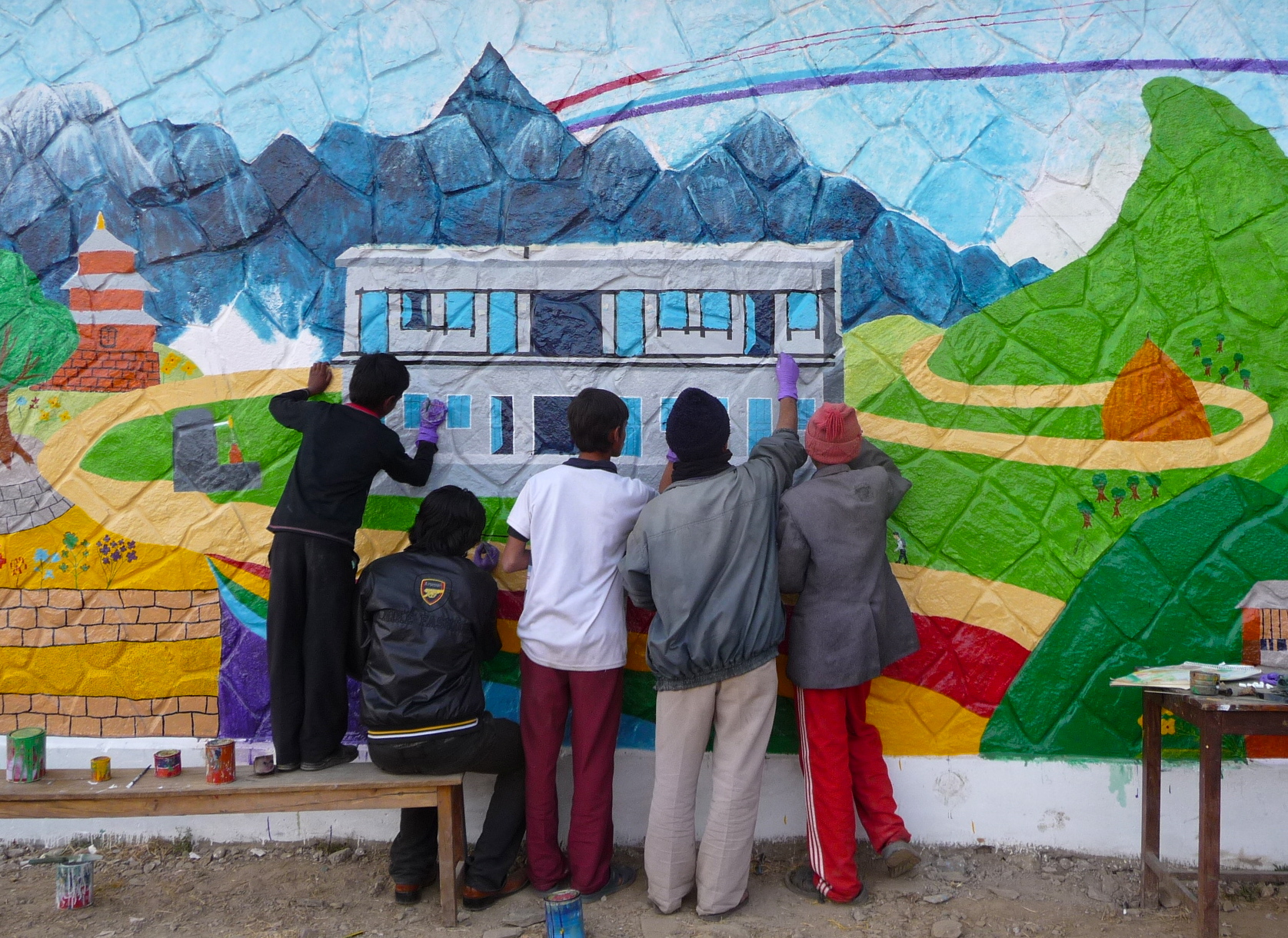
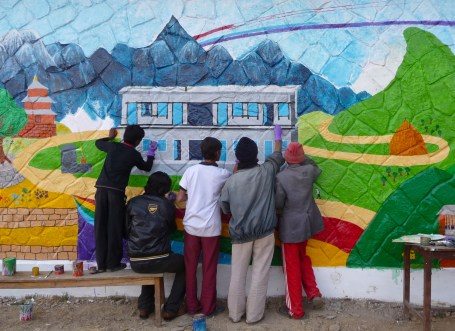
In the days leading up to the eclipse, I was at school from early in the morning right up until dusk, painting. Govinda and the kids and I were rushing to finish a mural before yet another departure.  It was a picture of their community: haystacks and houses, the whipped-cream shaped Kalika Hill with its little temple at the top, a paraglider sailing overhead, and road winding around from one place to the next, with a dominating school at the center.
P1010876 - Version 2

As the day of the eclipse approached, there was a great deal of anticipation.  Everyone was talking about it.  Once, Aamaa said, she’d been out during a solar eclipse and, just like that, it had turned to night.  They’d been forced to wait for a few hours until it got light again so they could go home.

Now that was something I wanted to see.

I went to visit Thakur sir, the astrologer, to get his opinion on a gift.  Back home, a great healer and teacher of mine was losing her eyesight.  I had purchased a necklace with the symbol kali chakra on it, and I wanted to ask about taking it up to the temple to be blessed, or infused, or something of that sort.  I wasn’t exactly sure, but I thought Thakur sir would know what I meant to ask.  A solar eclipse, he said, would be a very auspicious day to bless a necklace, even though it wasn’t allowed to do a puja during the hours of the eclipse itself.  And, once the necklace was up there at the temple, at the top of the Kalika hill, I couldn’t take it away until the eclipse was over.

The movement of necklaces was one of many things couldn’t happen during the eclipse.  Everyone would fast, of course, from exactly 12:36pm to 3:30pm, and many people would fast the whole day.  Any water in the house would have to be poured out after it was over, and replaced with fresh water from the tap.  It is wood cutting season, and trips to the forest were put on hold for the day.  And Maghe Sakranti was, for all intents and purposes, cancelled.

In the U.S., a solar eclipse is, for the majority of busy people, a science project for kids.  But here, where astrological charts are consulted for even the opening of businesses and choosing of brides, everything seemed to slow down as the days spiraled towards a grand and humbling halt.  Gazing at the top of the Kalika hill against the sky, I could feel the world catapulting through the solar system to a particular magical position—a great thing getting closer and closer to us, small people, standing where we would witness the movements of the galaxy.

By the prior night, there were three buses waiting to take people all the way to Chitwan in the morning so they could bathe at the place where the Trishuli, Gandaki and Kali rivers meet.  First thing in the morning, Aamaa repainted the floors with a fresh layer of mud.  It would be a day filled with ritual.

Like the rest of the world, I had hoped to stay put for the solar eclipse…but the mural wasn’t finished.  We had painted and painted that week, trying to finish in time, but when we pounded the lids in to the tops of the metal paint canisters the night before what should have been Maghe Sakranti, our creation still wasn’t complete.  So I departed for school early in the morning, swearing to Aamaa I’d be back by noon so that I could eat before the fast.

I met Govinda in the road with the necklace in my pocket.  When I’d taken it out that morning, I’d been surprised to see how mysterious and powerful the kali chakra looked, separated now from the rows of silver and symbols in the glass case at the shop.  When we passed Thakur sir’s house, I put it in his hand and he gave it a long look.  I wasn’t sure if I’d actually end up giving it to my teacher back home. I thought I’d send it up to the temple during the solar eclipse, and then give it away later if it seemed appropriate.  I was afraid it might seem kind of silly, and ridiculously enough, decided I would ask the priest at the temple for an opinion when I went to retrieve it later; after the solar eclipse.

Govinda and I arrived at school to find the kids waiting anxiously, and out came the paint. I had stayed out past the witching hour, painting a mural, many times over my years in Kaskikot.  But there was no thought of that today, not in the quivering air, under the glare of that acute collective focus on the cosmos.  I was incredibly P1010864excited.  It felt huge and magical and a little ominous, and made me think about what it must have been like for ancient cultures that didn’t know the science behind such events.  It must have been incredulous and awful to see the sun – so reliable! – disappear in the middle of the day!
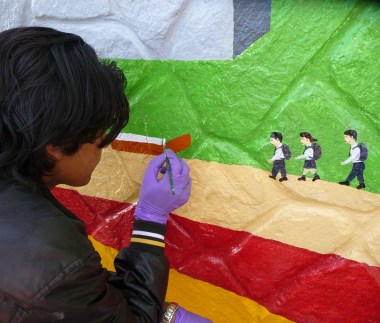
And that’s how we found ourselves rushing to complete our masterpiece before the stroke of noon, small people painting small people, the sun under the brush racing the sun circling in the sky.  “The eclipse is coming!” passers-by admonished us.  What were we doing out?

At 11:15, we decided we were done, and with terrible haste threw remaining paint in to boxes, picked up old gloves, ran and locked the office, forgot something in the office (Unlock the office!  The eclipse is coming!) and, at last, set off running down the road to get home before the eclipse struck us dead in the road.  Kids peeled off at their homes.  As we raced by in the dust, people called to us from their houses: Hurry!  The eclipse is coming!  There had been conjecture that we would see stars.  The entire world was about to evaporate.

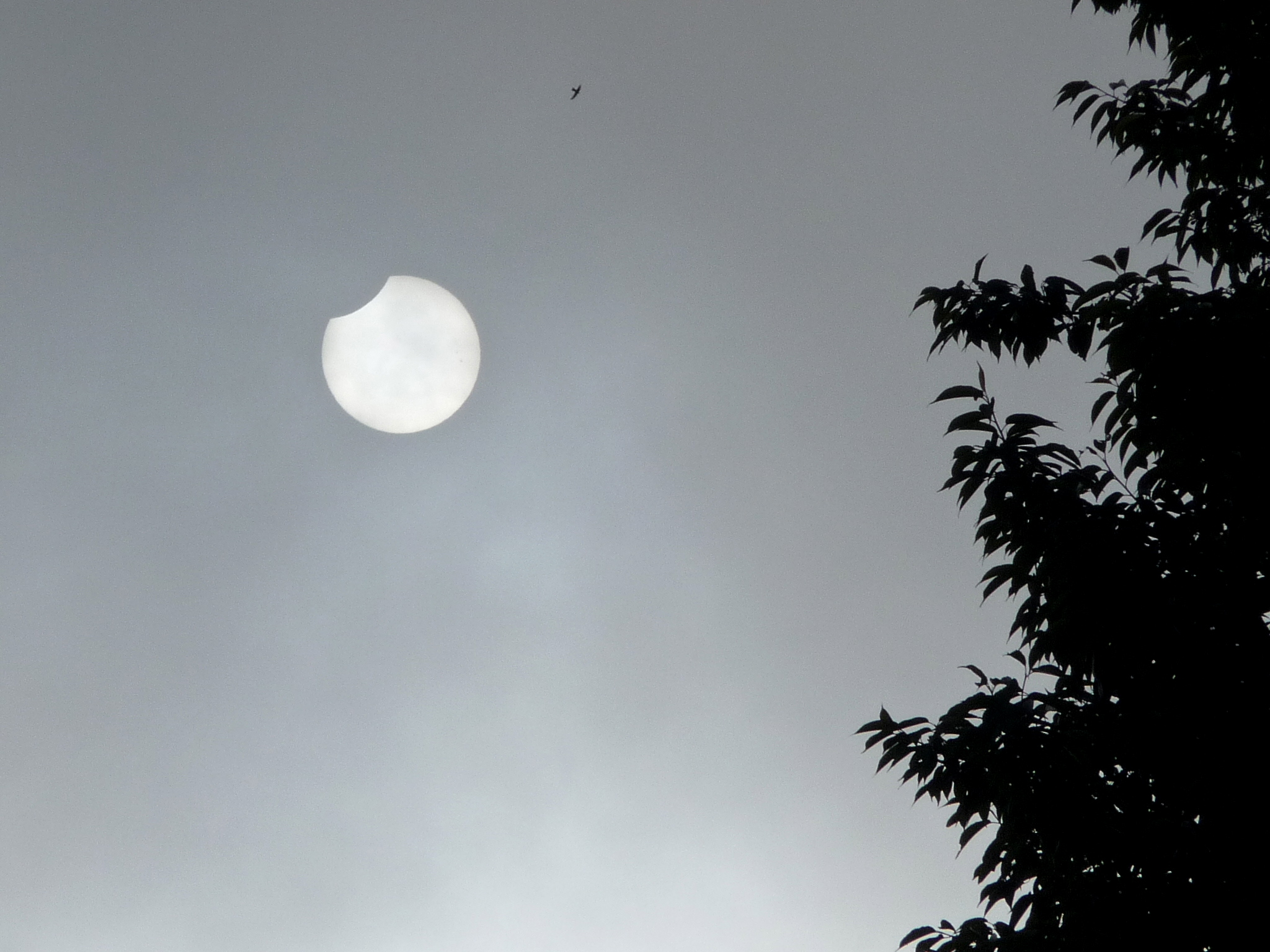
I made it home by noon, in time to eat. One o’clock in the afternoon, twenty-four minutes after the official start of the eclipse, brought a subtle change in the quality of the light.

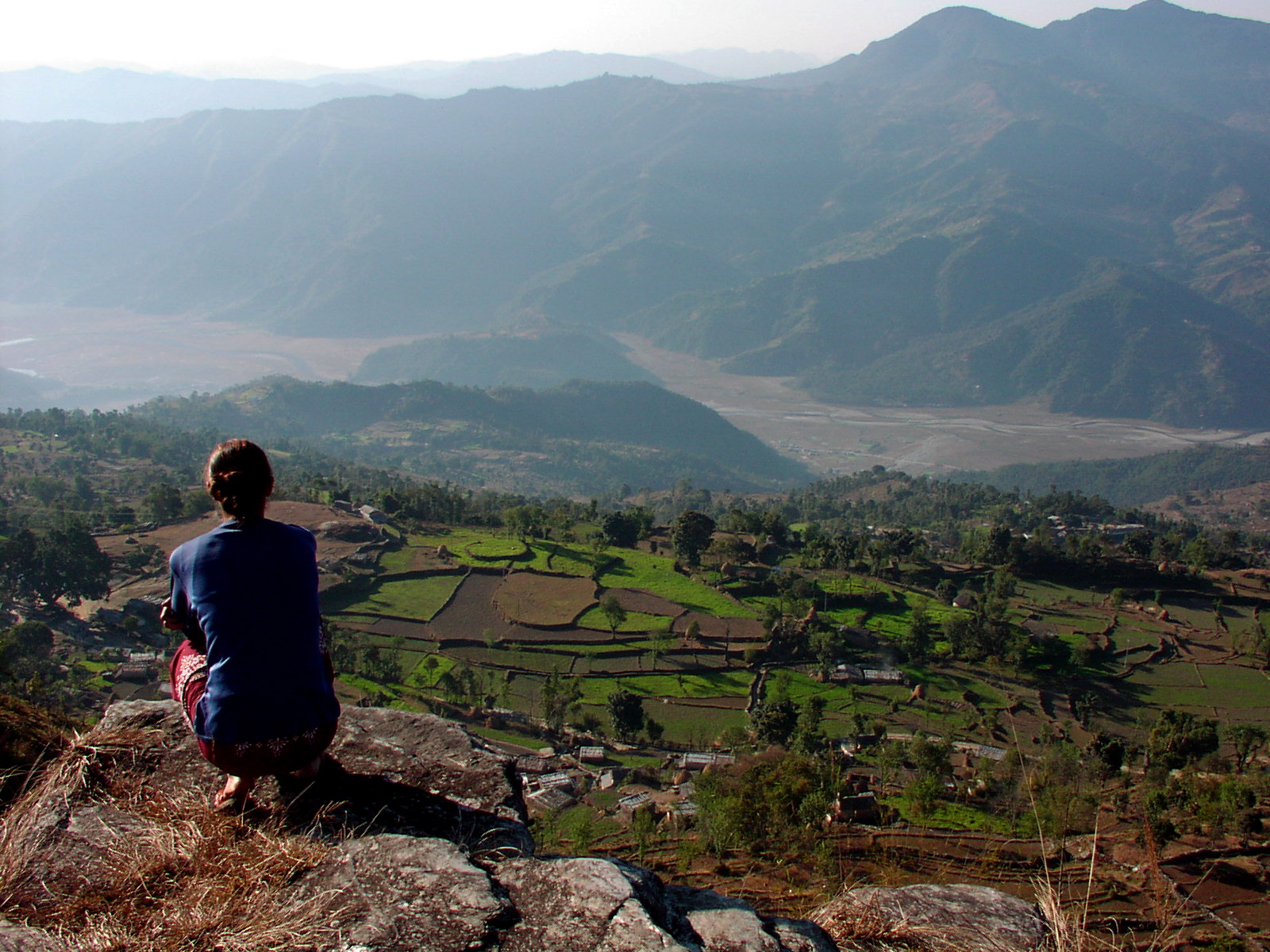
Bhinaju and Bishnu and I decided we would climb up the hill behind the house and watch from the resort.  We set to discussing what we should bring along.  A flashlight?  Poncho?  Extra sweater?  Rubber bands?  Camera?  (Would it be too dark for photos?)  We rummaged around and put some belongings together.  We climbed up to the top of the hill. And there I was, surrounded by a Himalayan panorama during a solar eclipse!  I wondered if I would be permanently altered, perhaps suffused with some kind of wisdom?

We sat in the grass.  We waited.

We stared earnestly at the sun for 30 minutes before admitting that we could see nothing.

We came home and sat on the porch.  It was a devastating disappointment.  I took out my journal.  I became impatient for tea.  As I looked a the water vessels and thought sullenly that we’d have to fetch new water before we could make tea, I considered the idea of “touched” water – that’s the word, chueko, “touched” water, the same word used for the impurity that a menstruating woman imparts to the things she contacts – and it occurred to me that all of these rituals – abstaining from pujas, fasting, dumping touched water – were fundamentally based in a fear of the awesome, not a celebration of it.  Too bad I wouldn’t see anything.  Even Maghe Sakranti had been cancelled.

For some reason, some of Aamaa’s old, beat-up x-rays were lying in a large envelope on the porch.  I have no idea why.  She’d had them taken when she was first sick, eight years ago; one of the slides showed her ribs and abdomen, a faded spine in the background, and another, a ball and socket joint.  Maybe they’d been deposited in this random location during a recent tidying, or while we’d been arranging articles to bring on our failed observation mission an hour earlier.

I was writing when Bhinaju suddenly said, “Laura, come here.”  He was standing in the yard, holding up the ribs and studying them.  I thought he wanted to continue a recent debate we’d had about the number of vertebrae in the spine.

“Why,” I mumbled.  “Vertebrae?”  I was in no mood to be proved wrong.

“Just come here.”  He switched to the ball and socket.

I got up and went to stand beside him.  And right there in Aamaa’s humeral head was a clean outline of the sun with a smooth bite out of the upper left-hand corner.

For the last twenty minutes of the solar eclipse, as the bite of shadow moved eastward and the sun became whole again, Bishnu and Bhinaju and I leaned together, small people, holding the x-ray over our heads and squinting.  We exclaimed and pointed and cried to each other: “The x-ray!  The x-ray!  It was here the entire time!  If we’d had it on the hill, what would we have seen?  What??”

P1020034

Opportunities for Enterprise

IMG_5426I was in a rush, winding through the narrow chintzy streets of Thamel.  The tourist section of Kathmandu has the same charm as Hershey’s chocolate milk: artificial and homogenized in a way that should be revolting, but is attractively digestible instead.

I tend to keep my head down in Thamel’s chaotic alleyways. There isn’t a lot of room to maneuver, and rather than dodge oncoming hippies and tiger balm vendors and tuk-tuks and the occasional ill-advised taxi driver, I find it more efficient to simply watch my feet and make sure they don’t step on anything within a 1-foot radius.  Usually that gets me where I’m going with the fewest number of unnecessary traffic encounters.

“HELLO!”

Not that afternoon.  A street boy had breached the 1-foot no-entry zone and was looking up at me.  I barely noticed the stack of rumpled schoolbook pages in his hand before I brushed by him.

“No thanks, little brother,” I said.  So many street children.  The agencies say that handouts only exacerbate the problem.  There are so many agencies.  There are so many tiger balm vendors and hippies and there is so little room to maneuver.  I kept my head down and pushed along the clamoring street.

I slowed, and then stopped.  Was that boy selling drawings?

I turned around and saw him in the road.  I’d spent a year pulling my hair out in Kaskikot, trying to get elementary school kids to combine imagination and paper the way they combined imagination and trees and rocks and flat soccer balls.  To inspire enterprising attitudes through art, and make notebooks spaces for creation, so that school would be about possibilities.

“Bhai!” I called.  “Little brother!”

I walked up and stood over him.  “Excuse me,” I said in Nepali, “could I see those again?”

Flustered, he turned over the ripped lined pages and I mulled over them carefully.  They were all colored-pencil drawings and had been carried around a fair amount, but with what flatness they still had, retained a look of attempted composure that was very charming.

“Did you draw these?”

“YES MISS!!!”

“What is this picture?” I asked importantly.

“THIS IS A BUDDHA!”

“Hm.  And this?”

“THIS IS A BIRD!”

“I see.  How old are you?”

“I AM NINE!”

“You are a very talented artist.  How much do these pictures cost?”

Wide-eyed, the boy scrambled for an answer.  On a good day, he was probably lucky to sell a picture or two for five or ten rupees each.

“FIFTY RUPEES!!!”

I gasped.  “Fifty rupees?  These must be very valuable.”  I looked at the stack of papers.  “I’ll take two.”

I picked out the Buddha and then asked him to choose another one for me.  He chose a man with a guitar.  As I handed over my 100 rupee note – worth about $1.10 – I added, “You’re a very nice artist.  You should keep at it.”

“YES MISS!!!!!” the boy cried, and then disappeared in to the swirl and clutter.

A few weeks later, I had the Buddha framed in cloth like a traditional thanka.  It is definitely the most magical thanka I will ever own, and ten years later, it still hangs in my home office in Connecticut, across from my desk, reminding me to stop and look up in the crowded and relentless street.

The tuk-tuks can dodge us for a darn second.

photo* Photo credit Rachel Seys, Birds in Thamel

A Story

Back in Kathmandu, Tom and Jerry ends, and we turn off the television.  We eat our rice.  I mush the grains between my fingers but resist the temptation to try to give the meal special attention.  You can’t grasp a thing at the last minute if you weren’t paying attention along the way.

I repack my bags, and don’t get in bed till after midnight.  With the heat and mosquitoes it’s a long time before I fall asleep.  I toss and turn, thinking about watching Bishnu and Bhinaju get in the bus back to Pokhara, and about the strange idea of being even farther away than I am now.  It seems like, for the rest of my life, I will keep getting farther and farther away.  Which is strange because, even from Kathmandu, in a big bedroom where I can hear Nepali music videos playing on TV, Kaskikot feels like a memory, a separate universe where I once was.  I was there only a few days ago.

You know, it never has been missing it that I dread, or the thought of loneliness that fills me with worry.  It’s the shift from real to remembered, from substance to recall; it’s that the absence has no bulk when you get far enough away, and that life goes on and—even if you can remember to miss it, it’s so disconnected, so unreal, that it’s mostly just a story.  And what of the part of you that has become the story, the skin that has touched this world and walked on it and dug fingernails into its mud?  When all of it is farther away than the moon—which at least your eyeballs can see at night—is that part of you just a story, too, that only exists to the extent that you still believe you were there?

Wouldn’t that be something, if after all this, all I could bring home with me was a story.

*

OLYMPUS DIGITAL CAMERA

Second Chances

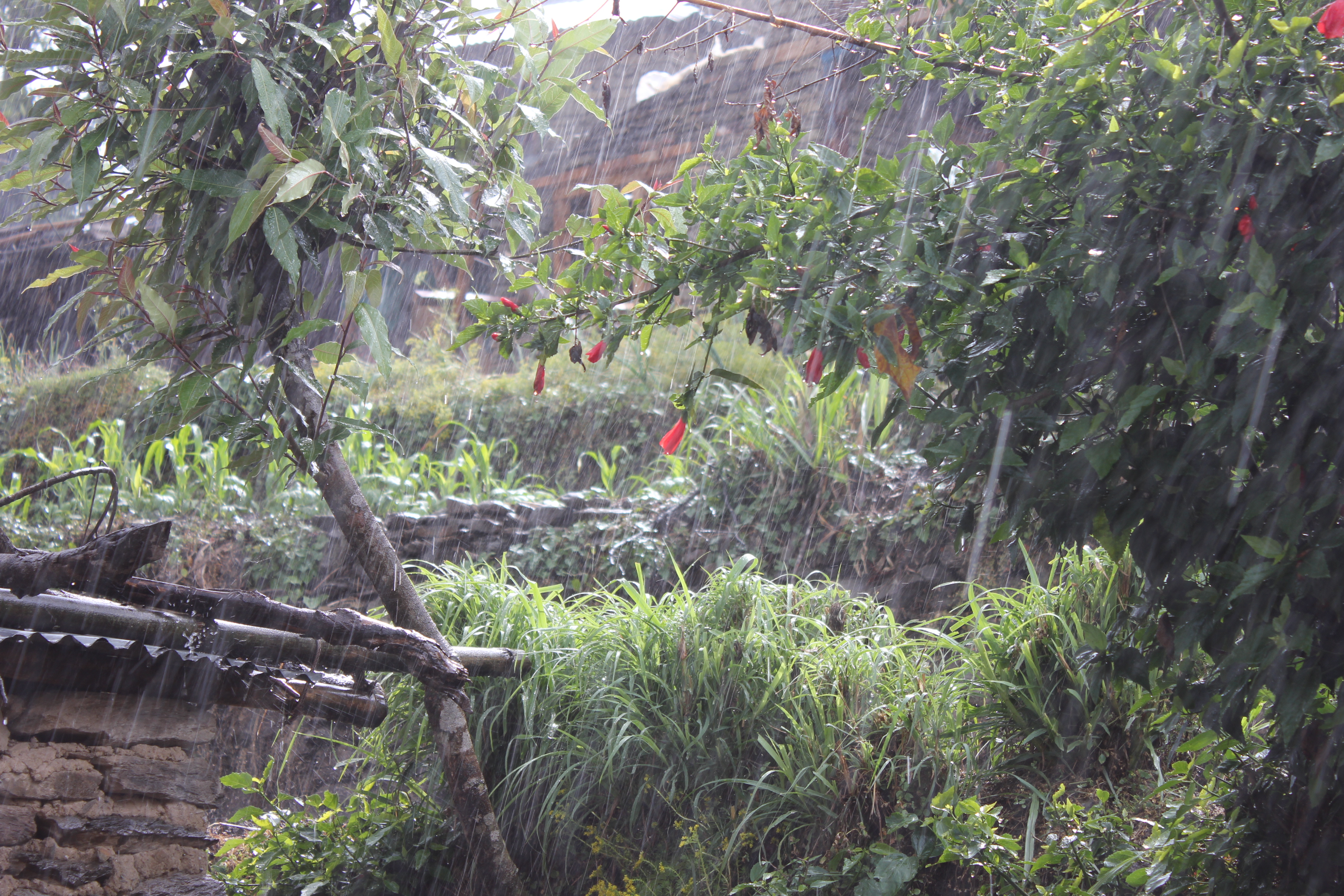
We were sitting on the porch eating popcorn beneath a rumbling sky, when all of a sudden, the air became thick and threatening.  Fat plops of water began to fall, and the four of us leapt up and scrambled in to the yard: Aamaa headed for the buffalo shed, and Didi to the goats tethered outside with their three jumpy children, while Bishnu and I ran for the wheat lying in the yard, where it had been drying just minutes earlier.  I bent over the precious pile of grain to shield it with my back, frantically sweeping it into a basket, and Bishnu scrambled around the yard brushing it towards me with a bundle of straw.  When that was done, I joined Didi in her tug of war with the goats, and just as we managed to get them untied and inside, and Aamaa threw the last few baskets and bundles of grass in to the buffalo shed, the clouds disgorged a furious rainstorm.  With the belongings and grain and goats stored away, the four of us dashed into the house to shelter ourselves.  We jumped up on to the beds and turned off the single light bulb to protect against an electrical surge.  And then we sat there, staring out the door.

Rain from PorchIt began to hail.  First a little; then in golf balls.  I’d never seen anything like it.  For a while Aamaa kept running back outside with a mat over her head—to put this or that away, to put the plastic tarp under shelter (why?).  But finally we had done all we could, and there was nothing left but to lean against each other on the beds and stare out the open door, where pale light came in and lit our four faces.

The torrent was powerful and close and deafening on the tin roof over the buffalo shed.  I looked down at my fingernails, where dirt and little grain fibers had taken harbor.  The hail pounded and clattered; a heartbeat.  It was thrilling.

“The corn is ruined,” Aamaa said.

“What?”  I turned towards her.  We’ve just spent weeks slaving over planting the corn.  I’m still sore.

“Oh, this rain will damage all the crops pretty badly,” Bishnu repeated.  “And everything else—cucumber, beans, zucchini—is already gone.”

My mouth dropped.  “What do you—how—I mean—we need to plant the corn again?!

The three of them looked at me for a long moment.

“We have no more seeds.”

I blinked.  This was obviously unacceptable.

“Doesn’t everyone have the same problem?” I finally demanded.  I felt this made it an unreasonable problem, which therefore, by the laws of logic, could not have cosmic permission to exist.  There had to be more seeds.  Meantime, the yard was an inch and a half deep in water and golf balls.

“Yes,” Aamaa said.  “Everyone.”

I glared at Bishnu, seeking a revision.

“If it stops soon, the corn will be damaged, but okay,” Bishnu offered.  “But the other things are already gone.”

And that seemed to be all there was to say about it.  Bishnu turned her face back toward the door.  Nobody appeared upset, which was what confused me the most.  I couldn’t even bother to ask, What will we eat?–the injustice of our wasted effort was enough.  So I sat on the bed and stared at the rain while it ruined the corn.  Because it was the only thing to do; because the people who knew how to make things work out were doing just that and nothing else.

There are no more seeds.

I have thought of this moment many times since.  Maybe loss, like mortality, is that globally unknowable thing so innate to our humanness that we can never discover it.  We can only be confronted directly with what we always knew: that we control things only with the permission of a universe that can render our efforts irrelevant or take everything away at any instant.  But we almost never separate from that reality and stare it in the eye as its own fact–instead, we are surprised again and again, each time something more unreasonable is broken.

My gaze falls back to my fingernails.  How have our lives been so different that what is unacceptable to me is already a familiar whim to Aamaa and Didi and Bishnu?  They will wait until the storm ends and salvage what they can.  In May, they’ll plant millet.  And in that moment I envy their grace, over and over, because my effort is still wasted throwing stones at a dispassionate sky while theirs is diverted back to planting.  To the ground.  Where things grow.

*

IMG_2855

The Middle Girl

Aamaa talks often about my departure now. She’s worried about being left alone when Didi also leaves to join Bhinaju in Pokhara, which will be happening any day now.  And of course, Bishnu will stay in the city as long as she can, to study for her 12th grade exam.  It’s so strange to think that when I first arrived a year and a half ago, Aamaa and Didi and Bishnu were so intimately bound here in Kaskikot, and now Didi is married, and Bishnu is studying, and we are all wondering what Aamaa will do when I leave for the U.S. in a few weeks.  It’s strange that despite everything, it’s my departure, of all things, that will thrust her in to real solitude for the first time.

The wheat harvest, with the lack of fanfare it has produced, has been a kind of seal for us.  It’s fun to be exotic to one another.  But as crazy as it sounds, one day we looked around and found that something had tipped over.  Today I did housework on my own most of the day, with no direction: watering the buffalo, doing dishes, pounding wheat, moving goats.  Just because it was there and needed to be done.  The fact that nobody’s all hot and bothered about these feats anymore feels…strange.  It’s an entirely new reality, for all of us.

“Everyone is saying to me, ‘Don’t let your mailie go,’” Aamaa said in the late afternoon, while Didi and I were lying on the beds inside, writing, and she was on the porch pounding wheat.  Mailie means middle girl.  “Your maile does all this work around the house,” they’re saying.  “She brings you good food, she helps you all the time.  Don’t send her to America.”

Didi interrupted Aamaa mid-sentence to ask me something from her book, but Aamaa doggedly re-commanded my attention.  She wanted to make her point.  I looked at her through the doorway.

“Other people have said that?” I asked.  Despite myself, I was delighted. I realize I had no business being here, but that doesn’t change the fact that I’ve taken some knocks.

“A lot of people,” Aamaa sighed. “When you go, I won’t be able to say anything, so I’m saying it now: raamro sanga jannus, eh?

Go well, okay?

I lay on my tummy on the bed with my head near the door, where Aamaa resumed pounding wheat.  I was writing a poem and story and speech I’ll recite at my school farewell if I get one.  And then where will I go?  Where on earth does a person go from here?

*

Family