The Milk Truck

We spent a very long time waiting for the milk truck to pick us up.  As part of Optional Class, I’ve found people to come up from the city and tell the kids about their jobs: a librarian, a radio jokey, and someone from the photo shop.  Today, we were headed to Pokhara to visit the places they work.

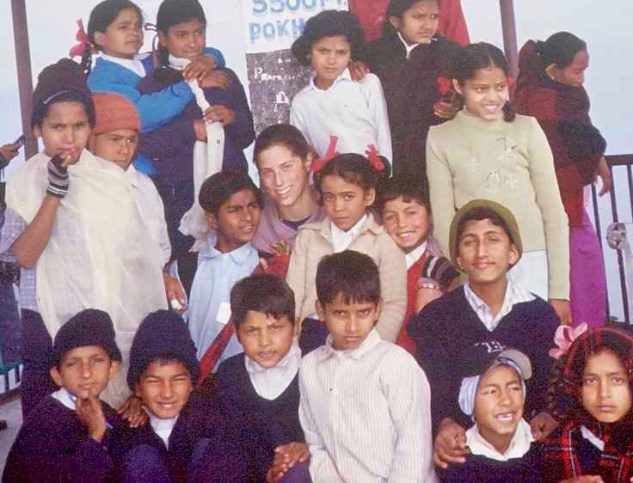
While we waited for our ride, the kids sat on the grass, leaning on each other, practicing the song that Govinda and I wrote about the solar system.  We make them sing it every day – Venus has poisonous air, there’s a big storm on Jupiter, la la – so the tune has more or less become the Optional Class Anthem.  The radio jockey had invited our students to sing the solar system song on air during our visit, and the quartet selected for that job was practicing next to a few other students who we’d chosen to read their poetry on the radio.  The early morning hour was one of quiet satisfaction for Govinda and me, watching our kids with their heads bent over the books they’ve made, feeling important.

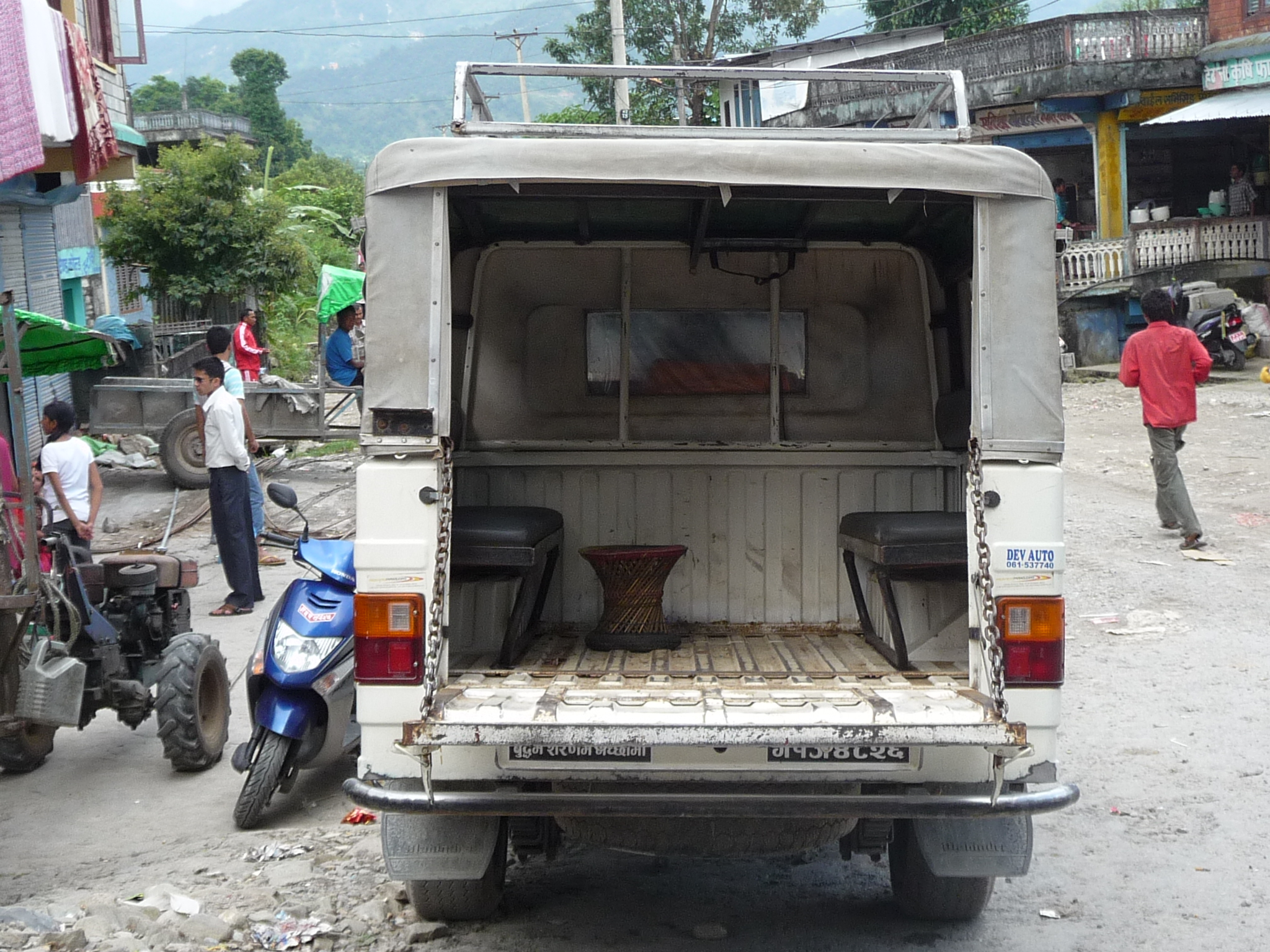
The milk truck finally came, and we all crammed in to the back: Govinda, Laximi, and eighteen kids, and me.P1060843  The inside was a military-style canvas box with two benches and railings on the ceiling to provide handholds.  With a lurch we set off, bouncing down the dirt road toward the city.

To keep out the dust from the road, we had all the canvas flaps down over the back and side windows.  I looked around at all the little faces squashed into our sealed box, and was struck with the sudden feeling that nothing, no words or photos or documentaries, would ever be able to recreate that stuffed space.  At the end of the day, we will be exactly that: a giggling ring of faces pressed together inside our container, moving along a dirt road towards something, out into a world which sees us as if from above, tiny on the crumpled earth.  The instant reels in my mind from its birds eye view, and I look from the inside out, where we are now, and fall on the moment with a surrendering crush of love.

Because the outside is moving, moving, always crawling along the road, but the inside—the inside is still, aside from the bouncing.  With the windows covered we couldn’t see the road going by, or the place we’d come from, or where we were headed.  And when I considered that we would eventually arrive, and get out, and be outside too, I felt the weight of a universe crammed into a milk truck.  This is our now: the gravity of all the past and future collapsed into a present that will pass and forever be gone.  It seems almost impossible, amazing, to be here now.  In a milk truck, with these kids.

*

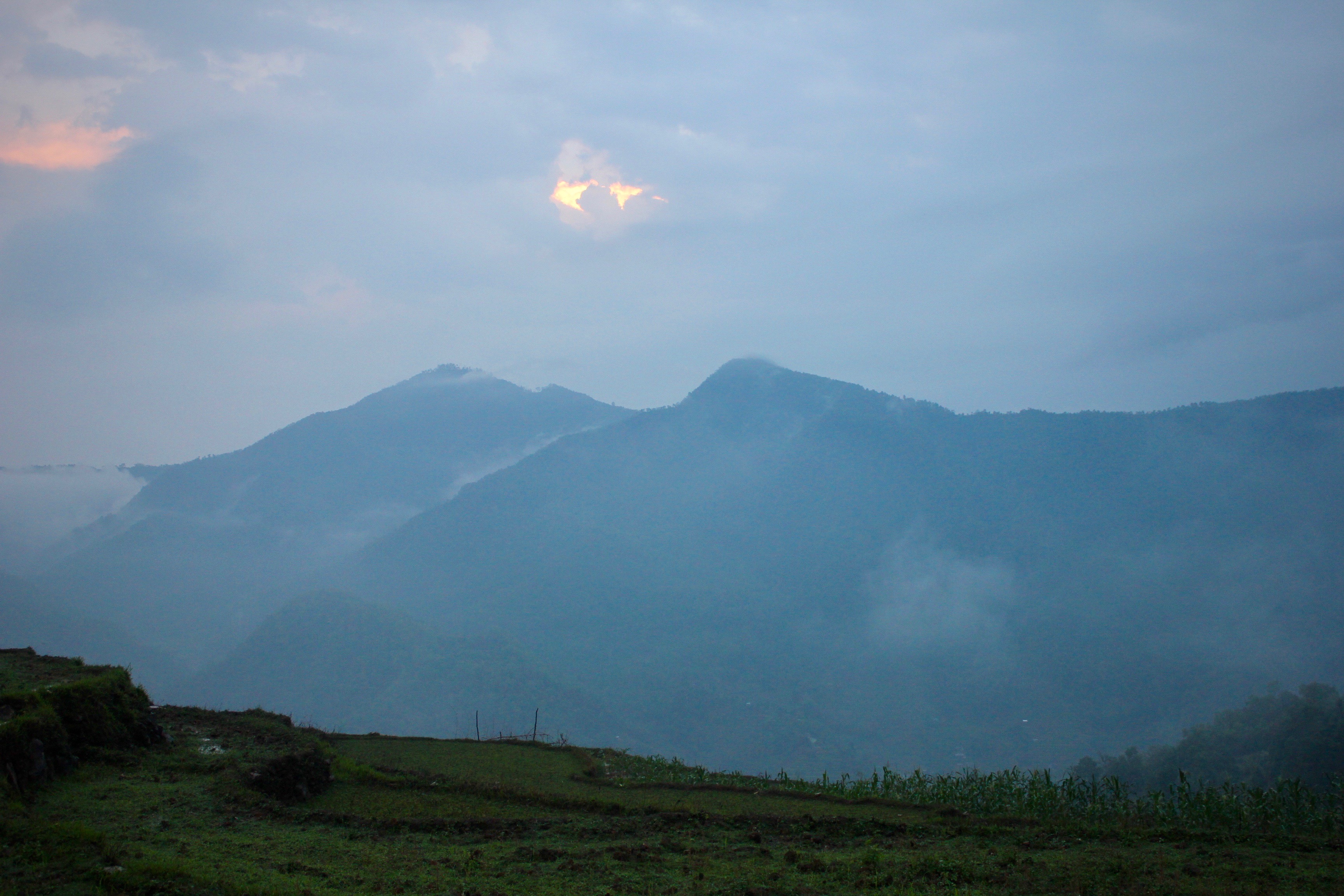
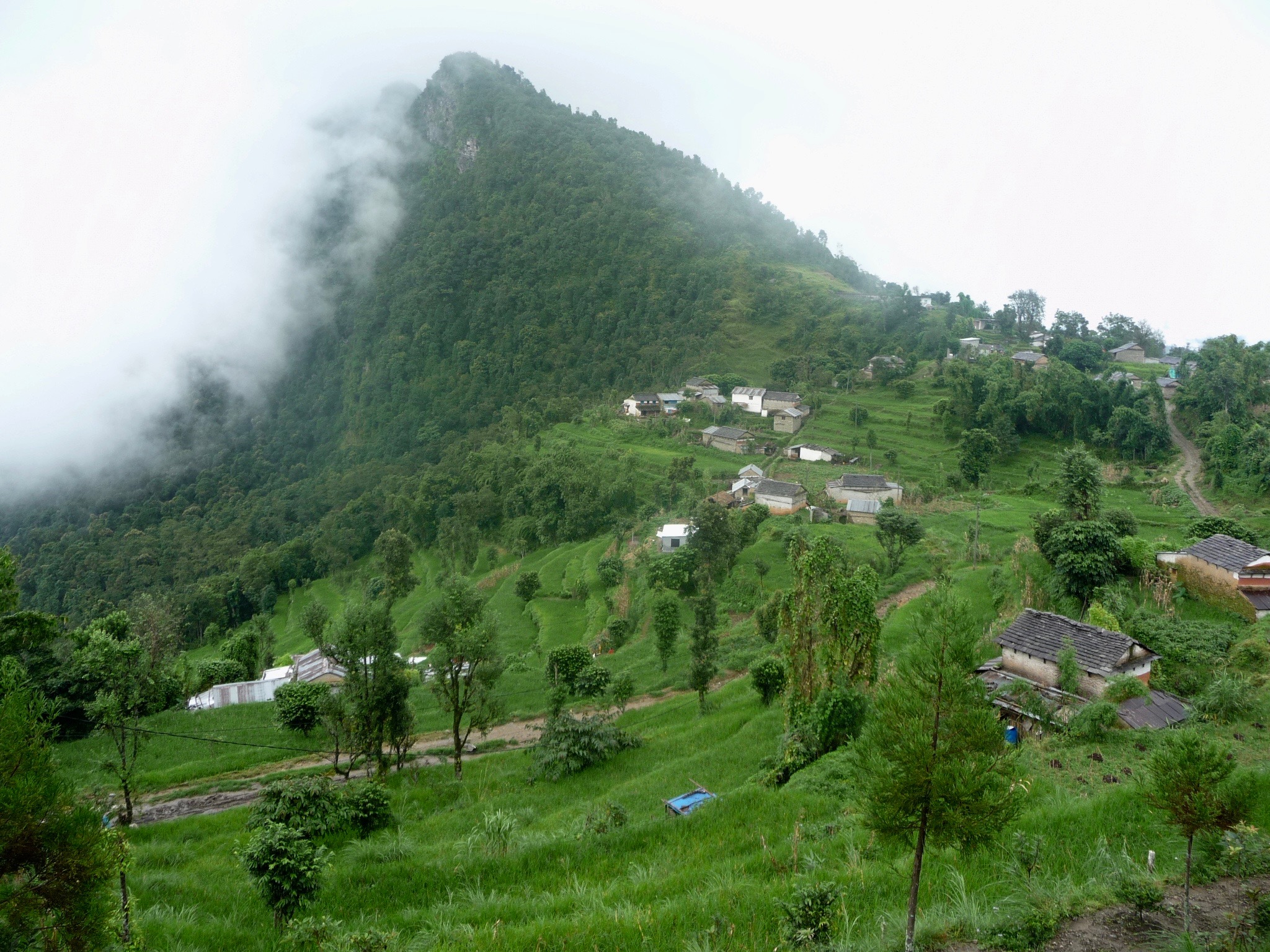
Lookout point (and clouds!)

Help from Elves

A flat rock about the size of a medium pizza, I figured, would work nicely.  I arrived at Sada Shiva half an hour early carrying my stone.

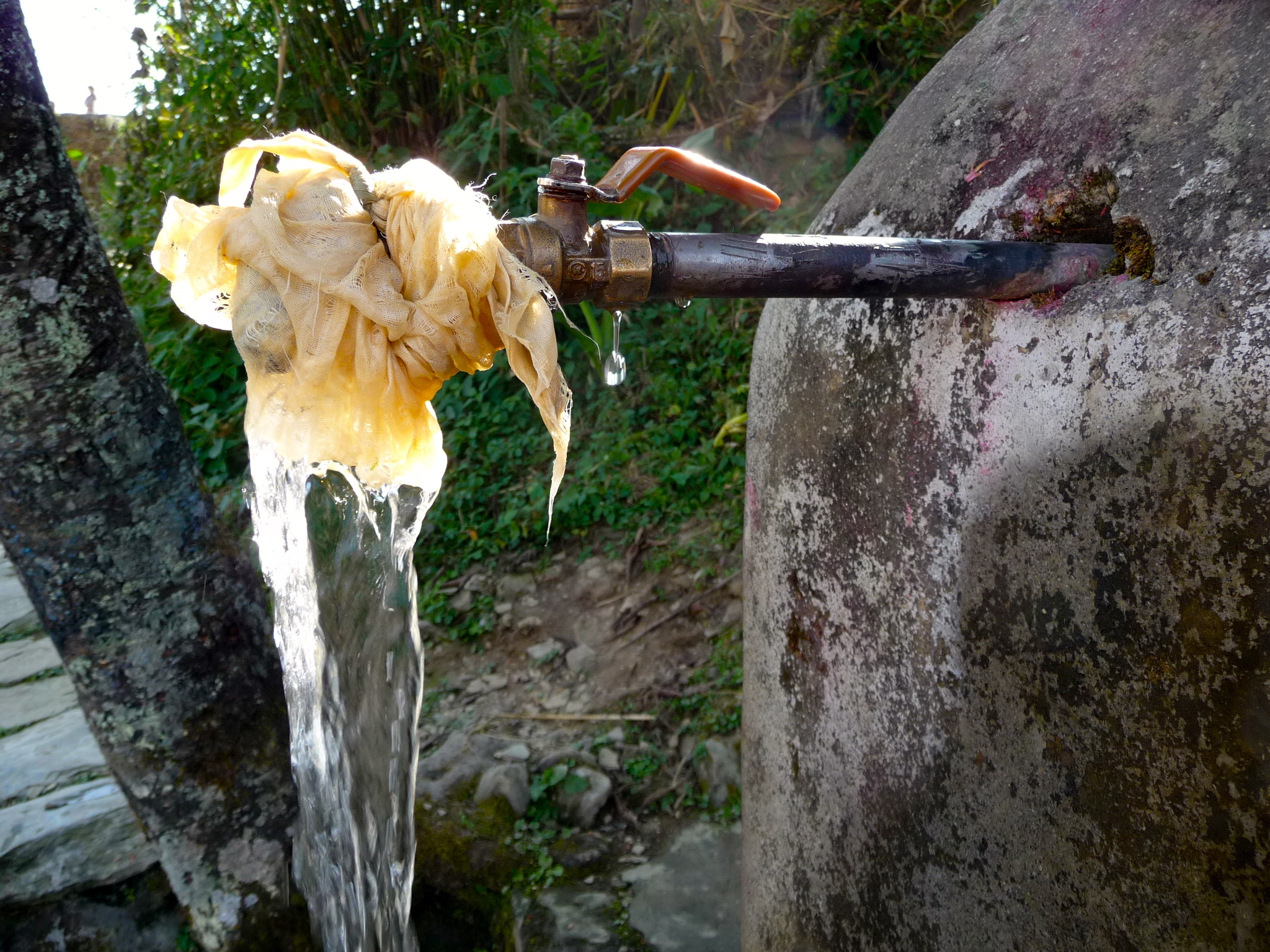
Last week, we installed a water hose that is propped up on a stick where the schoolyard drops off and slopes downhill.  It’s a great setup, except that in order to use the waterspout, you have to stand on the hill, which is gradually eroding under the constant stream of water splashing out of the pipe.  I had decided to improve things by wedging a rock into the hill, so that at least one small pair of feet could find purchase on the muddy slope.

Setting my bag down outside class three, I climbed over the edge of the yard and scooted down to where I could crouch below the water spout.  Using another rock, I began chipping away at the hill.  It was peaceful in the deserted yard.

“MISS!”

I looked up to see Sunil and Hari looking down at me.

“ARE YOU BUILDING A WATER TAP?”  They always talk in capital letters.

“Yes,” I said, although it seemed generous of the boys to elevate my stone to a “tap.”  Without further discussion, Sunil and Hari disappeared.  I began chipping again.

“MISS!!”

Overhead, Sunil and Hari were leaning over the edge of the yard, holding two wide, flat rocks.

“MISS!!!”  Krishna came galloping up behind them with a third rock.

I looked down at the small stone I was using to whittle away an indent in the hill.  Things were not going according to plan.  When I looked up all three boys had left their three stones and gone off again.

“MISS!!!!” Madu and Ganga arrived. More rocks.

Five minutes later, students were coming out of the woods, like elves, by the dozens.  Their stones piled up at the edge of the yard.  I was impeached, moved aside, and replaced by Ganga and Madu, who began wedging the stones into the hillside where I had been standing.  Rita-Madam arrived and squatted at the top of the slope, looking down at us.  Her ponytail rolled around to the front of her shoulder.

Thik, thik,” she murmured.  Good, good.

More rocks marched out of the woods.  Ganga and Madu shouted up to Hari, who passed them down.  It was not eight minutes before the students had built a neat ledge where the water splatted onto a flat rock, sending up fine celebratory drops that leapt into the grass.  Just to show off, they’d created a few steps leading down to the tap from the yard.  There were still five minutes to spare before morning line.

That, I thought, is what I meant.

Thik, thik,” Rita Madam said.

We climbed back up to the yard and they scrambled into place for morning exercises.  Govinda arrived and initiated the daily yard routine.  I went into the office, where everybody had taken up their normal posts: by the table, with the comic book, quietly off to the side.  Rita Madam rang the bell, and the day began.

–  –  –

P1000217

Putting Away a Chicken

This afternoon, a handful of serious looking men were sitting on the porch visiting with Aamaa, who is still not moving much after her operation a few weeks ago.  I was puttering around when Aamaa called me to put the chicken inside for the night.  Now, I’ve never put a chicken away before, but I was so pleased to be asked that, without any questions, I strode out to the porch and walked up to the chicken.  It promptly went skittering off.

Ah, I thought, I see.  This is going to be like climbing on to the upper roof.  Seems straightforward until you try to do it, at which point it’s too late; you’re already committed.  And standing on a middle roof.  With everyone looking at you.

As I pondered how one goes about putting away a skittering chicken, my doubt must have been obvious on my face because Aamaa immediately told me to forget about it and let Bishnu put the chicken away.  That’s the routine: I try to do something, we all realize just how much I don’t know how to do it, everyone tells me to stop, I insist, there is a contest of wills, and then something happens.  But one thing is certain: I’m not about to lay down and be defeated by an uppity chicken.

So the array of serious looking men, and Aamaa lying on a mat, watched as I chased the chicken around the yard, into the radish patch, through a thick of flowers, back into the yard and through the door of the house, where I thought I finally had it cornered, and then back outside, all the while trying to act casual.  I frittered after the disobedient little excuse for a bird, and eventually, after another trip through the flowers, managed to chase it back inside, where I finally got my hands on it with a decisive dive and firm grasp.  Like the surprisingly solid upper roof, it turns out that a chicken does not squirm as much as one would expect if one chooses to grab it forthrightly.

I emerged triumphantly onto the porch holding the gleeful chicken, which seemed very satisfied with the trouble it had caused, having certainly never enjoyed such an entertaining bedtime.  I went into the goat room to put it in its little chicken box, which I’d never really seen, because the goat room is unlit and I never have a reason to be in there.  I felt around for the chicken box, which turned out to have a top and a bottom compartment.  Not wanting to ask any questions, I promptly stuffed the chicken into the top compartment.  But it didn’t seem to want to fit and I had to push on its chicken butt while calling, “Aamaa, the top or the bottom?”  I got the chicken and its butt into the top compartment.

“The bottom,” Aamaa called from the porch.

I pulled the chicken out–it must have been quite perplexed by this point after years of daily extraction and replacement from its box in an efficient and reasonable manner–and then stuffed it into the bottom compartment.  I learned later that there’s a little piece of wood I’m supposed to put across the box for a door, but I didn’t now it at the time, so I was quite pleased with myself when I came stumbling out of the dark goat room back onto the porch.

There the gathered group of serious men sat there impassively, or stunned, if you will, no comments to be made.  As for Aamaa, she had a look I’ve become familiar with.  It says, “Well, that’s a hell of a way to put away a chicken.  But it appears to have worked.”

*

00012004050900500082

Bua


For some time now, Govinda has been asking me to join him on a trip to Begnas to meet his in-laws. We began planning our visit a few days ago. Govinda’s father in law, who he calls Bua, will be alone for a few days while other members of the family are traveling, so it was a good time for us to arrange a visit to keep him company.

There was some thought that we would travel with Guru sir, who is searching for a match for his daughter. This has raised for me many questions about match-matching procedures. Does one stand in the road and stop the first reasonably marriageable looking male? Go from house to house soliciting bachelors? Distribute letters of inquiry? And why travel all the way to Begnas for this undertaking, twenty kilometers east of Kaskikot? 

I asked around a bit. My investigation was admittedly hindered by a very limited cache of Nepali words related to arranged marriage, but I deduced that Guru sir’s first visit to Begnas was for the purpose of meeting his relatives to discuss the search. So that solved the geographic question, though as far as I could tell, it simply meant Guru sir’s relatives would be standing in the road picking up single men. You can see why I was quite looking forward to whatever was going to happen during our visit to Begnas with Guru sir. But at the last minute it turned out that Guru sir’s rice harvest bonanza would be the same day we had planned our outing, and he would not be able to join us. So I’m afraid that at this time I can’t offer any resolution on the question of Guru sir’s daughter’s marriage arrangement. 

Early in the morning, Govinda and I set off for Begnas on our own. We arrived in Pokhara mid-morning and stopped in to see the artist who is helping us with our school mural, and I paid him. We discussed the idea of having him come to Sada Shiva to give a talk about his profession, as part of the series of visits I’m working on for the kids to learn about topics of interest like how libraries work and what pilots do and how photos are made.

At the bus depot in Prithvi Chowk, where dozens of buses paw sullenly at the pavement and pant in the diesel-filled hot air, we boarded another bus to Begnas. It set off laboriously down the highway, and I felt sleepy in the warm, acrid air inside the bus. Govinda bought some peanuts, and we ate them together in companionable silence, throwing the shells out the window, as storefronts sped by and blended together in a haze of mid-day life: pencils, apples, kilos of sugar, shoes, sticky cartons of fruit juice, pencils, sugar, apples, shoes. Finally the highway dead-ended in another small depot, where a dirt road wandered away from a collection of food stalls and small shops. It disappeared gently up into the hills. We followed it and began a long, rather hot walk to Bua’s house. 

The walk was pleasant, even though I still felt lethargic from the unyielding sun. Govinda’s uneven, methodical gait kept time, spurring us on at a steady and unchangeable pace. Begnas is warmer than Kaskikot, and we passed mango and banana and guava trees; it is currently orange season, and everywhere we could see ripening fruit that will soon find its way back to the roadside stalls and slung baskets and curbside mats heaped with fruit that we passed on the journey in. We stopped at a tea shop for peas and hard boiled eggs, and I drank a moderately cold coke out of a glass bottle, which left me feeling reinvigorated. We bought some hard candy and crackers to gift to the family. When we set off again, a hush had set over the terraces and orange trees, and the city felt far away. Finally, as we approached Bua’s house, I could see Begnas Lake to the west and Rupa Lake further east. Govinda removed his hat, and fanned himself briefly in the yard.

No sooner had we arrived than we were gathered around a plate of oranges with Bua. Govinda’s father in law was a slender, wiry man with a square jaw and lined, approachable face. He had a boyish way of moving that reminded me of my monkey-like fifth graders. Bua had work to do around the house, so even though Guru sir wasn’t there to answer my questions, Govinda and I sat outside talking about marriage practices until the sun dropped below the hills and it got cold.

We went back into the house where Bua was just starting to cook dinner. The next two hours were the longest rice-preparation process I’d ever watched on a hungry stomach. We did have an interlude of tea and biscuits, but I’ve become used to watching rice-cooking as a well-rehearsed, mindless affair, something that occurs very efficiently in the cramped spaces between other work. But Bua cooked very slowly: first one item, then the next, often pausing to talk as he cut vegetables or mashed spices. He was at once nimble, even lively, and unmistakably weary. It was as if he had to keep re-convincing himself that quelling his hunger was worth all the effort, and yet in the absence of dinner, I felt he would have been quite content to simply sit and gaze at the darkening hills with us.

Begnas

While Bua cooked, Govinda and I sat at a table, I with my journal resting under my hands. But I didn’t do much writing because Bua began to ask me a series of questions about America. 

“Nani,” he said, addressing me as one does a grandchild, “I hear they have very tall buildings in your country. Very very tall. Is that true?”

“Well, in some places they do.”

“And I hear there are those things that can take you up in the building,” he added, raising his hands.

“Yes,” I replied, “they’re called elevators.”

“Nani, in your country, how do people make money?”

“Nani, in your country, are clothes made to be durable for a long time?”

Between questions, Bua moved around the cooking fire cutting vegetables with his sickle. He seemed a little sad, but without a trace of bitterness, and there was an authenticity about Bua that put me at ease. I don’t think I’d ever met someone who could be genuine and restless at the same time like Bua was when he asked me about worlds I have seen. As the evening wore on, we developed an uncomplicated rapport, Bua taking an interest in this and that, and me content to feel like the kind of guest that he enjoyed: a participator with no agenda. It was a relief not to be waited on in awkward silence, and to have the opportunity for manageable dialogue that left space for the clumsy maneuvering of language-learning. 

As Bua picked up a korela vegetable and pulled his sickle down the middle of its alligator-like lumpy green skin, Govinda rose to go outside. I gazed quietly at Bua in the orange glow of the cooking fire, waiting for the next topic of discussion. 

“I’m going to die here,” he said matter of factly. He lifted his long hand and indicated the house. 

I didn’t have a good answer, because he’s probably right. So I just waited while he picked up my journal and gazed at its pages and pages of tiny writing.

“You will do your writing, see our country, and go back to America,” he sighed. The ink-filled pages suddenly seemed a pathetic sum of Bua’s entire world. “Me…” he waved again at the dim narrow walls, “I will die here.”

Then he shook his head, and picked up his sickle again.

“Nani,” he said amicably. “In your country, what are houses made from?”


*


Thanksgiving


It’s Thanksgiving, and I had high hopes that the other teachers would participate in my holiday lesson. I arrived at school to find Govinda, Laximi, Guru sir, and Rita Madam already in the office, each at their usual stations. They seemed reasonably enthusiastic as I described Thanksgiving and my plans for class. Encouraged, I sorted out a few last vocabulary words and assigned various roles to everyone else. Even though my lesson wasn’t usually until recess, we decided to start Thanksgiving early because nobody was teaching their regular classes anyway and the kids were all running about.

I walked across the yard and burst into the classroom, declaring joyously that today is an American festival. Govinda and I wrote “Thanksgiving” in big letters in English and Nepali on the board, and below that, “I am grateful for____” in Nepali.  Then I explained the purpose and practice of Thanksgiving: how we gather with family and friends and think about the things we are thankful for in our lives.  I described a turkey, stuffing, and mashed potatoes. I briefly re-enacted the story of the Mayflower and Plymouth Rock, albeit in a simplistic way that swerved around colonization and focused instead on legendry itself.  The usually chattery room of lit faces quieted and watched me closely, with that deliciously infuriating mix of doubt, amusement, and insatiable interest which has driven me to madness a million times over. 

When I finished explaining Thanksgiving in America, I declared that today we would have Thanksgiving in Nepal.  First, I asked, what should we eat?  

I got a lot of blank stares.  

Listen, it’s important that there’s a lot of eating, I insisted. It’s Thanksgiving.

“…Rice?” someone finally ventured.  

“Rice!”  I agreed enthusiastically.  Govinda wrote it on the board.  The answers began to pour in.

“Vegetables!”

“Dal!”

“Roti!”  

“Excellent idea. But what kind of roti?” I asked.

They went for them all. “Fried roti!  Rice roti!  Millet roti!”

Soon the kids were shouting out every food they could think of too fast for Govinda to write them down.  “Rice Pudding!  Noodles!  Curd!”  The bare room clamoring with noise.  For encouragement, I swayed in anticipation of our upcoming feast.

When the menu was complete, and I passed out notecards so everyone could write what they were thankful for.  This took quite a while and, sadly, ended up being the least successful part of our Thanksgiving.  They didn’t understand it.  Maybe being thankful for certain things implies being less grateful for other ones, which upon reflection is something of an indulgence.

Finally all the kids stood up and we rearranged the benches into a makeshift table with everyone sitting along the sides. I was surprised at how satisfied I felt by the result.  It looked less like class and more like Thanksgiving, all these small bodies crammed in around our long table.  The stone walls became our castle and the dirt floor quieted down to observe with us.

Guru-Sir was in charge of the legend.  I don’t know what it was because he told it in Nepali, but all the kids listened with rapt attention to some story about the history of Nepal and Kaskikot.  Then we gave thanks—and while this was not, as I said, entirely satisfactory, most were thankful that Laura-Miss had come from America, so I forgave them for copying each other.

At last, it was time to eat.  

Leaning forward from my seat on the bench, I reached for an invisible bowl in the center of our improvised table.  I heaped a spoonful of air-rice on to my imaginary plate, piled a few kinds of roti next to it, and started eating.  Everyone blinked at me.

“Aren’t you all going to eat?!” I said through a mouth full of fruit.  “There’s a lot of food here.” I indicated our scribbled list on the blackboard.  

There was a bit more silence while I stuffed myself hopefully.

“THIS IS AN ORANGE!” Krishna shouted. (Krishna is incapable of speaking to me without shouting.)

“Oh!  Give me one!” I cried, cramming it into my face.  Soon I had kids shoving food at me from every direction. I did my best to add each offering to my plate, but the treats were coming at me so fast that I began to slouch, holding my stomach.  I took a bookbag and shoved it under my shirt, eliciting a satisfying explosion of laughter.  Then I couldn’t convince them I was full.  So I tried swaying, then sleeping, and then fainting, but I was still pressed to put some rice pudding in my pocket for later.  I finally had to stand up and say firmly, “Thanksgiving is over!  Go outside and play.”

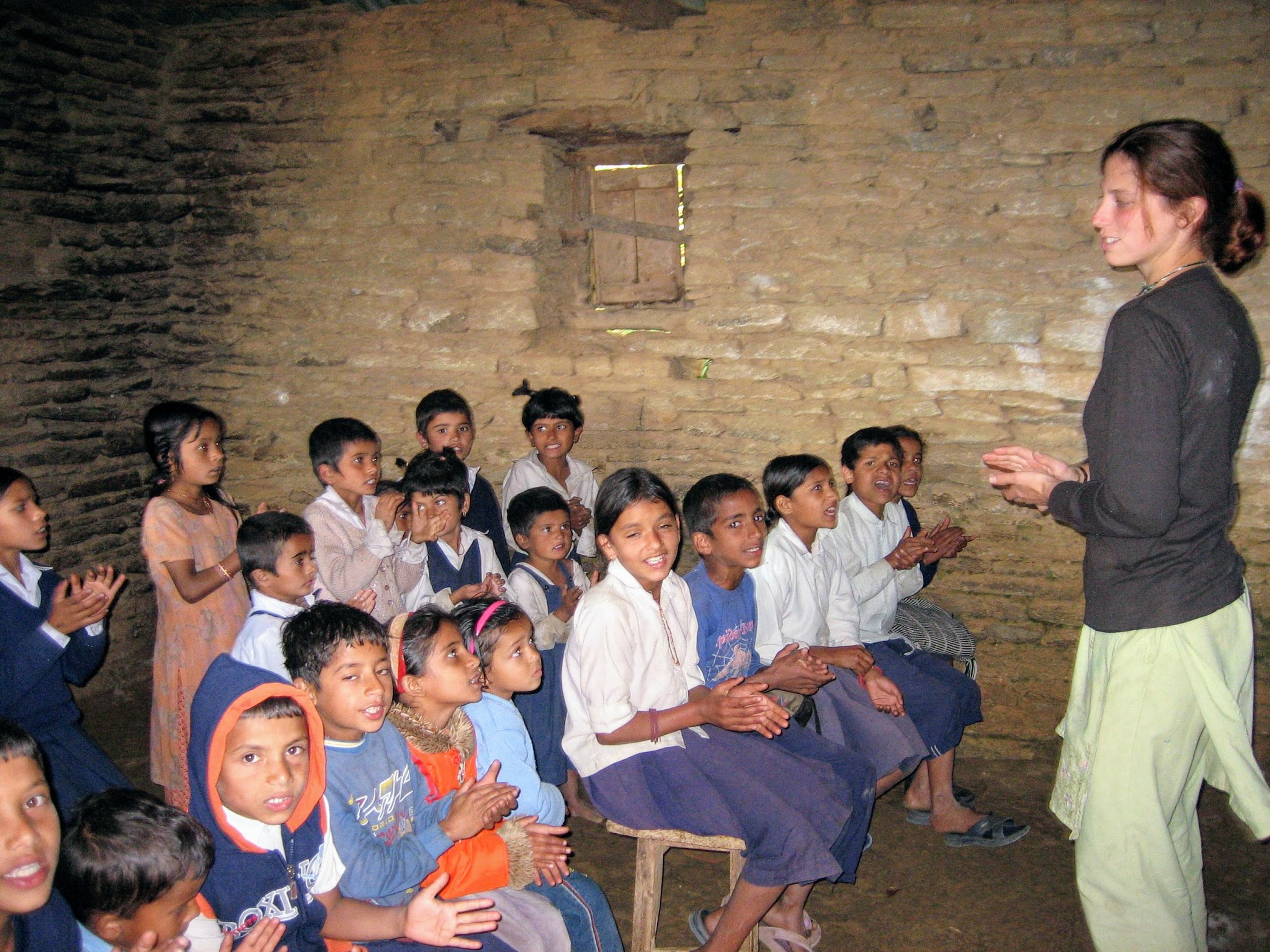
*Sada Shiva Classroom


The Rice Harvest

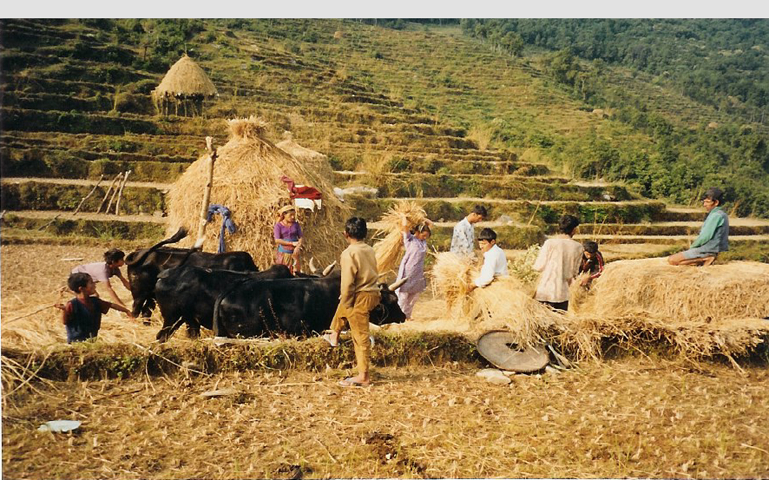
Bishnu and I got up early to do housework, and then we left with Saano Didi and her kids for today’s rice harvest in her fields. Saano and Bishnu carried big baskets loaded with pots and array of cooking materials; I had a bucket of spinach in one hand, a pot of tea in the other (life can be so odd), and my audio recorder slung over my shoulder.

Saano’s boys and I stopped at the tap to wash the bucket of spinach.  The ground still hasn’t dried out from the monsoon, and path through the rice paddies was narrow, slippery, and sometimes non existent.  When we finally arrived, we found an elaborate and energetic rice thrashing, ox-circling, tea and rice cooking, straw flinging fiasco I am becoming familiar with.  Mahendra’s father was perched on top of the hut-sized pile of cut rice stalks, smoking a cigratte and handing down bundles of crop every twenty seconds or so.

I ended up in the rice thrashing group.  Our job is to pick up the bundles of cut rice stalks as Mahendra’s father unloaded them from the haystack.  We lift the bundles over our heads and slam the grain end on a flat rock to separate out the seeds.  Then we put the straw aside, where the straw flinging people shake it out and toss it over to where the are circling.  Saano Didi’s son Kancha drives the oxen in circles and they trample the straw to soften it, so it is easier to carry (for us) and easier to eat (for our baby buffalo Sticky and her parents).

It’s quite a scene.  Very spritely.

Dain

Today’s seen was mainly composed of boisterous men, slightly older than me and Bishnu, in their mid and late twenties.  I make great entertainment, banging rice from the unreasonable height reached by my upended arms, hay sticking out of my hair and attaching itself to my lungi.  Also, dudes in their mid and late twenties are just generally loud.

So for three hours while we thrashed and drove oxen and whatnot, we talked about America, our respective governments, poverty, wealth, opportunity, taboo subjects like royal murders.  I was so glad I wasn’t logging tape in a carpeted sound studio.

Mean time, Saano didi was putting the pots and spinach and teapot to work over a fire she’d built nearby.  When we had thrashed and trampled the entire haystack, we sat down right there in the fields to eat.  Then I had to leave for school.  While I was away they would have get all the grains into sacks and bundle the straw into loads, and spend the afternoon going back and forth carrying it all up to the house.

I returned late in the afternoon to see if there were more loads to carry.  It had begun to rain, and the narrow, field-winding route was even more treacherous.  I met up with the gang: Siete, a wiry young man about my age; Radju-daai, slightly older but youngish man, and Saano Didi’s husband, a solid ball of muscle a few inches and a few teeth shorter than I am.

I was a little surprised when Saano didi’s husband prepared for me to take over his enormous load, so that he could go get another.  I’m used to everyone bending over backwards to find me the easiest work, and arguing to do more; this time, exhausted and wary of the path up, I was prepared to happily accept something a little easier.  As they propped the fat white bag up on a ledge, someone asked if I’d rather take Siete’s load, which was a little smaller.  Well, working off principle rather than common sense (and noting, after all, that nobody ever offers me harder work than I can do–I always argue my way in over my head), I shrugged and said I’d try this one.

Let me pause to explain the mechanics of carrying a 100 pound sack of rice on your head.  One way to get started is to lift the heavy load from the ground. The bag sits there with a circular rope around it and you lean against it like a chair, stick your head in the sling, and as you lean forward you gradually take on more and more weight until you’re crouched beneath the sack.  Then with a massive effort and a burst of leg power you stand up – that’s the hardest part, because you’re 100 pounds heavier.

Alternatively, the bag can be placed on a ledge, where you can sling it from a standing position and avoid the killer leg press.  The tradeoff is that you don’t take on the gravity of the bag bit by bit using your muscles, either.  Conveniently, it can be pushed right off the ledge.  Onto you.

Today we decided to go with method number two.  So I leaned against the sack, on a ledge behind me, slung the rope on my forehead, and crouched just slightly, to about 3/4 standing. I’d still have to pop myself up to full walking height, but it’s much harder from the ground and I already had a 120 degree angle in the knees.  Raju dai moved the weight of the bag from the ledge to my back, neck, and 120 degree bent legs.

Go ahead and picture a perfectly balanced scale sitting next to a ledge.  Now picture that a 50 kg sack of rice is ever so gently tipped off the ledge onto one side.

That’s me.  One instant we are executing a delicate but routine operation; the next I am pinned to the ground by a sack of rice.  It never passed go, it just went directly off the ledge and crashing to the ground with me underneath it.  There no pause where my astonished quads considered staying at a 120 degree angle.  There was never the slightest consideration of straightening up.  Luckily, because I fell over on my side, my foot (the same one the ox tried to mangle a few days ago when I was a straw flinger) was the only thing besides my ego that got directly squashed.  Of course, what with the enormous sack of rice on my foot (and my ego), I couldn’t get up. Or get my foot out.  My excellent problem-solving skills eventually led me to remove my foot from my sandal.

Also, the sack of rice ripped.  Thanks a lot, sack of rice.

With my first try now finished, I took Siete’s smaller load.  He stayed behind to get a new bag for the one I’d ruined.  Raju and I set off.

For the first bit of the climb, there was no path at all.  We climbed up over the terraces, which are narrow and rocky, and by now it was raining and slick.  Often getting up to the next terrace required a big step up, for which one would use hands and feet together even without the added body weight of a 100 pound sack of rice.

Not to worry!  I gallantly wobbled and teetered my way up as awkwardly and pathetically as anyone has ever done in the history of rice cultivation.  We came to a terrace that was about my height.  Happily, I was able to pull myself up and over to the field above.  Unhappily, I could not quite get the weight of the rice on my back to tip forward with me onto the upper ledge.  So it did what a sack of rice does when it cannot tip forward onto a ledge.  It tipped backwards off the ledge.

Given that said bag was slung to my forehead, this was rather terrifying, but luckily the rope slipped right off my brow. The traitorous bag went tumbling down, and I landed in an upside down hanging position with my legs on the ledge and my torso dangling off.  A passer by (it’s a rather popular spot) might have thought me just shot by an arrow.  Raju might have considered it.

Fortunately the sack was still in tact this time.  I vehemently refused to let Raju carry it over the ledge for me, which I’m sure he found very thoughtful.  We put the whole operation back together and set off again.  By now my back was cramping and spasming despite the relatively easy load, and nobody needed to convince me not to go again when we reached Saano didi’s some untold hour later.

After getting over the initial shock of my actually having arrived alive, the tired crowd wasted no time rocking back on their stools and retelling tales of my performance over the course of the day.  Everyone kept asking if I’d hurt myself, but other than my foot, I was fine–nothing had been badly bashed except my pride. Everyone’s attention was soon diverted to a vat of boiling millet alcohol.  I have never enjoyed whiskey before, but it’s like they say when you’ve been twice attacked by a sack of rice: there is a time and a place for everything.

Roof Leaping

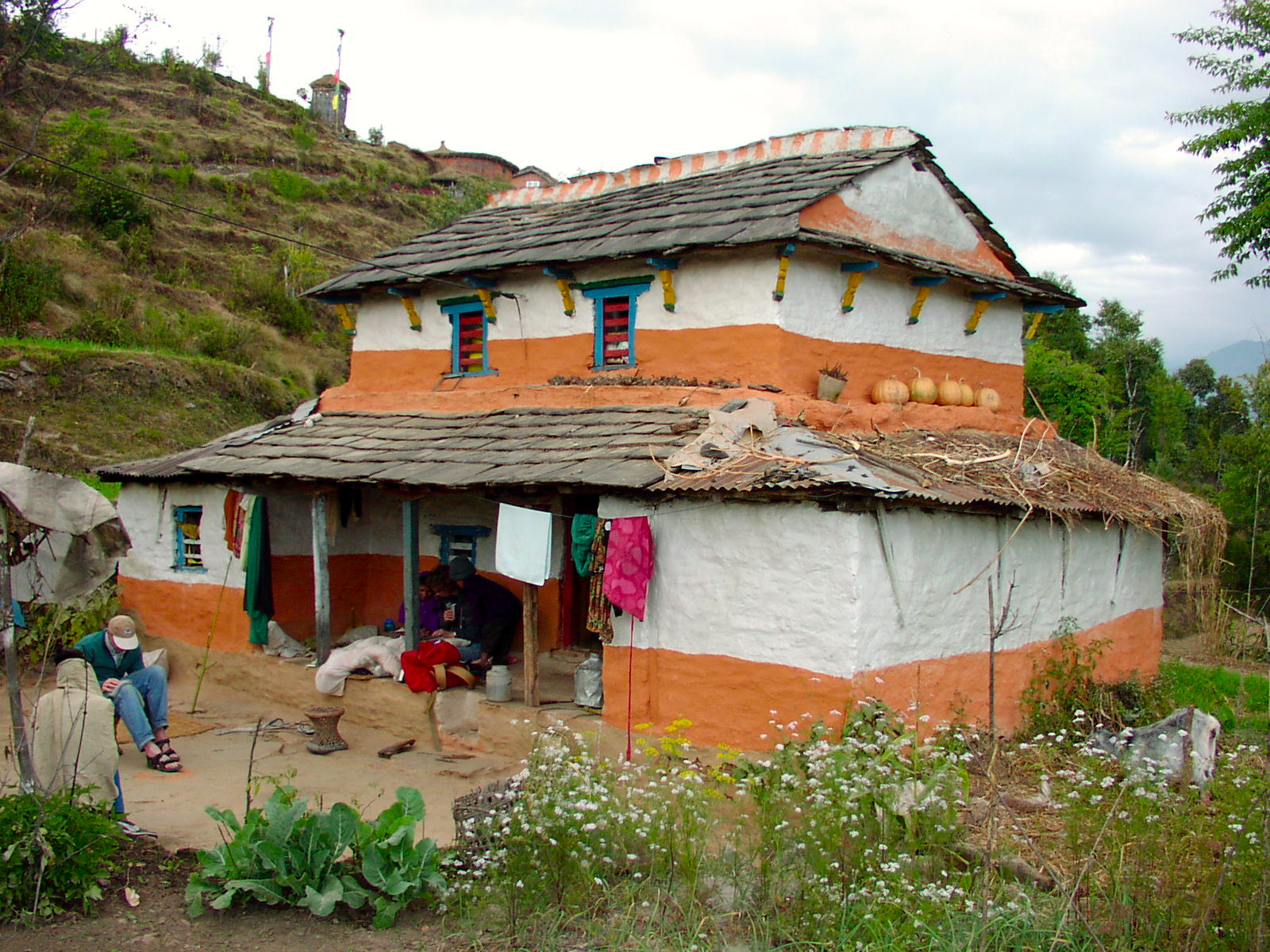
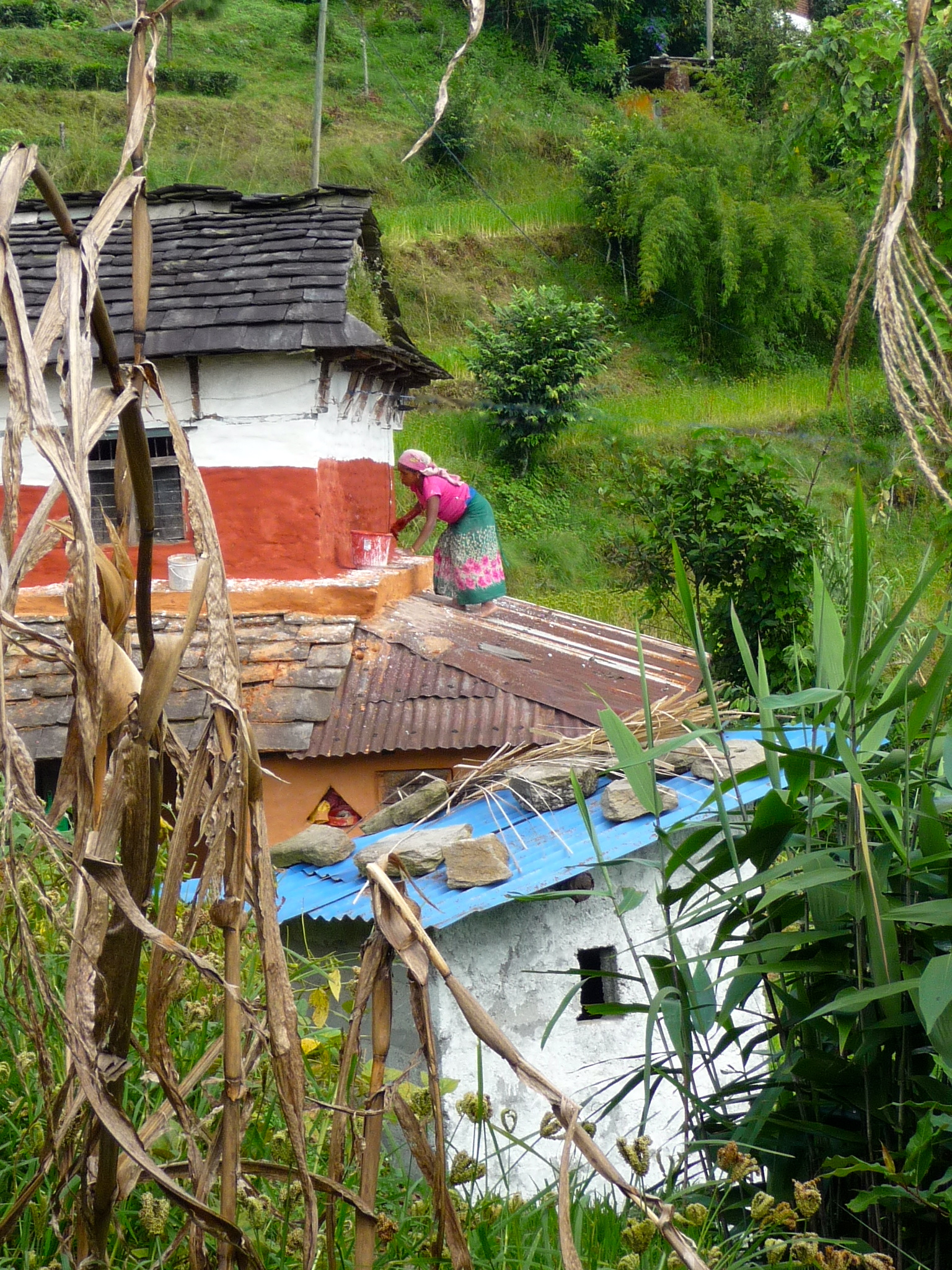
Bishnu and I went to the field at about 7am to cut grass before breakfast.  After we ate, it was time for more house painting.  Fortunately, the structural layer involving buffalo poo is all done, so now we just have to go over it again with thinner mud that has color mixed into it.  This is how the house ends up orange on the bottom and white from the middle up.

The village looked like a party.  The jaunty line where the orange and white paint meet seemed to be winding from house to house in the sunlight, leaving its fresh mark on one cheerful home after another.  Women splattered in paint and mud were scattered over rooftops and sticking out of the grass behind their houses, painting away.

OLYMPUS DIGITAL CAMERAOur house is shaped kind of like a house on a house.  There is the roof over the first floor, and then the attic built on top of that, and then a triangular roof on top of the attic.  I came outside to find Bishnu and Aamaa standing on the highest roof, painting the uppermost part of the house.

As I stood there planning my next move, Mahendra came over carrying a severed goat head and smeared blood over our door.  His family was roasting the body in their yard on the terrace behind and above our house, in preparation for today’s big meat-eating celebration.

I climbed up to the lower roof, where I go frequently to lay out laundry in the sun, and after a while I got bored waiting for Aamaa and Bishnu to give me something to do.  So I did what you would do if you were standing on a middle roof with nothing to do: I made to climb up a level to the upper roof.

Aamaa immediately had a fit about how I was going to fall and kill myself.  “You can’t, you can’t do it!” she cried, as if she didn’t know by now that the fastest way to get me to do something I’m unqualified for is exactly like that.  And Bishnu expressed her disdain in characteristic fashion by smirking and standing in that unsympathetic posture that says, “What are you going to do, American?”

This attracted the attention of Mahendra’s entire family on the terrace above us, where they had previously been observing the headless roasting goat.  Just as I was realizing that climbing on to the upper roof really wasn’t that easy, I also took some pleasure in being more interesting than a headless roasting goat.  I calculated that climbing up on to a roof wouldn’t be all that difficult if a) I hadn’t been wearing a lungi and b) I had full confidence in the stability of the upper shingles.

So there I was.  Ironically, the only one trying to help me was Baa!, Mahendra’s father, who as a general rule seems more ambivalent than anyone of my right to show up like this, to explore the poverty he got stuck with like it’s some kind of escapade.  Let’s just say that Baa! has shown a distinct lack of confidence in my ability to be a fast learner.  But from edge of the roasting goat pit, he was, quite generously, making emphatic motions indicating the pulling up of one’s lungi above the knees.

Let’s face it – there really is no way to climb up from a middle roof to a top roof in a lungi except by grabbing on to the shingles over your head and jumping.  You hope for the best and don’t ask yourself what’s really worth risking your life for.

I was up.  The shingles did not fall off the roof, but Aamaa was still yelling “YOU CAN’T!” in a prolonged and energetic babble that apparently couldn’t be cut off simply by being proved incorrect.  I stood to my full height–more than enough to be a chimney for this house–raised my hands up, and tromped around defiantly.  Great view up there.

And that ended the show.  Everybody went back to their business.  Roasting goats; smearing mud.  I, however, still had nothing to do.  So when Bishnu and Aamaa went around to the other side of the house, I decided it was time to go down.  I returned to the spot where I’d come up.

Well, let’s just say that leaping up is one thing.  Leaping down a different matter entirely.

The audience had dispersed.  So it was before the eyes of God alone that I saw myself peering off the edge of one little roof, down to the top of another, reaching one leg down and straining with my toe, which dangled a good foot above the sloped shingles below, at the bottom of which was a nice little drop to the ground.  I looked over my shoulder to make sure nobody was watching.  I tried everything: this leg, that angle, slide on my bum, brace to the left, hike up the goddamn lungi; I looked for another disembarkation spot, an invisible step; I considered the unthinkable—waiting for Bishnu to give me a hand.

With sudden clarity I thought of Katharine Hepburn climbing houses (I’ve been reading her memoir, of course), and wondered if the roof below me could support my weight if I just jumped.  I pictured myself tumbling off the edge below, breaking my leg, and thinking that any small concession would have been a better gamble than loosing every last shred of dignity (and my leg).  I really dwelled on that image – what it would feel like, lying there on the ground in my own pain and stupidity.

I jumped.  I landed softly on the lower roof and walked over to the other side of the house, where Aamaa and Bishnu were still painting, and demanded that they give me a job.

Matters of Poop

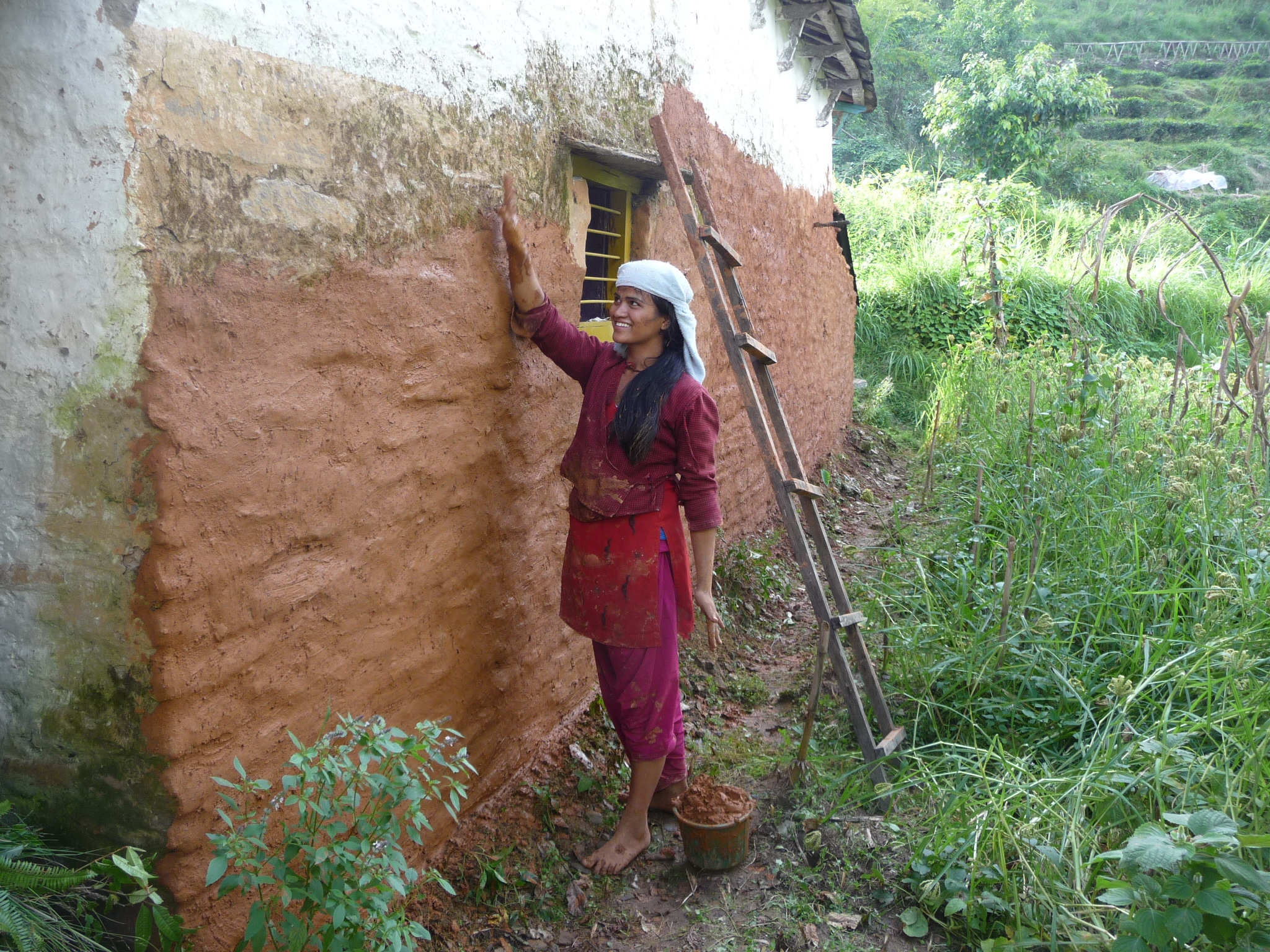
P1070066I came home to find Bishnu and Aamaa painting the house in preparation for the festival of Dashain.  Aamaa had a pot in one hand, and in the other, a rag dripping with goop that she was slapping and smearing over the walls.  Next door, Saano didi was doing the same thing – in fact, all over the village this week, women are standing on their roofs, sticking up like chimneys and shouting to each other across the open space.

Now, and this house-painting business is an interesting topic.  Because it’s something I really want to be a part of: the annual re-making of our house, renewing and refreshing the walls that shelter us.   It is both an extremely practical and very beautiful tradition, which we in our brick-and-plaster, carpeted houses are denied.  It a special opportunity to want to share in restoring the house and strengthening it for the coming year.

Unfortunately, the house is made of mud and buffalo shit.

See, I have this problem with shit.  I’ve really made some serious efforts to get over it.  I accepted Didi standing knee deep in a mound of shit and hacking at it with an axe, sending little bits of buffalo turd flying everywhere.  I accepted Aamaa walking into the house with an enormous heap of poop in her hands and cooking it in a vegetable pot in the kitchen and then putting it on Bishnu’s sprained ankle and then putting Bishnu in bed with me.  I’ve accepted that the hands that carry buffalo shit around the house are dark with grit beneath the nails and also cook the food that keeps me alive.  I even carried some shit in a basket hanging on my back and swung it bravely over my head to make it land in a tidy basket-sized pile of fertilizer in the wheat field.

But I cannot put my hands directly and purposefully on shit.  I can’t do it.

I know that the house is made of shit.  I know that I walk around in bare feet in the house made of shit; I eat off a plate on the floor of the house made of shit; I know that the wall that I lean on next to the bed is made of shit.  This is all perfectly okay with me.  But it is not okay with me to sink both hands into a pile of shit, mush it around with water and mud, and smear it against the wall.  I simply cannot touch shit in pure shit form.  It needs to at least be disguised as part of a house.

So instead of helping to paint the house, I took a nap inside, stewing in guilt and regret that could not quite defeat this final barrier in my relationship with shit.  And much later on, when Bishnu and Aamaa had come in for the day, and the ladder to the attic had been put back inside, and the mud and shit mixture was still drying on the rungs and I kept putting my hands in it and then washing them with soap and water, and our various water jugs—used both inside and out, for washing, cooking, and occasionally for giving liquid to the animal family members—had had the soupy brown water washed out of them, but had not been sterilized with hospital antiseptic, and everyone was going about the evening business of sitting around and cooking rice…even then, I still felt bad that I hadn’t helped paint the house.  But I felt worse that I’m afraid to just up and pick up a wad of shit—and worst of all, that I still didn’t want to.

And the conclusion that I came to is that I’m simply never going to want touch shit before I do it.  If I’m going to do it at all, and if I’m going to use my own two hands to renew the house for the new year, I’m just going to have to touch buffalo shit before I’ve decided that it’s okay with me.

P1060818

Learning by Cucumber


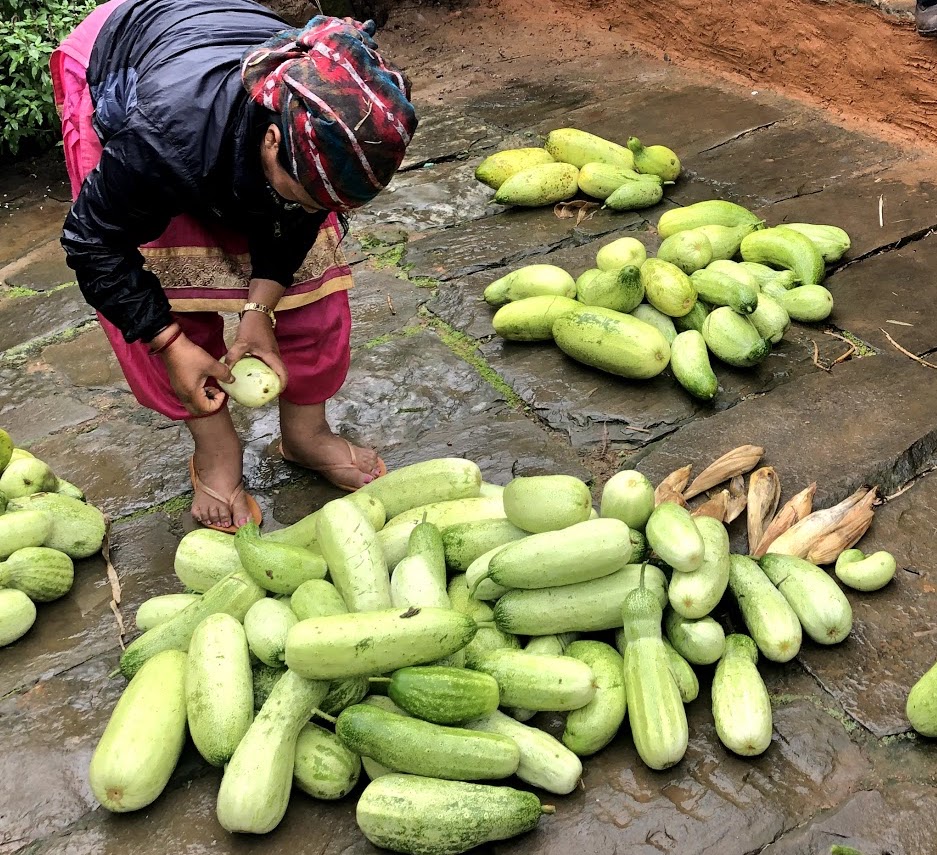
It had been a long day for both of us: me at school, Aamaa cutting grass for the buffalo all afternoon in the heat. We convened in the kitchen as the sun was going down. Both of us were too tired to bother with rice, so Aamaa began putting wheat rotis in a pan for us to eat for dinner with some iskus left over from this morning. Iskus is my favorite vegetable, a slightly sweet gourd that’s plentiful at the end of summer. I was just about to bite in to a little scoop of it I had carefully placed on a nice hot roti, when shouting began outside.

So listen, my language skills are pretty good for someone who’s lived in Nepal for a total of a few months, but at the end of the day, I can no more decode haphazard shouting outside the door than I can follow a parliamentary debate. And since I can’t understand the words, it took me longer to notice the sound at all…and to be honest, I was really focused on my roti and my little pile of vegetables. So Aamaa was the first to jump up and run outside, leaving me in a momentary cognitive stall-out after a wearying day of trying to think in another language.

What about my roti? I thought, looking longingly at the little pile of carefully placed iskus. And then I snapped alive to the world outside, where my attention fully redirected to the ruckus coming through the door. Not wanting to miss any action, I put my down roti untouched, leapt up, and followed Aamaa outside.
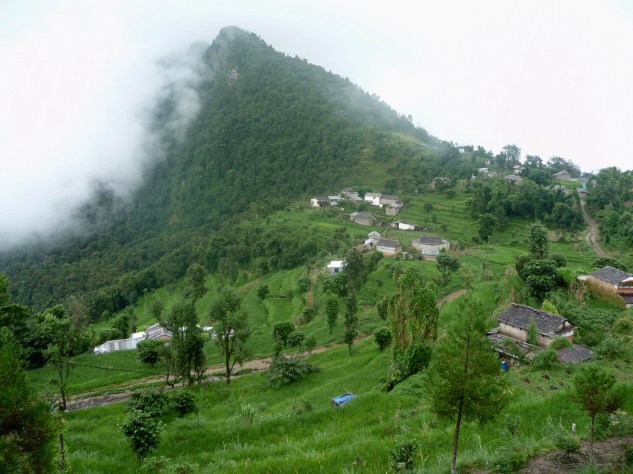
It was dark and Aamaa had already taken off with the light. Our mountain alcove was thick with nighttime, but shouting was coming from all around, and leaping from squares of yellow light and vaulting off the terraces and bouncing maniacally about in the huge darkness.

I scrambled half-blind over the path from our house to the edge of the terrace, which drops off to the next field below. There, Aamaa stood at attention on the terrace edge, listening to the tempest of voices. Without warning, she let go an unbridled screech and submitted her own opinion to the fray.

There were no further clues as to what anyone was yelling about. I wanted to ask, but I was afraid to interrupt the flow.

Abruptly, Aamaa took off again. Now to the left, and down over the terrace, past where the buffalo stay in the winter; a patch of field that now, in late summer, is a wet leafy carpet. The Ritz Carleton for leeches. Determined to be a full participant, I ran after her, jumping over the terrace ledge, and plunging heedlessly through the soft plants to where she was standing with a flashlight, now yelling again. Two small girls had appeared out of literally nowhere; and logically, given the leech situation, they stayed perched on the ledge over my head.

“WHAT HAPPENED?” I asked Aamaa breathlessly, my feet absorbing moisture from the buzzing ground. I was rewarded with more incomprehensible shouting coming from everywhere.

Finally, without averting her gaze from the inscrutable darkness, Aamaa said something about a cucumber, which I couldn’t quite catch, except for “cucumber.” And then she was promptly too distracted to tell me any more.

I thought about the leeches. Fine. I returned to the base of the ledge, resolved to climb back up. While doing so, my sandal fell off. The two mystery girls wanted to to help me up, but on principle I fixed my sandal and got myself up the ledge. Still utterly baffled, I returned to our house with the two girls, and a minute later, Aamaa followed. The yelling wafted along behind us, still unattached to any source or story.

The girls had brought us what I now know was belaunti, a cheese-like, crumbly, slightly sweet milk product that comes from a buffalo that has just calved. It is packed with both nutrition and luck; birth, after all, is a dangerous and miraculous thing, and belaunti is treated with the respect any auspicious gift of the universe is due. But in that moment, all I knew was that we’d gone from the inexplicable cucumber crisis outside to an equally illogical and randomly-timed cottage cheese situation inside, which unfolded as follows: Aamaa put a bit on her forehead and then started eating it. Then she asked if I wanted some, so I said yes, and I was about to eat it when she told me to put some on my head first.

Alas, I’d started out tired, and my mental state was only becoming more fragile as the number of things that made no sense accumulated.

Just as I was trying to work out why the two mysterious girls had brought over cottage cheese while people were shouting about the cucumber, and why we had interrupted that serious event to put the cheese on our foreheads, Aamaa offered the girls some roti. I’d nearly forgotten about my once-important roti. And I forgot again, because in the half second it took the girls to refuse the roti, Aamaa had gone back outside to shout about the cucumber.

Not to be outwitted, I dashed back in to our yard, where now I found our neighbor Saano Didi and her three boys. They were standing as if squinting with their bodies, leaning slightly forward in to the darkness, watching the invisible shouting. I pleaded with Saano Didi to explain what in God’s name was going on. I just wanted to be in on the cucumber issue. I just wanted to play with everyone.

What followed was an extended five-way exchange that involved a fantastic amount of explaining and re-explaining, handwaving, pointing, and acting, in which I tried to piece together the story of the cucumber emergency based on comprehension of only one out of every fifteen words. At first I believed that somehow a cucumber plant had fallen over–I was not focused right then on the fact that our cucumber plant is most decidedly a vine–and I became very worried that somebody had been injured by a falling cucumber tree. But Saano Didi and her boys kept mentioning boys and girls; apparently the cucumber tree had fallen when too many boys and girls were climbing it, and a mystery man appeared–wait, no, the cucumbers were stolen! The tree fell over and the boys and girls were stealing all the cucumbers from it! Oh–no–a man came and stole all the cucumbers–but not from a tree, he went around to people’s homes and asked for cucumbers, and didn’t tell anyone else that he was exploiting cucumber generosity from them all–no, he didn’t ask, the man was just stealing cucumbers from each person’s house! And then he was CAUGHT! Ah, this was beginning to make sense–but wait, how did the man go running from house to house with a growing collection of cucumbers? Hold on, he was eating them as he collected them.
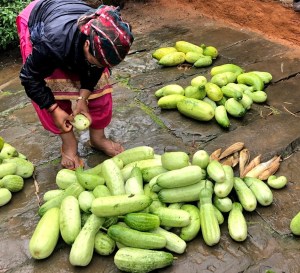
Yes, this surely explained the excitement! A man had been caught–well, seen, but escaped–while sneaking from house to house eating cucumbers. And now he had got away, despite the dazzling mountain-sized net of female screeching through which nobody could possibly run freely and un-apprehended, even without an untold number of cucumbers to carry.

Saano Didi invited me over to her house. Aamaa was clearly indisposed with the cucumber crime, so I wasn’t to get any further intel any time soon, and I’d forgotten about my roti, so I went and sat by the fire in Saano Didi’s house and drank some hot buffalo milk. Then she produced a cucumber.

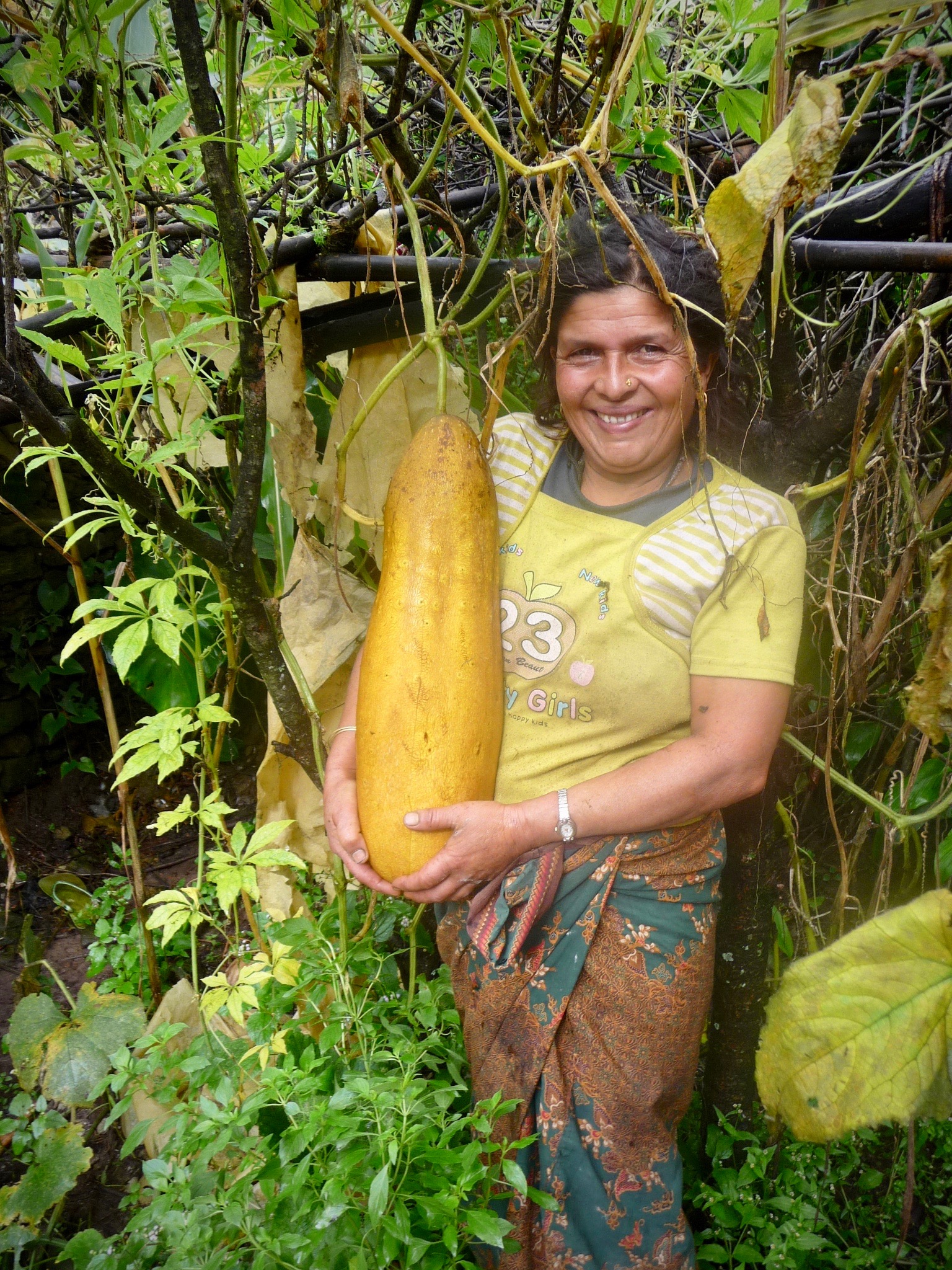
Which turned out to be the most enormous vegetable I’d ever laid eyes on. It could easily have crushed a cricket bat. It was of a stature that unequivocally qualified its seeds to be harvested for next year’s cucumber crop. This new evidence threw the cucumber fraud situation in to chaos all over again. It was hopeless. I would never solve it. Saano Didi cut the Gozillacumber in to massive, dripping hunks of flesh, and we sat slurping, crunching and dripping in cucumber juice, while somewhere unknown, some cucumber lover was apparently reclined in the dark recesses of his home, totally immobile.

*
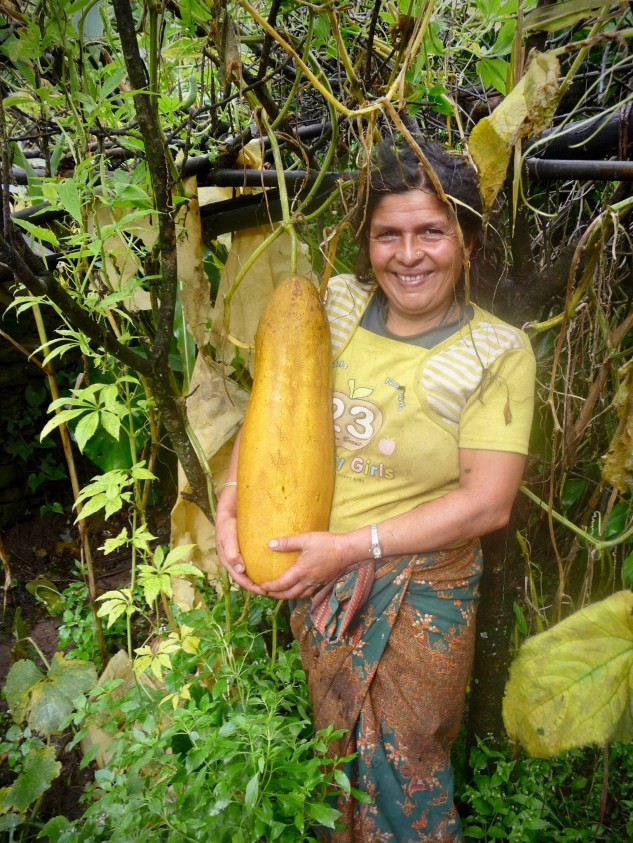
Aamaa with a Godzillacumber