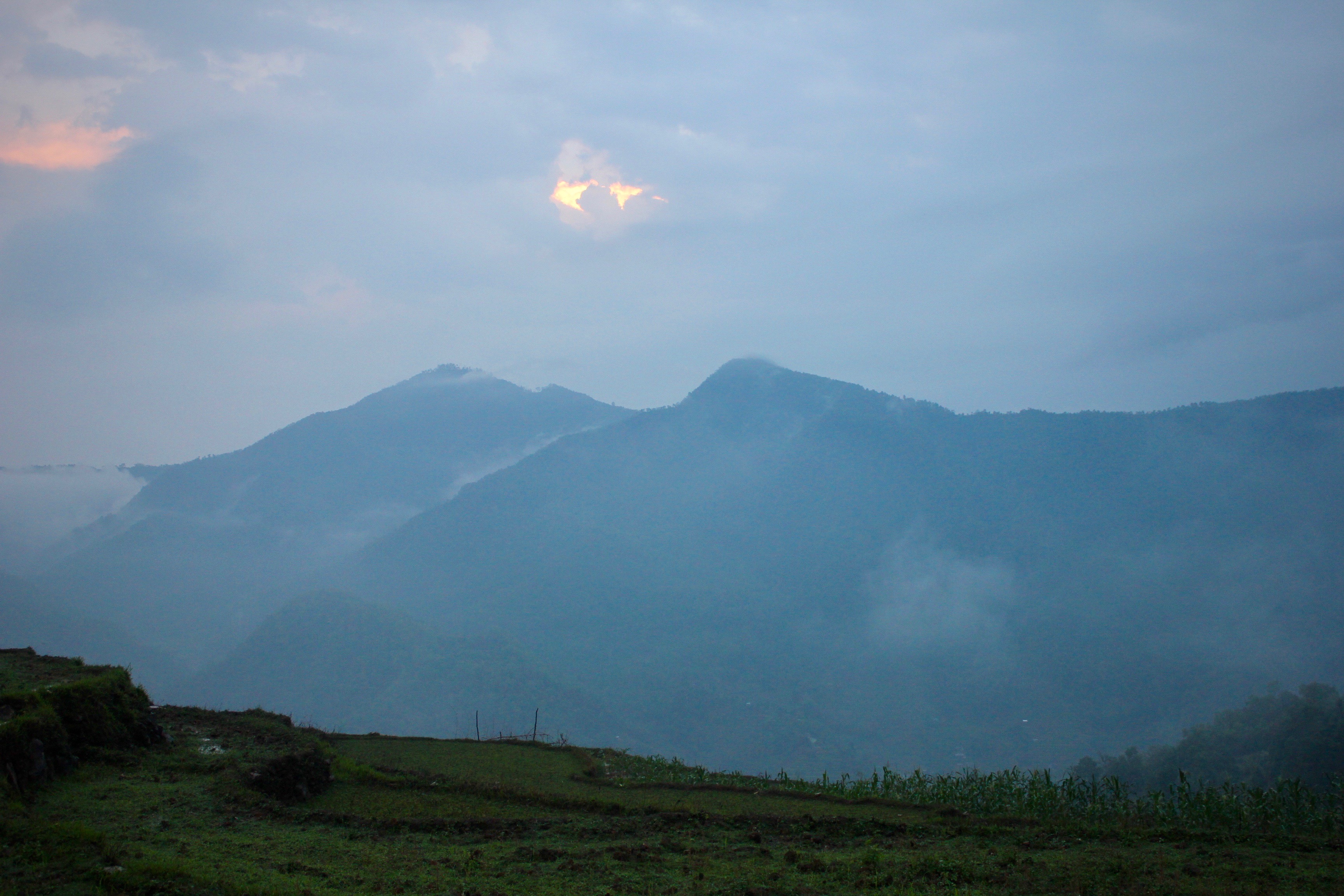
No Time Like the Present


I woke up after our day in Lamjung feeling all grayed out. I didn’t want to get up so I stayed in bed until 8:45am, which is mid-afternoon here. Everything seemed complicated and shifty. I haven’t even been out to any of the real damage yet and I’m having trouble keeping my spirits up.

I went for a run along the lake in the hot sun, showered and sat down in a café with some iced coffee. I took out Manisha’s email from May 1 and reviewed it with everything in mind that I’ve learned now about transitional housing.

One thing that’s obvious is that there’s no more time for talking and thinking and researching without acting. We’re going to have to learn as we go. The basics are the basics – don’t impose ill-conceived ideas on people, focus on local resources and let people use their own knowledge to build. Supplement with structural ideas, manpower, and additional raw materials as possible when you know what can be used. Building for thousands of people at once in a short time is a different ballgame than designing the ideal temporary rural house.

I looked at how the destroyed and damaged houses are distributed among our working areas and put them in to an order I thought made sense for us to learn by doing. In some, where there are just 2-6 damaged houses, we can try something like earthbag building. In others, were there are 40 or 100 homeless families, we’ll follow the generally accepted plan to provide tin and manpower. We’ll see what happens and improve as we go.

I put this all in an email and sent it out to our advisory board. Things felt a little more organized. I needed to confirm that my data from our villages was still correct, because the second earthquake caused more damage, and also other groups may have already provided some materials to some of these places. But Kaski and Parbat, the districts where we are, weren’t hit as hard, so there’s a lot less attention here, even though hundreds of homes are unlivable. There are no big cluster meetings and the government is under very little public pressure to act quickly around here.

Once that was all sorted out, I headed to the Gaky’s Light community house. Our Fellows have the first performance of their final project tonight. It’s a tribute to earthquake victims that they’ve beenIMG_8841 working on with a dance teacher. When I arrived they were practicing and setting up a sound system outside. A crowd was beginning to gather around.
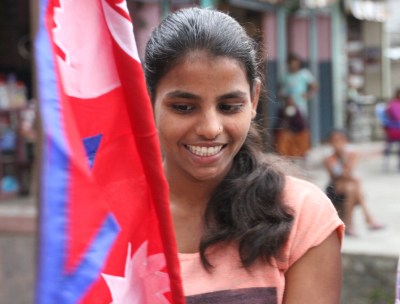
As soon as the kids were about to start their performance, the clouds came in, purple and ominous. The rain began but they did their performance anyway, and people watched from under the eaves of shops on either side of the street. One man pulled over on his bicycle, wrapped up in plastic bags from head to toe. He was upset to find out that we weren’t collecting donations, which we weren’t allowed to do in a public space because there’s so much worry about people exploiting the situation to raise funds for dishonest purposes.

I decided to have dinner with the kids and sleep at the GL community house. Just as it was getting late, I got a message from Bene and Robin, French friends of mine who live in Pokhara, that there was a meeting the next morning in Sarangkot where they’d be doing presentations about earth bag building. So the next morning I got up and went straight to meet them in this crazy jeep they bought that looks like it was used for transporting goats or ammunition at some point.

Robin drives like a bat out of hell, and the road to Sarangkot – the same one I take many times each week to Kaski – isn’t exactly paved with pavement. I’m a pretty hearty passenger, but we were all in the back of the truck bouncing like popcorn, things rolling out the back, I hit my head on the bars a few times, all while trying to shout at the two other guys in the back of the jeep to figure out what we were all doing there.  Then I was up at Sarangkot for a few hours with a random collection of foreigners who’d all been doing various forms of freelance aid, learning about how to build houses with earthbags.
IMG_9098

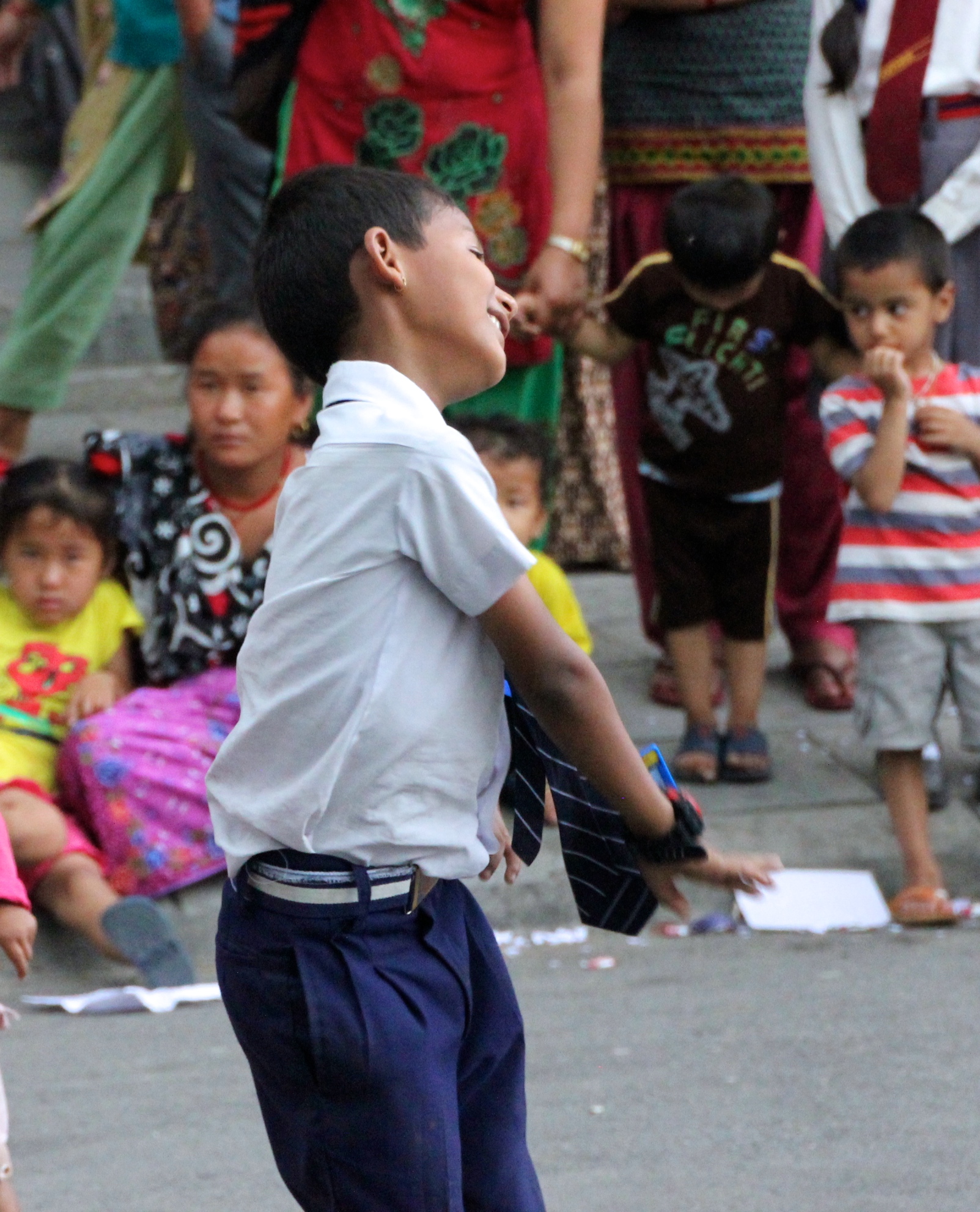
This beautiful boy in the crowd started dancing during a tribute song written by our fellow Umesh, and kept going for a full five minutes.

For the record, I’d left the office at 2pm the prior afternoon, thinking I’d be back in 4 hours after watching a dance performance.

I didn’t get back from Sarangkot until late afternoon and went straight to watch the kids do their second performance. A good crowd gathered and lots of people were filming on their phones. But the instant their dance ended, the performance was once again interrupted by rain – this time a thunderous downpour of fat plops of rain and huge chunks of hail. We all ran under a nearby tin roof and waited it out while the sound guy pulled in all his equipment.

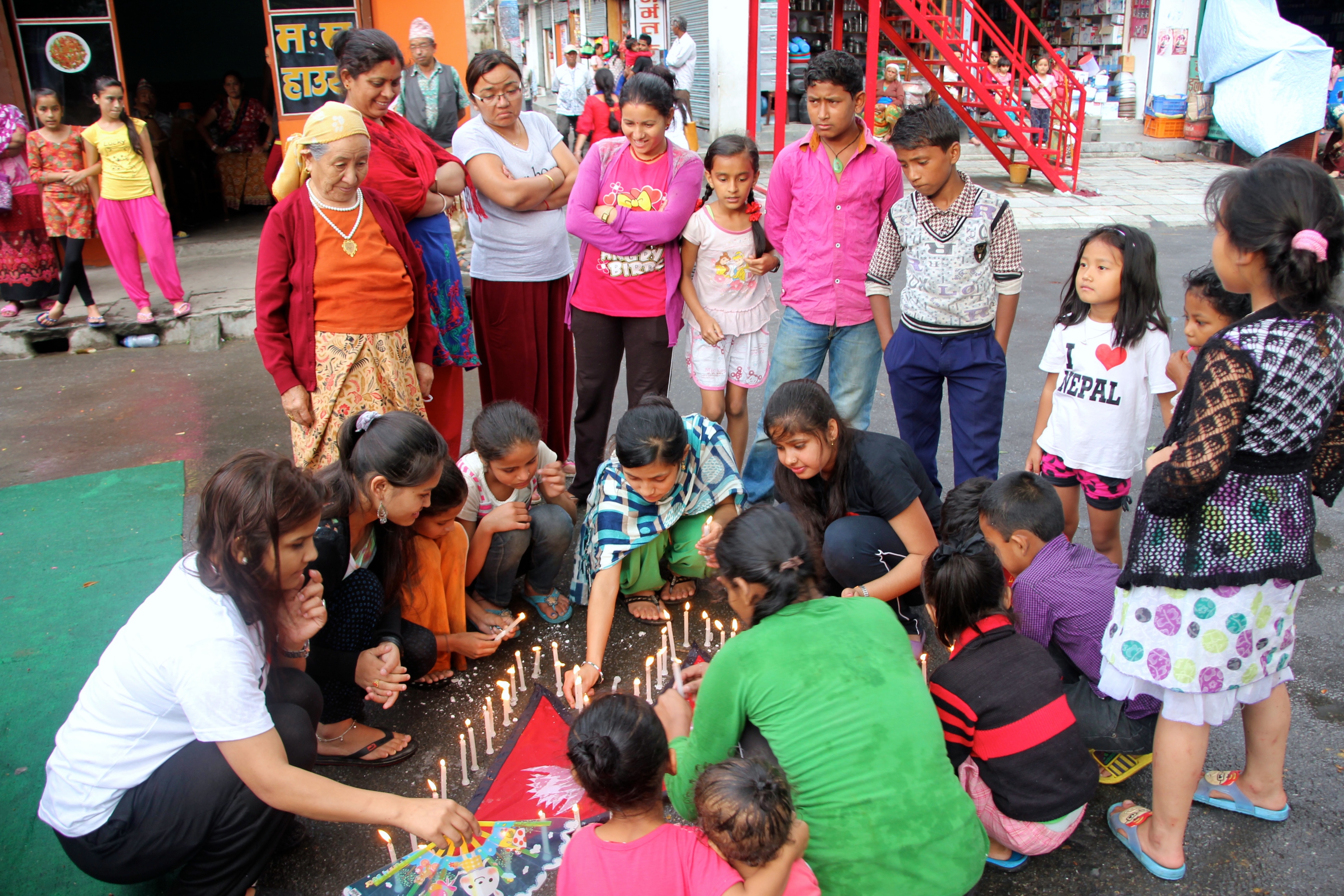
When the storm ended, most people had gone home. But the kids set up one of the speakers and did the rest of their show – a poem, a few more songs, and a candle lighting. It took all of them at the same time lighting and relighting the wet candles, hovering over them to keep them all going at once, to get the Nepal flag surrounded. And of course a new crowd formed around them.
IMG_9233

My phone rang and I found out we had a last minute board meeting. I showed up quite wet and bedraggled at 6pm on the back of Shiva’s motorcycle. All my electronics were dead because I had no chargers with me. We ended up sitting there till the place closed, and I finally hopped in a cab and went home.

Well that’s kind of how things go here, moving from one universe to another on the backs of bikes and jeeps, following things as they unfold in the moment. I left the office at 2pm on a Tuesday thinking I was coming back for dinner, and didn’t come back until 9:30pm the next day, having been to up to Sarangkot in a jeep and hiked down through the woods for an hour and a half in my flip flops, watched two dance performances, run from hail, spent a night with the kids in the community house, and had a 3 hour board meeting while sipping an americano in a coffee shop under a thinly disguised knockoff Starbucks logo.

Nothing like a little Nepal style to shake you out of your gray and put you back on your toes…

Boxes and Glass Cases

It’s been a tough arrival.  The monsoon is still clinging to the hills, thick and cloistering, and each afternoon it dumps an unremitting rain that I swear to God follows everybody inside.  The air itself is full of water; there’s no place to be dry.

And the truth is, I am also a drop suspended in mid air.  I’ve moved out of my apartment in New York, but I haven’t moved in to a new apartment in Connecticut, so all my things are in boxes in my parents’ basement.  The plan is that when I get back in two months I’m going to be working in a manual therapy clinic in Hartford…but it hasn’t actually happened yet.  It’s an idea, hovering in good faith around some boxes in a basement, waiting to be taken out and used.

That feeling has trailed me all the way to Pokhara–the hint that my life is full of theories.  Even IMG_2479though my contact with my projects in Nepal has increased a great deal in the past year through Skype and regular written reporting, and I have files and files of documents proving to me that these creations are real, they still feel like experiments when I re-encounter them on the ground.  Plus, there’s a big disappointment right off the bat: our first program director has left unexpectedly, after growing the Kaski Oral Health Care Project much less than we’d hoped since last fall.  I’m tired and frustrated and it’s enough with the freelancing.  I am ready to feel like I know what I’m doing, and some of this fits together, and it’s leading somewhere that matters.

Today it led back up the road to Kaski.  I went to Vindivasini Temple this morning to catch the bus on its way down, so I could save a seat before the bus arrived at the park, where a crowd  gathers around the door and starts pushing in to secure real estate for the ride up before people can even get out.  As I waited, I sat on a stoop with my duffel by my feet, watching a man selling vegetables across the road.  And I wondered again if this is all some kind of act.  I’m just doing the same thing over and over.  I can’t keep my grasp on what it’s about.

Other than a story.  The word comes to me again, and then again: Story.  Right out of the blue, at nine in the morning, I’m sitting on a stoop waiting for a bus, watching a man weigh a cauliflower, and the next thing I know I’m watching a story, and my identity is divorced from my soul.  Poof!  I am a character.

It must be natural that when you go through enough repetitions of something, even something incredible, it becomes unmoored from any particular episode.  And with that goes its singular miraculousness, because it’s just what it is: a cycle.  How profound would the sunset be if you only saw it once in your life?

Sometimes the sense that everything is just a series of events, with nothing transcendent to tie them together, seems like the most awful thing possible.  Even the leaves clinging to the trees look worthless.  But in certain moments, that same arbitrariness erases the perpetual burden of discerning the purpose of each passing instant, and my role in things is set free from an anchor that, in truth, may never have been there.  What a relief.

This morning I watched the vegetable vendor.  The story settled around me, like snow in its glass case, shaken from the sky.  I waited, again, for the bus to take me up to Kaski, where I knew Aamaa would be waiting.  Again.  For me.

IMG_2638

A Story

Back in Kathmandu, Tom and Jerry ends, and we turn off the television.  We eat our rice.  I mush the grains between my fingers but resist the temptation to try to give the meal special attention.  You can’t grasp a thing at the last minute if you weren’t paying attention along the way.

I repack my bags, and don’t get in bed till after midnight.  With the heat and mosquitoes it’s a long time before I fall asleep.  I toss and turn, thinking about watching Bishnu and Bhinaju get in the bus back to Pokhara, and about the strange idea of being even farther away than I am now.  It seems like, for the rest of my life, I will keep getting farther and farther away.  Which is strange because, even from Kathmandu, in a big bedroom where I can hear Nepali music videos playing on TV, Kaskikot feels like a memory, a separate universe where I once was.  I was there only a few days ago.

You know, it never has been missing it that I dread, or the thought of loneliness that fills me with worry.  It’s the shift from real to remembered, from substance to recall; it’s that the absence has no bulk when you get far enough away, and that life goes on and—even if you can remember to miss it, it’s so disconnected, so unreal, that it’s mostly just a story.  And what of the part of you that has become the story, the skin that has touched this world and walked on it and dug fingernails into its mud?  When all of it is farther away than the moon—which at least your eyeballs can see at night—is that part of you just a story, too, that only exists to the extent that you still believe you were there?

Wouldn’t that be something, if after all this, all I could bring home with me was a story.

*

OLYMPUS DIGITAL CAMERA

The Milk Truck

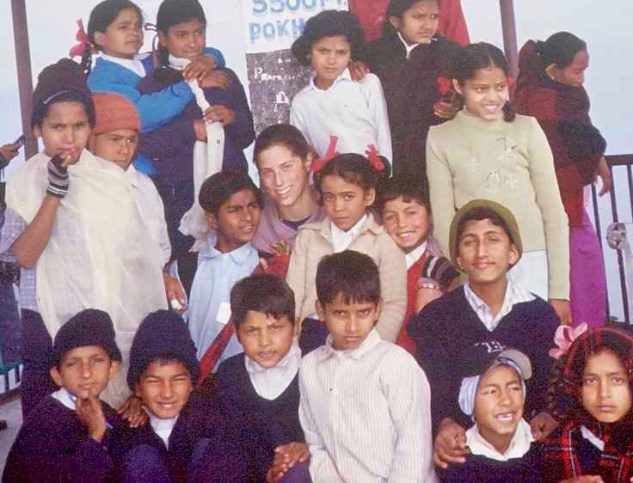
We spent a very long time waiting for the milk truck to pick us up.  As part of Optional Class, I’ve found people to come up from the city and tell the kids about their jobs: a librarian, a radio jokey, and someone from the photo shop.  Today, we were headed to Pokhara to visit the places they work.

While we waited for our ride, the kids sat on the grass, leaning on each other, practicing the song that Govinda and I wrote about the solar system.  We make them sing it every day – Venus has poisonous air, there’s a big storm on Jupiter, la la – so the tune has more or less become the Optional Class Anthem.  The radio jockey had invited our students to sing the solar system song on air during our visit, and the quartet selected for that job was practicing next to a few other students who we’d chosen to read their poetry on the radio.  The early morning hour was one of quiet satisfaction for Govinda and me, watching our kids with their heads bent over the books they’ve made, feeling important.

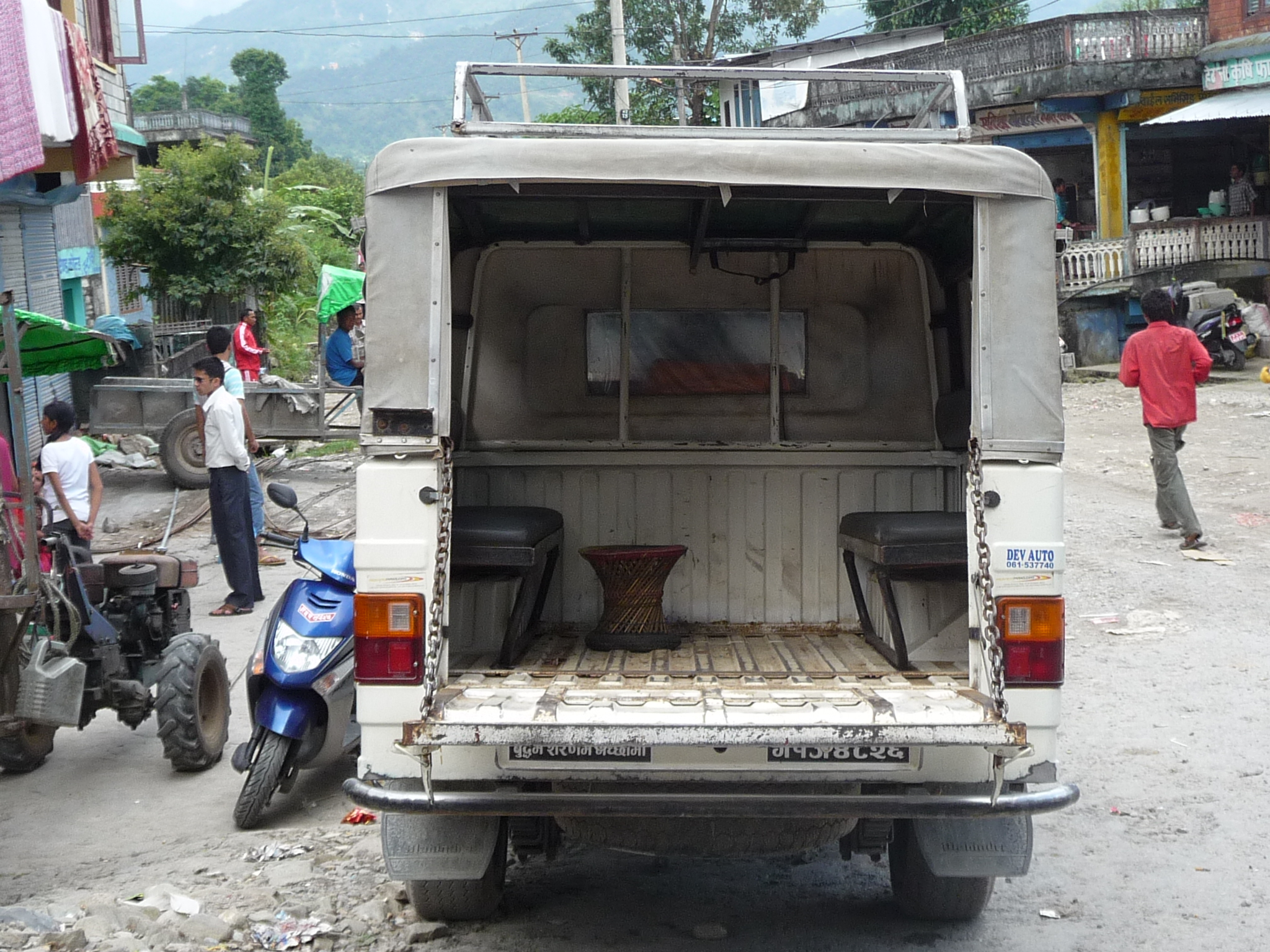
The milk truck finally came, and we all crammed in to the back: Govinda, Laximi, and eighteen kids, and me.P1060843  The inside was a military-style canvas box with two benches and railings on the ceiling to provide handholds.  With a lurch we set off, bouncing down the dirt road toward the city.

To keep out the dust from the road, we had all the canvas flaps down over the back and side windows.  I looked around at all the little faces squashed into our sealed box, and was struck with the sudden feeling that nothing, no words or photos or documentaries, would ever be able to recreate that stuffed space.  At the end of the day, we will be exactly that: a giggling ring of faces pressed together inside our container, moving along a dirt road towards something, out into a world which sees us as if from above, tiny on the crumpled earth.  The instant reels in my mind from its birds eye view, and I look from the inside out, where we are now, and fall on the moment with a surrendering crush of love.

Because the outside is moving, moving, always crawling along the road, but the inside—the inside is still, aside from the bouncing.  With the windows covered we couldn’t see the road going by, or the place we’d come from, or where we were headed.  And when I considered that we would eventually arrive, and get out, and be outside too, I felt the weight of a universe crammed into a milk truck.  This is our now: the gravity of all the past and future collapsed into a present that will pass and forever be gone.  It seems almost impossible, amazing, to be here now.  In a milk truck, with these kids.

*

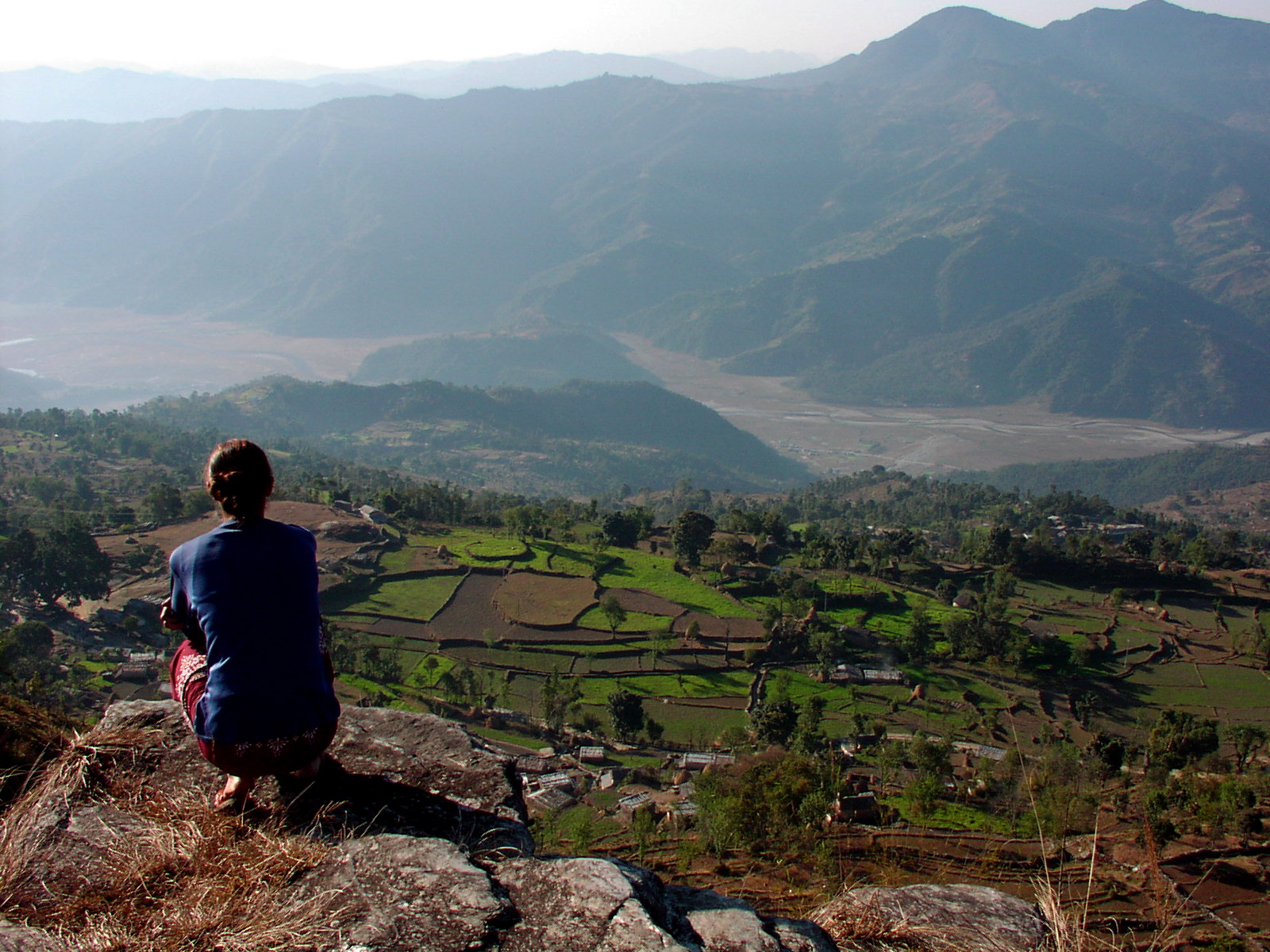
Lookout point (and clouds!)

Bua


For some time now, Govinda has been asking me to join him on a trip to Begnas to meet his in-laws. We began planning our visit a few days ago. Govinda’s father in law, who he calls Bua, will be alone for a few days while other members of the family are traveling, so it was a good time for us to arrange a visit to keep him company.

There was some thought that we would travel with Guru sir, who is searching for a match for his daughter. This has raised for me many questions about match-matching procedures. Does one stand in the road and stop the first reasonably marriageable looking male? Go from house to house soliciting bachelors? Distribute letters of inquiry? And why travel all the way to Begnas for this undertaking, twenty kilometers east of Kaskikot? 

I asked around a bit. My investigation was admittedly hindered by a very limited cache of Nepali words related to arranged marriage, but I deduced that Guru sir’s first visit to Begnas was for the purpose of meeting his relatives to discuss the search. So that solved the geographic question, though as far as I could tell, it simply meant Guru sir’s relatives would be standing in the road picking up single men. You can see why I was quite looking forward to whatever was going to happen during our visit to Begnas with Guru sir. But at the last minute it turned out that Guru sir’s rice harvest bonanza would be the same day we had planned our outing, and he would not be able to join us. So I’m afraid that at this time I can’t offer any resolution on the question of Guru sir’s daughter’s marriage arrangement. 

Early in the morning, Govinda and I set off for Begnas on our own. We arrived in Pokhara mid-morning and stopped in to see the artist who is helping us with our school mural, and I paid him. We discussed the idea of having him come to Sada Shiva to give a talk about his profession, as part of the series of visits I’m working on for the kids to learn about topics of interest like how libraries work and what pilots do and how photos are made.

At the bus depot in Prithvi Chowk, where dozens of buses paw sullenly at the pavement and pant in the diesel-filled hot air, we boarded another bus to Begnas. It set off laboriously down the highway, and I felt sleepy in the warm, acrid air inside the bus. Govinda bought some peanuts, and we ate them together in companionable silence, throwing the shells out the window, as storefronts sped by and blended together in a haze of mid-day life: pencils, apples, kilos of sugar, shoes, sticky cartons of fruit juice, pencils, sugar, apples, shoes. Finally the highway dead-ended in another small depot, where a dirt road wandered away from a collection of food stalls and small shops. It disappeared gently up into the hills. We followed it and began a long, rather hot walk to Bua’s house. 

The walk was pleasant, even though I still felt lethargic from the unyielding sun. Govinda’s uneven, methodical gait kept time, spurring us on at a steady and unchangeable pace. Begnas is warmer than Kaskikot, and we passed mango and banana and guava trees; it is currently orange season, and everywhere we could see ripening fruit that will soon find its way back to the roadside stalls and slung baskets and curbside mats heaped with fruit that we passed on the journey in. We stopped at a tea shop for peas and hard boiled eggs, and I drank a moderately cold coke out of a glass bottle, which left me feeling reinvigorated. We bought some hard candy and crackers to gift to the family. When we set off again, a hush had set over the terraces and orange trees, and the city felt far away. Finally, as we approached Bua’s house, I could see Begnas Lake to the west and Rupa Lake further east. Govinda removed his hat, and fanned himself briefly in the yard.

No sooner had we arrived than we were gathered around a plate of oranges with Bua. Govinda’s father in law was a slender, wiry man with a square jaw and lined, approachable face. He had a boyish way of moving that reminded me of my monkey-like fifth graders. Bua had work to do around the house, so even though Guru sir wasn’t there to answer my questions, Govinda and I sat outside talking about marriage practices until the sun dropped below the hills and it got cold.

We went back into the house where Bua was just starting to cook dinner. The next two hours were the longest rice-preparation process I’d ever watched on a hungry stomach. We did have an interlude of tea and biscuits, but I’ve become used to watching rice-cooking as a well-rehearsed, mindless affair, something that occurs very efficiently in the cramped spaces between other work. But Bua cooked very slowly: first one item, then the next, often pausing to talk as he cut vegetables or mashed spices. He was at once nimble, even lively, and unmistakably weary. It was as if he had to keep re-convincing himself that quelling his hunger was worth all the effort, and yet in the absence of dinner, I felt he would have been quite content to simply sit and gaze at the darkening hills with us.

Begnas

While Bua cooked, Govinda and I sat at a table, I with my journal resting under my hands. But I didn’t do much writing because Bua began to ask me a series of questions about America. 

“Nani,” he said, addressing me as one does a grandchild, “I hear they have very tall buildings in your country. Very very tall. Is that true?”

“Well, in some places they do.”

“And I hear there are those things that can take you up in the building,” he added, raising his hands.

“Yes,” I replied, “they’re called elevators.”

“Nani, in your country, how do people make money?”

“Nani, in your country, are clothes made to be durable for a long time?”

Between questions, Bua moved around the cooking fire cutting vegetables with his sickle. He seemed a little sad, but without a trace of bitterness, and there was an authenticity about Bua that put me at ease. I don’t think I’d ever met someone who could be genuine and restless at the same time like Bua was when he asked me about worlds I have seen. As the evening wore on, we developed an uncomplicated rapport, Bua taking an interest in this and that, and me content to feel like the kind of guest that he enjoyed: a participator with no agenda. It was a relief not to be waited on in awkward silence, and to have the opportunity for manageable dialogue that left space for the clumsy maneuvering of language-learning. 

As Bua picked up a korela vegetable and pulled his sickle down the middle of its alligator-like lumpy green skin, Govinda rose to go outside. I gazed quietly at Bua in the orange glow of the cooking fire, waiting for the next topic of discussion. 

“I’m going to die here,” he said matter of factly. He lifted his long hand and indicated the house. 

I didn’t have a good answer, because he’s probably right. So I just waited while he picked up my journal and gazed at its pages and pages of tiny writing.

“You will do your writing, see our country, and go back to America,” he sighed. The ink-filled pages suddenly seemed a pathetic sum of Bua’s entire world. “Me…” he waved again at the dim narrow walls, “I will die here.”

Then he shook his head, and picked up his sickle again.

“Nani,” he said amicably. “In your country, what are houses made from?”


*