I’ve been in Nepal for a week now, and just yesterday I attended a shotgun wedding in the middle of the night at Vindivasini Temple. The excitement started when I came home from the office and found Bhinaju with his knickers in a twist. He was trying frantically to charge his cell phone, and something about the connection wasn’t working right, and every two seconds the phone was ringing, but the battery was almost dead.
Bhinaju’s nephew Bishnu is scheduled to be married this month, as are many other betrothed, because according to an array of astrological indicators, this is an auspicious time of year for weddings. As per tradition, Bishnu’s marriage was recently arranged and the engagement confirmed by an exchange of tikka, the red dot you’ve seen Hindus wearing between their eyes. And once the tikka has been exchanged, there’s no going back. The deed must be done.
All this was already in the works when, yesterday afternoon, a pregnant relative of Bishnu’s went in to labor earlier than expected. Custom dictates that if the relative has the baby, the entire extended family is banned for eleven days from various ritual activities—including, inconveniently, weddings. And – stay with me here – eleven days from now, we will be past the astrologically auspicious marriage window, which won’t come around again for another year, which, since Bishnu and his bride have already exchanged tikka, would just be a violation of the entire system of everything.
And this now brings us to the heart of the matter, which is me holding Bhinaju’s phone charger in the socket to suck out all the electricity it can muster, and then all of us tripping on our shoes as we run out the door to hail a taxi at 9pm, buy some oranges and flowers, and rush to Vindivasini Temple for Bishnu’s wedding before some baby, somewhere, is born. It is now a matter of birth vs. marriage; we can’t take the risk of waiting till morning.
Vindivasini temple is usually crowded with people and priests and marriages and fruit, but at 9:30pm it is absolutely deserted, with nothing but two police officers and a cold breeze blowing over the laid stones. Aidan and Pascal think this is the perfect place for me to teach them some taekwondo, and we pass the time running in circles and doing flying side kicks in front of the frozen statues.
Just as we’re losing interest in this adventure, Bishnu, his bride, and an entourage of people in puffy coats show up with the priest. We all stand around shivering and trying to take iPhone pictures in the pitch dark (nobody had time to bring a real camera) as the priest rushes them through a series of rituals. I am struck as always by how abstract the bride and groom seem at these weddings, and this is even more apparent tonight: Bishnu and his bride are at the center of the marriage, but it is not about them at all.
Is it over? Is it over? Everyone is freezing. Bhinaju’s brother has a van. Everyone piles in to take the girl back to Bishnu’s house an hour away in Lumle, where the family will take turns “showing their faces” to the new wife. I almost never turn down a chance to be part of a face-showing ceremony in Nepal in the middle of the night, but this next phase is going to last till morning and I have nothing with me. I’m tired and I catch a ride back home.
The night I arrived in Kathmandu from the U.S., I recorded a midnight interview with an airlines agent. When the interview ended, Laxu and I asked for a record of bodies received at the airport, for two reasons: one, we need a better estimate of numbers, and two, I am looking for a family I can spend some time getting to know. The agent told us each airline keeps separate lists of bodies it receives, so if we wanted a combined list, we’d have to go to the customs office.
Two days later, Laxu and I returned to the airport to visit the customs office. A police officer outside told us we needed permission from customer information to enter the airport. Customer information sent us back to the police officer. We went back and forth until the officer took us inside, where four guards told us we could not talk to customs without permission from the government, and then said the list we were looking for was in the cargo office, not the customs office. We hailed a cab to the cargo office.
A security guard looked at my ID, told me not to record or take any photos, and opened the gate to the cargo office.
At last, Laxu and I entered a cavernous hangar filled with endless towering stacks of packages and containers. I was alarmed to find myself scanning the warehouse for casket-sized boxes, and willed myself to stop, but I couldn’t help it.
It seemed the search for The List, which had started so simply in the airlines office, would never end. Laxu and I wound our way from office to office in the cargo hangar, being bounced from one official to another. At last we entered a third-floor room at the end of of a long hall, lined with rows and rows of dusty files, harboring a single employee who looked like he did not often get visits.
Being in this room of papers felt oddly momentous. Somewhere in these weary stacks was a document that would turn this warehouse into a list of people who had lives, families, stories, names.
Nope. The single employee informed us that before he could give us any records, we would have to get permission from “The Chief.” He sent us down another hallway.
Outside The Chief’s office, Laxu and I sat in a gigantic waiting room that contained nothing but one desk, somewhat reminiscent of the Oval Office, and two women sitting on a low windowsill, starting absently out at the parking lot. An empty teacup sat on the windowsill. The women told us to wait, so we waited. And waited.
“If you’re able to get permission,” one of the women said during a random moment of waiting, “it will still take quite some time to get The List.” But why? I whispered to Laxu. We had just been in a room with nothing but lists and a person who seemed to have very little to do.
We entered The Chief’s office. Sitting before him like children summoned before the school principal, we asked permission to go back to the first room and get The List.
The Chief replied that the cargo office doesn’t keep a separate list of laborers. It records all bodies that arrive from overseas each day, on average three to four, he estimated, including people who die overseas for any variety of reasons. To get a list of laborers, he suggested we go to the insurance office. Wherever that was.
For a moment we simply sat there. It had been such an effort to arrive, this seemed like too short an answer.
I suddenly thought to ask if The Chief would mind telling us: what happens when bodies arrive in this cargo hangar?
“Everyone,” said The Chief, “is processed in ten to fifteen minutes. Maximum.” He repeated “maximum” a few times.
I asked if I could record our conversation, and The Chief said, absolutely not. However, he added, leaning back in to his chair, he had recently done an hour-long interview on an important radio program.
Could he tell us, then, who comes to retrieve people who have died abroad here at the cargo office? What clothes are the families wearing? What kind of transport do they use? And where do they go when they leave here? After all, there are no provisions for this situation—bodies are not meant to be in airports.
Some families, The Chief said, have a long way to go back to their villages to conduct rites, and they come in plain clothes with a hearse. But some do the rites here in Kathmandu at Pashupathi or Boudanath or Swayambhu, and they might arrive in a procession. I looked out the window at the same parking lot the women in the waiting room had been staring at and thought of it filled with a funeral procession. Oddly enough, weeks after this interview, it’s the view of the parking lot from the Chief’s office that still floats in unbidden into my thoughts.
“We don’t enforce a rigid protocol,” the Chief said, which, I’ve thought since, was a strange and pregnant detail.
I tried to press for more particulars. What has he noticed about which of the deceased are treated in what way?
“Look,” The Chief finally said, “there’s no difference to us. You want to know who is who or how many of a certain kind of people or something. There’s just a process. Big shots and laborers are all managed the same way.”
Ten to fifteen minutes. Maximum.
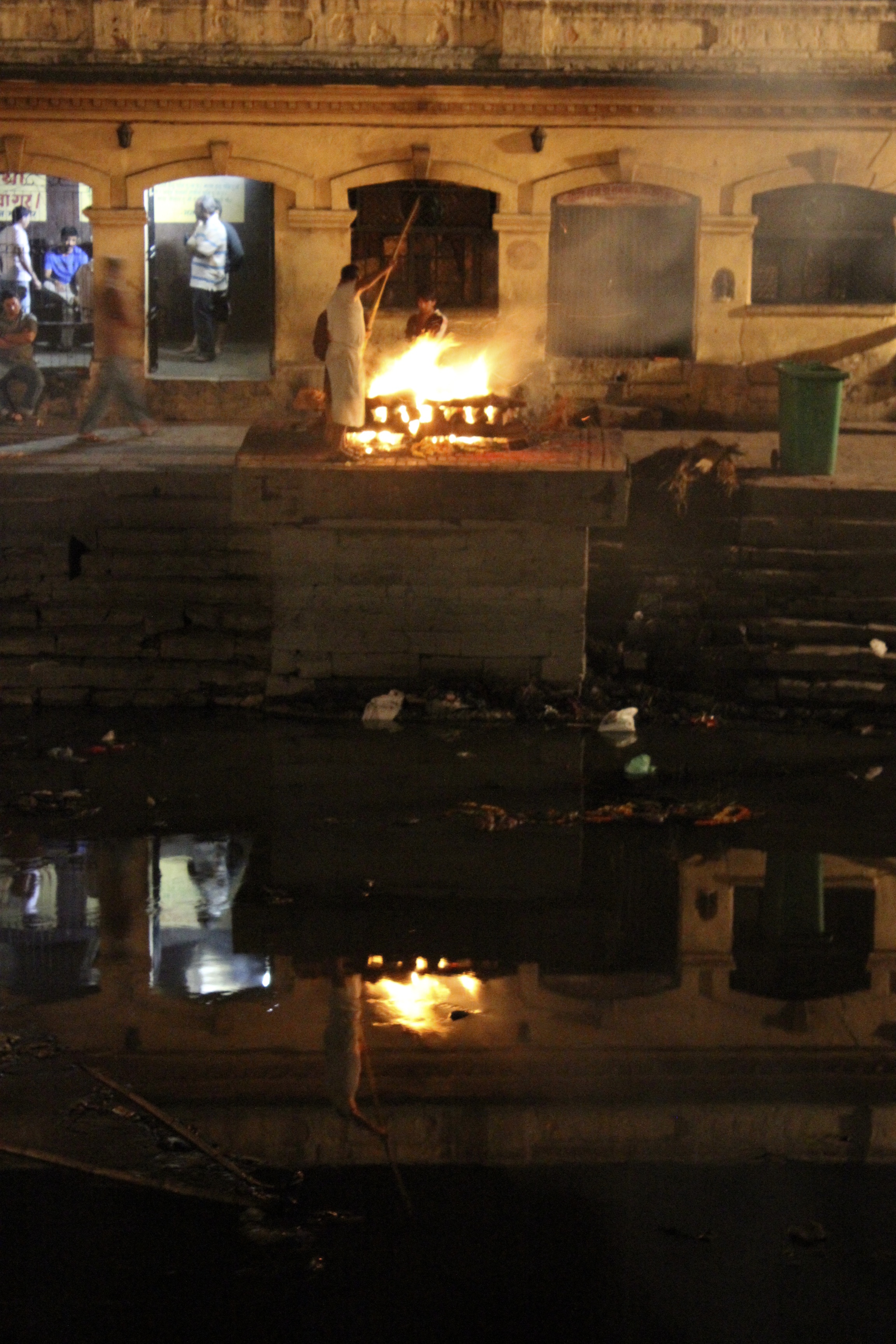
In the West we’re accustomed to the idea of bodies being transported around for and by people who know what to do with them. But what about the white curtain that covered Shaula dai? Or the night I sat at Pashupathi Nath and watched a son put fire in the sacred mouth of his parent? Or when our neighbor Maina bouju passed away in Kaskikot, and Bishnu and I went to her house and sat with her family as they kept vigil over her head and feet until morning, when her sons dressed her and lifted her on to a bamboo gurney balanced on their shoulders, and I was transfixed by how Maina bouju’s covered head was so close to her son’s face that they brushed against each other as he carried her all the way down from the ridge to the river in his white clothes. What about that?
“When there is nobody to accompany the body home,” The Chief said, “it comes through as cargo and arrives here. If there is a friend to fly along, it is treated as baggage.”
Over the years, I have witnessed many passages in Nepal. Marriages, coming of age ceremonies, births of animals and people, and deaths of many kinds. The weather itself has a careless drama about it,demanding reverence for the seasons and relentless passage of time…when it is hot, it’s time to plant millet; when there is a full moon, it’s time to fast; when a distant glacier becomes heavy, it’s time for it to break apart, time for the river it lands in to overflow in a torrent, time for an entire village to be swept away. When it is morning, it’s time to get up and cook breakfast.
The intimate relationship between people and cycles in this part of the world is one of its most moving qualities. I think it is a hard thing to see if you have always been inside it. But I am outside of it. And peering in, I am endlessly preoccupied with how a single human existence can be subtly accepted as a grand and meaningless expression of a larger constellation of forces and relations and nature, awesome because it is small, not because it is unique. I only notice this because I learned to see myself as separate from the moment I came in to the world. In the West we gain power, intelligence and purpose from our individuality. But it’s something I can’t explain to Aamaa. There simply isn’t a vocabulary to say that my life possesses a greater idea than the idea of the universe itself.
I know I’ll never be comfortable with this fact. Instead, I am perpetually drawn to these rites of passage, which integrate our small lives with those of our ancestors, with the cosmos, with God and with the future. Perhaps it’s like continually trickling cool water into a wound that will always burn.
This winter I’ve decided to start a project that has been some time in the making. Since I first began coming to Nepal in 2002, young men have flooded out of the country for migrant labor in gulf countries; last year, over 300,000 people left for that purpose alone. A surprisingly large number of these young men die abroad, and when they do, normal mourning rituals are turned completely upside-down. Many of the essential features of customary mourning become impossible. My project will document the way that families have adapted ritual grieving when their sons die overseas.
Nepal’s funerary customs in the weeks that immediately follow a death are called kriya. There is great intelligence and beauty in these rituals, which provide a structured role for the community and extended family in sharing grief, reaffirming ties, and placing the life and death of the deceased in to a coherent cosmic story. Many aspects of kriya are austere and demanding, putting physical and mental purification above comfort, and imposing isolation as a sanctuary for the emptiness that follows loss. When the kriya period ends, other rituals last weeks, years, and in some cases, forever. Aamaa, a widow since age 23, hasn’t worn red in 35 years. Anyone who meets her can immediately know without a word that she is widowed – if they are attuned to this custom.
Stories of grief and loss in other places have immense importance for us. Ritual grieving in American culture is increasingly short-lived and mainly the private domain of the bereaved. Death as a matter of politics or policy or violence is in our media every day. But mourning, the outward expressions by which we integrate death in to the un-ended lives of the living, seems to be on the periphery of our inquiry, at best. In some ways, mourning is treated as an obstacle to our collective concern with affirming and carrying out our individual significance.
But mourning is a choice we make to ascribe meaning to our grief. It is a willful sanctification of our mortality. We hope for the grace to extract from this some kind of redemption, something beautiful about life. Or perhaps simply the courage to keep living.
In the course of this series, I hope to honor the beauty of Nepal’s kriyatraditions, as well as a generation of young people caught in the ambiguous place between a world that has shattered and one that does not yet exist—at the threshold, in that empty uncertainty, where we are reinvented.
For some time now, Govinda has been asking me to join him on a trip to Begnas to meet his in-laws. We began planning our visit a few days ago. Govinda’s father in law, who he calls Bua, will be alone for a few days while other members of the family are traveling, so it was a good time for us to arrange a visit to keep him company.
There was some thought that we would travel with Guru sir, who is searching for a match for his daughter. This has raised for me many questions about match-matching procedures. Does one stand in the road and stop the first reasonably marriageable looking male? Go from house to house soliciting bachelors? Distribute letters of inquiry? And why travel all the way to Begnas for this undertaking, twenty kilometers east of Kaskikot?
I asked around a bit. My investigation was admittedly hindered by a very limited cache of Nepali words related to arranged marriage, but I deduced that Guru sir’s first visit to Begnas was for the purpose of meeting his relatives to discuss the search. So that solved the geographic question, though as far as I could tell, it simply meant Guru sir’s relatives would be standing in the road picking up single men. You can see why I was quite looking forward to whatever was going to happen during our visit to Begnas with Guru sir. But at the last minute it turned out that Guru sir’s rice harvest bonanza would be the same day we had planned our outing, and he would not be able to join us. So I’m afraid that at this time I can’t offer any resolution on the question of Guru sir’s daughter’s marriage arrangement.
Early in the morning, Govinda and I set off for Begnas on our own. We arrived in Pokhara mid-morning and stopped in to see the artist who is helping us with our school mural, and I paid him. We discussed the idea of having him come to Sada Shiva to give a talk about his profession, as part of the series of visits I’m working on for the kids to learn about topics of interest like how libraries work and what pilots do and how photos are made.
At the bus depot in Prithvi Chowk, where dozens of buses paw sullenly at the pavement and pant in the diesel-filled hot air, we boarded another bus to Begnas. It set off laboriously down the highway, and I felt sleepy in the warm, acrid air inside the bus. Govinda bought some peanuts, and we ate them together in companionable silence, throwing the shells out the window, as storefronts sped by and blended together in a haze of mid-day life: pencils, apples, kilos of sugar, shoes, sticky cartons of fruit juice, pencils, sugar, apples, shoes. Finally the highway dead-ended in another small depot, where a dirt road wandered away from a collection of food stalls and small shops. It disappeared gently up into the hills. We followed it and began a long, rather hot walk to Bua’s house.
The walk was pleasant, even though I still felt lethargic from the unyielding sun. Govinda’s uneven, methodical gait kept time, spurring us on at a steady and unchangeable pace. Begnas is warmer than Kaskikot, and we passed mango and banana and guava trees; it is currently orange season, and everywhere we could see ripening fruit that will soon find its way back to the roadside stalls and slung baskets and curbside mats heaped with fruit that we passed on the journey in. We stopped at a tea shop for peas and hard boiled eggs, and I drank a moderately cold coke out of a glass bottle, which left me feeling reinvigorated. We bought some hard candy and crackers to gift to the family. When we set off again, a hush had set over the terraces and orange trees, and the city felt far away. Finally, as we approached Bua’s house, I could see Begnas Lake to the west and Rupa Lake further east. Govinda removed his hat, and fanned himself briefly in the yard.
No sooner had we arrived than we were gathered around a plate of oranges with Bua. Govinda’s father in law was a slender, wiry man with a square jaw and lined, approachable face. He had a boyish way of moving that reminded me of my monkey-like fifth graders. Bua had work to do around the house, so even though Guru sir wasn’t there to answer my questions, Govinda and I sat outside talking about marriage practices until the sun dropped below the hills and it got cold.
We went back into the house where Bua was just starting to cook dinner. The next two hours were the longest rice-preparation process I’d ever watched on a hungry stomach. We did have an interlude of tea and biscuits, but I’ve become used to watching rice-cooking as a well-rehearsed, mindless affair, something that occurs very efficiently in the cramped spaces between other work. But Bua cooked very slowly: first one item, then the next, often pausing to talk as he cut vegetables or mashed spices. He was at once nimble, even lively, and unmistakably weary. It was as if he had to keep re-convincing himself that quelling his hunger was worth all the effort, and yet in the absence of dinner, I felt he would have been quite content to simply sit and gaze at the darkening hills with us.
While Bua cooked, Govinda and I sat at a table, I with my journal resting under my hands. But I didn’t do much writing because Bua began to ask me a series of questions about America.
“Nani,” he said, addressing me as one does a grandchild, “I hear they have very tall buildings in your country. Very very tall. Is that true?”
“Well, in some places they do.”
“And I hear there are those things that can take you up in the building,” he added, raising his hands.
“Yes,” I replied, “they’re called elevators.”
“Nani, in your country, how do people make money?”
“Nani, in your country, are clothes made to be durable for a long time?”
Between questions, Bua moved around the cooking fire cutting vegetables with his sickle. He seemed a little sad, but without a trace of bitterness, and there was an authenticity about Bua that put me at ease. I don’t think I’d ever met someone who could be genuine and restless at the same time like Bua was when he asked me about worlds I have seen. As the evening wore on, we developed an uncomplicated rapport, Bua taking an interest in this and that, and me content to feel like the kind of guest that he enjoyed: a participator with no agenda. It was a relief not to be waited on in awkward silence, and to have the opportunity for manageable dialogue that left space for the clumsy maneuvering of language-learning.
As Bua picked up a korela vegetable and pulled his sickle down the middle of its alligator-like lumpy green skin, Govinda rose to go outside. I gazed quietly at Bua in the orange glow of the cooking fire, waiting for the next topic of discussion.
“I’m going to die here,” he said matter of factly. He lifted his long hand and indicated the house.
I didn’t have a good answer, because he’s probably right. So I just waited while he picked up my journal and gazed at its pages and pages of tiny writing.
“You will do your writing, see our country, and go back to America,” he sighed. The ink-filled pages suddenly seemed a pathetic sum of Bua’s entire world. “Me…” he waved again at the dim narrow walls, “I will die here.”
Then he shook his head, and picked up his sickle again.
“Nani,” he said amicably. “In your country, what are houses made from?”
It’s Thanksgiving, and I had high hopes that the other teachers would participate in my holiday lesson. I arrived at school to find Govinda, Laximi, Guru sir, and Rita Madam already in the office, each at their usual stations. They seemed reasonably enthusiastic as I described Thanksgiving and my plans for class. Encouraged, I sorted out a few last vocabulary words and assigned various roles to everyone else. Even though my lesson wasn’t usually until recess, we decided to start Thanksgiving early because nobody was teaching their regular classes anyway and the kids were all running about.
I walked across the yard and burst into the classroom, declaring joyously that today is an American festival. Govinda and I wrote “Thanksgiving” in big letters in English and Nepali on the board, and below that, “I am grateful for____” in Nepali. Then I explained the purpose and practice of Thanksgiving: how we gather with family and friends and think about the things we are thankful for in our lives. I described a turkey, stuffing, and mashed potatoes. I briefly re-enacted the story of the Mayflower and Plymouth Rock, albeit in a simplistic way that swerved around colonization and focused instead on legendry itself. The usually chattery room of lit faces quieted and watched me closely, with that deliciously infuriating mix of doubt, amusement, and insatiable interest which has driven me to madness a million times over.
When I finished explaining Thanksgiving in America, I declared that today we would have Thanksgiving in Nepal. First, I asked, what should we eat?
I got a lot of blank stares.
Listen, it’s important that there’s a lot of eating, I insisted. It’s Thanksgiving.
“…Rice?” someone finally ventured.
“Rice!” I agreed enthusiastically. Govinda wrote it on the board. The answers began to pour in.
“Vegetables!”
“Dal!”
“Roti!”
“Excellent idea. But what kind of roti?” I asked.
They went for them all. “Fried roti! Rice roti! Millet roti!”
Soon the kids were shouting out every food they could think of too fast for Govinda to write them down. “Rice Pudding! Noodles! Curd!” The bare room clamoring with noise. For encouragement, I swayed in anticipation of our upcoming feast.
When the menu was complete, and I passed out notecards so everyone could write what they were thankful for. This took quite a while and, sadly, ended up being the least successful part of our Thanksgiving. They didn’t understand it. Maybe being thankful for certain things implies being less grateful for other ones, which upon reflection is something of an indulgence.
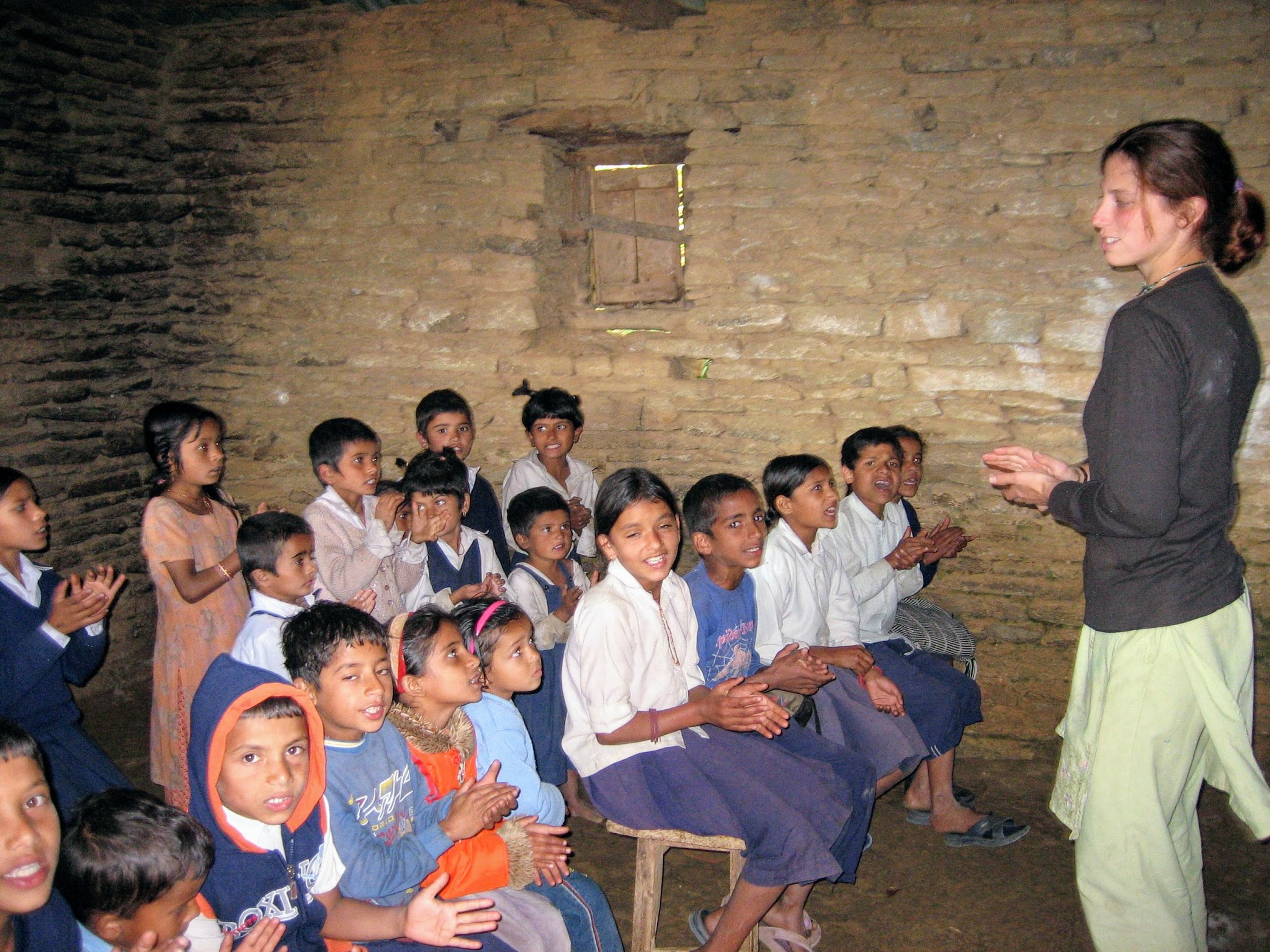
Finally all the kids stood up and we rearranged the benches into a makeshift table with everyone sitting along the sides. I was surprised at how satisfied I felt by the result. It looked less like class and more like Thanksgiving, all these small bodies crammed in around our long table. The stone walls became our castle and the dirt floor quieted down to observe with us.
Guru-Sir was in charge of the legend. I don’t know what it was because he told it in Nepali, but all the kids listened with rapt attention to some story about the history of Nepal and Kaskikot. Then we gave thanks—and while this was not, as I said, entirely satisfactory, most were thankful that Laura-Miss had come from America, so I forgave them for copying each other.
At last, it was time to eat.
Leaning forward from my seat on the bench, I reached for an invisible bowl in the center of our improvised table. I heaped a spoonful of air-rice on to my imaginary plate, piled a few kinds of roti next to it, and started eating. Everyone blinked at me.
“Aren’t you all going to eat?!” I said through a mouth full of fruit. “There’s a lot of food here.” I indicated our scribbled list on the blackboard.
There was a bit more silence while I stuffed myself hopefully.
“THIS IS AN ORANGE!” Krishna shouted. (Krishna is incapable of speaking to me without shouting.)
“Oh! Give me one!” I cried, cramming it into my face. Soon I had kids shoving food at me from every direction. I did my best to add each offering to my plate, but the treats were coming at me so fast that I began to slouch, holding my stomach. I took a bookbag and shoved it under my shirt, eliciting a satisfying explosion of laughter. Then I couldn’t convince them I was full. So I tried swaying, then sleeping, and then fainting, but I was still pressed to put some rice pudding in my pocket for later. I finally had to stand up and say firmly, “Thanksgiving is over! Go outside and play.”

 Over the years, I have witnessed many passages in Nepal. Marriages,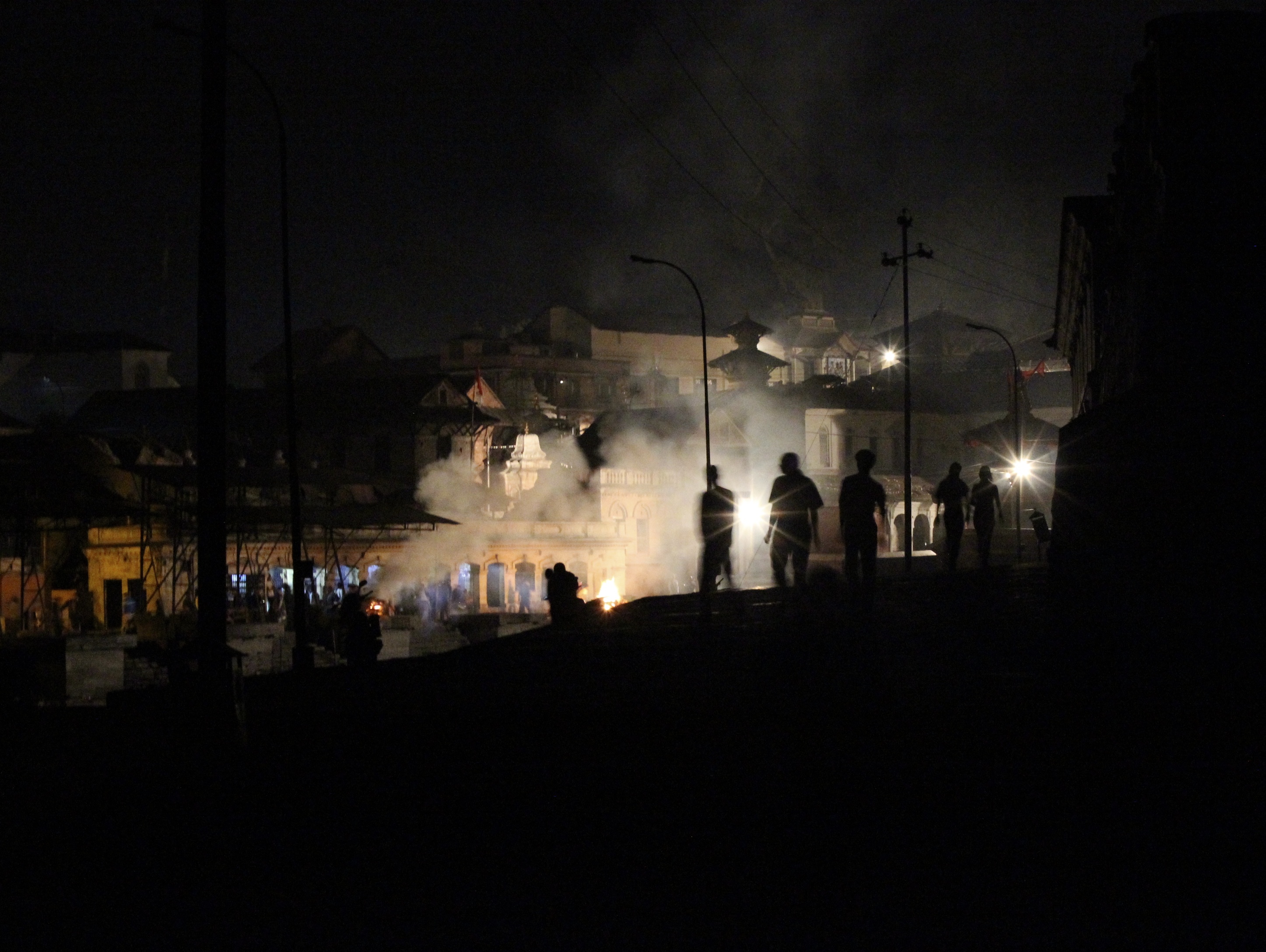

 All The Pieces