Our Future After the Earthquake

IMG_3282 - Version 2


Dear friends and family,
First, thank you with all my heart for the flood of emails, texts, calls, posts, and chats that have blown up my phone and computer in the last 72 hours.  It’s true that the darkest moments show us the brightest things – the world has never felt smaller to me than it did this weekend, chatting with people I love in Nepal with one hand while answering emails about them with the other.  Everybody is okay, and I was/am in Connecticut for six weeks.  Everybody’s been sleeping outdoors for fear of aftershocks, one of our students lost his house, and there is some damage in our working areas–but we were mostly spared because the earthquake moved east.  Had it moved west, Pokhara and Kaskikot would be rubble, as we were just 50 miles from the epicenter.
Tons of people have asked how they can help.  After days of looking into this, it’s clear there are a million conflicting answers amid widespread caution; disasters of this nature cause huge sums of money to be suddenly poured in to a poor country with corrupt public systems and an overzealous, wealthy international aid machine. Terrible precedents in Haiti and other places, strong opinions that the punditry is already debating on the news….
We have to start someplace, so here’s the advice I’ve settled on.  There are two types of donating: a large relief agency, and something more closely related to your area of interest or personal connection to a place or organization. These roughly correlate to massive crisis relief vs. community recovery, as well.
1. MASSIVE AID: If you are most comfortable giving to a large, well-recognized agency, there are recommendations in the links below. The up side is these organizations play an essential role in crisis relief, and their financial pluses and minuses are known.  The down side is that they get saturated with more donations than they can spend on the specific crisis in question, and these agencies are not good mechanisms for long-term recovery.  That said, Nepal couldn’t possibly deal with the immediate disaster on its hands without their involvement, and the same will be true of the next disaster, if that’s where your dollar technically lands.  I’d also suggest the Nepal Red Cross Society as these funds will at least stay in Nepal (http://www.nrcs.org – this link doesn’t work in Safari, that’s Nepal for you), or Doctors Without Borders (http://bit.ly/1pf6vN4) in the hope they’ll be quicker to get out to neglected rural areas.
Top recommended by PRI: http://bit.ly/1GjrqTm
2. COMMUNITY-BASED RECOVERY: It is going to take many years to rebuild, and smaller, local organizations with experience in grassroots organizing and sustainable community work will play an essential role because of their nuanced knowledge, experience, and granular infrastructure. The challenge here – and I will be the bad guy who says this now – is that nobody knows exactly what will be required of them yet. I’ve been in contact with many of my friends who have long standing connections and expertise in Nepal, and we’re all grappling with the same problem, trying to figure out where we can best apply our efforts.  But the truth is that everything is unknown.  It has only been three days and people are currently sleeping in the rain with dwindling food supplies.
Here is a short, poignant article that talks about how hard-to-reach areas have already been widely neglected by both aid and the media – because, well, they are harder to reach – but how badly they will be needed to avoid another Haiti fiasco. I wish this could be on the cover of every major newspaper.
Therefore after much deliberation, I’ve decided the best thing I can do is create a relief fund that will be used intelligently as things clarify. I will be arriving in Nepal in 2 weeks, and working with others to find something unreachable by “big aid” that needs doing and figure out who is the best person or agency to do it. I may donate this whole fund to a nimble community organization or individual doing critical work, or we may set up something ourselves. There may be a water source that needs repairing for a whole village, or a single family or child whose life has been forever altered where we can intervene with a surgery or other aid – I just don’t know yet.  But Pokhara is fifty miles from Gorkha, which looks like this:
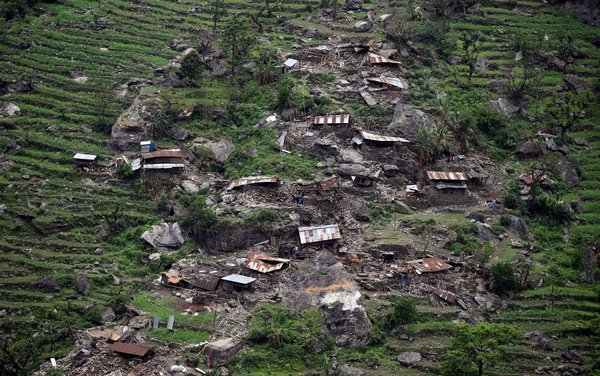
Courtesy of the New York Times

Courtesy of the New York Times

As my friend Prashant said, “Laura, I can’t see with my fingers or eat with my knees.  We each have to do the thing we’re suited for.”  So in that vein, please don’t take this as pressure to contribute to Eva Nepal’s recovery fund specifically – the point is to choose something and pitch in.  Since I find myself among a tiny minority of Americans with a long-standing personal connection to this country and its people, that’s what I’m going to start with.  I simply know my area and its ecosystem better than I know other things about this colossal situation.
Here is the link. Please write RELIEF in the indicated space:
https://evanepal.secure.nonprofitsoapbox.com/earthquake-donateObviously, I would be extremely grateful if you would share this with people asking you where to donate.
If something else calls you, go for it.  The only real DONT’s are:
  • send stuff (google “send money not stuff”)
  • go running to Nepal (unless you have an expertise to offer – but I don’t think most of you were considering it?)
  • do nothing. The scale of devastation in Nepal is staggering. When I think about being in New Orleans eight months after Hurricane Katrina and the inside-out buildings that were still piled up on the streets, I can’t even fathom how Nepal with its underlying poverty and challenging terrain is going to rebuild without a lot of help.  Please pick something and pitch in.
I will leave you with a thought from the article I linked above, that helped me put the storm of the last few days in to perspective as they relate to me, one person with a tiny mud and stone home in Nepal that I love dearly.
Far away from Mt. Everest’s glamorous peak…villagers are reeling from injuries, death and the destruction of already precarious livelihoods on a massive scale. One villager told us that although his family and many others were unharmed, his home of mud and stone, like the entire village, was a pile of rubble. For many of the rural poor, a two-story home is a most prized asset. While their plight may not make the international headlines, rural Nepalis across the country will need long-term support to rebuild their lives. 
With much love and gratitude for all of your inquiries and prayers,
Laura and all of us.
Base Camp

Bua


For some time now, Govinda has been asking me to join him on a trip to Begnas to meet his in-laws. We began planning our visit a few days ago. Govinda’s father in law, who he calls Bua, will be alone for a few days while other members of the family are traveling, so it was a good time for us to arrange a visit to keep him company.

There was some thought that we would travel with Guru sir, who is searching for a match for his daughter. This has raised for me many questions about match-matching procedures. Does one stand in the road and stop the first reasonably marriageable looking male? Go from house to house soliciting bachelors? Distribute letters of inquiry? And why travel all the way to Begnas for this undertaking, twenty kilometers east of Kaskikot? 

I asked around a bit. My investigation was admittedly hindered by a very limited cache of Nepali words related to arranged marriage, but I deduced that Guru sir’s first visit to Begnas was for the purpose of meeting his relatives to discuss the search. So that solved the geographic question, though as far as I could tell, it simply meant Guru sir’s relatives would be standing in the road picking up single men. You can see why I was quite looking forward to whatever was going to happen during our visit to Begnas with Guru sir. But at the last minute it turned out that Guru sir’s rice harvest bonanza would be the same day we had planned our outing, and he would not be able to join us. So I’m afraid that at this time I can’t offer any resolution on the question of Guru sir’s daughter’s marriage arrangement. 

Early in the morning, Govinda and I set off for Begnas on our own. We arrived in Pokhara mid-morning and stopped in to see the artist who is helping us with our school mural, and I paid him. We discussed the idea of having him come to Sada Shiva to give a talk about his profession, as part of the series of visits I’m working on for the kids to learn about topics of interest like how libraries work and what pilots do and how photos are made.

At the bus depot in Prithvi Chowk, where dozens of buses paw sullenly at the pavement and pant in the diesel-filled hot air, we boarded another bus to Begnas. It set off laboriously down the highway, and I felt sleepy in the warm, acrid air inside the bus. Govinda bought some peanuts, and we ate them together in companionable silence, throwing the shells out the window, as storefronts sped by and blended together in a haze of mid-day life: pencils, apples, kilos of sugar, shoes, sticky cartons of fruit juice, pencils, sugar, apples, shoes. Finally the highway dead-ended in another small depot, where a dirt road wandered away from a collection of food stalls and small shops. It disappeared gently up into the hills. We followed it and began a long, rather hot walk to Bua’s house. 

The walk was pleasant, even though I still felt lethargic from the unyielding sun. Govinda’s uneven, methodical gait kept time, spurring us on at a steady and unchangeable pace. Begnas is warmer than Kaskikot, and we passed mango and banana and guava trees; it is currently orange season, and everywhere we could see ripening fruit that will soon find its way back to the roadside stalls and slung baskets and curbside mats heaped with fruit that we passed on the journey in. We stopped at a tea shop for peas and hard boiled eggs, and I drank a moderately cold coke out of a glass bottle, which left me feeling reinvigorated. We bought some hard candy and crackers to gift to the family. When we set off again, a hush had set over the terraces and orange trees, and the city felt far away. Finally, as we approached Bua’s house, I could see Begnas Lake to the west and Rupa Lake further east. Govinda removed his hat, and fanned himself briefly in the yard.

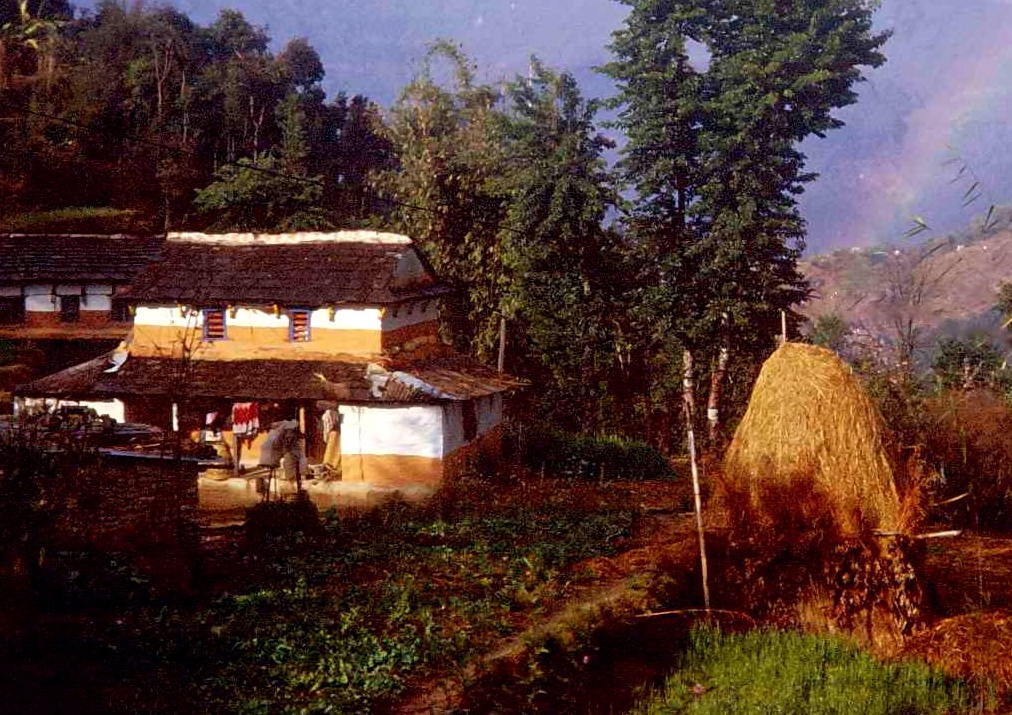
No sooner had we arrived than we were gathered around a plate of oranges with Bua. Govinda’s father in law was a slender, wiry man with a square jaw and lined, approachable face. He had a boyish way of moving that reminded me of my monkey-like fifth graders. Bua had work to do around the house, so even though Guru sir wasn’t there to answer my questions, Govinda and I sat outside talking about marriage practices until the sun dropped below the hills and it got cold.

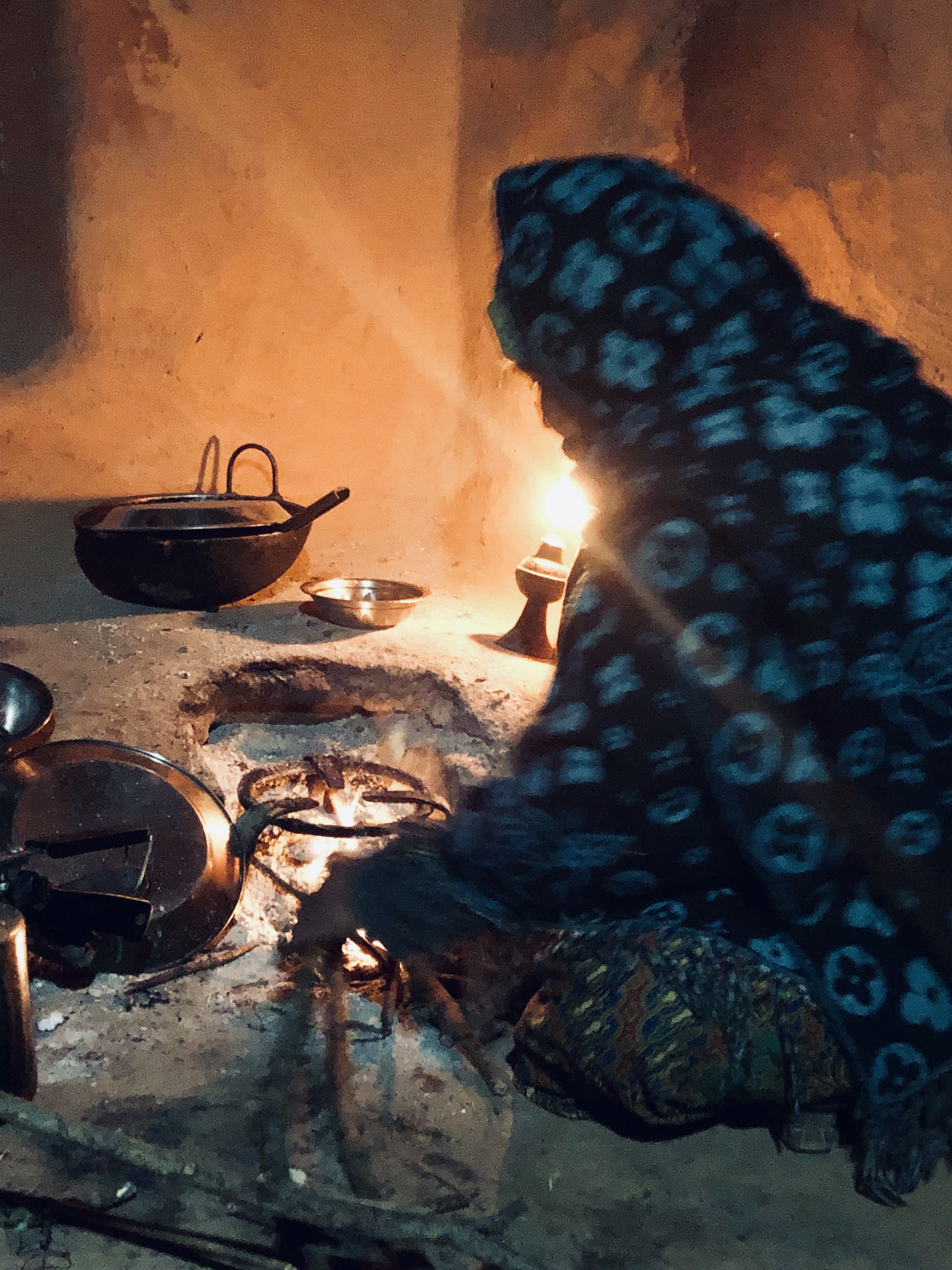
We went back into the house where Bua was just starting to cook dinner. The next two hours were the longest rice-preparation process I’d ever watched on a hungry stomach. We did have an interlude of tea and biscuits, but I’ve become used to watching rice-cooking as a well-rehearsed, mindless affair, something that occurs very efficiently in the cramped spaces between other work. But Bua cooked very slowly: first one item, then the next, often pausing to talk as he cut vegetables or mashed spices. He was at once nimble, even lively, and unmistakably weary. It was as if he had to keep re-convincing himself that quelling his hunger was worth all the effort, and yet in the absence of dinner, I felt he would have been quite content to simply sit and gaze at the darkening hills with us.

Begnas

While Bua cooked, Govinda and I sat at a table, I with my journal resting under my hands. But I didn’t do much writing because Bua began to ask me a series of questions about America. 

“Nani,” he said, addressing me as one does a grandchild, “I hear they have very tall buildings in your country. Very very tall. Is that true?”

“Well, in some places they do.”

“And I hear there are those things that can take you up in the building,” he added, raising his hands.

“Yes,” I replied, “they’re called elevators.”

“Nani, in your country, how do people make money?”

“Nani, in your country, are clothes made to be durable for a long time?”

Between questions, Bua moved around the cooking fire cutting vegetables with his sickle. He seemed a little sad, but without a trace of bitterness, and there was an authenticity about Bua that put me at ease. I don’t think I’d ever met someone who could be genuine and restless at the same time like Bua was when he asked me about worlds I have seen. As the evening wore on, we developed an uncomplicated rapport, Bua taking an interest in this and that, and me content to feel like the kind of guest that he enjoyed: a participator with no agenda. It was a relief not to be waited on in awkward silence, and to have the opportunity for manageable dialogue that left space for the clumsy maneuvering of language-learning. 

As Bua picked up a korela vegetable and pulled his sickle down the middle of its alligator-like lumpy green skin, Govinda rose to go outside. I gazed quietly at Bua in the orange glow of the cooking fire, waiting for the next topic of discussion. 

“I’m going to die here,” he said matter of factly. He lifted his long hand and indicated the house. 

I didn’t have a good answer, because he’s probably right. So I just waited while he picked up my journal and gazed at its pages and pages of tiny writing.

“You will do your writing, see our country, and go back to America,” he sighed. The ink-filled pages suddenly seemed a pathetic sum of Bua’s entire world. “Me…” he waved again at the dim narrow walls, “I will die here.”

Then he shook his head, and picked up his sickle again.

“Nani,” he said amicably. “In your country, what are houses made from?”


*


Learning by Cucumber


It had been a long day for both of us: me at school, Aamaa cutting grass for the buffalo all afternoon in the heat. We convened in the kitchen as the sun was going down. Both of us were too tired to bother with rice, so Aamaa began putting wheat rotis in a pan for us to eat for dinner with some iskus left over from this morning. Iskus is my favorite vegetable, a slightly sweet gourd that’s plentiful at the end of summer. I was just about to bite in to a little scoop of it I had carefully placed on a nice hot roti, when shouting began outside.

So listen, my language skills are pretty good for someone who’s lived in Nepal for a total of a few months, but at the end of the day, I can no more decode haphazard shouting outside the door than I can follow a parliamentary debate. And since I can’t understand the words, it took me longer to notice the sound at all…and to be honest, I was really focused on my roti and my little pile of vegetables. So Aamaa was the first to jump up and run outside, leaving me in a momentary cognitive stall-out after a wearying day of trying to think in another language.

What about my roti? I thought, looking longingly at the little pile of carefully placed iskus. And then I snapped alive to the world outside, where my attention fully redirected to the ruckus coming through the door. Not wanting to miss any action, I put my down roti untouched, leapt up, and followed Aamaa outside.

It was dark and Aamaa had already taken off with the light. Our mountain alcove was thick with nighttime, but shouting was coming from all around, and leaping from squares of yellow light and vaulting off the terraces and bouncing maniacally about in the huge darkness.

I scrambled half-blind over the path from our house to the edge of the terrace, which drops off to the next field below. There, Aamaa stood at attention on the terrace edge, listening to the tempest of voices. Without warning, she let go an unbridled screech and submitted her own opinion to the fray.

There were no further clues as to what anyone was yelling about. I wanted to ask, but I was afraid to interrupt the flow.

Abruptly, Aamaa took off again. Now to the left, and down over the terrace, past where the buffalo stay in the winter; a patch of field that now, in late summer, is a wet leafy carpet. The Ritz Carleton for leeches. Determined to be a full participant, I ran after her, jumping over the terrace ledge, and plunging heedlessly through the soft plants to where she was standing with a flashlight, now yelling again. Two small girls had appeared out of literally nowhere; and logically, given the leech situation, they stayed perched on the ledge over my head.

“WHAT HAPPENED?” I asked Aamaa breathlessly, my feet absorbing moisture from the buzzing ground. I was rewarded with more incomprehensible shouting coming from everywhere.

Finally, without averting her gaze from the inscrutable darkness, Aamaa said something about a cucumber, which I couldn’t quite catch, except for “cucumber.” And then she was promptly too distracted to tell me any more.

I thought about the leeches. Fine. I returned to the base of the ledge, resolved to climb back up. While doing so, my sandal fell off. The two mystery girls wanted to to help me up, but on principle I fixed my sandal and got myself up the ledge. Still utterly baffled, I returned to our house with the two girls, and a minute later, Aamaa followed. The yelling wafted along behind us, still unattached to any source or story.

The girls had brought us what I now know was belaunti, a cheese-like, crumbly, slightly sweet milk product that comes from a buffalo that has just calved. It is packed with both nutrition and luck; birth, after all, is a dangerous and miraculous thing, and belaunti is treated with the respect any auspicious gift of the universe is due. But in that moment, all I knew was that we’d gone from the inexplicable cucumber crisis outside to an equally illogical and randomly-timed cottage cheese situation inside, which unfolded as follows: Aamaa put a bit on her forehead and then started eating it. Then she asked if I wanted some, so I said yes, and I was about to eat it when she told me to put some on my head first.

Alas, I’d started out tired, and my mental state was only becoming more fragile as the number of things that made no sense accumulated.

Just as I was trying to work out why the two mysterious girls had brought over cottage cheese while people were shouting about the cucumber, and why we had interrupted that serious event to put the cheese on our foreheads, Aamaa offered the girls some roti. I’d nearly forgotten about my once-important roti. And I forgot again, because in the half second it took the girls to refuse the roti, Aamaa had gone back outside to shout about the cucumber.

Not to be outwitted, I dashed back in to our yard, where now I found our neighbor Saano Didi and her three boys. They were standing as if squinting with their bodies, leaning slightly forward in to the darkness, watching the invisible shouting. I pleaded with Saano Didi to explain what in God’s name was going on. I just wanted to be in on the cucumber issue. I just wanted to play with everyone.

What followed was an extended five-way exchange that involved a fantastic amount of explaining and re-explaining, handwaving, pointing, and acting, in which I tried to piece together the story of the cucumber emergency based on comprehension of only one out of every fifteen words. At first I believed that somehow a cucumber plant had fallen over–I was not focused right then on the fact that our cucumber plant is most decidedly a vine–and I became very worried that somebody had been injured by a falling cucumber tree. But Saano Didi and her boys kept mentioning boys and girls; apparently the cucumber tree had fallen when too many boys and girls were climbing it, and a mystery man appeared–wait, no, the cucumbers were stolen! The tree fell over and the boys and girls were stealing all the cucumbers from it! Oh–no–a man came and stole all the cucumbers–but not from a tree, he went around to people’s homes and asked for cucumbers, and didn’t tell anyone else that he was exploiting cucumber generosity from them all–no, he didn’t ask, the man was just stealing cucumbers from each person’s house! And then he was CAUGHT! Ah, this was beginning to make sense–but wait, how did the man go running from house to house with a growing collection of cucumbers? Hold on, he was eating them as he collected them.

Yes, this surely explained the excitement! A man had been caught–well, seen, but escaped–while sneaking from house to house eating cucumbers. And now he had got away, despite the dazzling mountain-sized net of female screeching through which nobody could possibly run freely and un-apprehended, even without an untold number of cucumbers to carry.

Saano Didi invited me over to her house. Aamaa was clearly indisposed with the cucumber crime, so I wasn’t to get any further intel any time soon, and I’d forgotten about my roti, so I went and sat by the fire in Saano Didi’s house and drank some hot buffalo milk. Then she produced a cucumber.

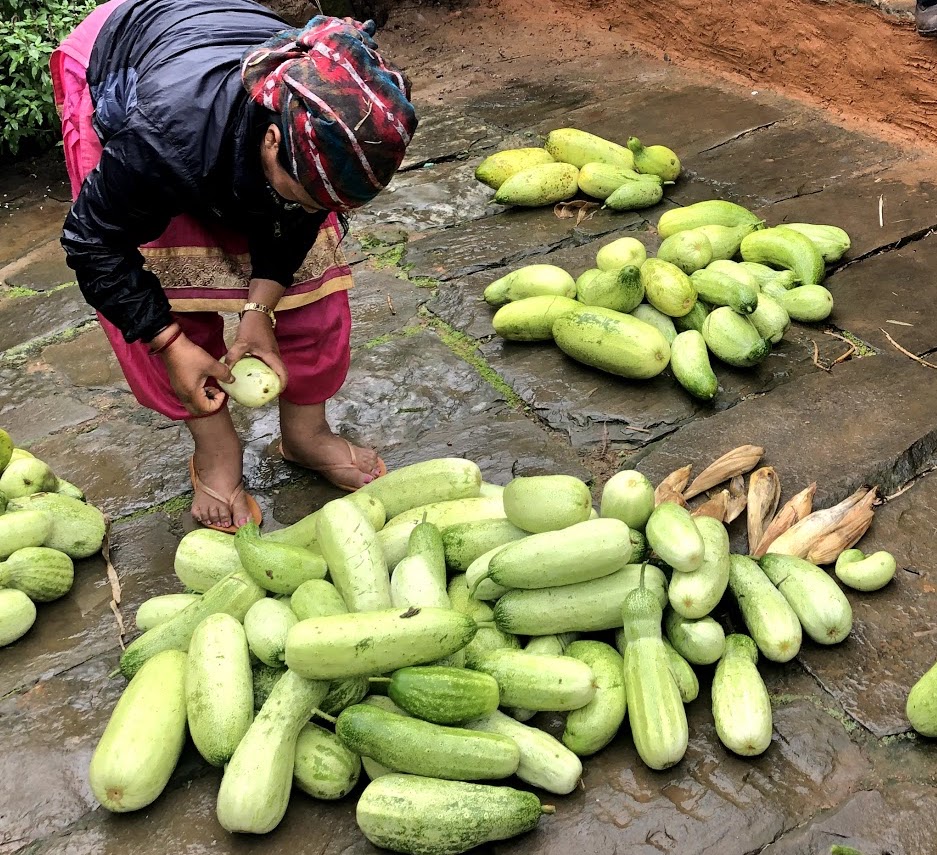
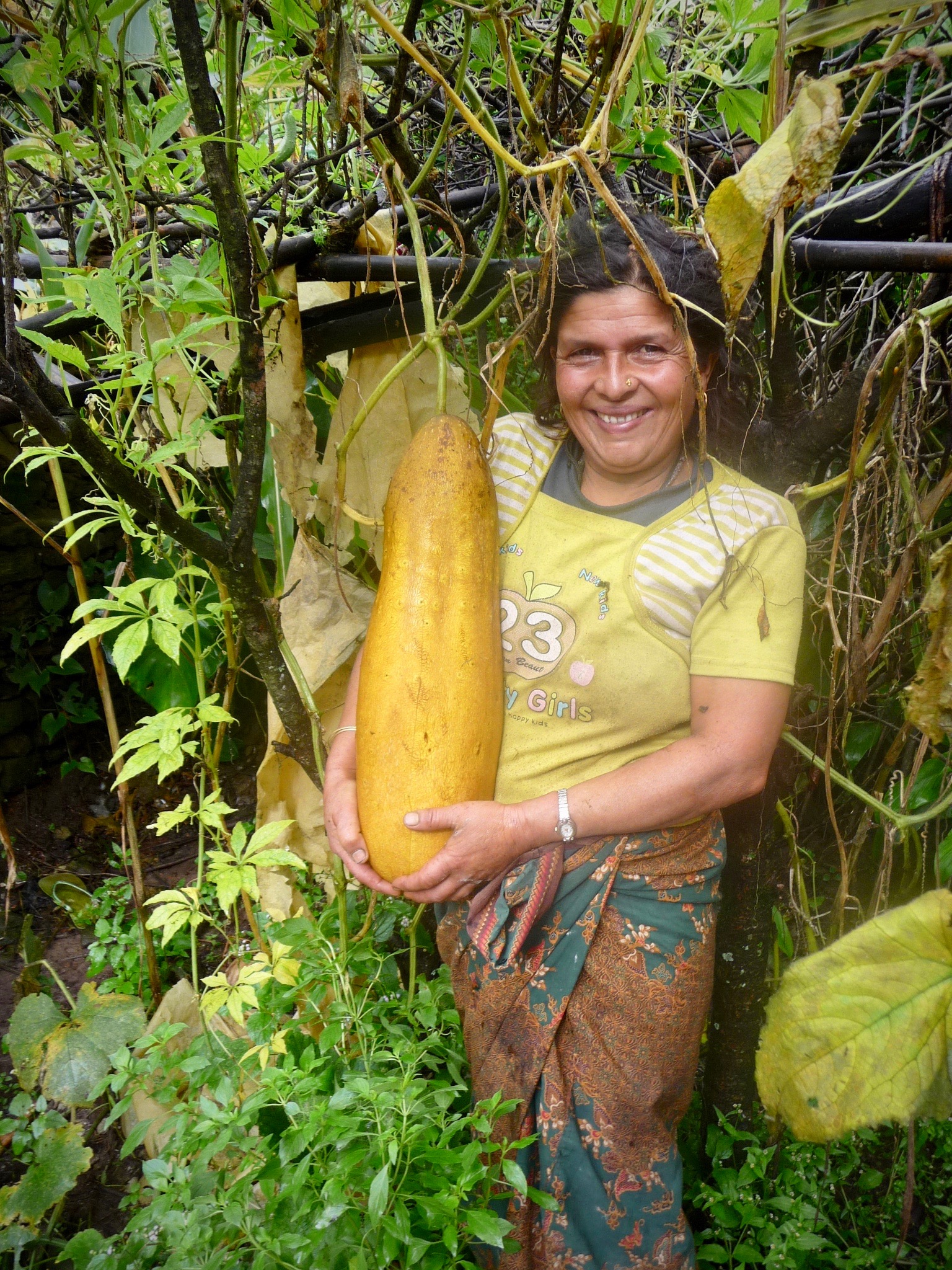
Which turned out to be the most enormous vegetable I’d ever laid eyes on. It could easily have crushed a cricket bat. It was of a stature that unequivocally qualified its seeds to be harvested for next year’s cucumber crop. This new evidence threw the cucumber fraud situation in to chaos all over again. It was hopeless. I would never solve it. Saano Didi cut the Gozillacumber in to massive, dripping hunks of flesh, and we sat slurping, crunching and dripping in cucumber juice, while somewhere unknown, some cucumber lover was apparently reclined in the dark recesses of his home, totally immobile.

*

Aamaa with a Godzillacumber