Water

Around the house, I am like a wind-up toy.  Maybe there’s a job for me over there!  Bzzzt.  Job?  Nope.  Bzzt.  Job?  Oh well, ok.  Job!  I see a job!!  Bzzt.  I have bumped in to the wall—bad naviagation—bzzt—rotate—sigh…bzzt??

Everyone is always doing interesting things.  Cooking, sifting, feeding, chopping, churning.   I can do stuff.  I’m a fast learner.  I’m enthusiastic.  If someone would just explain how to use this circular basket-pan-thing, for instance, I could be useful.

Luckily, it is becoming clear that, other deficiencies not withstanding, I make a perfectly adequate mule.  In fact, as a mule I am more than adequate—I am talented.  Carrying loads is mostly a matter of putting one foot in front of the other.  So even though Aamaa is nervous about my wrecking most of the other household tasks (I don’t know why), every load that I carry is one that someone else doesn’t have to haul from one place to another.  So, I am granted some latitude to do it inelegantly.  Thank you.

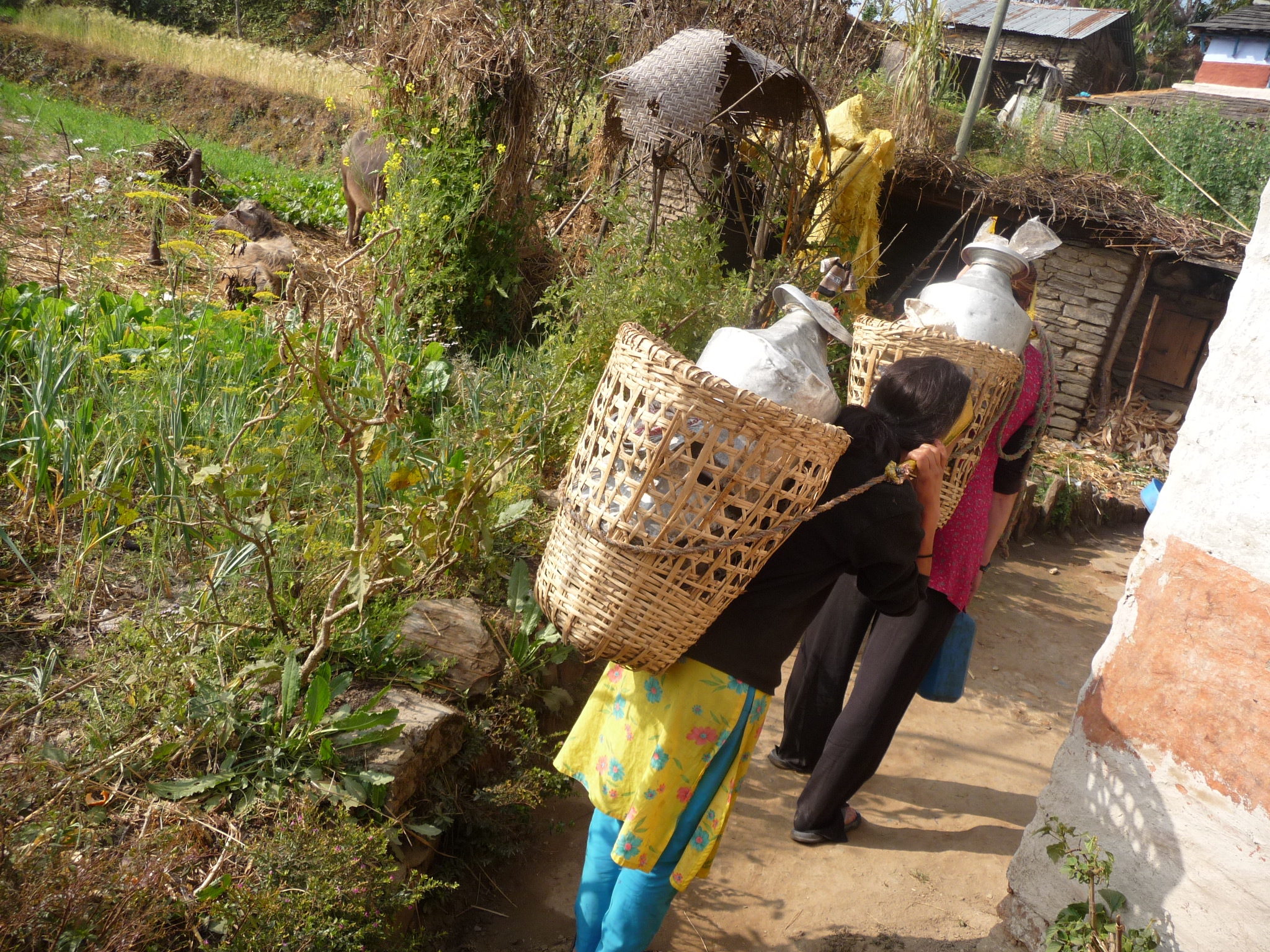
It appears that I have found my calling in water.  Everything else involves mysterious kinds of dexterity, or intuition, or magical powers.  But fetching water simply means taking an empty jug to the tap, filling it, and IMG_2362carrying it home in a basket.  And you can never have too much water.
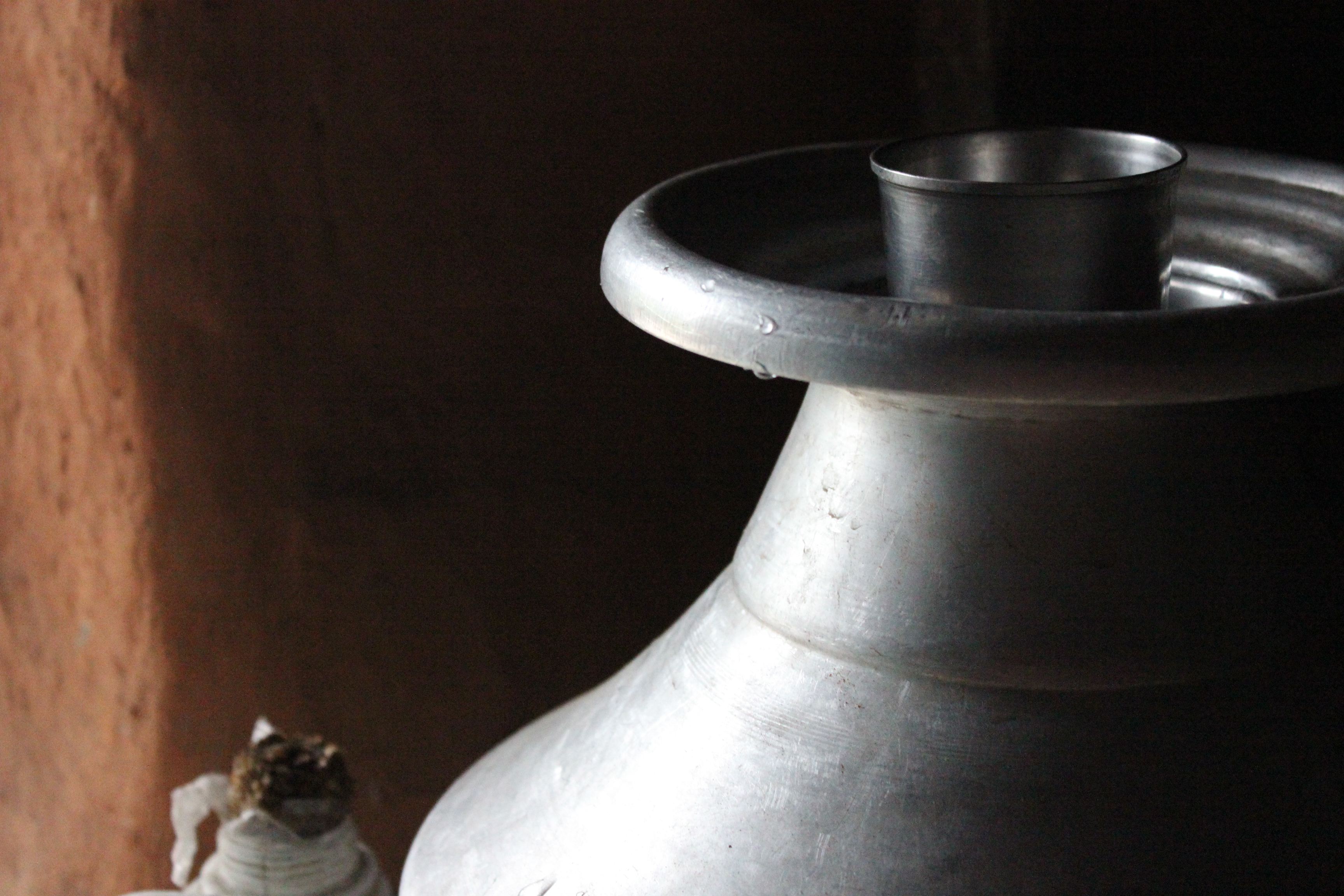
And that, my friends, is how I have come to watch the water jugs like an underworked waiter monitoring the wine glasses at her only table for the evening.  My awareness gets magnetized to these tin vessels, God forbid they languish for a single moment with any spare real estate inside.  An entire section of my mind is devoted to calculating when and how water could be combined in various receptacles to leave the main jugs empty and in need of filling.  It isn’t exactly that I enjoy getting water, but that I passionately want this job to depend on my contribution.

Each evening when I return from school around 4:45, the four of us sit on the porch drinking tea and eating popcorn.  And I absolutely cannot relax as long as an inch of space remains available inside those tin jugs in the yard.

The routine is as follows.  First, I say, “I’m going to get water,” and leap off the porch.

Then Bishnu says, “Sit down, Laura.  I’ll get water.”   Then I insist.  Then Didi or Aamaa says, “Just take one jug.”  But I have no idea what the logic of taking just one jug is.  As long as I’m going, why wouldn’t I take two?  And get more water.

And then Aamaa always tries, “Tomorrow, do it tomorrow.”  What in the world is that supposed to mean?  First of all, I know that we need water before tomorrow.  I know because there is space in the big jug, and if there wasn’t space, I could create space by pouring water out of the big jug and into a smaller jug, and I could do that now, before tomorrow.
P1000858

I’m not easily fooled.

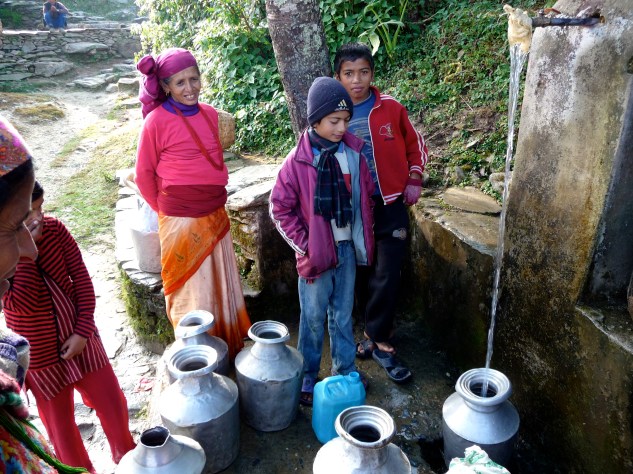
So invariably, I get water.  And the water tap is one of my most pitiless houses of education.  This is mainly due to a strict Canon of Maneuvering that determines the order of access to the waterspout; moreover, everyone fends for themselves, and negotiations occur manually, not vocally.

Let me explain.  It’s like chess.  Upon arrival at the tap, you set down your basket and rope and jugs strategically: close to the spout, but not too close.  You can’t be cocky about it.  At the same time, you will take stock of your place in line.  However, there is no linear line, just a theoretical, jointly acknowledged line–it’s a virtual line where everyone knows who arrived when.  Nevertheless, you absolutely must monitor exactly where your place is, because you hold your spot in the virtual line by moving in as your turn approaches—protectively, but not too protectively—and the instant the person in front of you whisks their jug from under the relentless stream of water, you have to be ready to replace it with yours.

If you’re too slow, a few things can happen.

1. An aggressor might swoop in.  Depending on the age and status and ferocity of the aggressor, it might be over before you know it, and if the aggressor has three jugs to fill, approximately nine minutes of your life are therein committed to waiting.  Loners are especially vulnerable; I don’t stand a chance.

2. On the other hand, an ally might come to your aid.  This is more likely to happen if the aggressor is young and overly ambitious, or, less often, if the ally is old and forceful.  But old and forceful ladies don’t usually waste their time being allies, so most commonly the ally is a young girl like Laximi, who does housework for Bhim.  Laximi and I are a great team.  She stands up on the ledge behind the spout, and when someone tries to mess with the virtual line, Laximi grabs my water jug and hooks it immediately under faucet, holding it there until the aggressor removes the offending vessel below it.  Then, when my jug gets full, I hand Laximi hers, and she hooks it just as mine fills, securing access before there’s an opening for challenge.  Then we leave together while the old ladies yell after us.

But ultimately, skilled water-getters stay totally disinterested in the entire affair.  Only the old, ferocious aggressors—tired out ladies who have every right to be weary with life and too busy for the nonsense of waiting—have the chutzpah to ignore the virtual line and the Canon of Maneuvering and just butt right off the bat.  Most of the time, a challenge involves placing your water jug too close too fast.  That’s how the arguing and shouting starts, and it’s really like a hundred times more fun than being an intern in some crappy office somewhere in New York.

I bring the basket of water home and sit back down.  Is there anything else to do?  Are you sure?  Definitely not?

Bzzt.  Maybe we need more water.

Rules of the Water Tap - 2010

Rules of the Water Tap – 2010

Night Watch

Bishnu and I were in the kitchen finishing dinner, one day after I’d moved in, when Bhim stuck his head through the door.

“Laura?” he inquired.  He asked me how I was doing.

Bhim seemed to have another world around him.  We’d been here as visitors less than two days earlier, and now I felt him observing me in my new habitat, going about my business, eating my food, interacting with the other family members.

I put two stools next to the sewing machine and we sat down. Bhim pointed to the low ceiling.  “Please be careful inside the house,” he said.  “You’ll have to stand up carefully and walk slowly to avoid hitting your head.”

This did appear to be true.

“And those straw mats on the bed must be uncomfortable.”  With the best of intentions, Bhim initiated an elaborate explanation of how I should put my inflatable camping mattress over the mats, and move my bag off the bed because the arrangement was cramped and unpleasant for sleeping.  When we’d dumped my things there, Didi had moved the rolled up camping mattress off the bed, not recognizing what it was, and I’d figured I didn’t need it.  I assured Bhim that the highly vocal chicken had overwhelmingly surpassed any disturbance caused by the straw mat.  But why hadn’t I used the mattress, Bhim insisted.  Later that evening I found everything on the bed reorganized.

I had arrived in the middle of the harvest, and the attic was full of rice.  For two nights, I slept downstairs because there was no room on the second floor, which was covered with baskets, tubs, homeless heaps and lost scatterings of unmilled pellets.  Downstairs I didn’t sleep very well.  Aamaa snored like a diesel engine.  Some new chicks were being housed in a box at the end of the bed, where they chirped and bustled around tirelessly.  But the real culprit was the chicken herself, who let loose at such a fearsome volume each morning that the mere sound was almost enough to send me through the ceiling and back up to the attic.

IMG_1037

After a few days, the attic was rearranged so I could sleep on the mats, and at night, it was absolutely, impenetrably dark.  When I woke at some unnamed hour, it was so dark that, for all I knew, I had actually woken in the middle of the day to find that someone had painted tar over my pupils. I had been dreaming about the lake where we used to row in New England.  Its dark smooth surface, the methodical sound of oarlocks turning.  Thunk.  Thunk.  Thunk.  I sat up and squinted out the slatted window and the other side was as dark and smooth as the lake.  A breeze blew softly through the bars.  I had to pee.

Cautiously I felt my way across the floor to the ladder.  Its smooth-worn wooden rungs creaked against their rope bindings while I climbed down as quietly as I could.  The darkness enhanced the gaping silence, and as one foot found the ground, I held my breath, clinging to my privacy, trying not to disturb Bishnu and Didi and Aamaa–or, God forbid, the chicken–in their sleep.  Their breathing ruffled the tranquil blackness.

One step, two steps toward the door, avoiding the wide wooden supports in the middle of the room.

A stirring on one of the cots.

BATTI!” Aamaa’s voice shattered the glassy stillness.  “BATTI!

If I had been able to see, I would have broken into a run.  What did batti mean?  In my dream-filled ears the incomprehensible sound reverberated cavernously.  Hand signals were useless, but there was not one suitable word—such as, “pee”—that I knew how to say.  I stretched out my palms, grasping for the door, willing an escape to come to my fingertips.

I heard Aamaa sitting up as my hands found the metal rod wedged across the inside of the door.  The rod provided our only nighttime security, and at the moment, it was securing me inside.  Slide the rod this way, then that way.  It was like trying to remain calm while diffusing a ticking bomb.

I was not fast enough.

BATTI KHULNU PARDAINA ESTO UNDERO MAA KASARI BAHIRA JANNEHOTANEEEE!”  It was a mystery how Aamaa could come out of a cold slumber and create that kind of volume.  The explosion of sound tore apart cobwebs of sleep and sections of my brain were impaled against flying knives of gibberish.  My hands fumbled as I tried to set myself free from the house.  The rod slid out of its hold and I pulled two wooden doors inward, ducked my chin, and fled outside into the night.

The toilet was at the other end of our terraced millet field, just below the hill leading up to the ridge.  I tottered along the edge of the field, which was almost invisible in the meager moonlight, and felt my way over to a rock that was sheltered by old mats and cut up rice sacks.  Inside, there was a bucket of water for washing, but I kept a plastic bag full of tissue that rustled with the slightest breeze, and even that disjointed noise seemed too loud.

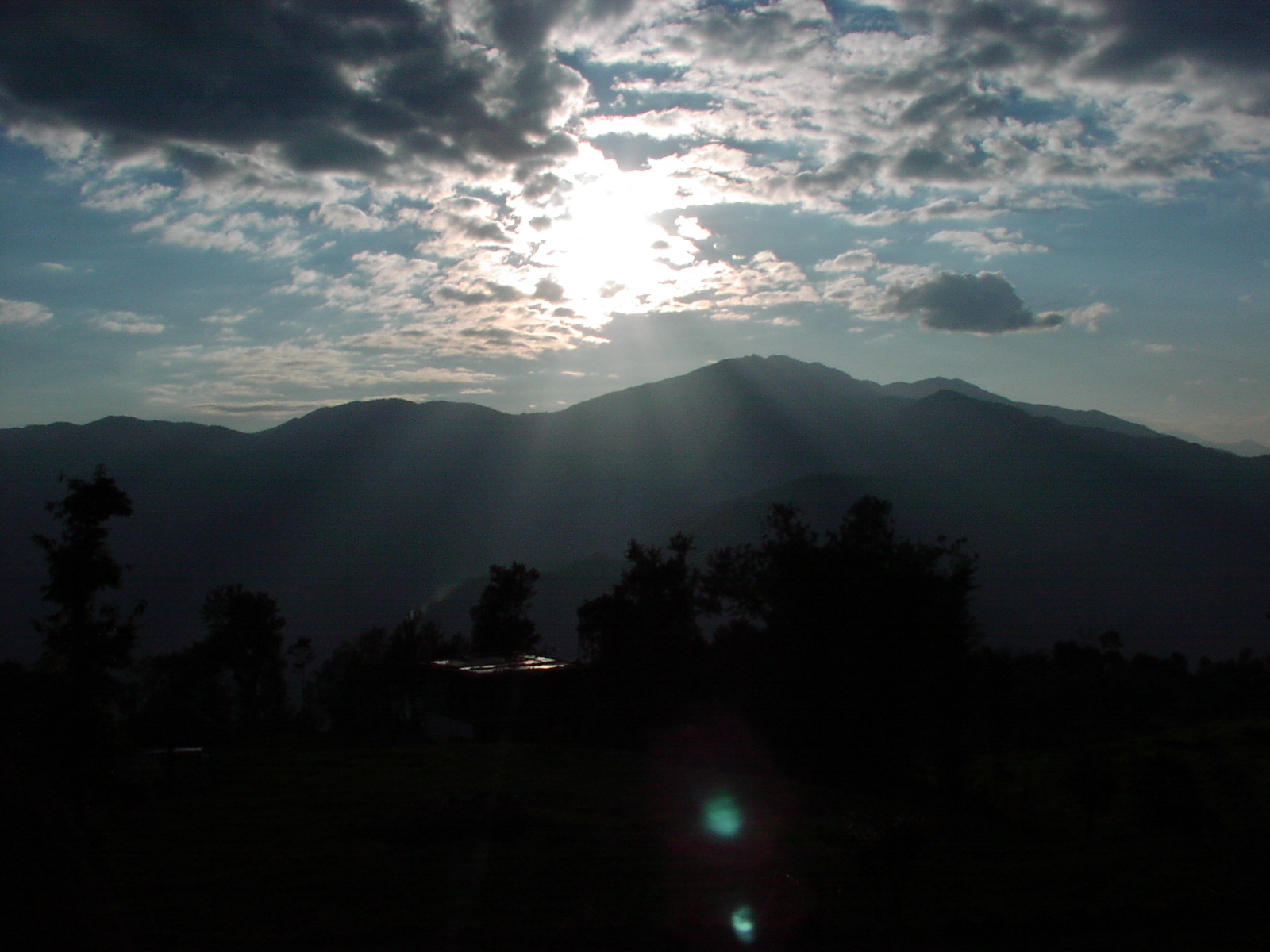
After I came out of the toilet I stayed outside, halfway up the hill to the ridge.  The moon was upside down; it looked like a slender bowl, an offering.  I traced Orion and Cassiopeia.  About fifty yards away, the house slept under the expanse of sky, and the evening’s symphony of insect sounds had silenced.  The village stretched out like a frozen yawn to the base of the Kalika Hill, whose massive triangular silhouette thrust toward the stars.

I made my way back to the house, so blind under the clipping of moon that I had to crawl along the edge of the garden to avoid falling off into the cut millet stalks one terrace lower.  But this journey to the toilet was to become a nightly practice, and after a few weeks the moon fattened until it was full like a white balloon; then, the terraces and the path were so light that it looked like somebody had neglected to turn off the daytime.  Eventually, after watching the moon wax and wane and wax again, and the constellations rise and fall with the passing hours, I made a regular game out of emerging from a deep sleep and guessing the time with a quick look around.  I couldn’t have described what the sky actually looked like at each hour—sometimes I barely gave it a glance—but I was usually correct within five minutes.  The night possessed a quality of solitude so complete that, like the living house, nighttime was knowable in its own right.  Those sacred moments of nothingness were the only times I felt unwatched.

The next morning Aamaa waved her hands and exclaimed about batti.  I turned to Bishnu for help.  She picked up the flashlight by Aamaa’s cot.

Batti,” Bishnu said, “means light.

OLYMPUS DIGITAL CAMERA

Pictures of Schools

all 710I had heard that there was a small school in the woods, facing south, far below the road that cut through Kaskikot along the mountain ridge.  On a late fall morning in 2002 I went looking for it.

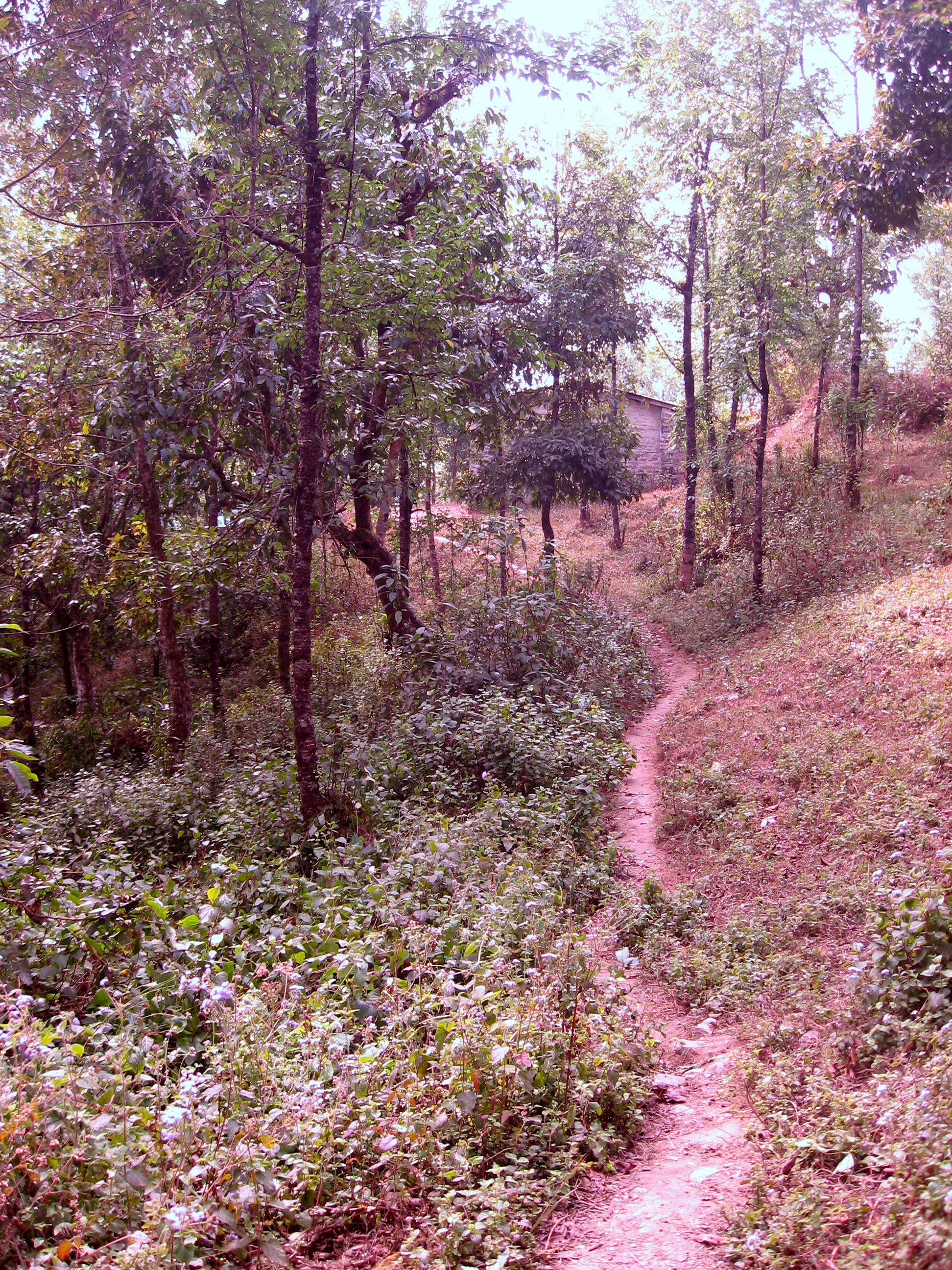
I followed a descending path of broad stones as far as the village mill, and from there I turned onto a winding footpath that halted and dropped and navigated roots in the ground and in some places seemed to disappear entirely.  Soon I heard no sounds except the whir of the trees and the suggestive rustle of an occasional monkey in the tall grass.  I passed a spring and a temple.  I came around a bend.  And then, demurely, as if waiting for a visitor, a stone wall appeared in a clearing up ahead.

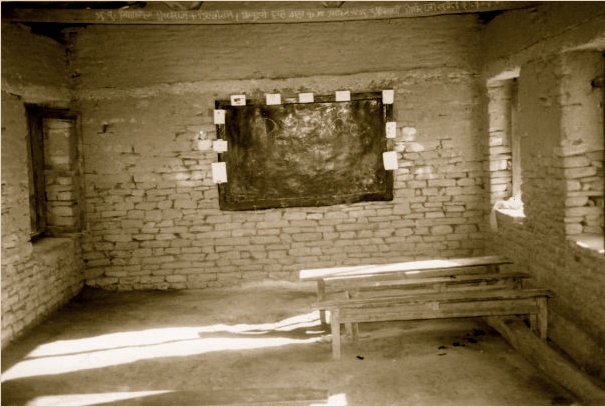
I approached the building and emerged from the hushed woods into its open yard, a bald mound of dry dirt looking out over forests and terraced fields.  The view extended all the way down to the valley floor, but the school ground still felt hidden among the trees.  There were two piled stone buildings with wooden shutters and doors, most of which were missing panels, the gaps blocky and conspicuous like missing teeth in the open-jawed windows.  I peeked in to some of the classrooms and saw benches sitting mid-wobble on the dirt floor, facing blackboards whose still-fading scribbles bespoke prior lessons.  These objects regarded each other diplomatically, as if ready for anything but expecting nothing soon.

When I’d left the United States, I hadn’t decided where I was going to end up.  China was a leading Sada Shiva (Class 3?) - Version 3contender.  I was offered a position in a school with 2000 students. My mother didn’t want me to go to Nepal—there was an insurgency happening.  I didn’t know anything about any of these places.  I didn’t speak Chinese, for example.  I spoke French.  I was a terrible candidate to do any reasoning on the topic.  One day, in Bhutan, I was sitting still doing nothing except worrying about where I was going next, when, with as little ceremony as a tenant entering his flat, a picture of a small classroom floated in to my mind and landed there.

To this day I can’t explain why, but I knew that classroom was in Nepal.  I was going to Nepal.

I wound my way back through the forest, past the spring and the temple and the mill, and up a different set of ascending broad stones, I emerged again onto the wide bus road along the ridge.  Directly across from me a man was sitting in front of his house on a low wall.  He was wearing simple brown pants and a V-neck sweater over a long sleeved shirt, and chatting with a round-bellied man dressed in the clothing of a Brahmin priest.

The two men called me over and asked when I had arrived in Kaskikot and what I would be doing there.  I told them I had just been to a small school in the woods, whose name I had forgotten, but where I was hoping to teach.  As it turned out, both of these men were teachers at that school, which was called Sada Shiva Primary.

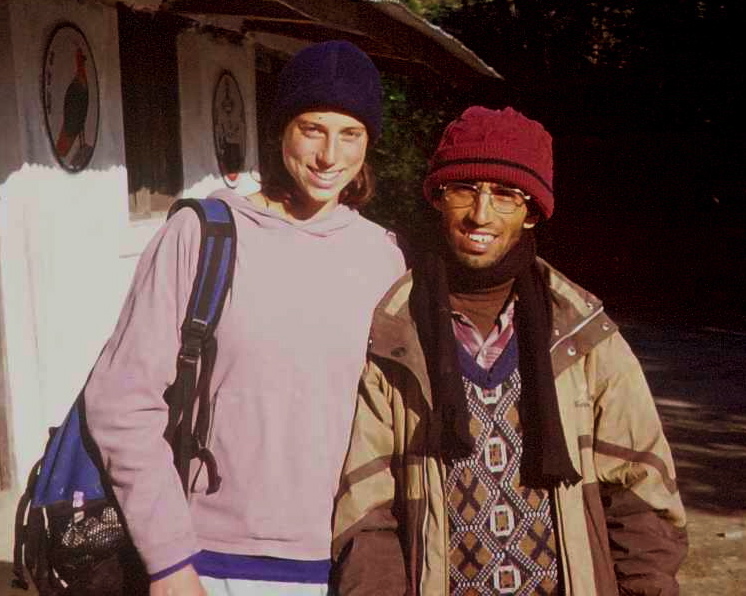
The man in the V-neck sweater introduced himself as Govinda Prasad Paudel, the English teacher.  For the next two and a half months Govinda and I walked the wooded path back from school together every day.  During that time our friendship was formed, and instead of calling each other by name, we began to follow the Nepali tradition of addressing one another by a familial relation.  I called him daai, or “older brother,” and he called me bahini.

00012004050900500061

The Road

The Road 

At Bagloon Bus park the fruit vendors weigh out half kilos of cauliflower as quickly as they can.  The next bus is just about to leave.  But then the bus sits there for quite some time and the snack vendors offer five-rupee cones of chana through the windows to all the people crowded inside.  Teenage boys with greasy hair flopping into their eyes are leaning against crates of spinach and sacks of grain near the front seat.  A latecomer presses his fingers against the ceiling of the bus for balance and the crowd forces him to lean over a mother and a slender man in slacks, who is seated by the window for air—but the man in slacks does not want chana.  A young child further back begs for chana and his mother relents, handing a five rupee note to the first mother, who hands it to the man in slacks, who passes it through the window.  An old lady tells a young man to stand up—she is old and she wants to sit down and she will not bounce up the road in this bus for two hours if she has to wait so long for it to get going.  The bus is late—late late late!—and there is work to do, the rice must be cooked, it will be dark when we arrive, where is the driver?—he is having his tea.

When it leaves Bagloon Bus Park at eight in the morning, or eleven, or four, or five in the evening, the bus makes only two turns: a right out of the lot and a left onto the switchbacked road that climbs up to Kaskikot.

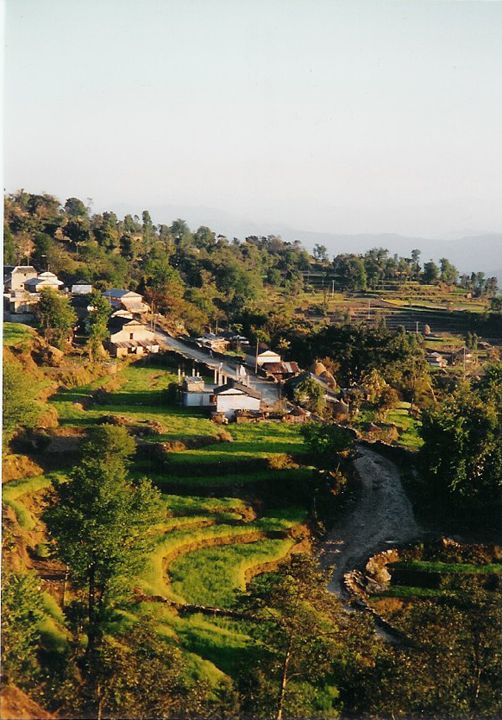
And now it’s important to tell you about the road, because there is going to be a lot of Deurali Roadgoing from here to there and there to here and most of it, when it’s not up and down and down and up, will be back and forth and forth and back along the road, which is paved from its origin in Pokhara all the way up to Sarangkot.  There, it turns to dirt.  Its deep ruts, carved by heavy tires during the monsoon, cause the bus to loll from side to side as it heaves and climbs, and the knotted ropes hanging over the front windshield swing like drunken metronomes.  The route snakes higher, following the crest of a ridge until it reaches its pinnacle at the Peace Land Guesthouse in Deurali, where a straw umbrella is cheerfully perched over a picnic table on Bhim Subedi’s patio.

Just a few dozen yards later the Shiva Lodge marks the last bus stop.  The metal beast huffs to a halt, spent, and stays the night near the Lodge’s green picnic tables.  But the road keeps going, dropping now, following the ridge until it intersects the paved Bagloon Highway in Naudanda.

There, in Naudanda, you can turn right or left.  I don’t know exactly where left leads, because I never followed it any further than Machhapuchhre Campus half a kilometer away.  It’s to the right that we always went: down tight smooth-paved switchbacks, over a small bridge, and back to Pokhara, where we’d started.

Going down was much faster.


Beginning

The hotel staff woke me up late.  I guess after i started crying last night when they couldn’t find my little green towels in the hotel laundry, they probably realized I was seriously stressed out.  I had to find my socks, since someone else’s socks came back in my laundry, and the staff couldn’t find keys to storage, and nobody called a taxi until 6:10am, even though–for the record–I who am not known for my intensive planning abilities inquired yesterday, and again last night, about calling a taxi.  My poor planning abilities have hereby been surpassed by a new phenomenon; I hear it is called “Nepali time.”

So that’s how I ended up walking, with a nice man from the hotel, to the tourist bus station in Kathmandu.  I was nervous, numb, and distracted over whether my placement would be the kind of thing I hoped for.  Mostly I was just lonely.  I was lonely for home, but also for the people I’d met in my week of training: other volunteers, Emma in office, the lovely village of Godawari where I stayed for four days with my language teacher Krishna didi.  I thought about Asmita, the 12-year old neighbor in Godawari; her photo was tucked away in my bag.  After just one and a half weeks it seemed like I’d already been far from home for a long time, and these were the things that had come to be comforts.  With that intensity that’s unique to homesickness, I was profoundly sad to be leaving these safeguards now too.

I threw my things to a guy on top of a bus and chose a cramped window seat inside.  I always like the cramped window seat better than lopsided aisle seats, where all the space on one side makes me feel off balance.  Better to just be crowded in on all sides.  I assumed my normal posture: a ball, knees resting at chin level on the seat in front of me.  The bus waited to leave.  I waited to leave.

I wondered what I’d forgotten to bring with me.  I did eventually find the green towels.  I had both of the ill-fitting kurta salwars I’d had sewn during my training—thank goodness for those, they make me feel like a cheerily clad elephant, and I’m sure will help me blend in. I had the apples and chocolate I’d purchased as a gift for my host family.  Who will they be?

I had dried fruit (keeps you regular).  I had my digital audio recorder, biodegradeable shampoo, and biking shorts to wear under a skirt.  I had no idea if I would use these things, and I had no skirt.  I had a pair of flip-flops I’d bought on the street, and I knew I would use those.  I had the dorky bean-stuffed lion Mom and Dad gave me when they left first left me at college—I’m a leo and the Dorky Lion’s name was Leo.  I missed Mom and Dad, and the pantry with raisin bread in it, and Asmita, and that nice guy from the hotel who dropped me off five minutes ago.  I wondered how I was going to communicate without Krishna didi.  Two months isn’t so long, anyway.  Two months isn’t long enough.  There is not a single bagel in the entire nation of Nepal.

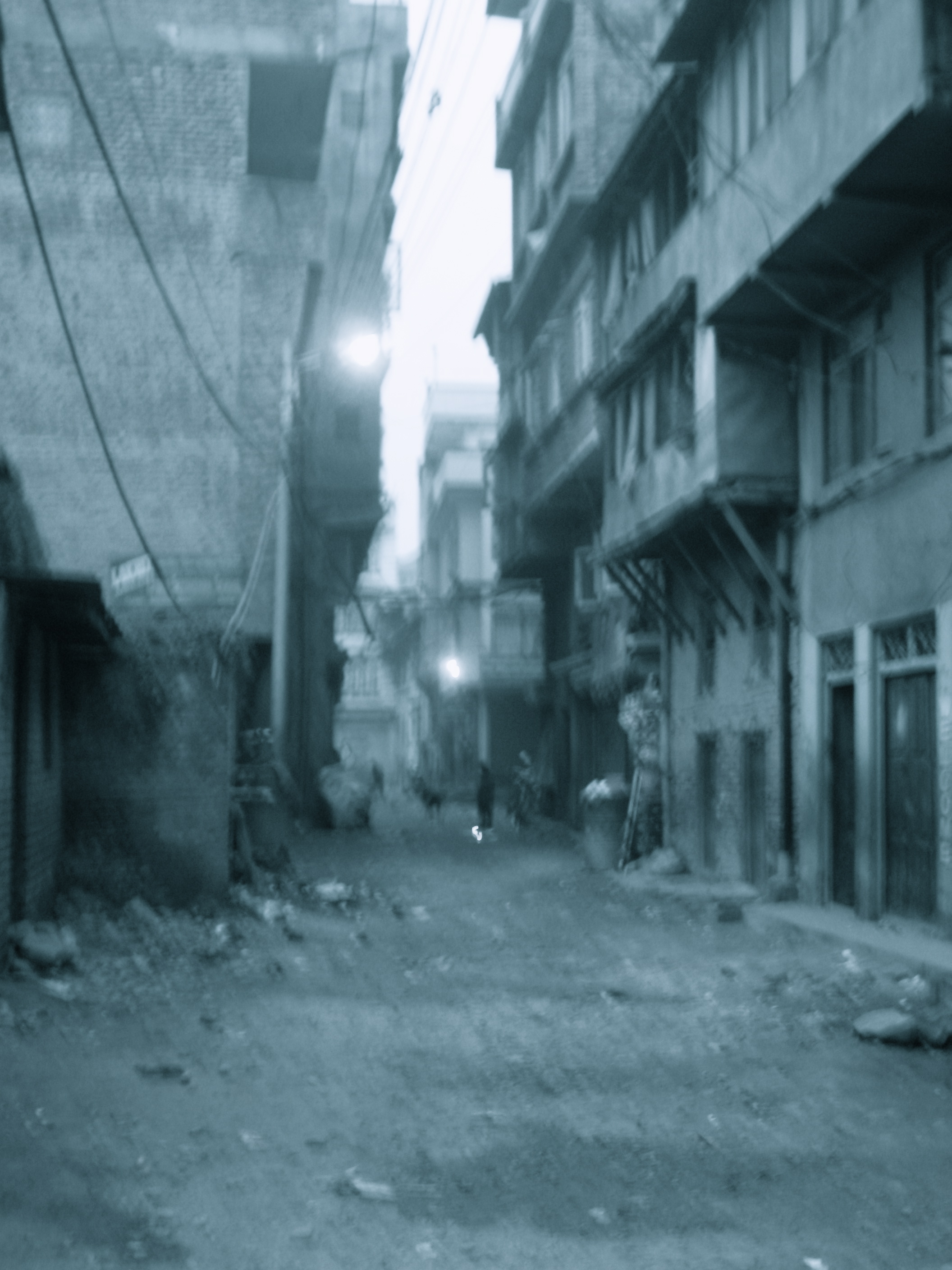
Then, in a moment sudden and unbidden, as I looked out the window onto the sepia street, a fall of serenity landed over me like a velvet mist.  Immediately I latched onto it, trying to expand it, find its source, make sure it was real, to be sure it would last.  But just as suddenly, I realized I could neither understand this moment of comfort, nor keep it.  I simply stayed still for that instant, looking at the washed out yellow light slanting onto Kathmandu’s gritty buildings, washing dawn away into morning, feeling peace with no identity.  And then it is gone, like so much creek-water slipping over the sitting stone.

Laura '08 - Solukhumbu 007