A New World

It was nighttime as we flew in yesterday, so I couldn’t watch the terraced hills coming in closer and giving way to Kathmandu’s gritty buildings. Staring at the city lights flickering in the vast darkness below, I felt a wave of sadness. I couldn’t shake the feeling of arriving in a foreign land and it made me feel like a foreigner to myself.

The normally quiet tarmac at the airport was scattered with a handful of helicopters and few gigantic cargo planes with their hatches open. And in a way that only Nepal can do, it seemed that someone had made an effort to spruce up the airport for an onslaught of international visitors: a new routing through the arrival area, which wound past a recently installed station where a vinyl banner reading HEALTH DESK had been mounted. A large sign announced that anyone having recently come from Africa was required to stop at the Health Desk for processing, and behind it, an airport official was tinkering with his iPhone. We all shuffled past him, to the main arrival terminal, where the computers weren’t working.
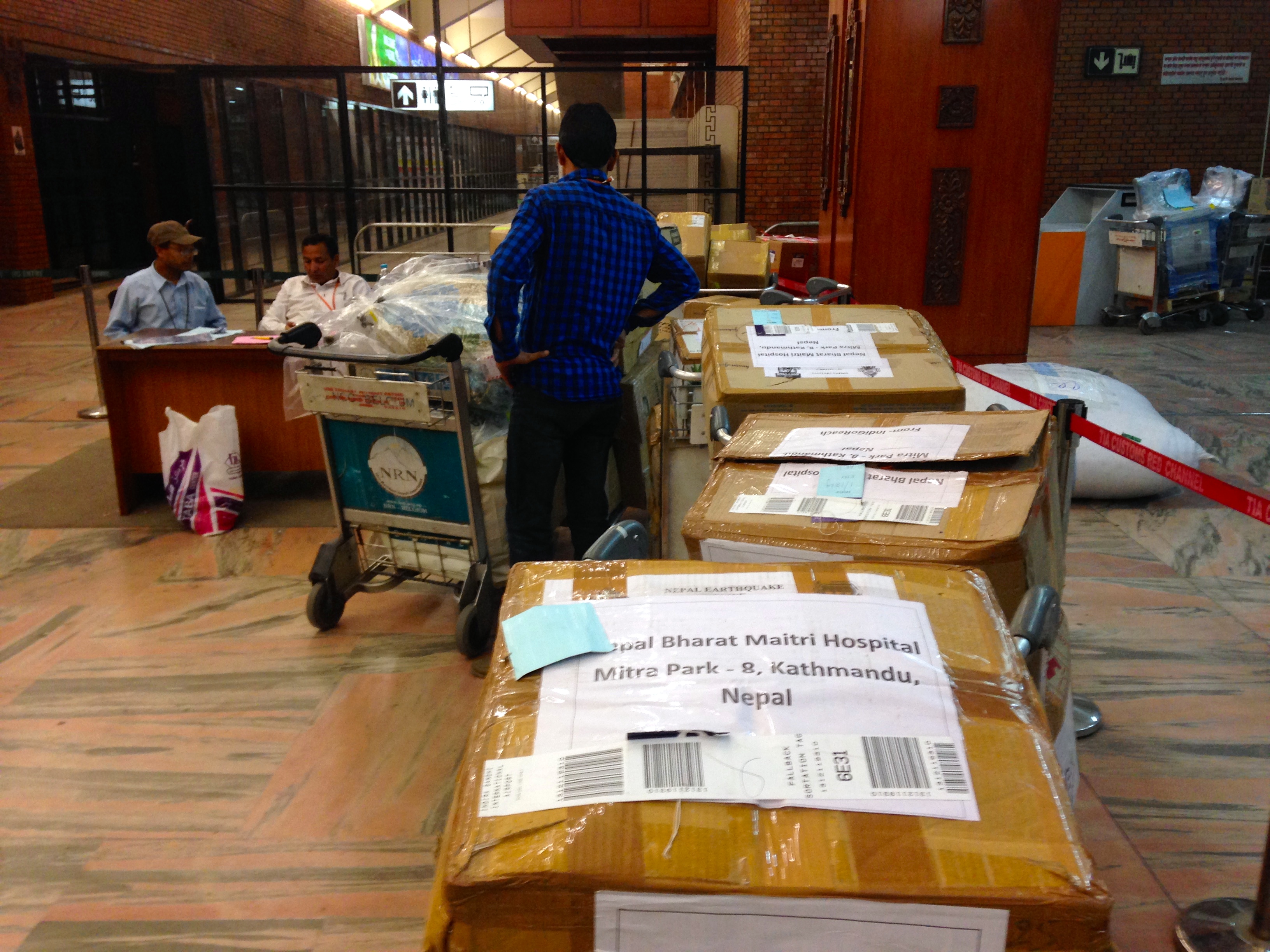
IMG_4863I was one of only about five foreigners waiting for a visa, which was new. And the baggage scanner that was previously set up at the airport exit was gone, probably to make way for a more official exit procedure. But to either side of the revised exit procedure were piles and piles of packages. I took a photo of a stack of boxes addressed to a hospital; it did not look anyone was in much of a hurry to get these parcels distributed.

Following Tuesday’s second earthquake, everyone is taking precautions again. On the cab ride from the airport, I didn’t see many damaged buildings, but people everywhere had tents up outside along the road. I stayed with a friend and the whole family slept on mattresses in the living room, right by the front door, which was left unlatched.  That’s where we are again tonight.
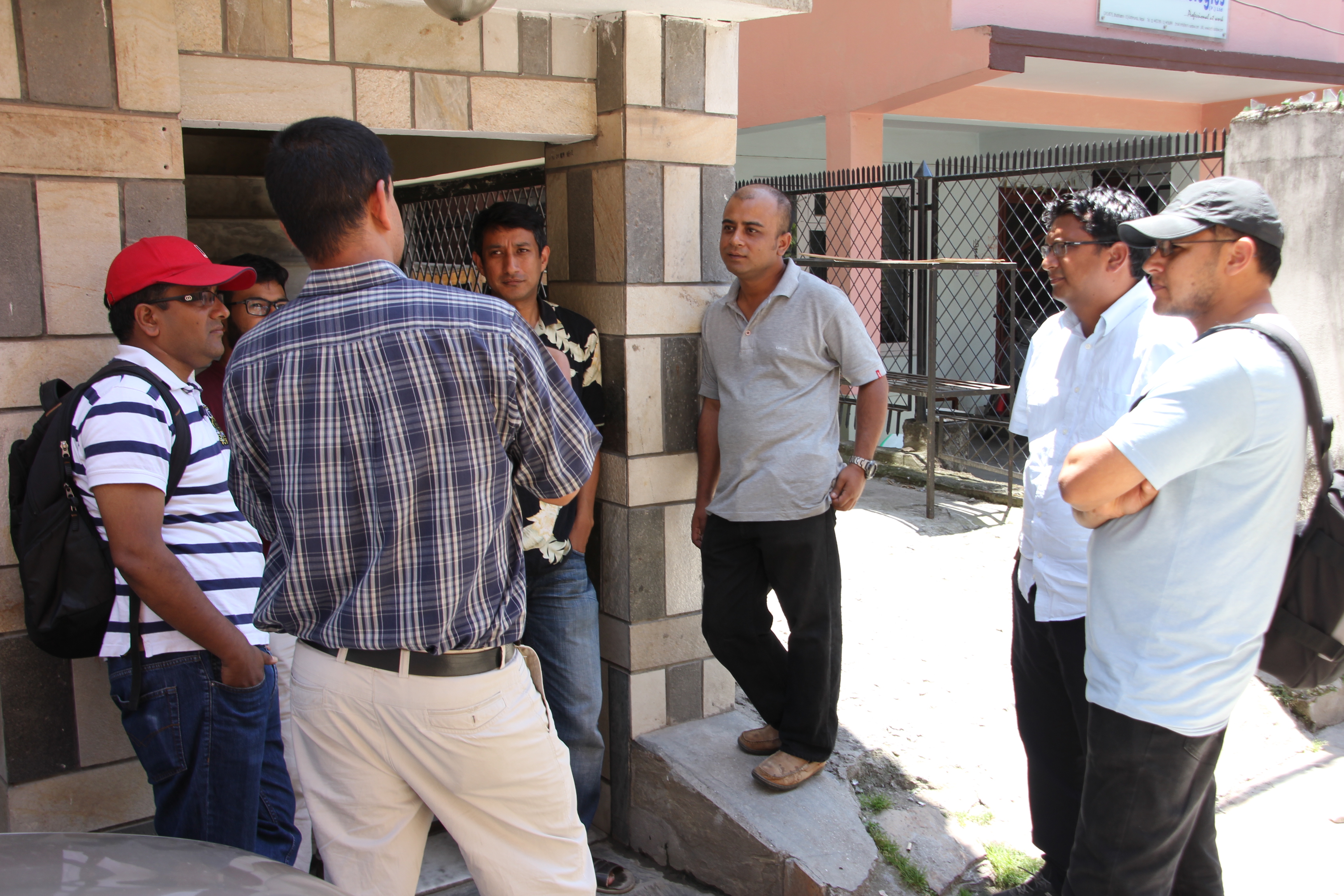
IMG_8714Today I spent the day getting a taste of local relief efforts, and it validated my early suspicion that the energy and creativity of locals can’t be dismissed. My friend Dr. Kiran Awasthi, who has trained all our dental technicians through his organization, has been furiously working with a group of high school classmates to distribute sanitation materials that will help prevent disease outbreaks. His connections through the private sector and health ministry have allowed his group to become a trustworthy distributor of hard-to-find supplies. They’ve also researched, designed and built a temporary housing unit in just two weeks, and they’ve tried it out in some areas already. Obviously the government will ultimately have to take the lead on a large scale, but groups like this are doing a huge amount to help get there more quickly.

My second stop was with a group called Women for Human Rights. Before the earthquake, I had planned to visit them on this trip to do an interview for a radio story I am producing about young widows in Nepal (as part of a series on migrant labor called Between Worlds…but that’s another story!). Like everyone, Women for Human Rights is also doing what they can towards relief, in this case for women especially. So I interviewed their founder about their aid efforts, and then went to a shelter they’ve set up for young mothers and children. It is a large canopy at one of the tent cities in Narayanchaur, at the center of a gigantic grassy mound in the middle of a traffic circle. I interviewed a 22 year old girl whose baby was three weeks old when the earthquake struck. When I asked the kids what they thought of spending their days lounging and playing in the hot sun at the camp, a twelve year old girl chirped: “It’s fun!”

I know that the government and army are making major efforts, and personally I believe very strongly that the government should be viewed with high expectations, tasked with responsibility, and held accountable.  But that said, there is huge distrust among the people of Nepal and the international community about the government’s ability to distribute aid, much less rebuilding, quickly or equitably.  There are still swaths of the hillsides where people have lost everything, suffered injuries and death, and received NO AID.  I couldn’t help noticing that when I walked past the police station, about two dozen officers were hard at work breaking, organizing and laying bricks – rebuilding the wall of their own compound.

IMG_8736

So that was a pretty long day. I already have hours of tape to sort through and tomorrow will bring a whole new chapter of stories before I fly to Pokhara at 3:00. I’ll be glad to get out of Kathmandu – about 70,000 people have left the city since the second earthquake on Tuesday.

Nepal has always shown me a graceful, practical relationship with nature and its whims. But everything feels wrong. Twice today I was in the middle of a conversation with someone who suddenly stopped and said, “Is that an aftershock?” and I couldn’t even feel any shaking. Everyone is on a razor’s edge. People keep telling me, “Things were getting back to normal,” when talking about the second earthquake, which really tells you something, because things were definitely not normal last Tuesday morning. But the second time seems to have redefined “not normal.” It’s as if now the injury of this event is not yet quantified – the sensation isn’t that something terrible happened, but that it is happening, and the final damage is unknown.   As long as the cost remains pending, the reckoning is impossible. You can’t mourn much less rebuild something that is still breaking apart. Everyone is just waiting, even as they run around providing aid to each other.

I will be glad to get to Pokhara tomorrow, but I think this month is going to be as strange and unsettling as expected. My mind is racing with ideas for how to make the best possible use of the $14,000+ we raised for aid, and it is good know that we have the ability to do something, or to provide significant support to someone doing something effective and under-funded. One idea I’m thinking about is collaborating with Kiran or a similar group working on temporary housing. Tomorrow, I am going to get an overview of how the big aid is working.

But I will write about that tomorrow!
Holi

IMG_4612

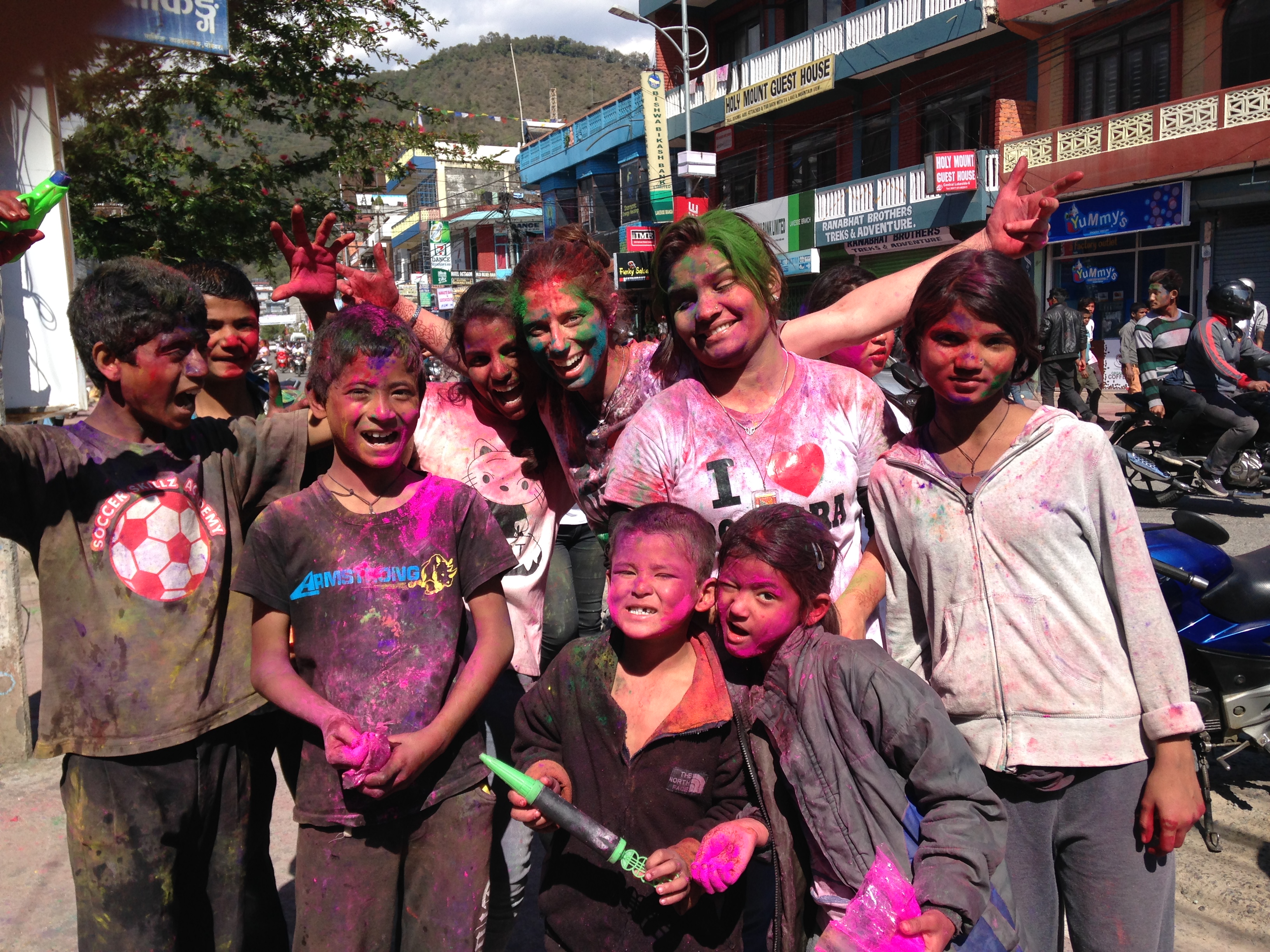
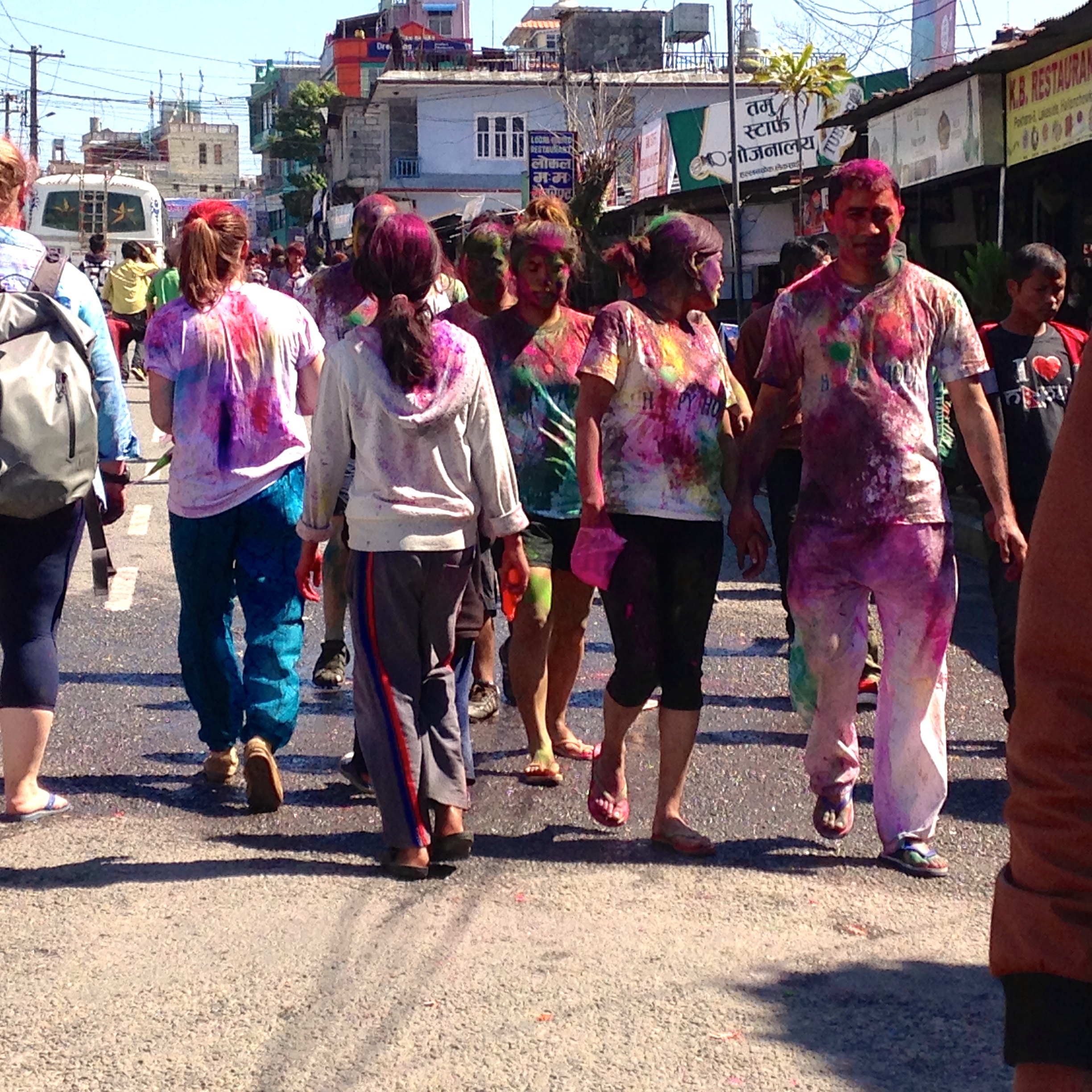
Today was the festival of Holi. Weirdly enough, I’ve only been in Nepal once for Holi in twelve years, and that was back in 2004, when I was in Kaskikot and basically missed it. So this was the first time I’ve really seen all the action, and it was pretty much the awesomest holiday in the history of ever.

Holi is a Hindu festival that celebrates the equinox, the start of spring, the renewal of relationships, and most importantly, the triumph of good over evil. In a brilliant stroke of luck, this is done by having people throw colored dust and water on each other in the streets all day.  Water balloons are allowed.  Anyone is fair game. Dude taking out the trash? Fair game. Small child sucking their thumb on the curb? Fair game. Foreigner walking home with morning coffee and a laptop in her backpack? Especially fair game. Leave the laptop at home, idiot.

IMG_4601


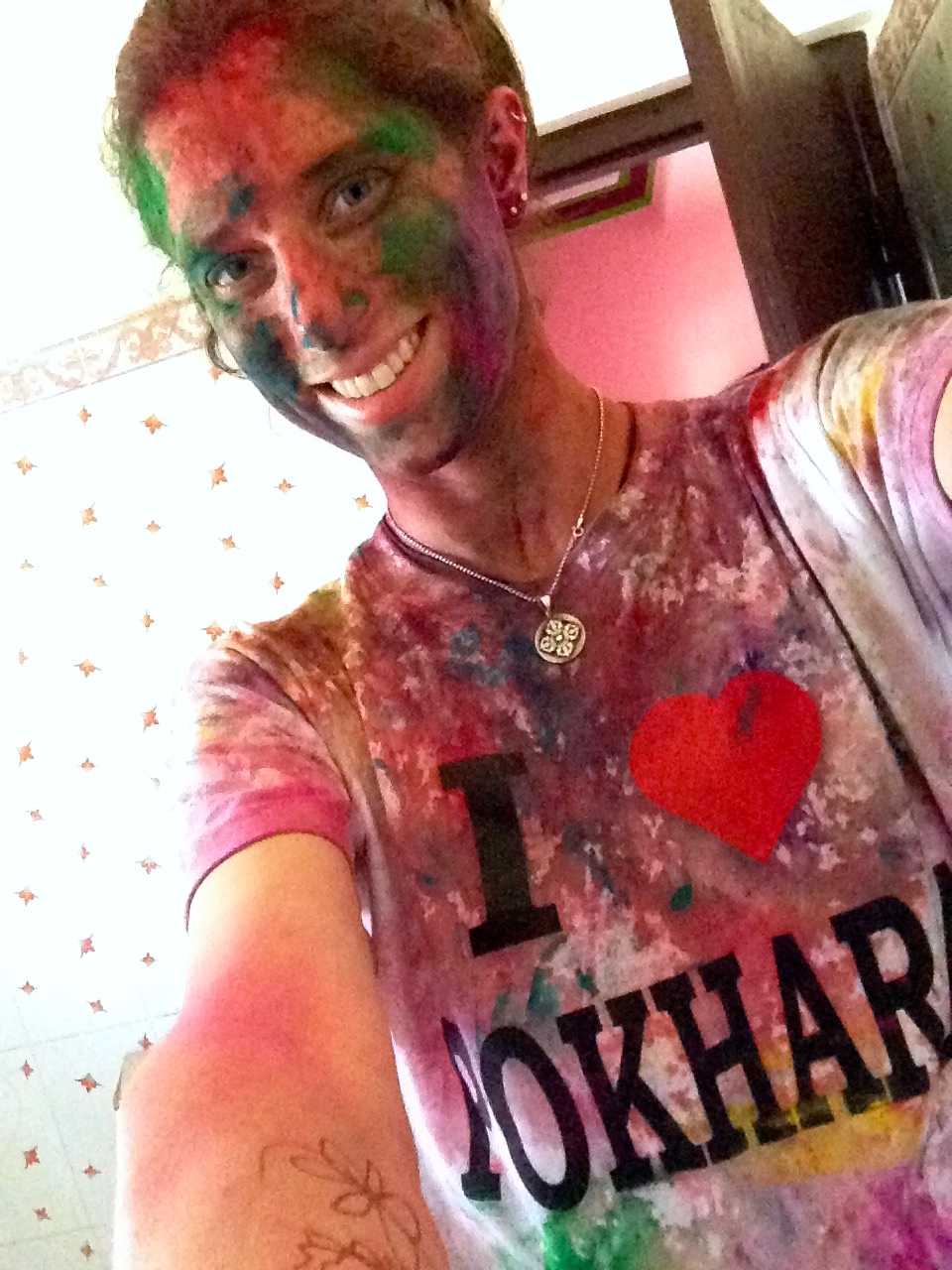
For weeks leading up to Holi, white clothes were on sale in every version and size. I got myself an “I Heart Pokhara” t-shirt and a cheap pair of pants, and on the morning of Holi I picked up some squirt guns and packets of brightly colored powder for the kids. I returned to the children’s home with my stash and presented them to the kids. They just looked at me like: you only got one squirt gun? What’s wrong with you? Sanjay filled up an empty plastic water bottle and dumped a packet of purple powder in to it. Someone had the excellent idea to poke a hole in the cap, and this bottle was to become our most potent weapon.

When we ventured out in to the street around noon, people were walking around with super soakers. I mean that kind where you spray the entire jumbo water cartridge continuously until it is empty. Poor little Laxu was carrying the mini squirt gun I’d given him that had to be refilled every three minutes through a flubbering hole in the side. We quickly began looking for a good deal on six more squirt guns.

IMG_4611We walked the streets for two hours, and then our Gaky’s Light Fellows showed up and I went back in  for round two. For a culture that’s fairly concerned with propriety as a general matter, Holi is an unruly and joyous anarchy – all the best of the bright pandemonium that is Nepal. Clouds of yellow and pink and green puffing up in to the air over the crowded sidewalks while colored water sprays haphazardly on to soaked shirts and faces. Strangers running up to each other and smearing hot pink powder on each other’s cheeks. Hooting and yelling and rainbows exploding every which way. I was with a group of kids ranging from age 7 to 13, and everyone in the packed streets was acting just like them. It was magic.

I did learn a few critical pieces of wisdom that I hereby pass on to you.

  1. Keep your mouth closed. I realize that when someone is throwing a fistful of green powder on you or blasting your armpit with orange water, your instinct is going to be to squeeze your eyes an open your mouth in a gleeful expression of frolickness. But, your mouth is going to get full of green powder (that’s really bad) or orange water (which is just gross on principle). So frolic with your lips tightly sealed.
  2. IMG_4638Don’t be the douchebag who does the move where you grab someone else’s water bottle, bend it towards them, and spray them with their own water. Because first of all, I’m already wet, so you’re not as special as you think you are, and second of all, Sanjay made this water bottle and you’re ruining it, douchebag. Make your own water bottle and squirt me with that.
  3. Pay attention to the color distribution on your target’s shirt. Your target, if your target is me, wants to save this I Heart Pokhara shirt forever and ever, and it’s no fun if the entire thing just turns brown. Am I missing yellow? Would a splash of blue do well to bring out the hot pink? And aim for the empty areas, for Pete’s sake. I paid $3 for this t-shirt and I want it properly ruined with some sense of artistry.
  4. Hit me from ahead where I can see you. Because the first person to grab me from behind and putt purple powder on my face and up my nose will probably get away with it – partially because I’m not ready to drop my mini flubbering squirt gun to whoop your ass, since I’m holding on to it for this small kid I came here with. However, if you’re the second or third person, I reserve the right to take out a can of taekwondo on your poorly executed headlock, and that’s not going to work out well for you. I don’t like purple powder in my nose. Thanks.

Happy Holi, fools.

IMG_4631

Shooting Lights at the Sky


Didi, Pascal and Aidan and I left for the New Year’s street festival right around dusk. It was already jammed with people and food stalls, a challenge for us because, while Pascal carefully soberly dodges people’s legs and ponders over his food options, Aidan absolutely doesn’t care where he’s going, and he’s only about 3.5 feet tall, and he wants to eat everything he sees, and he can’t take his eyes off anything.  We got some ice cream, and some hot dogs, and some cotton candy.

At 9pm the Gaky’s Light Fellows showed up with arms locked in a blob. It was such a fantastic moment – they were all dressed up and so excited to be there together, and then they practically mowed me down in the street in a mob of happiness.  On the corner a crowd of people was dancing to some impromptu devotional drumming and singing.  So that’s how I ended up on New Years spinning around with Aidan on my shoulders and Pascal on my leg and our fellows clinging to my hands while we all danced in the street to a bajan.

The street crowd grew so thick that it became river.  I left Didi and the boys and waded in with our fellows – we were literally all holding on to each other and being carried down the street by a massive crowd.  Every once and a while someone would pick the person right in front of them and, just for fun, shout: “SANDIP IS LOST!” or “SOMEONE HOLD ON TO PABITRA, SHE’S SMALL AND WILL GET LOST!”  Samundra, our program director, had a scarf wrapped tightly around his neck.  “SAMUNDRA’S NECK IS LOST!” I cried.

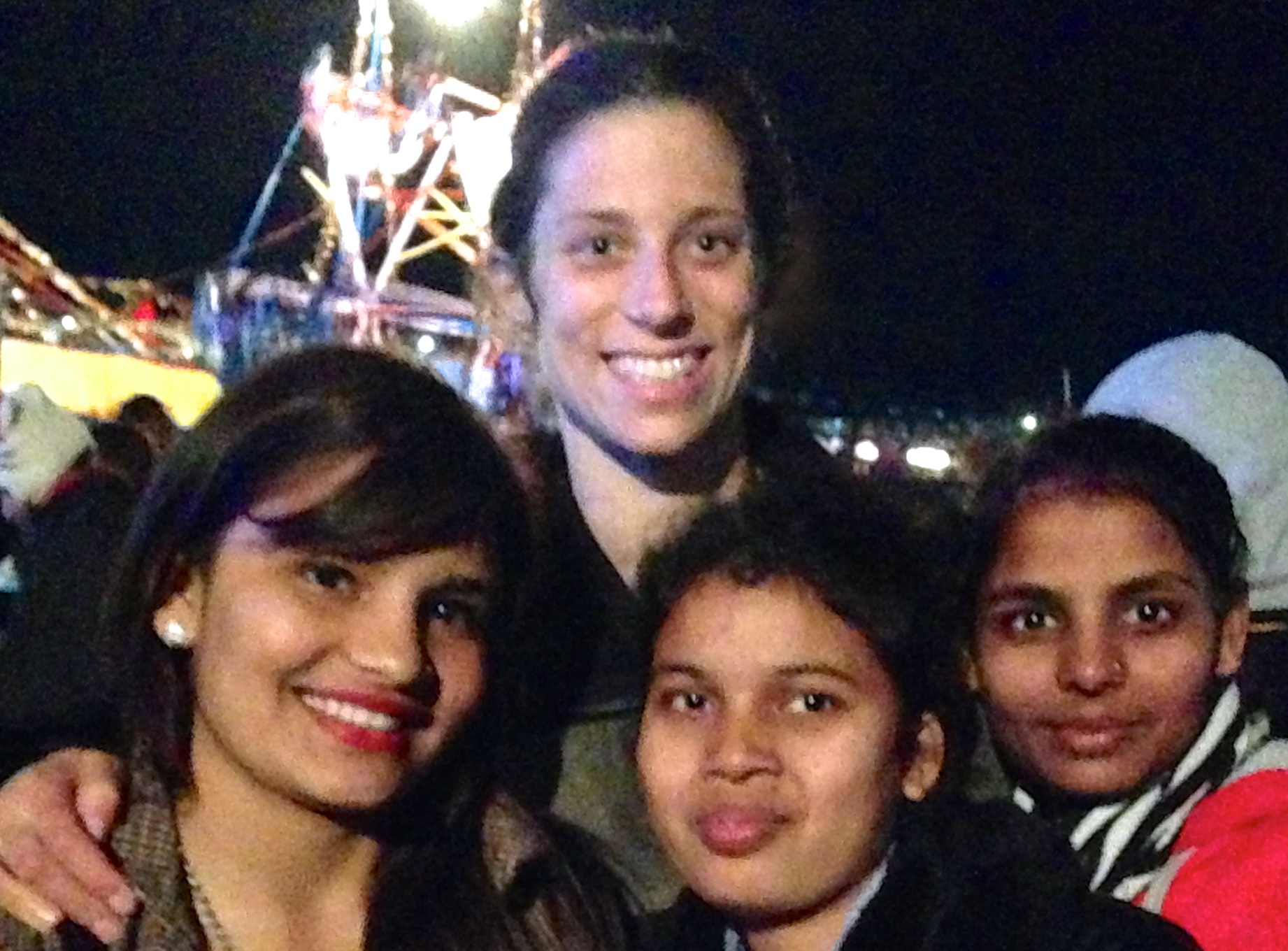
Eventually, we got lost.  There were just too many people, our group was cleaved, and I ended up swimming along with Sabina and Asmita and Anju.  All the phone networks were jammed and we couldn’t get through to any of the others.  We were finally catapulted through a gate to the fair – I mean washed over the threshold while clutching each others jackets, past a wall of police trying to look for tickets. We came tumbling out next to a ferris wheel like Alice in Wonderland.

We dusted our selves off and looked around.  It was 10:30pm.  There were lights and huge objects everywhere, surreal and dizzying.  The four of us stood locked together so we wouldn’t be separated in the hectic sea of people, until we boarded a boat that swings back and forth on a pendulum.  We let people in line pass us until we could get a spot all the way at the tip of the boat, where we had the highest view, where all the strange fair lights streak across the sky and the top of the ferris wheel is right there, and you can’t ignore the moment the boat reverses direction and you’re suspended for an instant in mid-air with nothing under you.

By this morning, Pokhara looked like the day after the worst frat party you’ve ever seen.  Trash, tables askew, dejected looking tents, all kinds of equipment and decorative paraphernalia sagging with a January 1st hangover.  Even the sunrise seemed weary.  But it was pretty worth it while it was happening.  Welcome to 2015, World.

Which reminds me of something.  When we’d left for the street festival, Aidan had been begging for a new light.  Throughout the festival they’ve been selling slingshot lights with wings that sail way up in the air and then slowly float down, so the night was full of beautiful falling blue lights.  Pascal, like me, is enthralled with the light but cautious of losing it, and kept his slingshot safe in his pocket most of the time.  Aidan on the other hand is completely reckless.  He’s too excited about shooting the light up in to the air to worry about what happens to it, and we had rescued his flying toy from more than one rooftop on tuesday night.  Each time it got lost he was utterly dejected, and then we’d retrieve it, and he would go right back to catapulting it at the night with unbridled enthusiasm.

“Laura auntie,” Aidan explained to me as we walked in to the street again on New Year’s Eve, “when you shoot the light, it goes up toward the sky like this.”  His put his hands over his head and pointed his little fingers toward his palm, in an angled T-shape, to show the way a light sails toward the sky.  “But then just when it’s about to touch the sky…” his eyes got big and his palm drifted up “…the sky MOVES, Laura auntie!  The sky MOVES!”

.      .      .

IMG_4160


Boxes and Glass Cases

It’s been a tough arrival.  The monsoon is still clinging to the hills, thick and cloistering, and each afternoon it dumps an unremitting rain that I swear to God follows everybody inside.  The air itself is full of water; there’s no place to be dry.

And the truth is, I am also a drop suspended in mid air.  I’ve moved out of my apartment in New York, but I haven’t moved in to a new apartment in Connecticut, so all my things are in boxes in my parents’ basement.  The plan is that when I get back in two months I’m going to be working in a manual therapy clinic in Hartford…but it hasn’t actually happened yet.  It’s an idea, hovering in good faith around some boxes in a basement, waiting to be taken out and used.

That feeling has trailed me all the way to Pokhara–the hint that my life is full of theories.  Even IMG_2479though my contact with my projects in Nepal has increased a great deal in the past year through Skype and regular written reporting, and I have files and files of documents proving to me that these creations are real, they still feel like experiments when I re-encounter them on the ground.  Plus, there’s a big disappointment right off the bat: our first program director has left unexpectedly, after growing the Kaski Oral Health Care Project much less than we’d hoped since last fall.  I’m tired and frustrated and it’s enough with the freelancing.  I am ready to feel like I know what I’m doing, and some of this fits together, and it’s leading somewhere that matters.

Today it led back up the road to Kaski.  I went to Vindivasini Temple this morning to catch the bus on its way down, so I could save a seat before the bus arrived at the park, where a crowd  gathers around the door and starts pushing in to secure real estate for the ride up before people can even get out.  As I waited, I sat on a stoop with my duffel by my feet, watching a man selling vegetables across the road.  And I wondered again if this is all some kind of act.  I’m just doing the same thing over and over.  I can’t keep my grasp on what it’s about.

Other than a story.  The word comes to me again, and then again: Story.  Right out of the blue, at nine in the morning, I’m sitting on a stoop waiting for a bus, watching a man weigh a cauliflower, and the next thing I know I’m watching a story, and my identity is divorced from my soul.  Poof!  I am a character.

It must be natural that when you go through enough repetitions of something, even something incredible, it becomes unmoored from any particular episode.  And with that goes its singular miraculousness, because it’s just what it is: a cycle.  How profound would the sunset be if you only saw it once in your life?

Sometimes the sense that everything is just a series of events, with nothing transcendent to tie them together, seems like the most awful thing possible.  Even the leaves clinging to the trees look worthless.  But in certain moments, that same arbitrariness erases the perpetual burden of discerning the purpose of each passing instant, and my role in things is set free from an anchor that, in truth, may never have been there.  What a relief.

This morning I watched the vegetable vendor.  The story settled around me, like snow in its glass case, shaken from the sky.  I waited, again, for the bus to take me up to Kaski, where I knew Aamaa would be waiting.  Again.  For me.

IMG_2638

Opportunities for Enterprise

IMG_5426I was in a rush, winding through the narrow chintzy streets of Thamel.  The tourist section of Kathmandu has the same charm as Hershey’s chocolate milk: artificial and homogenized in a way that should be revolting, but is attractively digestible instead.

I tend to keep my head down in Thamel’s chaotic alleyways. There isn’t a lot of room to maneuver, and rather than dodge oncoming hippies and tiger balm vendors and tuk-tuks and the occasional ill-advised taxi driver, I find it more efficient to simply watch my feet and make sure they don’t step on anything within a 1-foot radius.  Usually that gets me where I’m going with the fewest number of unnecessary traffic encounters.

“HELLO!”

Not that afternoon.  A street boy had breached the 1-foot no-entry zone and was looking up at me.  I barely noticed the stack of rumpled schoolbook pages in his hand before I brushed by him.

“No thanks, little brother,” I said.  So many street children.  The agencies say that handouts only exacerbate the problem.  There are so many agencies.  There are so many tiger balm vendors and hippies and there is so little room to maneuver.  I kept my head down and pushed along the clamoring street.

I slowed, and then stopped.  Was that boy selling drawings?

I turned around and saw him in the road.  I’d spent a year pulling my hair out in Kaskikot, trying to get elementary school kids to combine imagination and paper the way they combined imagination and trees and rocks and flat soccer balls.  To inspire enterprising attitudes through art, and make notebooks spaces for creation, so that school would be about possibilities.

“Bhai!” I called.  “Little brother!”

I walked up and stood over him.  “Excuse me,” I said in Nepali, “could I see those again?”

Flustered, he turned over the ripped lined pages and I mulled over them carefully.  They were all colored-pencil drawings and had been carried around a fair amount, but with what flatness they still had, retained a look of attempted composure that was very charming.

“Did you draw these?”

“YES MISS!!!”

“What is this picture?” I asked importantly.

“THIS IS A BUDDHA!”

“Hm.  And this?”

“THIS IS A BIRD!”

“I see.  How old are you?”

“I AM NINE!”

“You are a very talented artist.  How much do these pictures cost?”

Wide-eyed, the boy scrambled for an answer.  On a good day, he was probably lucky to sell a picture or two for five or ten rupees each.

“FIFTY RUPEES!!!”

I gasped.  “Fifty rupees?  These must be very valuable.”  I looked at the stack of papers.  “I’ll take two.”

I picked out the Buddha and then asked him to choose another one for me.  He chose a man with a guitar.  As I handed over my 100 rupee note – worth about $1.10 – I added, “You’re a very nice artist.  You should keep at it.”

“YES MISS!!!!!” the boy cried, and then disappeared in to the swirl and clutter.

A few weeks later, I had the Buddha framed in cloth like a traditional thanka.  It is definitely the most magical thanka I will ever own, and ten years later, it still hangs in my home office in Connecticut, across from my desk, reminding me to stop and look up in the crowded and relentless street.

The tuk-tuks can dodge us for a darn second.

photo* Photo credit Rachel Seys, Birds in Thamel

The Milk Truck

We spent a very long time waiting for the milk truck to pick us up.  As part of Optional Class, I’ve found people to come up from the city and tell the kids about their jobs: a librarian, a radio jokey, and someone from the photo shop.  Today, we were headed to Pokhara to visit the places they work.

While we waited for our ride, the kids sat on the grass, leaning on each other, practicing the song that Govinda and I wrote about the solar system.  We make them sing it every day – Venus has poisonous air, there’s a big storm on Jupiter, la la – so the tune has more or less become the Optional Class Anthem.  The radio jockey had invited our students to sing the solar system song on air during our visit, and the quartet selected for that job was practicing next to a few other students who we’d chosen to read their poetry on the radio.  The early morning hour was one of quiet satisfaction for Govinda and me, watching our kids with their heads bent over the books they’ve made, feeling important.

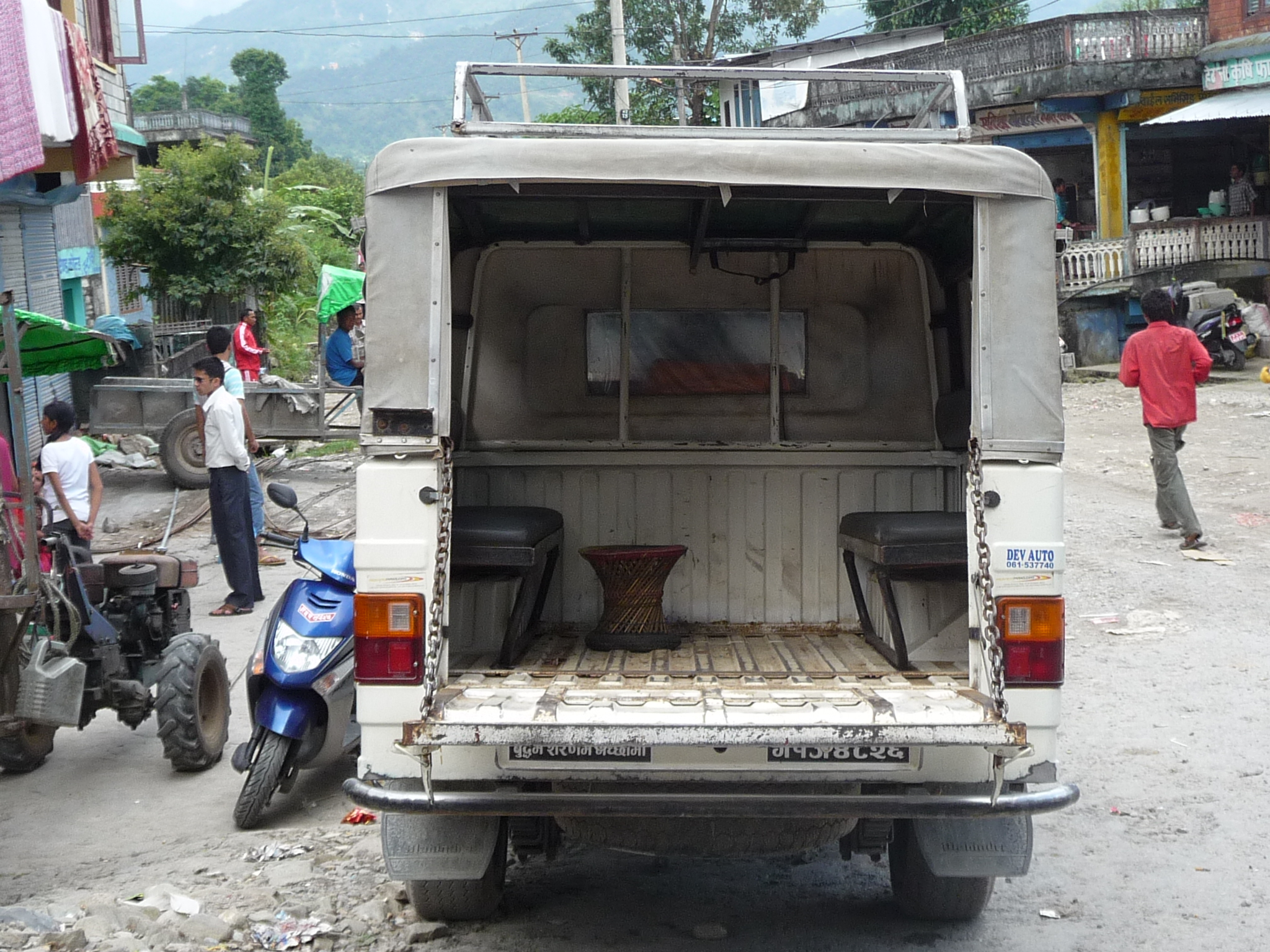
The milk truck finally came, and we all crammed in to the back: Govinda, Laximi, and eighteen kids, and me.P1060843  The inside was a military-style canvas box with two benches and railings on the ceiling to provide handholds.  With a lurch we set off, bouncing down the dirt road toward the city.

To keep out the dust from the road, we had all the canvas flaps down over the back and side windows.  I looked around at all the little faces squashed into our sealed box, and was struck with the sudden feeling that nothing, no words or photos or documentaries, would ever be able to recreate that stuffed space.  At the end of the day, we will be exactly that: a giggling ring of faces pressed together inside our container, moving along a dirt road towards something, out into a world which sees us as if from above, tiny on the crumpled earth.  The instant reels in my mind from its birds eye view, and I look from the inside out, where we are now, and fall on the moment with a surrendering crush of love.

Because the outside is moving, moving, always crawling along the road, but the inside—the inside is still, aside from the bouncing.  With the windows covered we couldn’t see the road going by, or the place we’d come from, or where we were headed.  And when I considered that we would eventually arrive, and get out, and be outside too, I felt the weight of a universe crammed into a milk truck.  This is our now: the gravity of all the past and future collapsed into a present that will pass and forever be gone.  It seems almost impossible, amazing, to be here now.  In a milk truck, with these kids.

*

Lookout point (and clouds!)

The Road

The Road 

At Bagloon Bus park the fruit vendors weigh out half kilos of cauliflower as quickly as they can.  The next bus is just about to leave.  But then the bus sits there for quite some time and the snack vendors offer five-rupee cones of chana through the windows to all the people crowded inside.  Teenage boys with greasy hair flopping into their eyes are leaning against crates of spinach and sacks of grain near the front seat.  A latecomer presses his fingers against the ceiling of the bus for balance and the crowd forces him to lean over a mother and a slender man in slacks, who is seated by the window for air—but the man in slacks does not want chana.  A young child further back begs for chana and his mother relents, handing a five rupee note to the first mother, who hands it to the man in slacks, who passes it through the window.  An old lady tells a young man to stand up—she is old and she wants to sit down and she will not bounce up the road in this bus for two hours if she has to wait so long for it to get going.  The bus is late—late late late!—and there is work to do, the rice must be cooked, it will be dark when we arrive, where is the driver?—he is having his tea.

When it leaves Bagloon Bus Park at eight in the morning, or eleven, or four, or five in the evening, the bus makes only two turns: a right out of the lot and a left onto the switchbacked road that climbs up to Kaskikot.

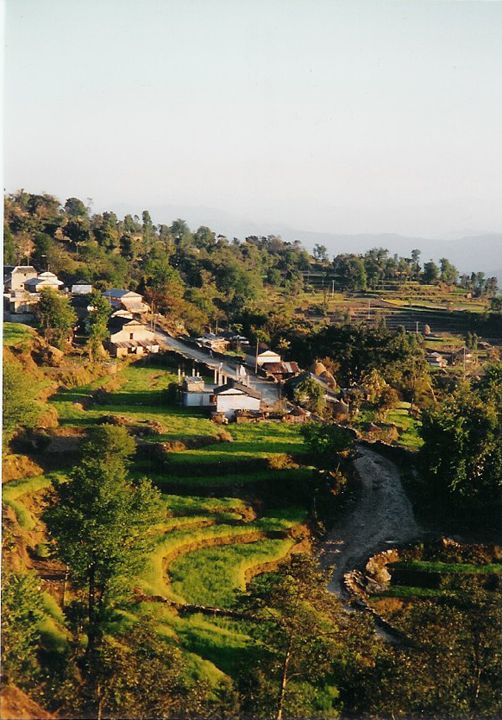
And now it’s important to tell you about the road, because there is going to be a lot of Deurali Roadgoing from here to there and there to here and most of it, when it’s not up and down and down and up, will be back and forth and forth and back along the road, which is paved from its origin in Pokhara all the way up to Sarangkot.  There, it turns to dirt.  Its deep ruts, carved by heavy tires during the monsoon, cause the bus to loll from side to side as it heaves and climbs, and the knotted ropes hanging over the front windshield swing like drunken metronomes.  The route snakes higher, following the crest of a ridge until it reaches its pinnacle at the Peace Land Guesthouse in Deurali, where a straw umbrella is cheerfully perched over a picnic table on Bhim Subedi’s patio.

Just a few dozen yards later the Shiva Lodge marks the last bus stop.  The metal beast huffs to a halt, spent, and stays the night near the Lodge’s green picnic tables.  But the road keeps going, dropping now, following the ridge until it intersects the paved Bagloon Highway in Naudanda.

There, in Naudanda, you can turn right or left.  I don’t know exactly where left leads, because I never followed it any further than Machhapuchhre Campus half a kilometer away.  It’s to the right that we always went: down tight smooth-paved switchbacks, over a small bridge, and back to Pokhara, where we’d started.

Going down was much faster.