The Milk Truck

We spent a very long time waiting for the milk truck to pick us up.  As part of Optional Class, I’ve found people to come up from the city and tell the kids about their jobs: a librarian, a radio jokey, and someone from the photo shop.  Today, we were headed to Pokhara to visit the places they work.

While we waited for our ride, the kids sat on the grass, leaning on each other, practicing the song that Govinda and I wrote about the solar system.  We make them sing it every day – Venus has poisonous air, there’s a big storm on Jupiter, la la – so the tune has more or less become the Optional Class Anthem.  The radio jockey had invited our students to sing the solar system song on air during our visit, and the quartet selected for that job was practicing next to a few other students who we’d chosen to read their poetry on the radio.  The early morning hour was one of quiet satisfaction for Govinda and me, watching our kids with their heads bent over the books they’ve made, feeling important.

The milk truck finally came, and we all crammed in to the back: Govinda, Laximi, and eighteen kids, and me.P1060843  The inside was a military-style canvas box with two benches and railings on the ceiling to provide handholds.  With a lurch we set off, bouncing down the dirt road toward the city.
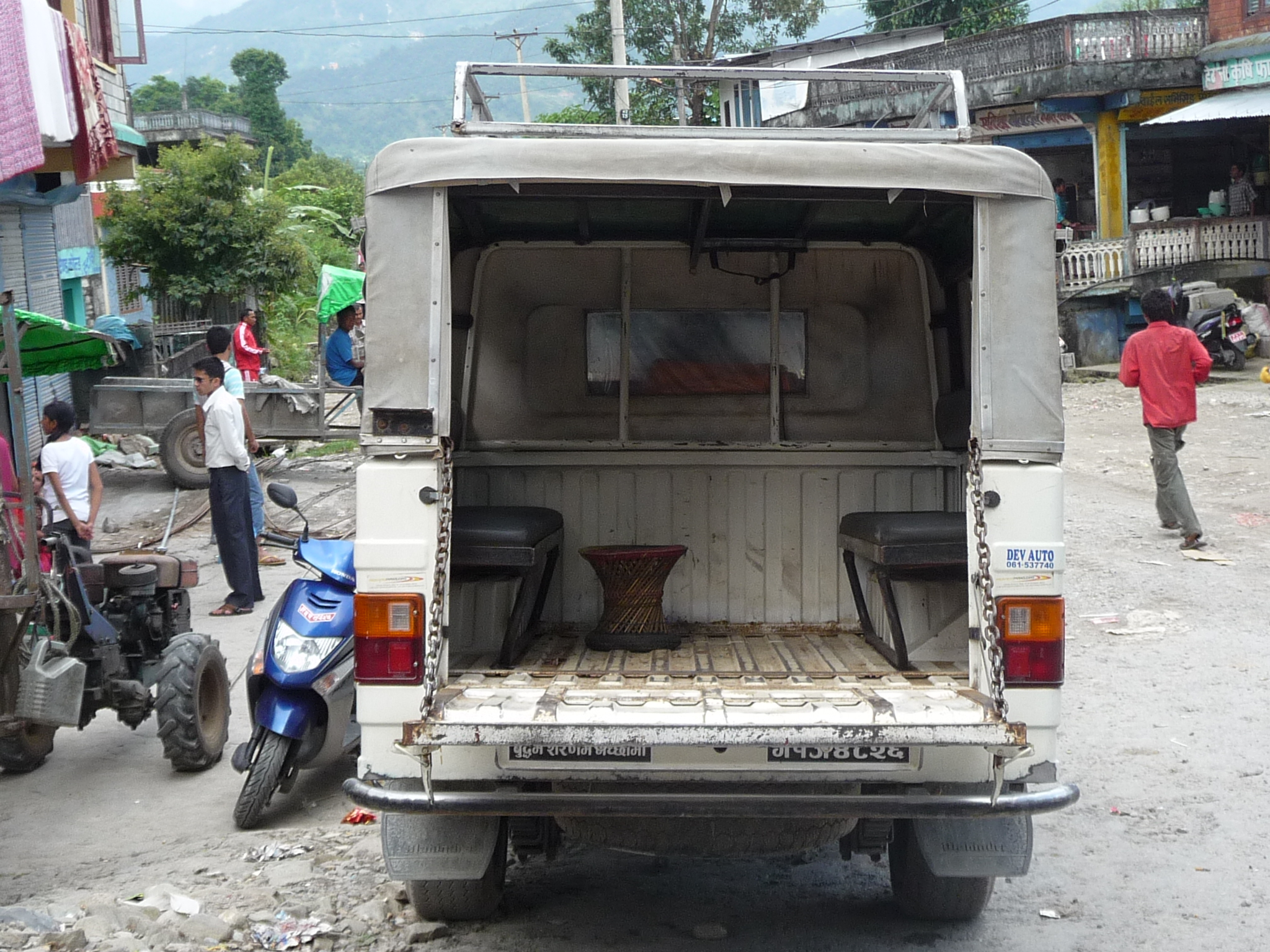
To keep out the dust from the road, we had all the canvas flaps down over the back and side windows.  I looked around at all the little faces squashed into our sealed box, and was struck with the sudden feeling that nothing, no words or photos or documentaries, would ever be able to recreate that stuffed space.  At the end of the day, we will be exactly that: a giggling ring of faces pressed together inside our container, moving along a dirt road towards something, out into a world which sees us as if from above, tiny on the crumpled earth.  The instant reels in my mind from its birds eye view, and I look from the inside out, where we are now, and fall on the moment with a surrendering crush of love.

Because the outside is moving, moving, always crawling along the road, but the inside—the inside is still, aside from the bouncing.  With the windows covered we couldn’t see the road going by, or the place we’d come from, or where we were headed.  And when I considered that we would eventually arrive, and get out, and be outside too, I felt the weight of a universe crammed into a milk truck.  This is our now: the gravity of all the past and future collapsed into a present that will pass and forever be gone.  It seems almost impossible, amazing, to be here now.  In a milk truck, with these kids.

*
Lookout point (and clouds!)

Thanksgiving


It’s Thanksgiving, and I had high hopes that the other teachers would participate in my holiday lesson. I arrived at school to find Govinda, Laximi, Guru sir, and Rita Madam already in the office, each at their usual stations. They seemed reasonably enthusiastic as I described Thanksgiving and my plans for class. Encouraged, I sorted out a few last vocabulary words and assigned various roles to everyone else. Even though my lesson wasn’t usually until recess, we decided to start Thanksgiving early because nobody was teaching their regular classes anyway and the kids were all running about.

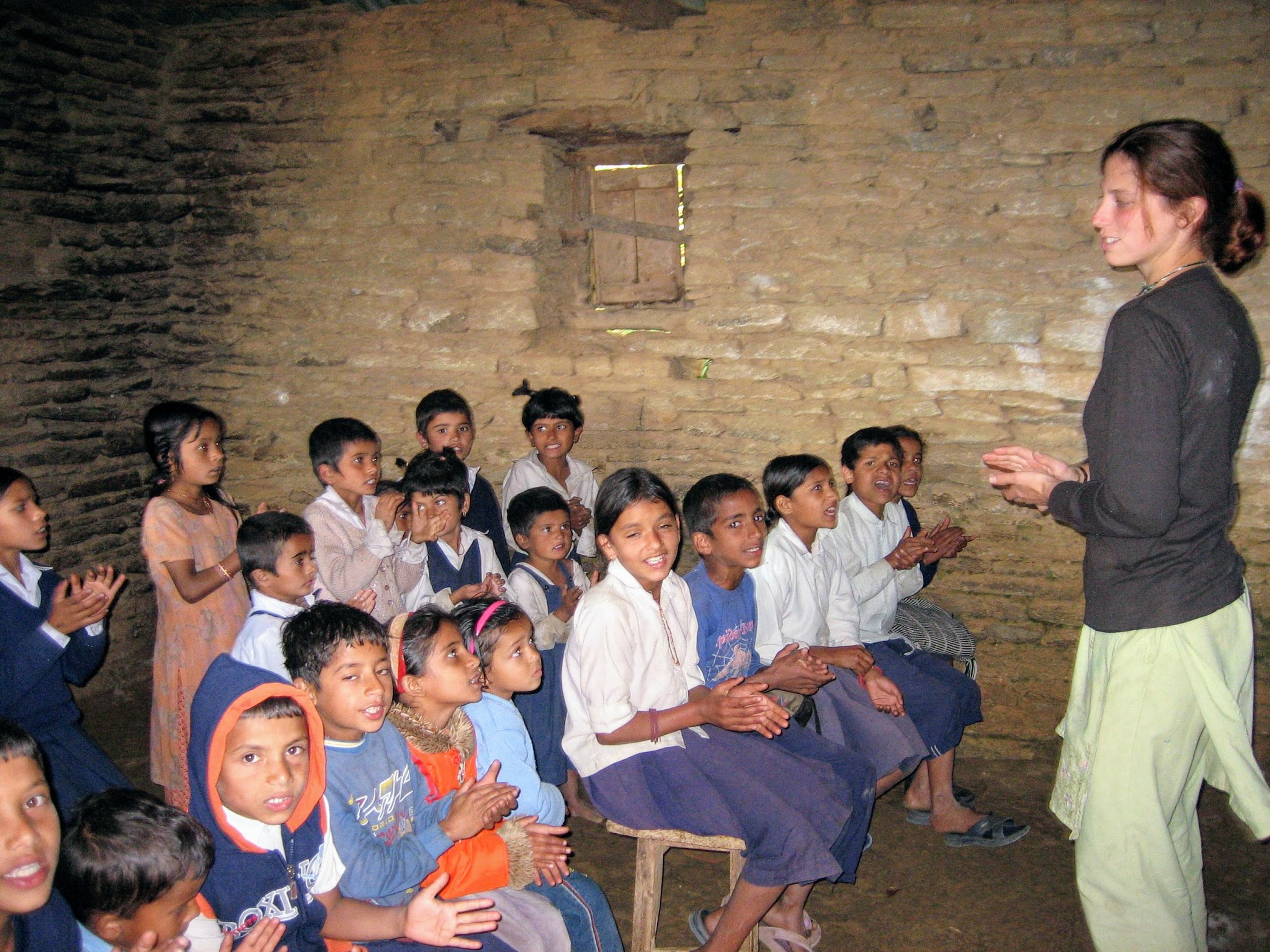
I walked across the yard and burst into the classroom, declaring joyously that today is an American festival. Govinda and I wrote “Thanksgiving” in big letters in English and Nepali on the board, and below that, “I am grateful for____” in Nepali.  Then I explained the purpose and practice of Thanksgiving: how we gather with family and friends and think about the things we are thankful for in our lives.  I described a turkey, stuffing, and mashed potatoes. I briefly re-enacted the story of the Mayflower and Plymouth Rock, albeit in a simplistic way that swerved around colonization and focused instead on legendry itself.  The usually chattery room of lit faces quieted and watched me closely, with that deliciously infuriating mix of doubt, amusement, and insatiable interest which has driven me to madness a million times over. 

When I finished explaining Thanksgiving in America, I declared that today we would have Thanksgiving in Nepal.  First, I asked, what should we eat?  

I got a lot of blank stares.  

Listen, it’s important that there’s a lot of eating, I insisted. It’s Thanksgiving.

“…Rice?” someone finally ventured.  

“Rice!”  I agreed enthusiastically.  Govinda wrote it on the board.  The answers began to pour in.

“Vegetables!”

“Dal!”

“Roti!”  

“Excellent idea. But what kind of roti?” I asked.

They went for them all. “Fried roti!  Rice roti!  Millet roti!”

Soon the kids were shouting out every food they could think of too fast for Govinda to write them down.  “Rice Pudding!  Noodles!  Curd!”  The bare room clamoring with noise.  For encouragement, I swayed in anticipation of our upcoming feast.

When the menu was complete, and I passed out notecards so everyone could write what they were thankful for.  This took quite a while and, sadly, ended up being the least successful part of our Thanksgiving.  They didn’t understand it.  Maybe being thankful for certain things implies being less grateful for other ones, which upon reflection is something of an indulgence.

Finally all the kids stood up and we rearranged the benches into a makeshift table with everyone sitting along the sides. I was surprised at how satisfied I felt by the result.  It looked less like class and more like Thanksgiving, all these small bodies crammed in around our long table.  The stone walls became our castle and the dirt floor quieted down to observe with us.

Guru-Sir was in charge of the legend.  I don’t know what it was because he told it in Nepali, but all the kids listened with rapt attention to some story about the history of Nepal and Kaskikot.  Then we gave thanks—and while this was not, as I said, entirely satisfactory, most were thankful that Laura-Miss had come from America, so I forgave them for copying each other.

At last, it was time to eat.  

Leaning forward from my seat on the bench, I reached for an invisible bowl in the center of our improvised table.  I heaped a spoonful of air-rice on to my imaginary plate, piled a few kinds of roti next to it, and started eating.  Everyone blinked at me.

“Aren’t you all going to eat?!” I said through a mouth full of fruit.  “There’s a lot of food here.” I indicated our scribbled list on the blackboard.  

There was a bit more silence while I stuffed myself hopefully.

“THIS IS AN ORANGE!” Krishna shouted. (Krishna is incapable of speaking to me without shouting.)

“Oh!  Give me one!” I cried, cramming it into my face.  Soon I had kids shoving food at me from every direction. I did my best to add each offering to my plate, but the treats were coming at me so fast that I began to slouch, holding my stomach.  I took a bookbag and shoved it under my shirt, eliciting a satisfying explosion of laughter.  Then I couldn’t convince them I was full.  So I tried swaying, then sleeping, and then fainting, but I was still pressed to put some rice pudding in my pocket for later.  I finally had to stand up and say firmly, “Thanksgiving is over!  Go outside and play.”

*Sada Shiva Classroom


Pictures of Schools

all 710I had heard that there was a small school in the woods, facing south, far below the road that cut through Kaskikot along the mountain ridge.  On a late fall morning in 2002 I went looking for it.

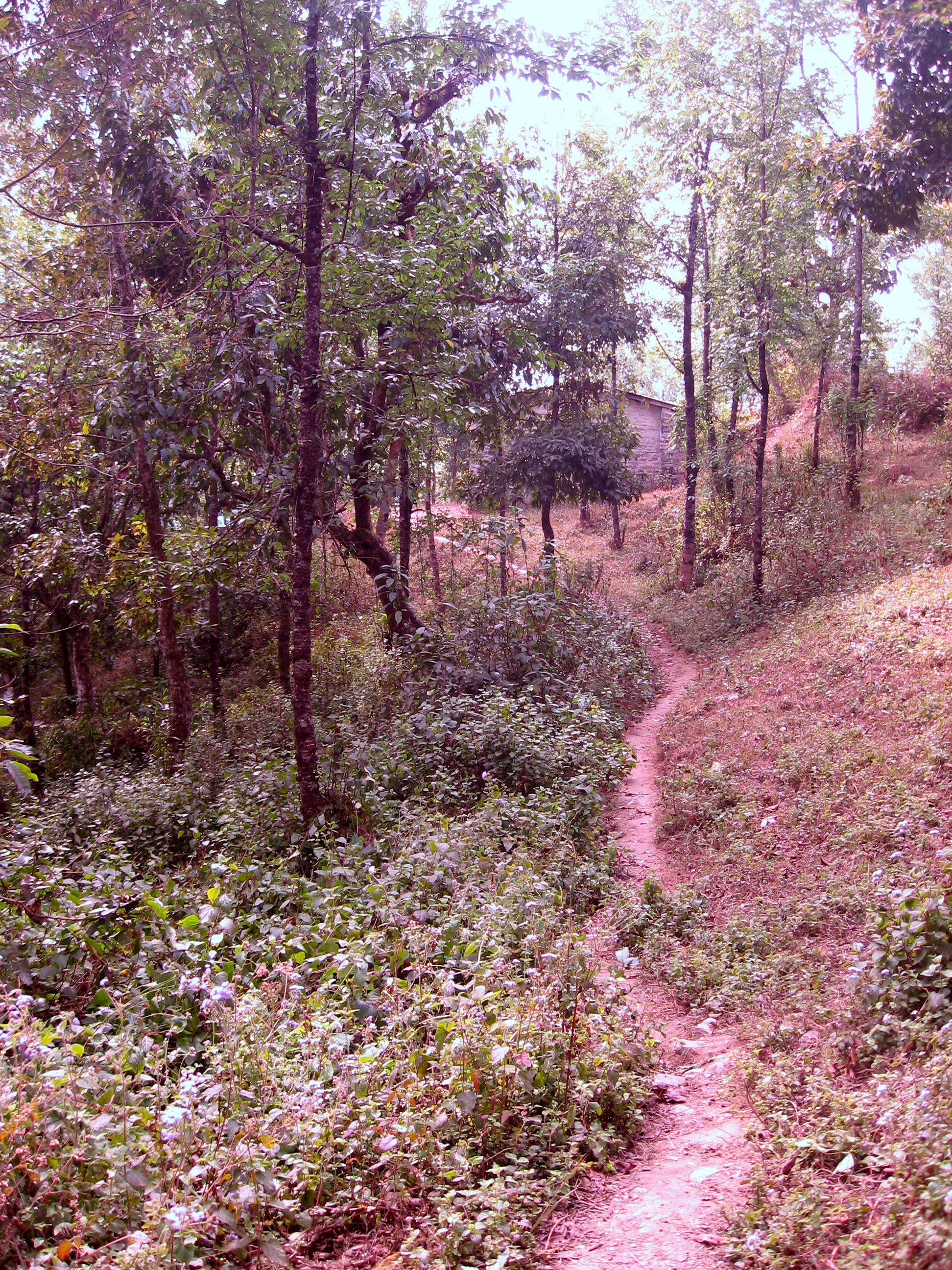
I followed a descending path of broad stones as far as the village mill, and from there I turned onto a winding footpath that halted and dropped and navigated roots in the ground and in some places seemed to disappear entirely.  Soon I heard no sounds except the whir of the trees and the suggestive rustle of an occasional monkey in the tall grass.  I passed a spring and a temple.  I came around a bend.  And then, demurely, as if waiting for a visitor, a stone wall appeared in a clearing up ahead.

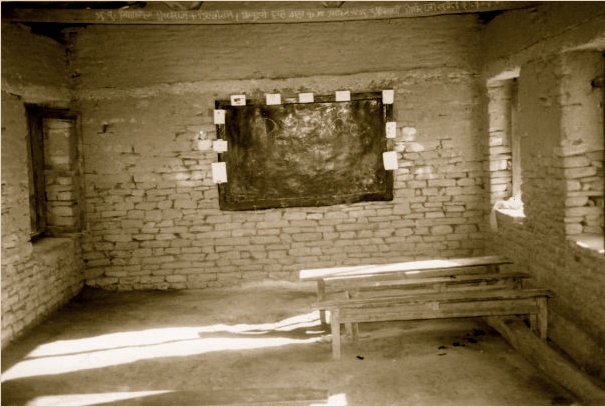
I approached the building and emerged from the hushed woods into its open yard, a bald mound of dry dirt looking out over forests and terraced fields.  The view extended all the way down to the valley floor, but the school ground still felt hidden among the trees.  There were two piled stone buildings with wooden shutters and doors, most of which were missing panels, the gaps blocky and conspicuous like missing teeth in the open-jawed windows.  I peeked in to some of the classrooms and saw benches sitting mid-wobble on the dirt floor, facing blackboards whose still-fading scribbles bespoke prior lessons.  These objects regarded each other diplomatically, as if ready for anything but expecting nothing soon.

When I’d left the United States, I hadn’t decided where I was going to end up.  China was a leading Sada Shiva (Class 3?) - Version 3contender.  I was offered a position in a school with 2000 students. My mother didn’t want me to go to Nepal—there was an insurgency happening.  I didn’t know anything about any of these places.  I didn’t speak Chinese, for example.  I spoke French.  I was a terrible candidate to do any reasoning on the topic.  One day, in Bhutan, I was sitting still doing nothing except worrying about where I was going next, when, with as little ceremony as a tenant entering his flat, a picture of a small classroom floated in to my mind and landed there.

To this day I can’t explain why, but I knew that classroom was in Nepal.  I was going to Nepal.

I wound my way back through the forest, past the spring and the temple and the mill, and up a different set of ascending broad stones, I emerged again onto the wide bus road along the ridge.  Directly across from me a man was sitting in front of his house on a low wall.  He was wearing simple brown pants and a V-neck sweater over a long sleeved shirt, and chatting with a round-bellied man dressed in the clothing of a Brahmin priest.

The two men called me over and asked when I had arrived in Kaskikot and what I would be doing there.  I told them I had just been to a small school in the woods, whose name I had forgotten, but where I was hoping to teach.  As it turned out, both of these men were teachers at that school, which was called Sada Shiva Primary.

The man in the V-neck sweater introduced himself as Govinda Prasad Paudel, the English teacher.  For the next two and a half months Govinda and I walked the wooded path back from school together every day.  During that time our friendship was formed, and instead of calling each other by name, we began to follow the Nepali tradition of addressing one another by a familial relation.  I called him daai, or “older brother,” and he called me bahini.

00012004050900500061