Dubai

IMG_4085My layover in Dubai was eight hours.  Long enough to trek back and forth many times along the glaring fluorescent strip of duty free shops betwen terminals one and two.  It was daytime in Dubai, but for me it was the no-time that happens during a trip from one hemisphere to another.

I wandered in to one of the bathrooms and soon found myself looking for an earring that had dropped.  A young employee who’d been sitting idly when I walked in came over to help me.  As I was shuffling through my belongings she noticed a coin.

“This is from Nepal,” she said.  “Have you been?”

Yes, I said, I’d been.  We got to talking in Nepali right away.  I wasn’t surprised to find out
that Mandira is 26 years old with a 1-year old baby she left in Nepal with her in-laws and her husband, who is also waiting for a visa to travel abroad.  When I asked what she’d paid a manpower company to broker her position in the Dubai Airport bathroom, I already knew roughly what the answer would be: about 10,000 dinars.  Her salary: 900 dinars per month.  It would take her a year to pay off her loan to the company before she started earning anything to send back to her family. It will be a few more years more before she can afford the 3.5 hour flight home to see her then four-year-old child.

It’s a typical story but it’s still amazing to see it in action without having to try. This kind of position has become so preferable to looking for local employment in Nepal that I don’t even have to leave the duty free section of the airport to find Mandira.

The flight from Dubai to Kathmandu is a special kind of cultural experience.  You step out of a hip multinational terminal in to a waiting area where almost everybody who isn’t a white person wearing hiking boots and tie-dye is a Nepali person returning home from a labor contract.  For many it is the second flight of their entire lives.  A large percentage of passengers have none of the practiced movement that comes with routine air travel.  There’s a lot of helping each other find seats, opening and closing latches to see what they do, gazing out the window at baggage trucks, calling to one another across the rows to look at this or that.  It’s about as close as you can get to walking out of an airport and getting on a city bus in Kathmandu that launches in to the air.

On the plane I immediately leaned against the window and tried to sleep.  I’d been traveling for 20 hours.  The young man next to me was quiet and stared straight ahead, and I assumed that he, too, was an amateur passenger just surviving the journey.  After an hour of half-sleeping, I sat up, and as I jostled my position, we exchanged a few words.

“My father just died,” he said.

I drew in my breath.  “I’m so sorry,” I said.

“I came straight from duty.  I don’t have a bag with me or anything.  I came straight to the airport and bought a ticket.”

“What happened?” I asked.

“He was in the U.K.  I work at a hotel in Dubai.  My family just got back to Nepal with his body.  After we land I have to take a 10 hour bus ride home, because they are waiting for me to start the rites.”  He stared ahead. “I usually talk to him quite often, but we hadn’t talked in about three days.  I don’t know why.”

The snack cart came along.

“Can I get you something?” he asked.  I declined, but he asked a few more times, and I declined again.  He bought a sandwich for himself. He asked the boy in the aisle seat – who didn’t look any older than 18 – what he wanted.

“Many of the new ones are scared,” he explained softly.  “So we help them out.”  He bought the boy a cup of tea.  “Are you sure you don’t want anything?”

“I’m really okay,” I said.

He opened and closed his sandwich.  “I’m not supposed to be eating this food,” he said.  “We have traditions – it’s called kriya.

I know about this of course.  It’s not just the sandwich.  The death of this young man’s father should have immediately been followed by 13 days of eating food cooked as part of a series of rituals, without salt, and by wearing only white clothes with no seams, and by sleeping on the ground, and by drinking special water, and by not touching any other people, and by daily pujas and bathing. He should have shaved his head.  But he was crammed next to me on a floating bus.

He took a bite of the sandwich.  “I haven’t had anything to eat or drink since yesterday,” he said.  “Actually, I haven’t talked to anyone.  Now I’m talking to you.”

“I can’t imagine how hard it must be in this strange situation,” I offered.  “It will be good to be in the right place with your family where you can do…all the things.”

“Are you sure you don’t want any of this sandwich?”

“I’m sure.  Thank you.”

“I usually talk to him often.  I don’t know why we hadn’t talked the last few days,” he repeated.

He gazed over the sandwich again to the back of the next seat.  “There’s no point in being sad now.”  He ate a chip.  “I can’t think of what to do.”  He offered me more of the sandwich.

I asked after the details of how he’d get from the airport to a friend’s house to the bus to his house.  It seemed like the only relevant thing to discuss.  Everything else was either too small or too big.

“So you will be with your mother and siblings by morning,” I said. I told myself that things would make more sense then. I wanted to believe that it would be better when he knew what to do.

“Yes.”  He gave the rest of his sandwich to the trash pick-up.  “But when I get there, you know…it will be real.”


Between Worlds

Read this series here.

IMG_2479Over the years, I have witnessed many passages in Nepal.  Marriages, coming of age ceremonies, births of animals and people, and deaths of many kinds. The weather itself has a careless drama about it, demanding reverence for the seasons and relentless passage of time…when it is hot, it’s time to plant millet; when there is a full moon, it’s time to fast; when a distant glacier becomes heavy, it’s time for it to break apart, time for the river it lands in to overflow in a torrent, time for an entire village to be swept away.  When it is morning, it’s time to get up and cook breakfast.
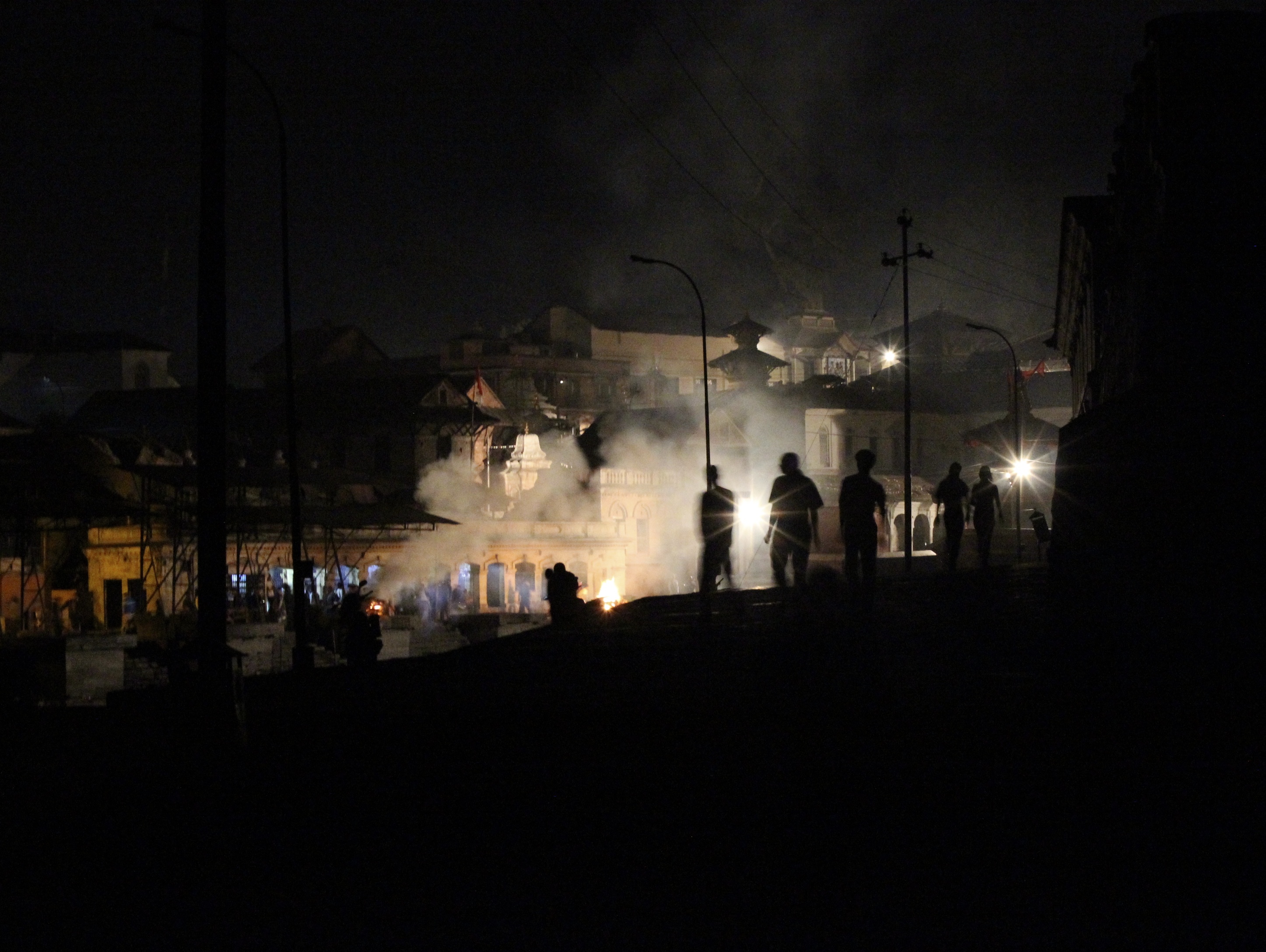
The intimate relationship between people and cycles in this part of the world is one of its most moving qualities.  I think it is a hard thing to see if you have always been inside it. But I am outside of it.  And peering in, I am endlessly preoccupied with how a single human existence can be subtly accepted as a grand and meaningless expression of a larger constellation of forces and relations and nature, awesome because it is small, not because it is unique.  I only notice this because I learned to see myself as separate from the moment I came in to the world.  In the West we gain power, intelligence and purpose from our individuality.  But it’s something I can’t explain to Aamaa.  There simply isn’t a vocabulary to say that my life possesses a greater idea than the idea of the universe itself.

I know I’ll never be comfortable with this fact.  Instead, I am perpetually drawn to these rites of passage, which integrate our small lives with those of our ancestors, with the cosmos, with God and with the future.  Perhaps it’s like continually trickling cool water into a wound that will always burn.

This winter I’ve decided to start a project that has been some time in the making. Since I first began coming to Nepal in 2002, young men have flooded out of the country for migrant labor in gulf countries; last year, over 300,000 people left for that purpose alone.  A surprisingly large number of these young men die abroad, and when they do, normal mourning rituals are turned completely upside-down.  Many of the essential features of customary mourning become impossible.  My project will document the way that families have adapted ritual grieving when their sons die overseas.

Nepal’s funerary customs in the weeks that immediately follow a death are called kriya.  There is great intelligence and beauty in these rituals, which provide a structured role for the community and extended family in sharing grief, reaffirming ties, and placing the life and death of the deceased in to a coherent cosmic story.  Many aspects of kriya are austere and demanding, putting physical and mental purification above comfort, and imposing isolation as a sanctuary for the emptiness that follows loss.  When the kriya period ends, other rituals last weeks, years, and in some cases, forever.  Aamaa, a widow since age 23, hasn’t worn red in 35 years.  Anyone who meets her can immediately know without a word that she is widowed – if they are attuned to this custom.

Stories of grief and loss in other places have immense importance for us. Ritual grieving in American culture is increasingly short-lived and mainly the private domain of the bereaved.  Death as a matter of politics or policy or violence is in our media every day.  But mourning, the outward expressions by which we integrate death in to the un-ended lives of the living, seems to be on the periphery of our inquiry, at best.  In some ways, mourning is treated as an obstacle to our collective concern with affirming and carrying out our individual significance.

But mourning is a choice we make to ascribe meaning to our grief. It is a willful sanctification of our mortality.  We hope for the grace to extract from this some kind of redemption, something beautiful about life.  Or perhaps simply the courage to keep living.

In the course of this series, I hope to honor the beauty of Nepal’s kriya traditions, as well as a generation of young people caught in the ambiguous place between a world that has shattered and one that does not yet exist—at the threshold, in that empty uncertainty, where we are reinvented.

.    .    .

IMG_0640


Read this series here.

Thanksgiving


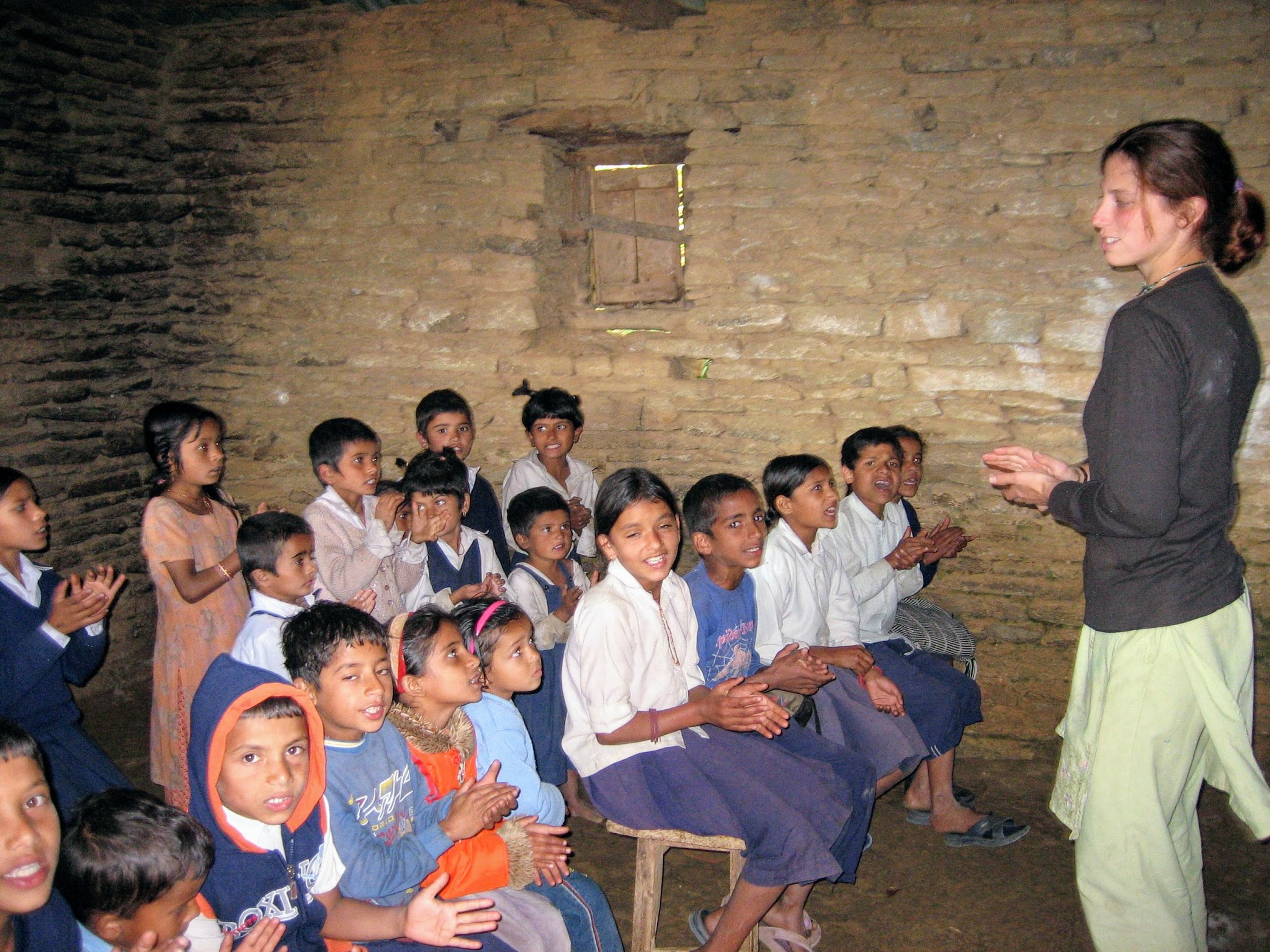
It’s Thanksgiving, and I had high hopes that the other teachers would participate in my holiday lesson. I arrived at school to find Govinda, Laximi, Guru sir, and Rita Madam already in the office, each at their usual stations. They seemed reasonably enthusiastic as I described Thanksgiving and my plans for class. Encouraged, I sorted out a few last vocabulary words and assigned various roles to everyone else. Even though my lesson wasn’t usually until recess, we decided to start Thanksgiving early because nobody was teaching their regular classes anyway and the kids were all running about.

I walked across the yard and burst into the classroom, declaring joyously that today is an American festival. Govinda and I wrote “Thanksgiving” in big letters in English and Nepali on the board, and below that, “I am grateful for____” in Nepali.  Then I explained the purpose and practice of Thanksgiving: how we gather with family and friends and think about the things we are thankful for in our lives.  I described a turkey, stuffing, and mashed potatoes. I briefly re-enacted the story of the Mayflower and Plymouth Rock, albeit in a simplistic way that swerved around colonization and focused instead on legendry itself.  The usually chattery room of lit faces quieted and watched me closely, with that deliciously infuriating mix of doubt, amusement, and insatiable interest which has driven me to madness a million times over. 

When I finished explaining Thanksgiving in America, I declared that today we would have Thanksgiving in Nepal.  First, I asked, what should we eat?  

I got a lot of blank stares.  

Listen, it’s important that there’s a lot of eating, I insisted. It’s Thanksgiving.

“…Rice?” someone finally ventured.  

“Rice!”  I agreed enthusiastically.  Govinda wrote it on the board.  The answers began to pour in.

“Vegetables!”

“Dal!”

“Roti!”  

“Excellent idea. But what kind of roti?” I asked.

They went for them all. “Fried roti!  Rice roti!  Millet roti!”

Soon the kids were shouting out every food they could think of too fast for Govinda to write them down.  “Rice Pudding!  Noodles!  Curd!”  The bare room clamoring with noise.  For encouragement, I swayed in anticipation of our upcoming feast.

When the menu was complete, and I passed out notecards so everyone could write what they were thankful for.  This took quite a while and, sadly, ended up being the least successful part of our Thanksgiving.  They didn’t understand it.  Maybe being thankful for certain things implies being less grateful for other ones, which upon reflection is something of an indulgence.

Finally all the kids stood up and we rearranged the benches into a makeshift table with everyone sitting along the sides. I was surprised at how satisfied I felt by the result.  It looked less like class and more like Thanksgiving, all these small bodies crammed in around our long table.  The stone walls became our castle and the dirt floor quieted down to observe with us.

Guru-Sir was in charge of the legend.  I don’t know what it was because he told it in Nepali, but all the kids listened with rapt attention to some story about the history of Nepal and Kaskikot.  Then we gave thanks—and while this was not, as I said, entirely satisfactory, most were thankful that Laura-Miss had come from America, so I forgave them for copying each other.

At last, it was time to eat.  

Leaning forward from my seat on the bench, I reached for an invisible bowl in the center of our improvised table.  I heaped a spoonful of air-rice on to my imaginary plate, piled a few kinds of roti next to it, and started eating.  Everyone blinked at me.

“Aren’t you all going to eat?!” I said through a mouth full of fruit.  “There’s a lot of food here.” I indicated our scribbled list on the blackboard.  

There was a bit more silence while I stuffed myself hopefully.

“THIS IS AN ORANGE!” Krishna shouted. (Krishna is incapable of speaking to me without shouting.)

“Oh!  Give me one!” I cried, cramming it into my face.  Soon I had kids shoving food at me from every direction. I did my best to add each offering to my plate, but the treats were coming at me so fast that I began to slouch, holding my stomach.  I took a bookbag and shoved it under my shirt, eliciting a satisfying explosion of laughter.  Then I couldn’t convince them I was full.  So I tried swaying, then sleeping, and then fainting, but I was still pressed to put some rice pudding in my pocket for later.  I finally had to stand up and say firmly, “Thanksgiving is over!  Go outside and play.”

*Sada Shiva Classroom