Holi

IMG_4612

Today was the festival of Holi. Weirdly enough, I’ve only been in Nepal once for Holi in twelve years, and that was back in 2004, when I was in Kaskikot and basically missed it. So this was the first time I’ve really seen all the action, and it was pretty much the awesomest holiday in the history of ever.

Holi is a Hindu festival that celebrates the equinox, the start of spring, the renewal of relationships, and most importantly, the triumph of good over evil. In a brilliant stroke of luck, this is done by having people throw colored dust and water on each other in the streets all day.  Water balloons are allowed.  Anyone is fair game. Dude taking out the trash? Fair game. Small child sucking their thumb on the curb? Fair game. Foreigner walking home with morning coffee and a laptop in her backpack? Especially fair game. Leave the laptop at home, idiot.

IMG_4601


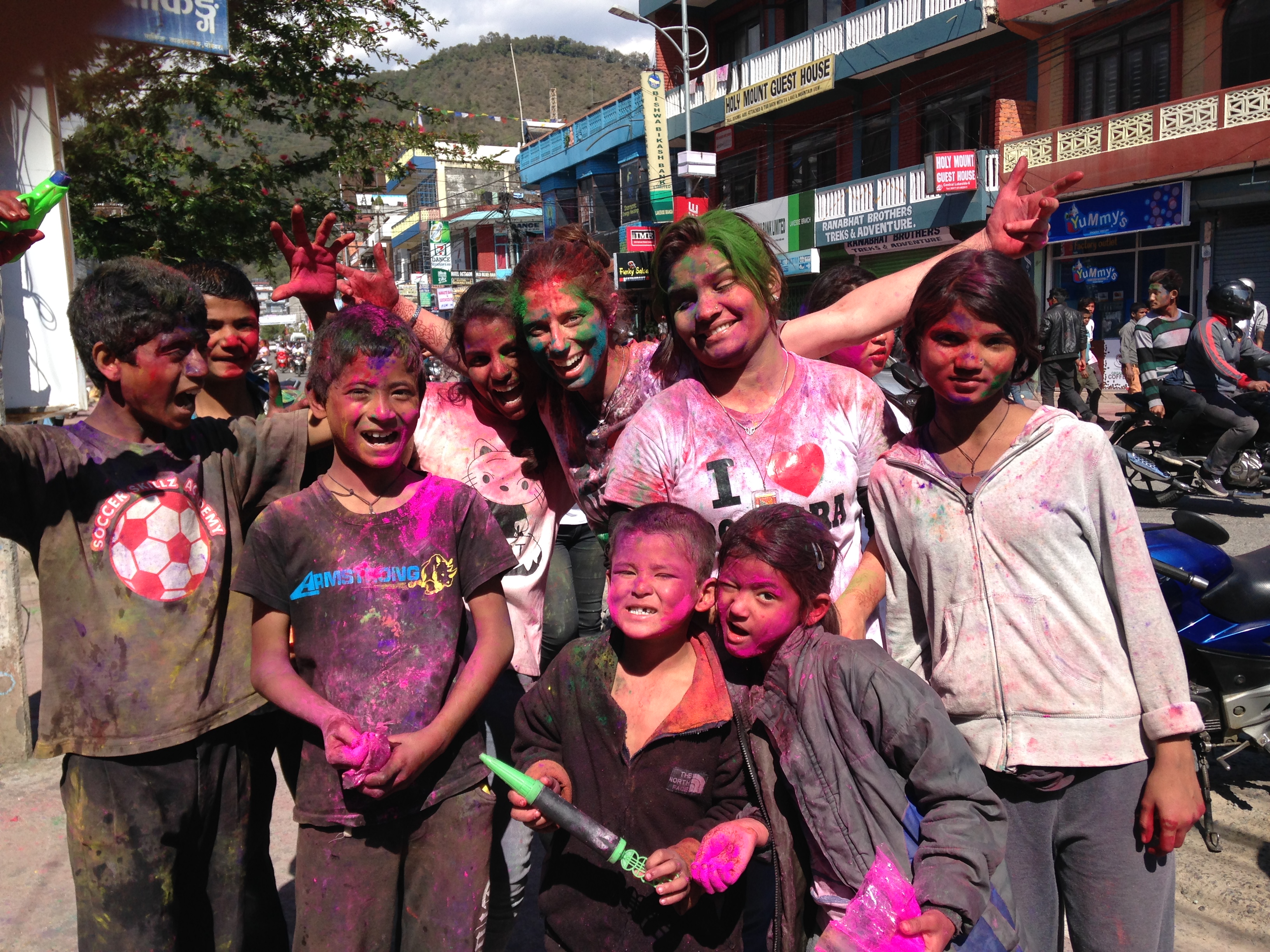
For weeks leading up to Holi, white clothes were on sale in every version and size. I got myself an “I Heart Pokhara” t-shirt and a cheap pair of pants, and on the morning of Holi I picked up some squirt guns and packets of brightly colored powder for the kids. I returned to the children’s home with my stash and presented them to the kids. They just looked at me like: you only got one squirt gun? What’s wrong with you? Sanjay filled up an empty plastic water bottle and dumped a packet of purple powder in to it. Someone had the excellent idea to poke a hole in the cap, and this bottle was to become our most potent weapon.

When we ventured out in to the street around noon, people were walking around with super soakers. I mean that kind where you spray the entire jumbo water cartridge continuously until it is empty. Poor little Laxu was carrying the mini squirt gun I’d given him that had to be refilled every three minutes through a flubbering hole in the side. We quickly began looking for a good deal on six more squirt guns.

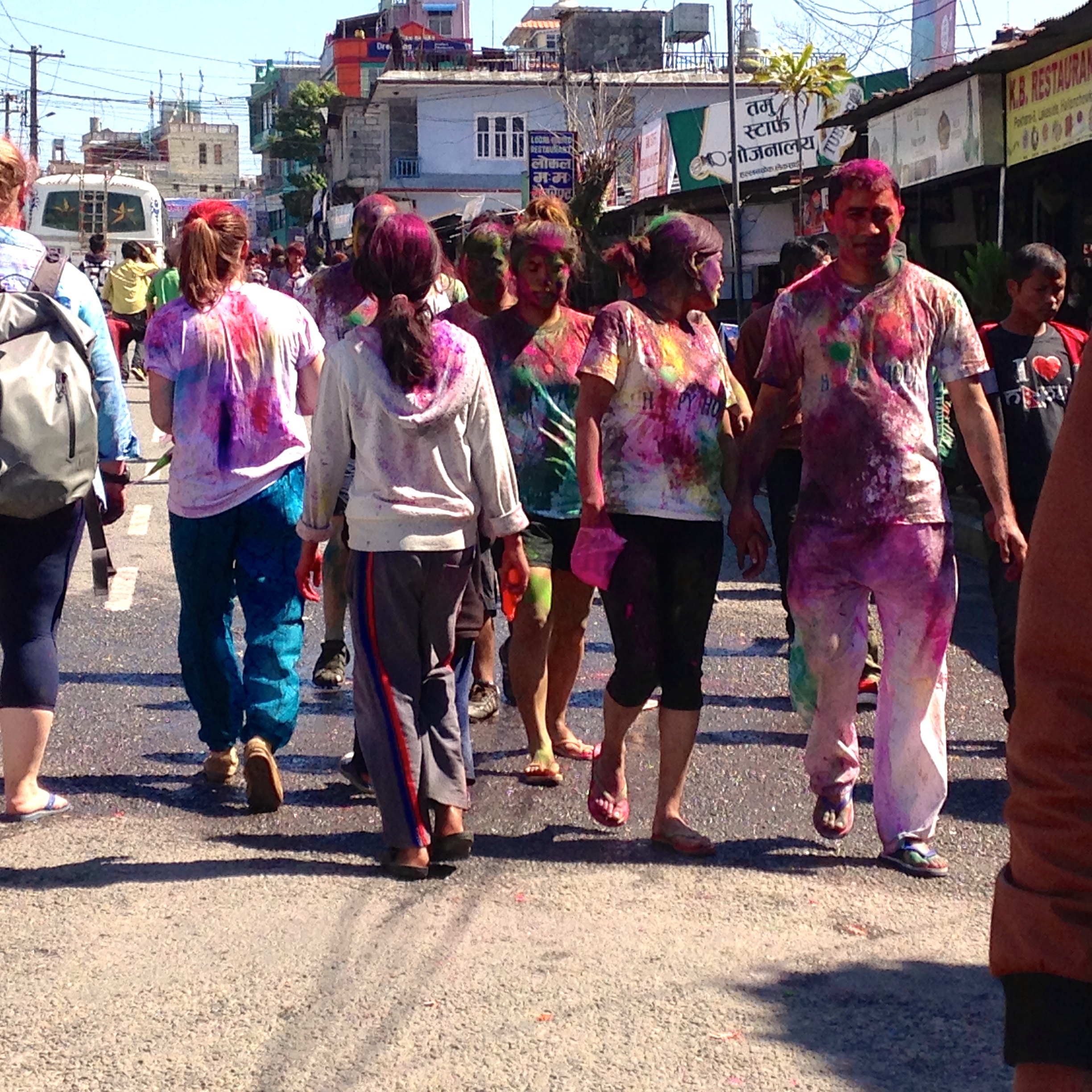
IMG_4611We walked the streets for two hours, and then our Gaky’s Light Fellows showed up and I went back in  for round two. For a culture that’s fairly concerned with propriety as a general matter, Holi is an unruly and joyous anarchy – all the best of the bright pandemonium that is Nepal. Clouds of yellow and pink and green puffing up in to the air over the crowded sidewalks while colored water sprays haphazardly on to soaked shirts and faces. Strangers running up to each other and smearing hot pink powder on each other’s cheeks. Hooting and yelling and rainbows exploding every which way. I was with a group of kids ranging from age 7 to 13, and everyone in the packed streets was acting just like them. It was magic.

I did learn a few critical pieces of wisdom that I hereby pass on to you.

  1. Keep your mouth closed. I realize that when someone is throwing a fistful of green powder on you or blasting your armpit with orange water, your instinct is going to be to squeeze your eyes an open your mouth in a gleeful expression of frolickness. But, your mouth is going to get full of green powder (that’s really bad) or orange water (which is just gross on principle). So frolic with your lips tightly sealed.
  2. IMG_4638Don’t be the douchebag who does the move where you grab someone else’s water bottle, bend it towards them, and spray them with their own water. Because first of all, I’m already wet, so you’re not as special as you think you are, and second of all, Sanjay made this water bottle and you’re ruining it, douchebag. Make your own water bottle and squirt me with that.
  3. Pay attention to the color distribution on your target’s shirt. Your target, if your target is me, wants to save this I Heart Pokhara shirt forever and ever, and it’s no fun if the entire thing just turns brown. Am I missing yellow? Would a splash of blue do well to bring out the hot pink? And aim for the empty areas, for Pete’s sake. I paid $3 for this t-shirt and I want it properly ruined with some sense of artistry.
  4. Hit me from ahead where I can see you. Because the first person to grab me from behind and putt purple powder on my face and up my nose will probably get away with it – partially because I’m not ready to drop my mini flubbering squirt gun to whoop your ass, since I’m holding on to it for this small kid I came here with. However, if you’re the second or third person, I reserve the right to take out a can of taekwondo on your poorly executed headlock, and that’s not going to work out well for you. I don’t like purple powder in my nose. Thanks.

Happy Holi, fools.

IMG_4631

Shooting Lights at the Sky


Didi, Pascal and Aidan and I left for the New Year’s street festival right around dusk. It was already jammed with people and food stalls, a challenge for us because, while Pascal carefully soberly dodges people’s legs and ponders over his food options, Aidan absolutely doesn’t care where he’s going, and he’s only about 3.5 feet tall, and he wants to eat everything he sees, and he can’t take his eyes off anything.  We got some ice cream, and some hot dogs, and some cotton candy.

At 9pm the Gaky’s Light Fellows showed up with arms locked in a blob. It was such a fantastic moment – they were all dressed up and so excited to be there together, and then they practically mowed me down in the street in a mob of happiness.  On the corner a crowd of people was dancing to some impromptu devotional drumming and singing.  So that’s how I ended up on New Years spinning around with Aidan on my shoulders and Pascal on my leg and our fellows clinging to my hands while we all danced in the street to a bajan.

The street crowd grew so thick that it became river.  I left Didi and the boys and waded in with our fellows – we were literally all holding on to each other and being carried down the street by a massive crowd.  Every once and a while someone would pick the person right in front of them and, just for fun, shout: “SANDIP IS LOST!” or “SOMEONE HOLD ON TO PABITRA, SHE’S SMALL AND WILL GET LOST!”  Samundra, our program director, had a scarf wrapped tightly around his neck.  “SAMUNDRA’S NECK IS LOST!” I cried.

Eventually, we got lost.  There were just too many people, our group was cleaved, and I ended up swimming along with Sabina and Asmita and Anju.  All the phone networks were jammed and we couldn’t get through to any of the others.  We were finally catapulted through a gate to the fair – I mean washed over the threshold while clutching each others jackets, past a wall of police trying to look for tickets. We came tumbling out next to a ferris wheel like Alice in Wonderland.

We dusted our selves off and looked around.  It was 10:30pm.  There were lights and huge objects everywhere, surreal and dizzying.  The four of us stood locked together so we wouldn’t be separated in the hectic sea of people, until we boarded a boat that swings back and forth on a pendulum.  We let people in line pass us until we could get a spot all the way at the tip of the boat, where we had the highest view, where all the strange fair lights streak across the sky and the top of the ferris wheel is right there, and you can’t ignore the moment the boat reverses direction and you’re suspended for an instant in mid-air with nothing under you.

By this morning, Pokhara looked like the day after the worst frat party you’ve ever seen.  Trash, tables askew, dejected looking tents, all kinds of equipment and decorative paraphernalia sagging with a January 1st hangover.  Even the sunrise seemed weary.  But it was pretty worth it while it was happening.  Welcome to 2015, World.

Which reminds me of something.  When we’d left for the street festival, Aidan had been begging for a new light.  Throughout the festival they’ve been selling slingshot lights with wings that sail way up in the air and then slowly float down, so the night was full of beautiful falling blue lights.  Pascal, like me, is enthralled with the light but cautious of losing it, and kept his slingshot safe in his pocket most of the time.  Aidan on the other hand is completely reckless.  He’s too excited about shooting the light up in to the air to worry about what happens to it, and we had rescued his flying toy from more than one rooftop on tuesday night.  Each time it got lost he was utterly dejected, and then we’d retrieve it, and he would go right back to catapulting it at the night with unbridled enthusiasm.

“Laura auntie,” Aidan explained to me as we walked in to the street again on New Year’s Eve, “when you shoot the light, it goes up toward the sky like this.”  His put his hands over his head and pointed his little fingers toward his palm, in an angled T-shape, to show the way a light sails toward the sky.  “But then just when it’s about to touch the sky…” his eyes got big and his palm drifted up “…the sky MOVES, Laura auntie!  The sky MOVES!”

.      .      .

IMG_4160


If I Can’t Say Namaste


Last Saturday evening I came home with a fresh bundle of vegetables from the market, but Aamaa said we’d be cooking without salt. A man at the house near the water tap in Rotepani passed away yesterday. Aamaa and I ate plain rice with ghee for dinner.

It wasn’t until the next day that I realized I knew the one of the bereaved daughters. “Malika,” Aamaa said, “Don’t you know Malika?” Of course. I remember her hanging around with Didi and Bishnu back when we were all in our early 20s, before anyone was married. “The really skinny one?” I asked. Yes, that Malika. Her father, in his sixties, had been ill for about a month.

This has given me an opportunity to pay respects during a traditional period of kriya, when a man with grown children has lived an honorable life and passed away at an age that, in these parts, is considered decent.

On the sixth evening of kriya, after Aamaa and I had eaten dinner, I rounded up Neru and Kanchaa from next door. Lighting our way with flashlights down the stone path toward Rotepani, we left for Malika’s house.

As we approached the house, a warm mist of voices bubbled up in the cold black night. We found a tarp stretched out over the yard from the edge of the roof, to shelter the stream of visitors from sun during the day and provide some warmth at night.

Three men were sitting on the mud-smoothed porch, leaning against the wall of the house. I recognized Krishna dai, who I’ve known since the first week I came to Kaskikot twelve years ago.

“Namaste,” I said, raising my hands.

“We don’t say Namaste now,” Krishna dai said.

“Sorry.” I looked down.  I had trouble figuring out where to replace my hands.  Lesson one, of many.

Malika’s brothers were peering through the door of an attached room on the small house – I’m guessing that at some point it was used for goats – sitting on the ground with white blankets wrapped around them, like bowling pins. Until the thirteenth day they will only wear new white clothes with no seams, and they’ll wash these clothes daily.

We talked quietly with Krishna dai and the other men outside for about ten minutes. They are all friends and relatives of the deceased. Their role is to sleep on mats on the porch and guard the door of the house, because the sons are not to touch anyone or anything during kriya.

“For example, if a chicken comes by,” Krishna dai said, “we shoo it away. So it won’t touch them.”  This seemed awful and gorgeous.

Krishna dai asked about our mourning traditions in the United States. I said they vary a lot according to religion and habit, but that I am Jewish, and our rules mandate a quick burial – strictly speaking, we don’t cremate. I explained how we have a gathering where people stand up and tell stories about the life of the person who has died, so that everyone can share and honor these memories in one place. The sons leaned in closely by the door of the goat room to listen to me. I said we bury our dead in a special place that’s marked with a stone, where we can return to do puja and be with our loved one. That we return from the cemetery and wash our hands and fill our stomachs with food, and people stream through our houses with flowers and food while we sit shiva – a mourning period when we keep our homes full of life, because we must keep living. By contrast, kriya imposes strict and challenging rules on almost every movement of the bereaved: fasting, washing, praying, isolation, burning. In some ways, everyone has died.

It occurs to me now how little I know about the orthodox dictates of Judiasm and mourning. Is there a period of purification? I have no idea. I could look it up easily for this post. But it’s more interesting that I have no idea.  So I’ll look it up afterwards.

As we were talking, a slight woman with her uncombed hair falling over her shoulders came out of the house. Malika and I haven’t seen each other in about eight years, but she heard my voice from inside the house. Despite the circumstances, it was a really lovely moment. There wasn’t a lot that needed saying, other than, “I heard.”

We entered the small house. Malika’s widowed mother was sleeping by herself on a bed of straw – she too must observe kriya for thirteen days. “Say ‘Aamaa,’” Malika said.

“But what do I say if I can’t say Namaste?” I asked.

“Just say ‘Aamaa,'” Malika said.  So I softly said, “Aamaa,” and her mother sat up.  There wasn’t really much more to add after that.

But just on the other side of a low wall, a crowd of women was gathered around a fire, where a kettle of tea was brewing for all the visitors. Mourning customs for daughters are lighter than for sons and wives: Malika and her two sisters observed kriya for four days, and on the fifth day, they added salt to their food and were allowed to touch other people.  Their straw beds, upgraded now to straw mats, are still arranged on the floor of the house. They’ll sleep there together and continue cooking their own food and eating only once a day for thirteen days. Their hair will stay uncombed until then.

Neru and I sat by the fire for about an hour. Between other chatter, the huddle of women asked me all kinds of things about death rites in the U.S., and also about my family and what I’ve been up to. There was lots of quiet laughing. We spent a long time on the topic of marriage, which, in these parts, is almost always arranged by parents. People here are endlessly enthralled by the concept that I am tasked with finding my own spouse.

“Love marriage,” I said by way of explanation.  Here the phrase has an illicit undertone, like eloping. “That’s our culture.”

An old lady next to me was having trouble following. The expectation she’s always known is that you are paired with a spouse who is astrologically compatible with you and socially compatible with your family, and then you sign up for a life together, and then you go from there. A younger auntie jumped in to help out.

“Love,” the auntie said, looking up at us from her seat by the fire. “When two people make things work between them—that’s love, right?”

.      .      .

IMG_6015

Between Worlds

Read this series here.

IMG_2479Over the years, I have witnessed many passages in Nepal.  Marriages, coming of age ceremonies, births of animals and people, and deaths of many kinds. The weather itself has a careless drama about it, demanding reverence for the seasons and relentless passage of time…when it is hot, it’s time to plant millet; when there is a full moon, it’s time to fast; when a distant glacier becomes heavy, it’s time for it to break apart, time for the river it lands in to overflow in a torrent, time for an entire village to be swept away.  When it is morning, it’s time to get up and cook breakfast.

The intimate relationship between people and cycles in this part of the world is one of its most moving qualities.  I think it is a hard thing to see if you have always been inside it. But I am outside of it.  And peering in, I am endlessly preoccupied with how a single human existence can be subtly accepted as a grand and meaningless expression of a larger constellation of forces and relations and nature, awesome because it is small, not because it is unique.  I only notice this because I learned to see myself as separate from the moment I came in to the world.  In the West we gain power, intelligence and purpose from our individuality.  But it’s something I can’t explain to Aamaa.  There simply isn’t a vocabulary to say that my life possesses a greater idea than the idea of the universe itself.

I know I’ll never be comfortable with this fact.  Instead, I am perpetually drawn to these rites of passage, which integrate our small lives with those of our ancestors, with the cosmos, with God and with the future.  Perhaps it’s like continually trickling cool water into a wound that will always burn.

This winter I’ve decided to start a project that has been some time in the making. Since I first began coming to Nepal in 2002, young men have flooded out of the country for migrant labor in gulf countries; last year, over 300,000 people left for that purpose alone.  A surprisingly large number of these young men die abroad, and when they do, normal mourning rituals are turned completely upside-down.  Many of the essential features of customary mourning become impossible.  My project will document the way that families have adapted ritual grieving when their sons die overseas.

Nepal’s funerary customs in the weeks that immediately follow a death are called kriya.  There is great intelligence and beauty in these rituals, which provide a structured role for the community and extended family in sharing grief, reaffirming ties, and placing the life and death of the deceased in to a coherent cosmic story.  Many aspects of kriya are austere and demanding, putting physical and mental purification above comfort, and imposing isolation as a sanctuary for the emptiness that follows loss.  When the kriya period ends, other rituals last weeks, years, and in some cases, forever.  Aamaa, a widow since age 23, hasn’t worn red in 35 years.  Anyone who meets her can immediately know without a word that she is widowed – if they are attuned to this custom.

Stories of grief and loss in other places have immense importance for us. Ritual grieving in American culture is increasingly short-lived and mainly the private domain of the bereaved.  Death as a matter of politics or policy or violence is in our media every day.  But mourning, the outward expressions by which we integrate death in to the un-ended lives of the living, seems to be on the periphery of our inquiry, at best.  In some ways, mourning is treated as an obstacle to our collective concern with affirming and carrying out our individual significance.

But mourning is a choice we make to ascribe meaning to our grief. It is a willful sanctification of our mortality.  We hope for the grace to extract from this some kind of redemption, something beautiful about life.  Or perhaps simply the courage to keep living.

In the course of this series, I hope to honor the beauty of Nepal’s kriya traditions, as well as a generation of young people caught in the ambiguous place between a world that has shattered and one that does not yet exist—at the threshold, in that empty uncertainty, where we are reinvented.

.    .    .

IMG_0640


Read this series here.

Outsiders

I woke up inside the mosquito net and thought, as I do every year, that it was going to be a shame to leave that delightful hiding place.  And for the first time, I found myself filled with downright resistance.  Usually on this morning, I lie in bed and enjoy the mini-world inside the net falling around me, its soft waking sounds and obscured view, and I feel the stretch of my existence from one world to another.  The sun peeks under the ruffle of the corrugated tin roof and draws a squiggle in the mirror. The prospect of departure highlights the distance and the miracle of my life’s cartography, and I float for a moment in an expanse of sadness and gratitude.  But today the other end of that fishing line felt so far away and tenuous that I just had to get out of bed and not think about it too much.

IMG_2785 - Version 2Leaving Aamaa is always the single hardest part of leaving at all.  I’ll call from home, but it’s hard for us to chat on the phone.  So much of our relationship is a physical presence; it’s moving together in this space.  When our communication is reduced to words and sieved through my imperfect language skills it becomes thin and stilted.  It’s hard for me to explain my life in Connecticut, and to understand life in Kaski through an update over the phone.

But even more important is that as I get older, Aamaa and I have a simple and innate perception of each other’s aloneness.  So on this morning, we orbit like two electrons, knowing this great force is about to separate us, and it seems like the loneliest thing in the world–because we sense each other’s singularity in addition to our own.

Sunrise was grayed out and respectfully subdued.  As the clouds gathered, Maya bouju came over and she and Aamaa and I sat on the porch drinking tea.  Soon a thick fog had rolled in and I could barely see out past the faded tomato vines in the garden – we were literally sitting on an island of yard inside a cloud.  And in that new configuration, looking out at the blankness, I felt the stretch at last.  That’s how exactly how it was: the three of us sheltered from the chaotic world in our temporary clearing, putting off the imminent moment when I would have to set down my tea cup and walk back in to the unknown.

.     .     .

IMG_3427 - Version 2

Rice Pot Literacy

IMG_2668A year or two ago, Aamaa starting making noises about getting an electric rice cooker.  Of all things, right?  I am constantly baffled by the perceived awesomeness of this contraption in a place with no plumbing, no heat in the winter or A/C in the summer, no political system, and widespread illiteracy, where the one thing that people have been doing for hundreds of years with no problem whatsoever is cooking rice. In pots. And never mind that in the winter, there’s load shedding for up to 16 hours a day.

Nevertheless, it is a thing.  By some mysterious process, the rice cooker has become the iPhone of the rural Nepali woman, just like TVs became standard in Kaski’s mud-and-stone houses when so many kids left the village to work abroad, where they send home just enough money to cover a few celebrity amenities.  Now a TV I can understand.  But a rice cooker?  I used to say that about cell phones – remember how we used to just call each other on landlines?  And that worked fine?  Aamaa used to cook rice in a pot, from 56 years ago until last June.  It’s not about whether it’s fine.  It’s about having a celebrity rice cooker.

So last year when Bishnu was visiting, she picked up a rice cooker for Aamaa.  And of course, Bishnu went for a large, impressive looking one – even though Bishnu should know better than that by now.  Because first of all, when you put rice for one or two people in a large, impressive rice cooker, you get a wide, unimpressive rice pancake.  And let’s not forget that there’s no electricity half the day.  So I arrived this year to find that when the electricity comes on, the first thing Aamaa does is rush to plug in the big electric rice cooker.

No matter what time of day it is.

IMG_1042This is how we have found ourselves eating a room-temperature rice pancake as our 2013 featured dinner entrée.  And the thing that blows my mind is that it’s not like Aamaa doesn’t know what hot, properly prepared rice tastes like. It’s the only meal she’s eaten for her entire life.  But this rice-cooker-chilled-pancake-system inexplicably retains its a status of superiority in the face of damning evidence that it is terrible.

“You know, Aamaa,” I said as we were eating the rice-pancake the other day (for the record, it can literally be cut like a pie), “the rice cooker is too big.  You should have a little one, like I have in Connecticut.”

Aamaa’s expression widened.  “Really?  Do they make small ones?”

Sometimes life is so strange.

“Yes Aamaa, they’re just—they’re just like that one, but smaller.  So you can cook less rice in it and it won’t come out like a roti.”

Ehhhhh,” Aamaa cooed.  “If you see one of those, will you get me one?”

I wasn’t sure how serious she was, but the next time I was in Pokhara, I decided to get Aamaa a 1-liter rice cooker.  Like the one I have, in Connecticut.

I brought the small rice cooker home the other day and we unwrapped it on the front porch.  It was like the Second Coming.

“Look at this pot Laura got me!” Aamaa has been telling the neighbors.  “It’s the perfect size.”

The fourth beloved grandchild of the family is introduced to all visitors. Aamaa takes it out and points to its dainty circumference and shiny exterior.  Then she and I regale the neighbors with stories about the failings of the large rice cooker – it makes rice like a roti, for goodness sake – and swoon over the shimmering, earth-shattering perfection of the small rice cooker.  Which is just right for two people.

Or one person.  Like my rice cooker, in Connecticut.

As we were eating our fluffy rice today, I couldn’t help being re-amazed that Aamaa, as my protector and general knower of all things, had no idea that the big awesome rice cooker was too big and awesome.  For somebody who can build anything, cook a complex meal over a fire with no measuring devices and not a single taste test, detect subtle changes in the mood of the buffalo, and nurture soil and seeds with a nuanced literacy that is invisible and incomprehensible to me, it seems completely incongruous that she didn’t look at the rice cooker and think, “That’s too big.”

I am so used to Aamaa’s highly technical and nimble mind that it never stops surprising me to run in to the boundaries of her experience. I remember during my first year in Nepal, I got first-grade primers so that Aamaa and I could learn to read together.  I started copying new letters and sounding out the phonetic alphabet.  It turned my world upside down the first time I watched Aamaa try the same thing and saw that she copied letters slowly and awkwardly like a child.  Why wouldn’t she?  I sifted grain like a child.

The rice cooker more than anything has reminded me that we simply have different types of literacy.  Most of Aamaa’s life has been extremely repetitive, and she moves in it with a technical and intuitive agility that I think few people in my world ever have the chance to know – if only because of the much wider range of experiences we have to integrate.  I think that makes us more adaptable across novelties and habituates us to thinking relationally; it’s what allows me to look at a new situation or task and decode it or try out variations in my mind.  But Aamaa just doesn’t encounter nearly as many new situations in her life, so instead, she knows the ones that are familiar to her with a level of subtlety that maybe only Olympic athletes and ultra-dorky mathematicians ever encounter where I come from.

So much so that even the rice cooker, which seemed just a few degrees removed from Aamaa’s mainstream world, turned out to be a static event for her, not something to be adapted or improved the way the millet seedlings can be tended to in the garden.  Now I’m trying to get her to use the “warming” feature, so that when dinner gets cooked at 3:06 pm, it stays warm as long as possible.  I mentioned this the other day when Aamaa rushed to unplug the cooker rather than leaving it with the warming light on.

“Aamaa, it’s going to get cold,” I said.

“I don’t want it to overcook,” she said.

“It’s just…” I sighed. “…Warming.”

Right.  It’s warming but not cooking…that makes no sense, does it?

IMG_2675

The Value of a Dollar

This was the fastest trip I’ve ever had to Nepal – I don’t know where it went!  Apparently, my Nepal life which was once just in Kaskikot and at a little primary school has been divided in to multiple villages and cities.  On the other hand, the more time goes by, the more I find things grow in depth rather than width.  As much as I seem to run around, during the last two months I’ve been much more aware of the dimensionality that time adds to the same routines, and it seems more important than any of the cutting-edge details of this project or that.

Last week I went with Govinda to visit his father in law in Begnas, because he was Buba (Govinda's Father in Law) - Version 2diagnosed with terminal stomach cancer in August.  I first made the trip to Begnas when Govinda and I were teaching together in 2003, and it became one of our most legendary adventures – we still tell tales of how I climbed in the orange trees, and sat with Bua while he cut vegetables, and we all slept up in a tiny attic–this elderly man insisted on giving me his bed (I was a 23 year old collegiate rower) and he slept on the floor and I could not convince him otherwise.  As we were all lying there in the dark, he slowly and carefully asked me questions like, “Nani, Little One, in your country, what do they eat at weddings?” “Nani, in your country, what do the roads look like?”  I told him about elevators and the job market and hot water taps.

Bua worked as a security guard in India for five years and is not as sheltered as he sometimes pretends to be. But he is the gentlest human being I have ever met and every tiny detail of the world seems to move him.  He has a way about him that is intimate and unceremonious at the same time.  Most of his wealth from working abroad was lost to loans he made and never demanded back – how would they pay?  On that magical trip to Begnas with the orange trees, Bua asked to see a rupee from my country and I gave him a dollar bill which he folded in half and put away.

00012004050900500110In the decade since, Bua has come to visit me in Kaski every year that I’ve been here.  Each year he’s older and more frail but he takes a few bus rides and schleps all the way to Kaskikot, and we never know when he is coming; he just arrives in the yard one morning.  Aamaa and I beg him to sit and eat with us before he goes and he always says he has to get home to do this or that.  Every single time he says, Nani lai dekhna paeyo, “I got a glimpse of the Little One, I have to go now,” and then he schleps all the way back to Begnas.  Once I brought him a poster of a photo of the moon.

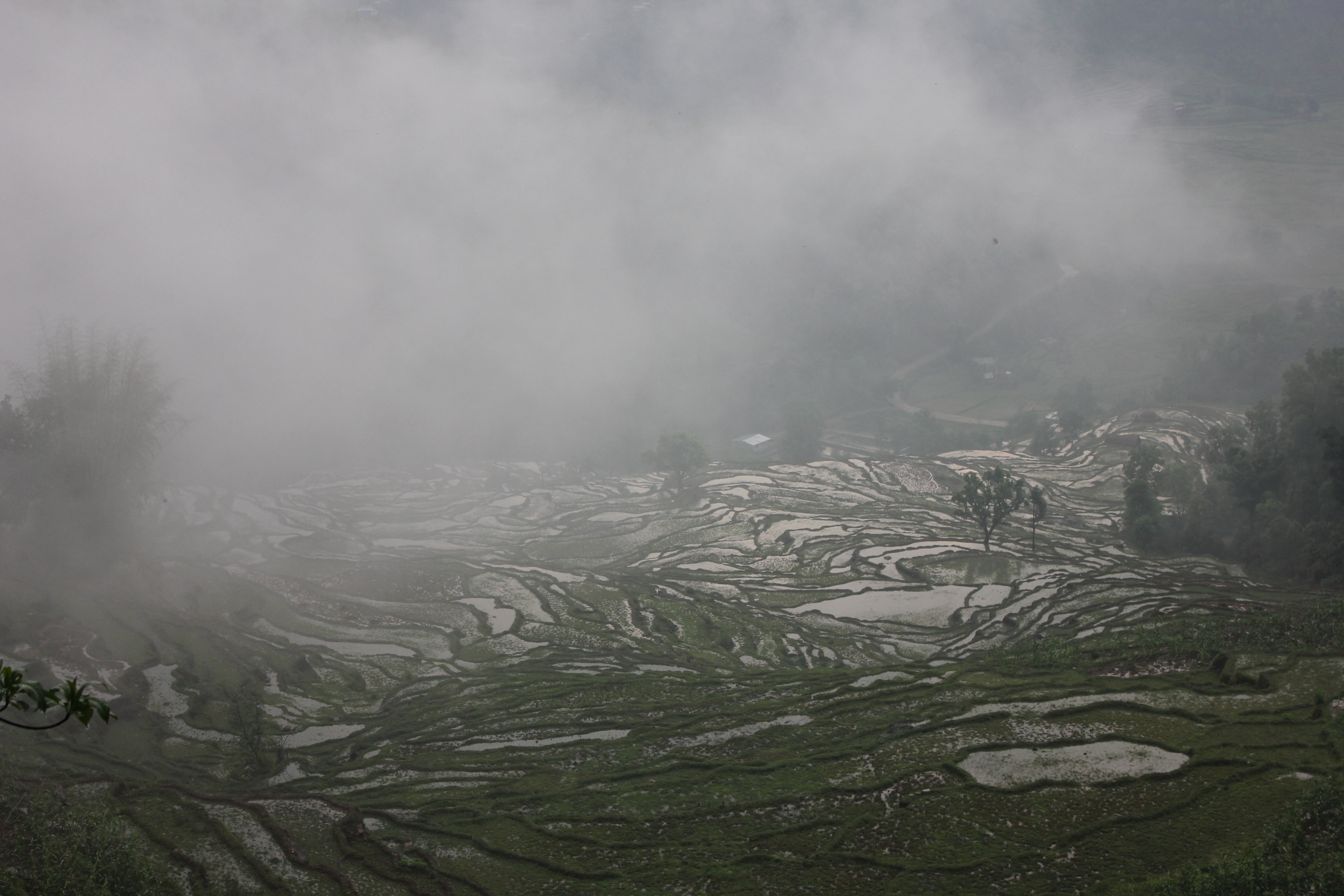
Last week Govinda and I went back to Begnas to see Bua during his last months of life.  It poured on the walk there and the rice paddies turned to mirrors under the clouds.  We spent the night at a relative’s house he has moved in to, in a space over the buffalo shed and under the slant of a corrugated tin roof, which sloped down over our heads and stopped in thin air, leaving an unobstructed drop to the ground and a view out to the hills.  The sheltered stone paths and trickling water of Begnas are quiet and patient like Bua, so different from Kaski’s dramatic himalayan perch.  He had asked for a light from the U.S. – maybe they make them better in my country – and I gave him a red metallic maglite that he tucked under his pillow.  We chatted some, about India, and then we fell asleep.

The next morning we got up to leave and Bua walked us down a path from the house to the dirt motor road.  He is barely more than the circumference of his bones, but still moves with an elegant deliberateness with no notice of my constant, automatic haste.  He stopped on a random set of descending stones in the trees and turned around.

“Nani, you won’t be back again till next year.  Me – maybe six months, who knows.  I’m in a lot of pain.  I am going to die now.”  In his unhurried way, he reached in to his breast pocket to get something.  I could hardly believe my eyes when he unfolded a dollar bill.  Ten years later, it still looked perfectly new.  He looked at it and shook his head, and in my mind I heard him say, “Nani lai dekhna paeyo–I caught a glimpse of the Little One–I have to go now.”

He put the dollar back in his pocket, and sent us on our way.

IMG_3279

IMG_3336 - Version 3


Boxes and Glass Cases

It’s been a tough arrival.  The monsoon is still clinging to the hills, thick and cloistering, and each afternoon it dumps an unremitting rain that I swear to God follows everybody inside.  The air itself is full of water; there’s no place to be dry.

And the truth is, I am also a drop suspended in mid air.  I’ve moved out of my apartment in New York, but I haven’t moved in to a new apartment in Connecticut, so all my things are in boxes in my parents’ basement.  The plan is that when I get back in two months I’m going to be working in a manual therapy clinic in Hartford…but it hasn’t actually happened yet.  It’s an idea, hovering in good faith around some boxes in a basement, waiting to be taken out and used.

That feeling has trailed me all the way to Pokhara–the hint that my life is full of theories.  Even IMG_2479though my contact with my projects in Nepal has increased a great deal in the past year through Skype and regular written reporting, and I have files and files of documents proving to me that these creations are real, they still feel like experiments when I re-encounter them on the ground.  Plus, there’s a big disappointment right off the bat: our first program director has left unexpectedly, after growing the Kaski Oral Health Care Project much less than we’d hoped since last fall.  I’m tired and frustrated and it’s enough with the freelancing.  I am ready to feel like I know what I’m doing, and some of this fits together, and it’s leading somewhere that matters.

Today it led back up the road to Kaski.  I went to Vindivasini Temple this morning to catch the bus on its way down, so I could save a seat before the bus arrived at the park, where a crowd  gathers around the door and starts pushing in to secure real estate for the ride up before people can even get out.  As I waited, I sat on a stoop with my duffel by my feet, watching a man selling vegetables across the road.  And I wondered again if this is all some kind of act.  I’m just doing the same thing over and over.  I can’t keep my grasp on what it’s about.

Other than a story.  The word comes to me again, and then again: Story.  Right out of the blue, at nine in the morning, I’m sitting on a stoop waiting for a bus, watching a man weigh a cauliflower, and the next thing I know I’m watching a story, and my identity is divorced from my soul.  Poof!  I am a character.

It must be natural that when you go through enough repetitions of something, even something incredible, it becomes unmoored from any particular episode.  And with that goes its singular miraculousness, because it’s just what it is: a cycle.  How profound would the sunset be if you only saw it once in your life?

Sometimes the sense that everything is just a series of events, with nothing transcendent to tie them together, seems like the most awful thing possible.  Even the leaves clinging to the trees look worthless.  But in certain moments, that same arbitrariness erases the perpetual burden of discerning the purpose of each passing instant, and my role in things is set free from an anchor that, in truth, may never have been there.  What a relief.

This morning I watched the vegetable vendor.  The story settled around me, like snow in its glass case, shaken from the sky.  I waited, again, for the bus to take me up to Kaski, where I knew Aamaa would be waiting.  Again.  For me.

IMG_2638

An Eclipse For Small People

P1010918My first solar eclipse was in sixth grade.  Our science teacher, Max – I went to a progressive school where we called our teachers by their first names, so I actually had a real science teacher named Max – took us outside and we sat in the grass, next to a blacktop, near the soccer fields.  In groups, we held something up in the air and peered through it, a notecard with a hole in it, or something like that.  I don’t recall exactly.  The entire memory is just an image of us, kids, sitting by the blacktop, holding a thing up in the air and squinting.  I found it rather tedious.

My second solar eclipse fell on the festival of Maghe Sakranti.  Before the solar eclipse, there had been a number of times when Maghe Sakranti had coincided with the day of my departure from Nepal, so over time, during visits when I found myself still there for this festival, Maghe Sakranti and its associated rituals had taken on a special flavor of celebration.  We were still together.

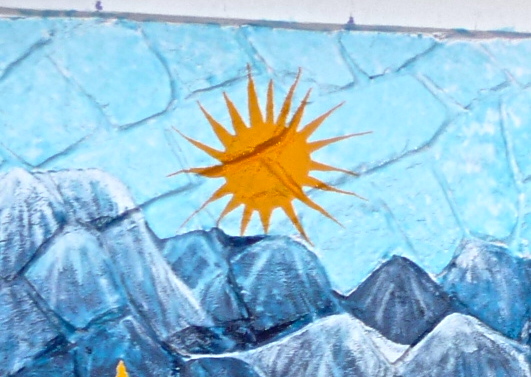
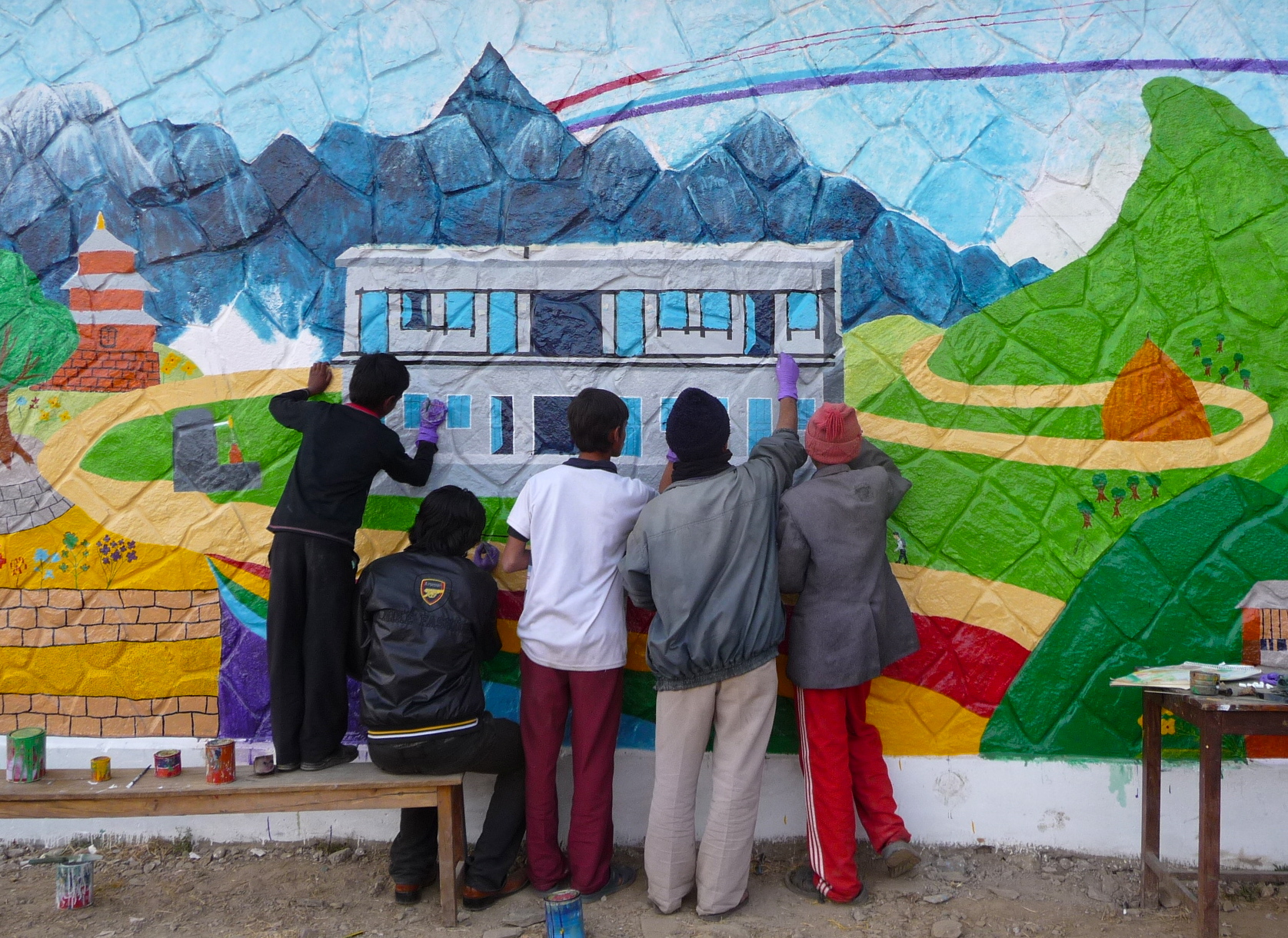
In the days leading up to the eclipse, I was at school from early in the morning right up until dusk, painting. Govinda and the kids and I were rushing to finish a mural before yet another departure.  It was a picture of their community: haystacks and houses, the whipped-cream shaped Kalika Hill with its little temple at the top, a paraglider sailing overhead, and road winding around from one place to the next, with a dominating school at the center.
P1010876 - Version 2

As the day of the eclipse approached, there was a great deal of anticipation.  Everyone was talking about it.  Once, Aamaa said, she’d been out during a solar eclipse and, just like that, it had turned to night.  They’d been forced to wait for a few hours until it got light again so they could go home.

Now that was something I wanted to see.

I went to visit Thakur sir, the astrologer, to get his opinion on a gift.  Back home, a great healer and teacher of mine was losing her eyesight.  I had purchased a necklace with the symbol kali chakra on it, and I wanted to ask about taking it up to the temple to be blessed, or infused, or something of that sort.  I wasn’t exactly sure, but I thought Thakur sir would know what I meant to ask.  A solar eclipse, he said, would be a very auspicious day to bless a necklace, even though it wasn’t allowed to do a puja during the hours of the eclipse itself.  And, once the necklace was up there at the temple, at the top of the Kalika hill, I couldn’t take it away until the eclipse was over.

The movement of necklaces was one of many things couldn’t happen during the eclipse.  Everyone would fast, of course, from exactly 12:36pm to 3:30pm, and many people would fast the whole day.  Any water in the house would have to be poured out after it was over, and replaced with fresh water from the tap.  It is wood cutting season, and trips to the forest were put on hold for the day.  And Maghe Sakranti was, for all intents and purposes, cancelled.

In the U.S., a solar eclipse is, for the majority of busy people, a science project for kids.  But here, where astrological charts are consulted for even the opening of businesses and choosing of brides, everything seemed to slow down as the days spiraled towards a grand and humbling halt.  Gazing at the top of the Kalika hill against the sky, I could feel the world catapulting through the solar system to a particular magical position—a great thing getting closer and closer to us, small people, standing where we would witness the movements of the galaxy.

By the prior night, there were three buses waiting to take people all the way to Chitwan in the morning so they could bathe at the place where the Trishuli, Gandaki and Kali rivers meet.  First thing in the morning, Aamaa repainted the floors with a fresh layer of mud.  It would be a day filled with ritual.

Like the rest of the world, I had hoped to stay put for the solar eclipse…but the mural wasn’t finished.  We had painted and painted that week, trying to finish in time, but when we pounded the lids in to the tops of the metal paint canisters the night before what should have been Maghe Sakranti, our creation still wasn’t complete.  So I departed for school early in the morning, swearing to Aamaa I’d be back by noon so that I could eat before the fast.

I met Govinda in the road with the necklace in my pocket.  When I’d taken it out that morning, I’d been surprised to see how mysterious and powerful the kali chakra looked, separated now from the rows of silver and symbols in the glass case at the shop.  When we passed Thakur sir’s house, I put it in his hand and he gave it a long look.  I wasn’t sure if I’d actually end up giving it to my teacher back home. I thought I’d send it up to the temple during the solar eclipse, and then give it away later if it seemed appropriate.  I was afraid it might seem kind of silly, and ridiculously enough, decided I would ask the priest at the temple for an opinion when I went to retrieve it later; after the solar eclipse.

Govinda and I arrived at school to find the kids waiting anxiously, and out came the paint. I had stayed out past the witching hour, painting a mural, many times over my years in Kaskikot.  But there was no thought of that today, not in the quivering air, under the glare of that acute collective focus on the cosmos.  I was incredibly P1010864excited.  It felt huge and magical and a little ominous, and made me think about what it must have been like for ancient cultures that didn’t know the science behind such events.  It must have been incredulous and awful to see the sun – so reliable! – disappear in the middle of the day!
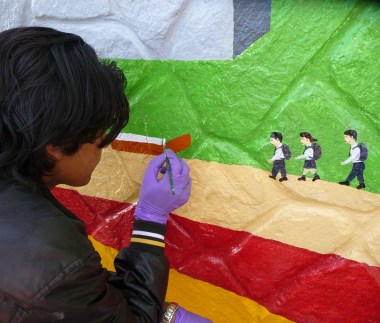
And that’s how we found ourselves rushing to complete our masterpiece before the stroke of noon, small people painting small people, the sun under the brush racing the sun circling in the sky.  “The eclipse is coming!” passers-by admonished us.  What were we doing out?

At 11:15, we decided we were done, and with terrible haste threw remaining paint in to boxes, picked up old gloves, ran and locked the office, forgot something in the office (Unlock the office!  The eclipse is coming!) and, at last, set off running down the road to get home before the eclipse struck us dead in the road.  Kids peeled off at their homes.  As we raced by in the dust, people called to us from their houses: Hurry!  The eclipse is coming!  There had been conjecture that we would see stars.  The entire world was about to evaporate.

I made it home by noon, in time to eat. One o’clock in the afternoon, twenty-four minutes after the official start of the eclipse, brought a subtle change in the quality of the light.

Bhinaju and Bishnu and I decided we would climb up the hill behind the house and watch from the resort.  We set to discussing what we should bring along.  A flashlight?  Poncho?  Extra sweater?  Rubber bands?  Camera?  (Would it be too dark for photos?)  We rummaged around and put some belongings together.  We climbed up to the top of the hill. And there I was, surrounded by a Himalayan panorama during a solar eclipse!  I wondered if I would be permanently altered, perhaps suffused with some kind of wisdom?

We sat in the grass.  We waited.

We stared earnestly at the sun for 30 minutes before admitting that we could see nothing.

We came home and sat on the porch.  It was a devastating disappointment.  I took out my journal.  I became impatient for tea.  As I looked a the water vessels and thought sullenly that we’d have to fetch new water before we could make tea, I considered the idea of “touched” water – that’s the word, chueko, “touched” water, the same word used for the impurity that a menstruating woman imparts to the things she contacts – and it occurred to me that all of these rituals – abstaining from pujas, fasting, dumping touched water – were fundamentally based in a fear of the awesome, not a celebration of it.  Too bad I wouldn’t see anything.  Even Maghe Sakranti had been cancelled.

For some reason, some of Aamaa’s old, beat-up x-rays were lying in a large envelope on the porch.  I have no idea why.  She’d had them taken when she was first sick, eight years ago; one of the slides showed her ribs and abdomen, a faded spine in the background, and another, a ball and socket joint.  Maybe they’d been deposited in this random location during a recent tidying, or while we’d been arranging articles to bring on our failed observation mission an hour earlier.

I was writing when Bhinaju suddenly said, “Laura, come here.”  He was standing in the yard, holding up the ribs and studying them.  I thought he wanted to continue a recent debate we’d had about the number of vertebrae in the spine.

“Why,” I mumbled.  “Vertebrae?”  I was in no mood to be proved wrong.

“Just come here.”  He switched to the ball and socket.

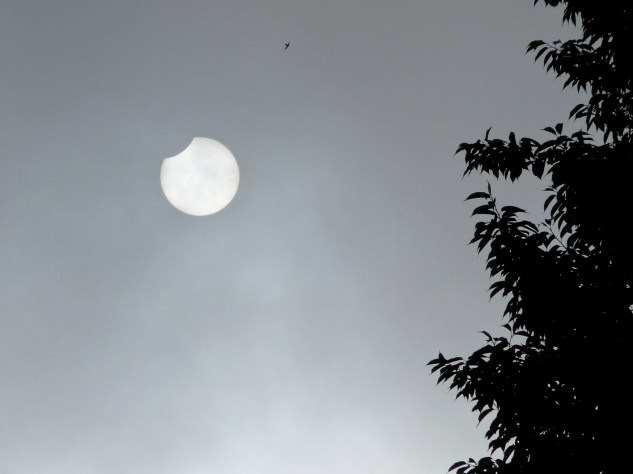
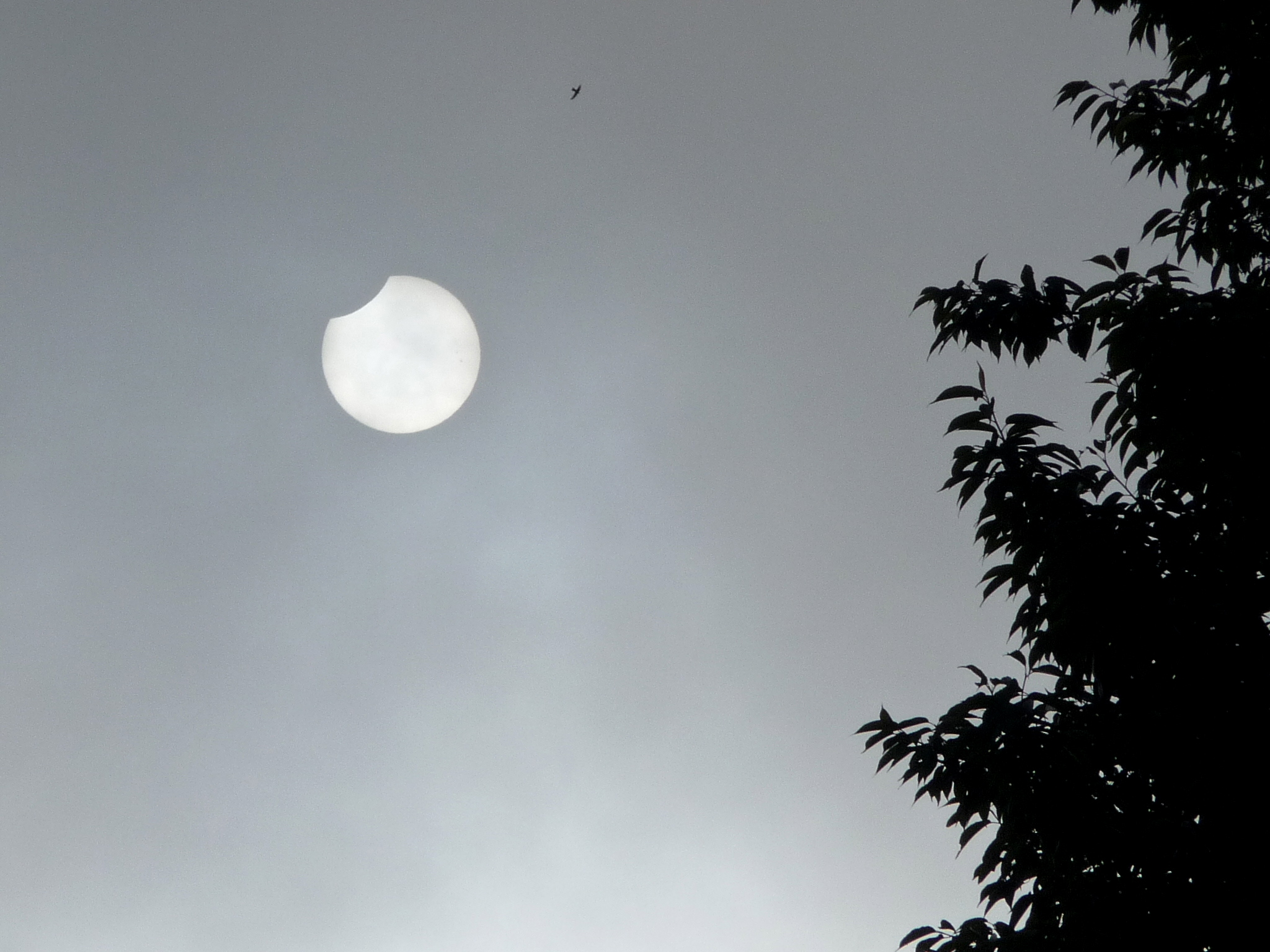
I got up and went to stand beside him.  And right there in Aamaa’s humeral head was a clean outline of the sun with a smooth bite out of the upper left-hand corner.

For the last twenty minutes of the solar eclipse, as the bite of shadow moved eastward and the sun became whole again, Bishnu and Bhinaju and I leaned together, small people, holding the x-ray over our heads and squinting.  We exclaimed and pointed and cried to each other: “The x-ray!  The x-ray!  It was here the entire time!  If we’d had it on the hill, what would we have seen?  What??”

P1020034