A Story

Back in Kathmandu, Tom and Jerry ends, and we turn off the television.  We eat our rice.  I mush the grains between my fingers but resist the temptation to try to give the meal special attention.  You can’t grasp a thing at the last minute if you weren’t paying attention along the way.

I repack my bags, and don’t get in bed till after midnight.  With the heat and mosquitoes it’s a long time before I fall asleep.  I toss and turn, thinking about watching Bishnu and Bhinaju get in the bus back to Pokhara, and about the strange idea of being even farther away than I am now.  It seems like, for the rest of my life, I will keep getting farther and farther away.  Which is strange because, even from Kathmandu, in a big bedroom where I can hear Nepali music videos playing on TV, Kaskikot feels like a memory, a separate universe where I once was.  I was there only a few days ago.

You know, it never has been missing it that I dread, or the thought of loneliness that fills me with worry.  It’s the shift from real to remembered, from substance to recall; it’s that the absence has no bulk when you get far enough away, and that life goes on and—even if you can remember to miss it, it’s so disconnected, so unreal, that it’s mostly just a story.  And what of the part of you that has become the story, the skin that has touched this world and walked on it and dug fingernails into its mud?  When all of it is farther away than the moon—which at least your eyeballs can see at night—is that part of you just a story, too, that only exists to the extent that you still believe you were there?

Wouldn’t that be something, if after all this, all I could bring home with me was a story.

*
OLYMPUS DIGITAL CAMERA

Pictures of Schools

all 710I had heard that there was a small school in the woods, facing south, far below the road that cut through Kaskikot along the mountain ridge.  On a late fall morning in 2002 I went looking for it.

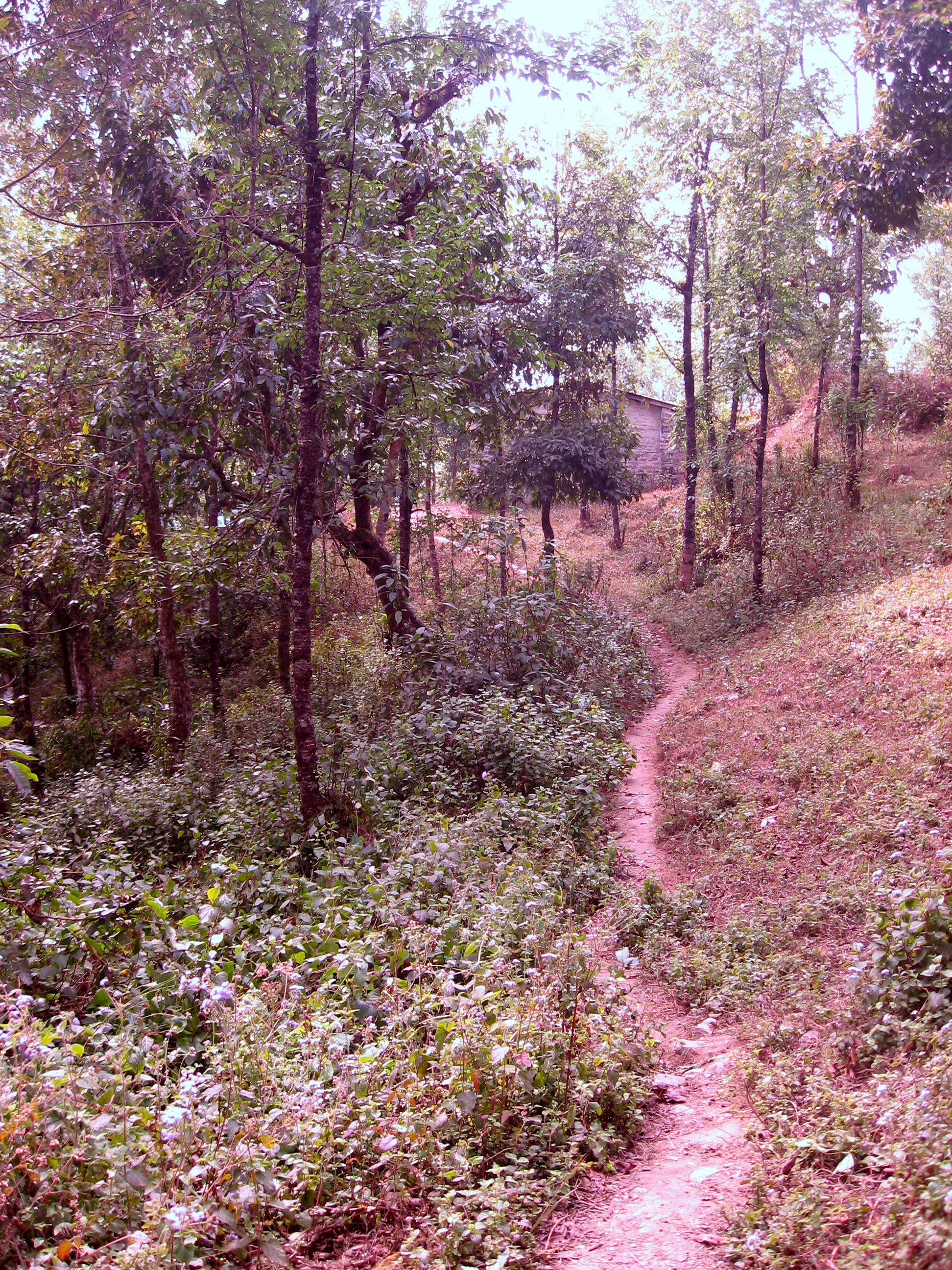
I followed a descending path of broad stones as far as the village mill, and from there I turned onto a winding footpath that halted and dropped and navigated roots in the ground and in some places seemed to disappear entirely.  Soon I heard no sounds except the whir of the trees and the suggestive rustle of an occasional monkey in the tall grass.  I passed a spring and a temple.  I came around a bend.  And then, demurely, as if waiting for a visitor, a stone wall appeared in a clearing up ahead.

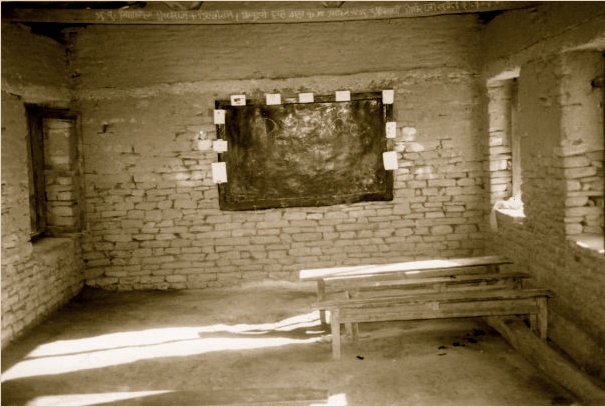
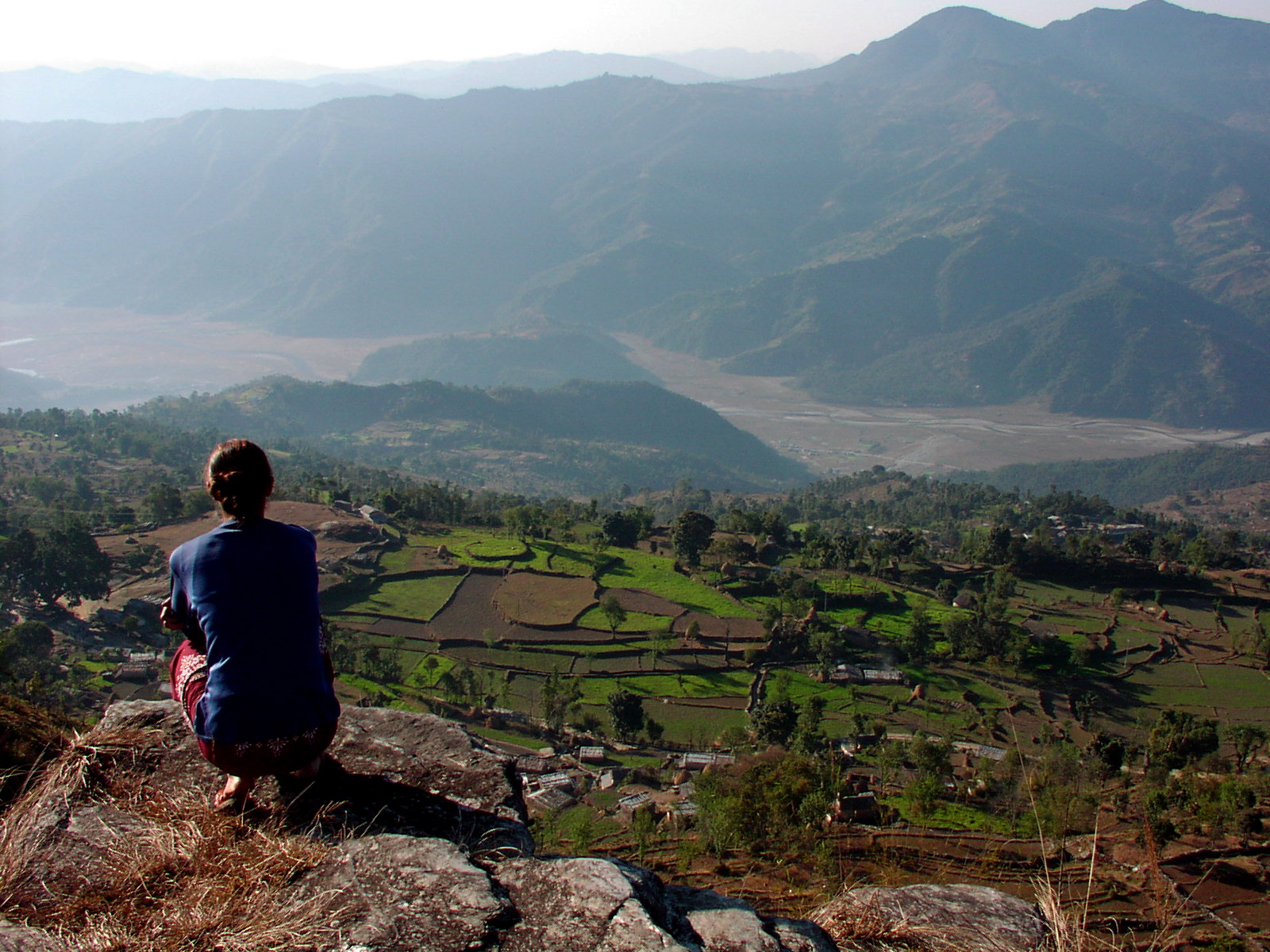
I approached the building and emerged from the hushed woods into its open yard, a bald mound of dry dirt looking out over forests and terraced fields.  The view extended all the way down to the valley floor, but the school ground still felt hidden among the trees.  There were two piled stone buildings with wooden shutters and doors, most of which were missing panels, the gaps blocky and conspicuous like missing teeth in the open-jawed windows.  I peeked in to some of the classrooms and saw benches sitting mid-wobble on the dirt floor, facing blackboards whose still-fading scribbles bespoke prior lessons.  These objects regarded each other diplomatically, as if ready for anything but expecting nothing soon.

When I’d left the United States, I hadn’t decided where I was going to end up.  China was a leading Sada Shiva (Class 3?) - Version 3contender.  I was offered a position in a school with 2000 students. My mother didn’t want me to go to Nepal—there was an insurgency happening.  I didn’t know anything about any of these places.  I didn’t speak Chinese, for example.  I spoke French.  I was a terrible candidate to do any reasoning on the topic.  One day, in Bhutan, I was sitting still doing nothing except worrying about where I was going next, when, with as little ceremony as a tenant entering his flat, a picture of a small classroom floated in to my mind and landed there.

To this day I can’t explain why, but I knew that classroom was in Nepal.  I was going to Nepal.

I wound my way back through the forest, past the spring and the temple and the mill, and up a different set of ascending broad stones, I emerged again onto the wide bus road along the ridge.  Directly across from me a man was sitting in front of his house on a low wall.  He was wearing simple brown pants and a V-neck sweater over a long sleeved shirt, and chatting with a round-bellied man dressed in the clothing of a Brahmin priest.

The two men called me over and asked when I had arrived in Kaskikot and what I would be doing there.  I told them I had just been to a small school in the woods, whose name I had forgotten, but where I was hoping to teach.  As it turned out, both of these men were teachers at that school, which was called Sada Shiva Primary.

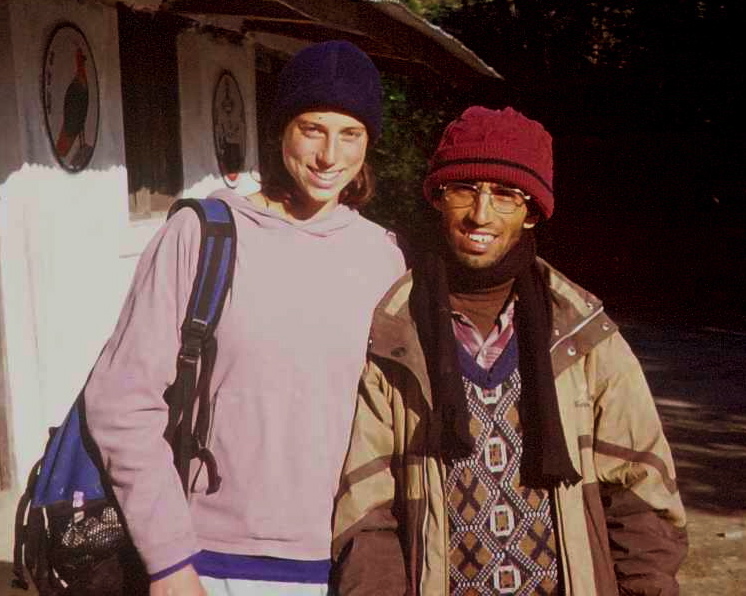
The man in the V-neck sweater introduced himself as Govinda Prasad Paudel, the English teacher.  For the next two and a half months Govinda and I walked the wooded path back from school together every day.  During that time our friendship was formed, and instead of calling each other by name, we began to follow the Nepali tradition of addressing one another by a familial relation.  I called him daai, or “older brother,” and he called me bahini.

00012004050900500061

The Road

The Road 

At Bagloon Bus park the fruit vendors weigh out half kilos of cauliflower as quickly as they can.  The next bus is just about to leave.  But then the bus sits there for quite some time and the snack vendors offer five-rupee cones of chana through the windows to all the people crowded inside.  Teenage boys with greasy hair flopping into their eyes are leaning against crates of spinach and sacks of grain near the front seat.  A latecomer presses his fingers against the ceiling of the bus for balance and the crowd forces him to lean over a mother and a slender man in slacks, who is seated by the window for air—but the man in slacks does not want chana.  A young child further back begs for chana and his mother relents, handing a five rupee note to the first mother, who hands it to the man in slacks, who passes it through the window.  An old lady tells a young man to stand up—she is old and she wants to sit down and she will not bounce up the road in this bus for two hours if she has to wait so long for it to get going.  The bus is late—late late late!—and there is work to do, the rice must be cooked, it will be dark when we arrive, where is the driver?—he is having his tea.

When it leaves Bagloon Bus Park at eight in the morning, or eleven, or four, or five in the evening, the bus makes only two turns: a right out of the lot and a left onto the switchbacked road that climbs up to Kaskikot.

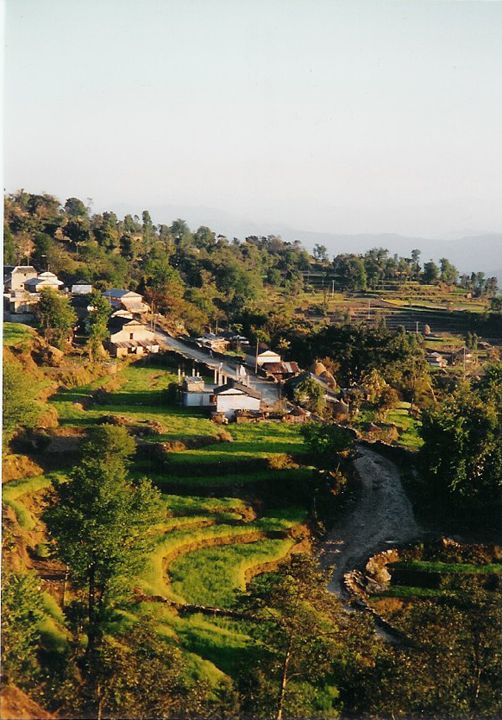
And now it’s important to tell you about the road, because there is going to be a lot of Deurali Roadgoing from here to there and there to here and most of it, when it’s not up and down and down and up, will be back and forth and forth and back along the road, which is paved from its origin in Pokhara all the way up to Sarangkot.  There, it turns to dirt.  Its deep ruts, carved by heavy tires during the monsoon, cause the bus to loll from side to side as it heaves and climbs, and the knotted ropes hanging over the front windshield swing like drunken metronomes.  The route snakes higher, following the crest of a ridge until it reaches its pinnacle at the Peace Land Guesthouse in Deurali, where a straw umbrella is cheerfully perched over a picnic table on Bhim Subedi’s patio.

Just a few dozen yards later the Shiva Lodge marks the last bus stop.  The metal beast huffs to a halt, spent, and stays the night near the Lodge’s green picnic tables.  But the road keeps going, dropping now, following the ridge until it intersects the paved Bagloon Highway in Naudanda.

There, in Naudanda, you can turn right or left.  I don’t know exactly where left leads, because I never followed it any further than Machhapuchhre Campus half a kilometer away.  It’s to the right that we always went: down tight smooth-paved switchbacks, over a small bridge, and back to Pokhara, where we’d started.

Going down was much faster.