If I Can’t Say Namaste


Last Saturday evening I came home with a fresh bundle of vegetables from the market, but Aamaa said we’d be cooking without salt. A man at the house near the water tap in Rotepani passed away yesterday. Aamaa and I ate plain rice with ghee for dinner.

It wasn’t until the next day that I realized I knew the one of the bereaved daughters. “Malika,” Aamaa said, “Don’t you know Malika?” Of course. I remember her hanging around with Didi and Bishnu back when we were all in our early 20s, before anyone was married. “The really skinny one?” I asked. Yes, that Malika. Her father, in his sixties, had been ill for about a month.

This has given me an opportunity to pay respects during a traditional period of kriya, when a man with grown children has lived an honorable life and passed away at an age that, in these parts, is considered decent.

On the sixth evening of kriya, after Aamaa and I had eaten dinner, I rounded up Neru and Kanchaa from next door. Lighting our way with flashlights down the stone path toward Rotepani, we left for Malika’s house.

As we approached the house, a warm mist of voices bubbled up in the cold black night. We found a tarp stretched out over the yard from the edge of the roof, to shelter the stream of visitors from sun during the day and provide some warmth at night.

Three men were sitting on the mud-smoothed porch, leaning against the wall of the house. I recognized Krishna dai, who I’ve known since the first week I came to Kaskikot twelve years ago.

“Namaste,” I said, raising my hands.

“We don’t say Namaste now,” Krishna dai said.

“Sorry.” I looked down.  I had trouble figuring out where to replace my hands.  Lesson one, of many.

Malika’s brothers were peering through the door of an attached room on the small house – I’m guessing that at some point it was used for goats – sitting on the ground with white blankets wrapped around them, like bowling pins. Until the thirteenth day they will only wear new white clothes with no seams, and they’ll wash these clothes daily.

We talked quietly with Krishna dai and the other men outside for about ten minutes. They are all friends and relatives of the deceased. Their role is to sleep on mats on the porch and guard the door of the house, because the sons are not to touch anyone or anything during kriya.

“For example, if a chicken comes by,” Krishna dai said, “we shoo it away. So it won’t touch them.”  This seemed awful and gorgeous.

Krishna dai asked about our mourning traditions in the United States. I said they vary a lot according to religion and habit, but that I am Jewish, and our rules mandate a quick burial – strictly speaking, we don’t cremate. I explained how we have a gathering where people stand up and tell stories about the life of the person who has died, so that everyone can share and honor these memories in one place. The sons leaned in closely by the door of the goat room to listen to me. I said we bury our dead in a special place that’s marked with a stone, where we can return to do puja and be with our loved one. That we return from the cemetery and wash our hands and fill our stomachs with food, and people stream through our houses with flowers and food while we sit shiva – a mourning period when we keep our homes full of life, because we must keep living. By contrast, kriya imposes strict and challenging rules on almost every movement of the bereaved: fasting, washing, praying, isolation, burning. In some ways, everyone has died.

It occurs to me now how little I know about the orthodox dictates of Judiasm and mourning. Is there a period of purification? I have no idea. I could look it up easily for this post. But it’s more interesting that I have no idea.  So I’ll look it up afterwards.

As we were talking, a slight woman with her uncombed hair falling over her shoulders came out of the house. Malika and I haven’t seen each other in about eight years, but she heard my voice from inside the house. Despite the circumstances, it was a really lovely moment. There wasn’t a lot that needed saying, other than, “I heard.”

We entered the small house. Malika’s widowed mother was sleeping by herself on a bed of straw – she too must observe kriya for thirteen days. “Say ‘Aamaa,’” Malika said.

“But what do I say if I can’t say Namaste?” I asked.

“Just say ‘Aamaa,'” Malika said.  So I softly said, “Aamaa,” and her mother sat up.  There wasn’t really much more to add after that.

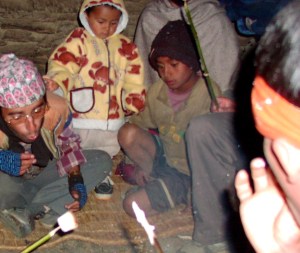
But just on the other side of a low wall, a crowd of women was gathered around a fire, where a kettle of tea was brewing for all the visitors. Mourning customs for daughters are lighter than for sons and wives: Malika and her two sisters observed kriya for four days, and on the fifth day, they added salt to their food and were allowed to touch other people.  Their straw beds, upgraded now to straw mats, are still arranged on the floor of the house. They’ll sleep there together and continue cooking their own food and eating only once a day for thirteen days. Their hair will stay uncombed until then.

Neru and I sat by the fire for about an hour. Between other chatter, the huddle of women asked me all kinds of things about death rites in the U.S., and also about my family and what I’ve been up to. There was lots of quiet laughing. We spent a long time on the topic of marriage, which, in these parts, is almost always arranged by parents. People here are endlessly enthralled by the concept that I am tasked with finding my own spouse.

“Love marriage,” I said by way of explanation.  Here the phrase has an illicit undertone, like eloping. “That’s our culture.”

An old lady next to me was having trouble following. The expectation she’s always known is that you are paired with a spouse who is astrologically compatible with you and socially compatible with your family, and then you sign up for a life together, and then you go from there. A younger auntie jumped in to help out.

“Love,” the auntie said, looking up at us from her seat by the fire. “When two people make things work between them—that’s love, right?”

.      .      .

IMG_6015

Birth vs. Wedding


I’ve been in Nepal for a week now, and just yesterday I attended a shotgun wedding in the middle of the night at Vindivasini Temple.  The excitement started when I came home from the office and found Bhinaju with his knickers in a twist.  He was trying frantically to charge his cell phone, and something about the connection wasn’t working right, and every two seconds the phone was ringing, but the battery was almost dead.

Bhinaju’s nephew Bishnu is scheduled to be married this month, as are many other betrothed, because according to an array of astrological indicators, this is an auspicious time of year for weddings.  As per tradition, Bishnu’s marriage was recently arranged and the engagement confirmed by an exchange of tikka, the red dot you’ve seen Hindus wearing between their eyes. And once the tikka has been exchanged, there’s no going back. The deed must be done.

All this was already in the works when, yesterday afternoon, a pregnant relative of Bishnu’s went in to labor earlier than expected.  Custom dictates that if the relative has the baby, the entire extended family is banned for eleven days from various ritual activities—including, inconveniently, weddings. And – stay with me here – eleven days from now, we will be past the astrologically auspicious marriage window, which won’t come around again for another year, which, since Bishnu and his bride have already exchanged tikka, would just be a violation of the entire system of everything.

And this now brings us to the heart of the matter, which is me holding Bhinaju’s phone charger in the socket to suck out all the electricity it can muster, and then all of us tripping on our shoes as we run out the door to hail a taxi at 9pm, buy some oranges and flowers, and rush to Vindivasini Temple for Bishnu’s wedding before some baby, somewhere, is born.  It is now a matter of birth vs. marriage; we can’t take the risk of waiting till morning.

Vindivasini temple is usually crowded with people and priests and marriages and fruit, but at 9:30pm it is absolutely deserted, with nothing but two police officers and a cold breeze blowing over the laid stones.  Aidan and Pascal think this is the perfect place for me to teach them some taekwondo, and we pass the time running in circles and doing flying side kicks in front of the frozen statues.

Just as we’re losing interest in this adventure, Bishnu, his bride, and an entourage of people in puffy coats show up with the priest.  We all stand around shivering and trying to take iPhone pictures in the pitch dark (nobody had time to bring a real camera) as the priest rushes them through a series of rituals. I am struck as always by how abstract the bride and groom seem at these weddings, and this is even more apparent tonight: Bishnu and his bride are at the center of the marriage, but it is not about them at all.

Is it over? Is it over? Everyone is freezing. Bhinaju’s brother has a van. Everyone piles in to take the girl back to Bishnu’s house an hour away in Lumle, where the family will take turns “showing their faces” to the new wife. I almost never turn down a chance to be part of a face-showing ceremony in Nepal in the middle of the night, but this next phase is going to last till morning and I have nothing with me. I’m tired and I catch a ride back home.

.      .      .

IMG_3968


Ten to Fifteen Minutes


The night I arrived in Kathmandu from the U.S., I recorded a midnight interview with an airlines agent. When the interview ended, Laxu and I asked for a record of bodies received at the airport, for two reasons: one, we need a better estimate of numbers, and two, I am looking for a family I can spend some time getting to know. The agent told us each airline keeps separate lists of bodies it receives, so if we wanted a combined list, we’d have to go to the customs office.

Two days later, Laxu and I returned to the airport to visit the customs office. A police officer outside told us we needed permission from customer information to enter the airport. Customer information sent us back to the police officer. We went back and forth until the officer took us inside, where four guards told us we could not talk to customs without permission from the government, and then said the list we were looking for was in the cargo office, not the customs office. We hailed a cab to the cargo office.

A security guard looked at my ID, told me not to record or take any photos, and opened the gate to the cargo office.

At last, Laxu and I entered a cavernous hangar filled with endless towering stacks of packages and containers. I was alarmed to find myself scanning the warehouse for casket-sized boxes, and willed myself to stop, but I couldn’t help it.

It seemed the search for The List, which had started so simply in the airlines office, would never end. Laxu and I wound our way from office to office in the cargo hangar, being bounced from one official to another. At last we entered a third-floor room at the end of of a long hall, lined with rows and rows of dusty files, harboring a single employee who looked like he did not often get visits.

Being in this room of papers felt oddly momentous. Somewhere in these weary stacks was a document that would turn this warehouse into a list of people who had lives, families, stories, names.

Nope.  The single employee informed us that before he could give us any records, we would have to get permission from “The Chief.” He sent us down another hallway.

Outside The Chief’s office, Laxu and I sat in a gigantic waiting room that contained nothing but one desk, somewhat reminiscent of the Oval Office, and two women sitting on a low windowsill, starting absently out at the parking lot. An empty teacup sat on the windowsill. The women told us to wait, so we waited.  And waited.

“If you’re able to get permission,” one of the women said during a random moment of waiting, “it will still take quite some time to get The List.” But why? I whispered to Laxu. We had just been in a room with nothing but lists and a person who seemed to have very little to do.

We entered The Chief’s office.  Sitting before him like children summoned before the school principal, we asked permission to go back to the first room and get The List.

The Chief replied that the cargo office doesn’t keep a separate list of laborers. It records all bodies that arrive from overseas each day, on average three to four, he estimated, including people who die overseas for any variety of reasons. To get a list of laborers, he suggested we go to the insurance office. Wherever that was.

For a moment we simply sat there.  It had been such an effort to arrive, this seemed like too short an answer.

I suddenly thought to ask if The Chief would mind telling us: what happens when bodies arrive in this cargo hangar?

“Everyone,” said The Chief, “is processed in ten to fifteen minutes. Maximum.He repeated “maximum” a few times.

I asked if I could record our conversation, and The Chief said, absolutely not. However, he added, leaning back in to his chair, he had recently done an hour-long interview on an important radio program.

Could he tell us, then, who comes to retrieve people who have died abroad here at the cargo office? What clothes are the families wearing? What kind of transport do they use? And where do they go when they leave here? After all, there are no provisions for this situation—bodies are not meant to be in airports.

Some families, The Chief said, have a long way to go back to their villages to conduct rites, and they come in plain clothes with a hearse. But some do the rites here in Kathmandu at Pashupathi or Boudanath or Swayambhu, and they might arrive in a procession. I looked out the window at the same parking lot the women in the waiting room had been staring at and thought of it filled with a funeral procession. Oddly enough, weeks after this interview, it’s the view of the parking lot from the Chief’s office that still floats in unbidden into my thoughts.

“We don’t enforce a rigid protocol,” the Chief said, which, I’ve thought since, was a strange and pregnant detail.

I tried to press for more particulars. What has he noticed about which of the deceased are treated in what way?

“Look,” The Chief finally said, “there’s no difference to us. You want to know who is who or how many of a certain kind of people or something. There’s just a process. Big shots and laborers are all managed the same way.”

Ten to fifteen minutes. Maximum.

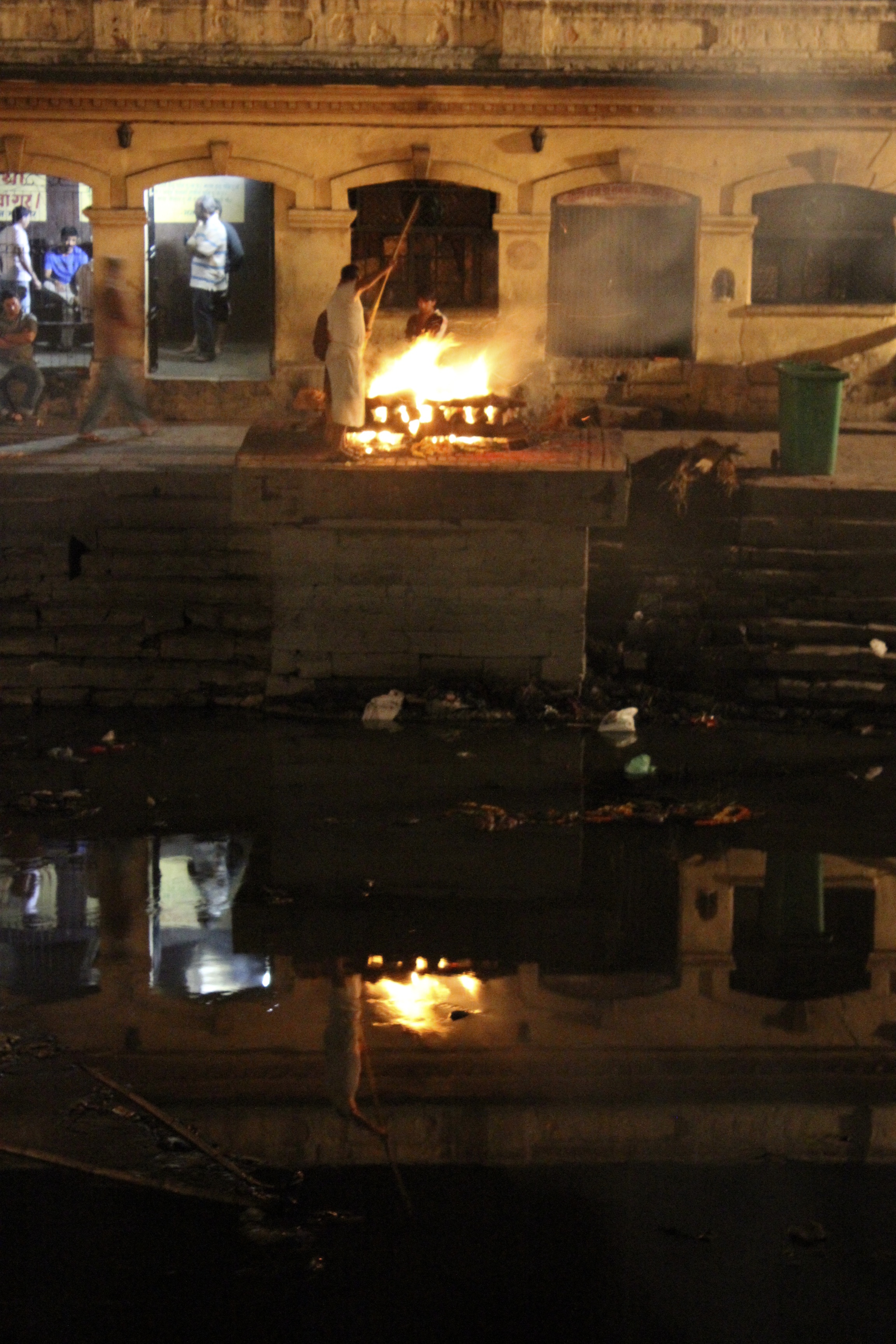
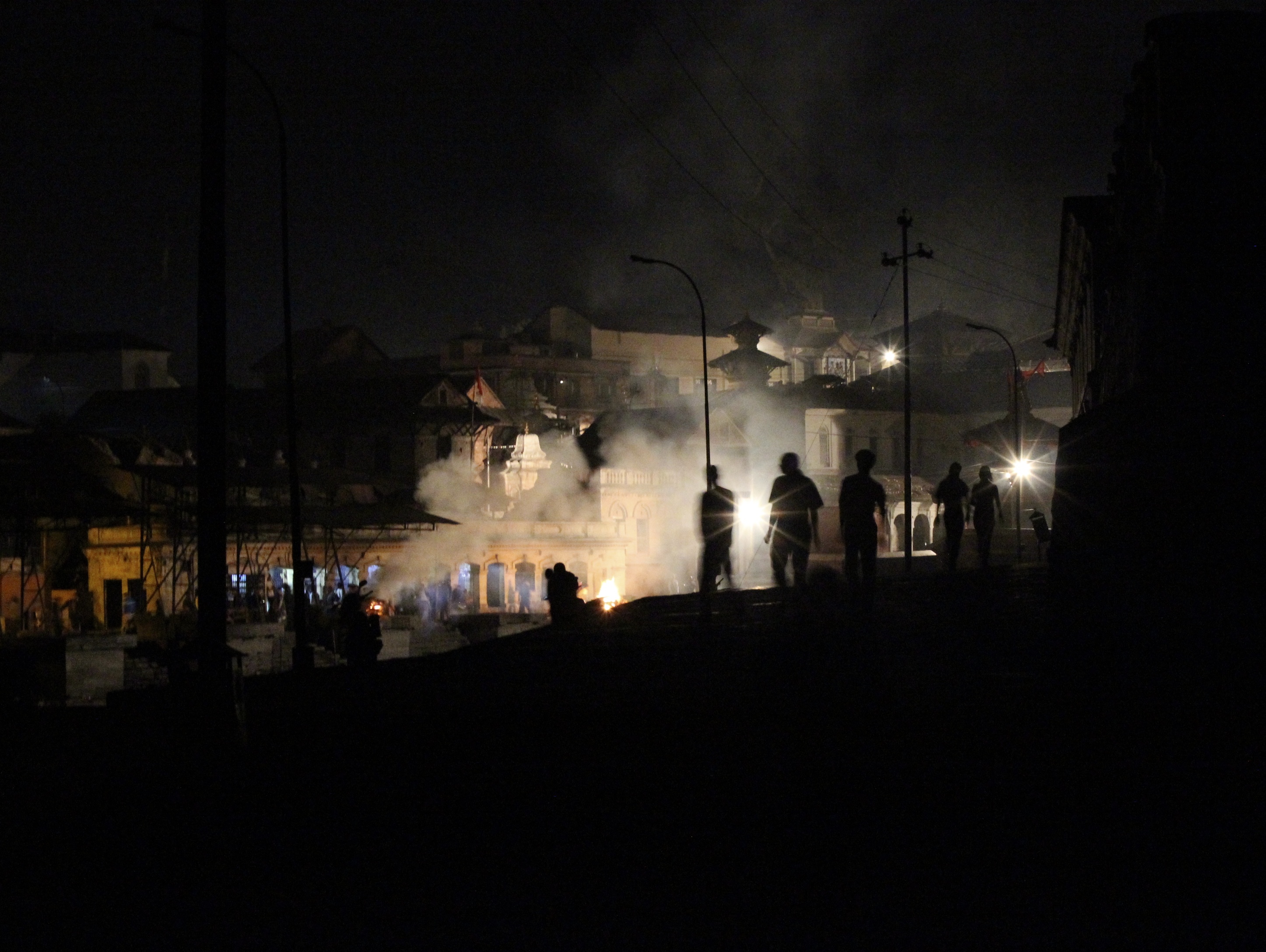
In the West we’re accustomed to the idea of bodies being transported around for and by people who know what to do with them. But what about the white curtain that covered Shaula dai? Or the night I sat at Pashupathi Nath and watched a son put fire in the sacred mouth of his parent? Or when our neighbor Maina bouju passed away in Kaskikot, and Bishnu and I went to her house and sat with her family as they kept vigil over her head and feet until morning, when her sons dressed her and lifted her on to a bamboo gurney balanced on their shoulders, and I was transfixed by how Maina bouju’s covered head was so close to her son’s face that they brushed against each other as he carried her all the way down from the ridge to the river in his white clothes. What about that?

“When there is nobody to accompany the body home,” The Chief said, “it comes through as cargo and arrives here. If there is a friend to fly along, it is treated as baggage.”

.      .      .

IMG_0638

Pashupathi Nath

Homecoming


Mahendra and Madu are two of the first boys I ever met in Kaskikot. They grew up in the houses on either side of us, and when I first arrived in 2002, Mahendra was about 13 and Madu was 11.

Mahendra, '06Mahendra has the chiseled features and doe eyes of a movie star and the athletic, wiry frame of a boy who is too restless for his environment. As a teenager, when all the kids built swings for the festival of Dashain, Mahendra would climb a towering stalk of bamboo like a monkey and fix the rope at the top while hanging horizontally, high above the ground. If Mahendra had grown up in the U.S., he would have been the star of the high school soccer team who smokes pot and can be counted on for a party when the parents are out. He’d always hated being born poor in this bottomed out village, even from the time he was very young. It bored the hell out if him and insulted his power. He was meant to be dangerous and to cut his teeth on anything but here.
Madu on the other hand was a gentle, slender boy with a soft voice and midnight skin. I often used to sit in his house in the evenings while his mother brewed moonshine to sell for a few dollars. Like Mahendra, Madu dropped out of high school before he graduated, and signed up with a manpower company when he was about 16. Before he left, Mahendra married and left behind a pregnant wife. Madu’s older brother Jivan left; then Madu left.

OLYMPUS DIGITAL CAMERA

So many of the boys in this village are like Madu and Mahendra. For the first few years I was coming to Kaskikot, we spent a lot of time together working in the fields, carrying loads, pounding and climbing and chopping and joking in the yard over tea. There was a posse of them that used to wander out at dusk after the work was done, to play soccer or roam or plan the future. Sometimes I would hear Barat playing his flute on the other side of the hill, where the posse used to hang out in his yard.

Then they started disappearing. Malaysia, Saudi Arabia, Qatar, Dubai. Madu’s house gained a TV and a new room, and Mahendra’s mud house, like many others, was rebuilt with cinderblocks. Large swaths of the hillside turned year by year from fertile to uncultivated land. One home after another became inhabited only by old people.

Last Monday night I arrived in Kaskikot for the twelfth year in a row. The next morning when I got up, Madu came over and sat in the yard talking with me for half an hour. He was wearing a faux-leather jacket and shoes. He has been working at a noodle factory in Malaysia for three years, first sealing spice packets, then as a line manager. It started off bad: the overtime they were promised not paid, the meals they were promised not provided, the roommate who ate dinner, went to bed, and then didn’t wake up the next morning for a reason nobody knows. Everyone was afraid to touch him, this body that at home would have been sacred. Once Madu got promoted, his salary doubled and it was better. Most of them, he admitted, don’t promoted.

I went to fetch water at the tap. I passed Barat’s yard and the whole posse was there. All home from their various countries this winter. Most of them married. Leaning carelessly against the wall, sitting with an arm angled across a knee, laughing at a private amusement, hair greased and shining in the morning sun. Mahendra looked as glamorously bored as ever, but he did light up – to the extent he does – to see me.

I asked what they’re all doing now. The answer: waiting for new visas.

.      .      .

IMG_5989

Midnight Confessions


Last night I arrived in Nepal on a flight from Dubai. It was nearly 11pm by the time I got through immigration and came out of the airport to meet our cousin Laxu. IMG_3894

As the baggage came bouncing on to the conveyer belt, dozens of televisions swirled by.  It was a funny moment, something like hearing my own song on the radio, because in the last ten years I’ve watched televisions appearing in one house after another Kaskikot. Next door at Saano Didi’s house, where Jivan and Madu have been working abroad for a few years now, they now have TWO televisions.  It is the single most reliable status symbol of a household with a family member working abroad, and for some reason it strikes me as funny that people actually bring the televisions back with them, rather than just purchasing TVs in Nepal after they get home.  Like many aspects of this whole system, it’s a thing.  It’s the ritual.

Before I left the airport, I decided should try to get a phone number for the baggage office. The purpose of this project is to look at how traditional death rites are altered when migrant laborers die abroad, which means, first of all, talking with someone who processes bodies that are shipped home to this very airport. Since it’s unclear how I’d explain this on the phone, it seemed like a good idea to get a name and phone number for the baggage office while I was already there.

I started at the baggage desk, where an agent gave me a cell phone number and a name and sent me to the airlines office building, which, oddly enough, was still open at 11pm. Laxu and I left my bags outside with his friend, and then waded through a series of muddled conversations about why we were there: with a police officer, a secretary, other people who had unclear reasons for being in the front hall of the airlines building so late at night. Eventually, we were led in to a narrow back cubicle, where we sat down at an empty desk, across from a clock that read 11:30pm. I had a feeling we’d be there a while, and probably with no result.

We waited.

What happened next was the typical Nepal phenomenon where nothing is happening for a long time, and just when you are certain your plan hasn’t worked, something appears out of nowhere.

The something was an airlines agent who did not want to be identified, but was very eager to talk to us about what it is like for him to receive and process bodies from abroad. He listed all the documents that come with bodies when they are shipped home, and the procedures for releasing them. He said it is “terrible scene” to deal with the families. He kept repeating “terrible scene.” As the clock ticked on, I was increasingly aware of the late hour and the hush outside the airport as everyone who’d been on my flight departed.

The agent was especially intent on explaining the travesty of the labor system to me. Every time I directed our conversation back to the baggage procedures that in this dreadful and bizarre situation have essentially usurped sacred death rituals, the agent would find his way back to condemning the exploitative labor trade.

I noticed that he insisted that the families he sees coming to retrieve their loved ones are “very poor,” “low caste,” and “uneducated.” I know this not to be true; almost every household in Kaskikot, like in so much of rural Nepal, has a young male family member abroad, and almost all of them, while poor, are educated (and high caste, while we’re at it). It’s the country that, in a global context, is colossally poor.

I wondered about this trenchant misconception later. It’s easy, after all, to deplore a system that preys on wholly ignorant people. But my impression is the vast majority of Nepali laborers, while disenfranchised, are nevertheless aware of the general inequity of the migrant labor system. Like Mandira, they make the bargain with their eyes open, usually multiple times. It’s too simplistic to assume that half a million people per year are too naive to realize what a high price they are paying, and doing so avoids the more complex question: Why is it worth it? What is in it for these youth and their families?  Hundreds of thousands of them?

By the end of my interview in the airlines office, it was after midnight, and a crowd of employees—inexplicably still at work—had crowded in to the office to listen. Our topic had obviously struck a cord. I turned off my recorder. Laxu and I dispersed in to the eerie, deserted airport parking lot, and caught a cab home.

And so it starts.

.      .      .

Kathmandu Airport

Kathmandu Airport, Home from Dubai

Dubai

IMG_4085My layover in Dubai was eight hours.  Long enough to trek back and forth many times along the glaring fluorescent strip of duty free shops betwen terminals one and two.  It was daytime in Dubai, but for me it was the no-time that happens during a trip from one hemisphere to another.

I wandered in to one of the bathrooms and soon found myself looking for an earring that had dropped.  A young employee who’d been sitting idly when I walked in came over to help me.  As I was shuffling through my belongings she noticed a coin.

“This is from Nepal,” she said.  “Have you been?”

Yes, I said, I’d been.  We got to talking in Nepali right away.  I wasn’t surprised to find out
that Mandira is 26 years old with a 1-year old baby she left in Nepal with her in-laws and her husband, who is also waiting for a visa to travel abroad.  When I asked what she’d paid a manpower company to broker her position in the Dubai Airport bathroom, I already knew roughly what the answer would be: about 10,000 dinars.  Her salary: 900 dinars per month.  It would take her a year to pay off her loan to the company before she started earning anything to send back to her family. It will be a few more years more before she can afford the 3.5 hour flight home to see her then four-year-old child.

It’s a typical story but it’s still amazing to see it in action without having to try. This kind of position has become so preferable to looking for local employment in Nepal that I don’t even have to leave the duty free section of the airport to find Mandira.

The flight from Dubai to Kathmandu is a special kind of cultural experience.  You step out of a hip multinational terminal in to a waiting area where almost everybody who isn’t a white person wearing hiking boots and tie-dye is a Nepali person returning home from a labor contract.  For many it is the second flight of their entire lives.  A large percentage of passengers have none of the practiced movement that comes with routine air travel.  There’s a lot of helping each other find seats, opening and closing latches to see what they do, gazing out the window at baggage trucks, calling to one another across the rows to look at this or that.  It’s about as close as you can get to walking out of an airport and getting on a city bus in Kathmandu that launches in to the air.

On the plane I immediately leaned against the window and tried to sleep.  I’d been traveling for 20 hours.  The young man next to me was quiet and stared straight ahead, and I assumed that he, too, was an amateur passenger just surviving the journey.  After an hour of half-sleeping, I sat up, and as I jostled my position, we exchanged a few words.

“My father just died,” he said.

I drew in my breath.  “I’m so sorry,” I said.

“I came straight from duty.  I don’t have a bag with me or anything.  I came straight to the airport and bought a ticket.”

“What happened?” I asked.

“He was in the U.K.  I work at a hotel in Dubai.  My family just got back to Nepal with his body.  After we land I have to take a 10 hour bus ride home, because they are waiting for me to start the rites.”  He stared ahead. “I usually talk to him quite often, but we hadn’t talked in about three days.  I don’t know why.”

The snack cart came along.

“Can I get you something?” he asked.  I declined, but he asked a few more times, and I declined again.  He bought a sandwich for himself. He asked the boy in the aisle seat – who didn’t look any older than 18 – what he wanted.

“Many of the new ones are scared,” he explained softly.  “So we help them out.”  He bought the boy a cup of tea.  “Are you sure you don’t want anything?”

“I’m really okay,” I said.

He opened and closed his sandwich.  “I’m not supposed to be eating this food,” he said.  “We have traditions – it’s called kriya.

I know about this of course.  It’s not just the sandwich.  The death of this young man’s father should have immediately been followed by 13 days of eating food cooked as part of a series of rituals, without salt, and by wearing only white clothes with no seams, and by sleeping on the ground, and by drinking special water, and by not touching any other people, and by daily pujas and bathing. He should have shaved his head.  But he was crammed next to me on a floating bus.

He took a bite of the sandwich.  “I haven’t had anything to eat or drink since yesterday,” he said.  “Actually, I haven’t talked to anyone.  Now I’m talking to you.”

“I can’t imagine how hard it must be in this strange situation,” I offered.  “It will be good to be in the right place with your family where you can do…all the things.”

“Are you sure you don’t want any of this sandwich?”

“I’m sure.  Thank you.”

“I usually talk to him often.  I don’t know why we hadn’t talked the last few days,” he repeated.

He gazed over the sandwich again to the back of the next seat.  “There’s no point in being sad now.”  He ate a chip.  “I can’t think of what to do.”  He offered me more of the sandwich.

I asked after the details of how he’d get from the airport to a friend’s house to the bus to his house.  It seemed like the only relevant thing to discuss.  Everything else was either too small or too big.

“So you will be with your mother and siblings by morning,” I said. I told myself that things would make more sense then. I wanted to believe that it would be better when he knew what to do.

“Yes.”  He gave the rest of his sandwich to the trash pick-up.  “But when I get there, you know…it will be real.”


Between Worlds

Read this series here.

IMG_2479Over the years, I have witnessed many passages in Nepal.  Marriages, coming of age ceremonies, births of animals and people, and deaths of many kinds. The weather itself has a careless drama about it, demanding reverence for the seasons and relentless passage of time…when it is hot, it’s time to plant millet; when there is a full moon, it’s time to fast; when a distant glacier becomes heavy, it’s time for it to break apart, time for the river it lands in to overflow in a torrent, time for an entire village to be swept away.  When it is morning, it’s time to get up and cook breakfast.
The intimate relationship between people and cycles in this part of the world is one of its most moving qualities.  I think it is a hard thing to see if you have always been inside it. But I am outside of it.  And peering in, I am endlessly preoccupied with how a single human existence can be subtly accepted as a grand and meaningless expression of a larger constellation of forces and relations and nature, awesome because it is small, not because it is unique.  I only notice this because I learned to see myself as separate from the moment I came in to the world.  In the West we gain power, intelligence and purpose from our individuality.  But it’s something I can’t explain to Aamaa.  There simply isn’t a vocabulary to say that my life possesses a greater idea than the idea of the universe itself.

I know I’ll never be comfortable with this fact.  Instead, I am perpetually drawn to these rites of passage, which integrate our small lives with those of our ancestors, with the cosmos, with God and with the future.  Perhaps it’s like continually trickling cool water into a wound that will always burn.

This winter I’ve decided to start a project that has been some time in the making. Since I first began coming to Nepal in 2002, young men have flooded out of the country for migrant labor in gulf countries; last year, over 300,000 people left for that purpose alone.  A surprisingly large number of these young men die abroad, and when they do, normal mourning rituals are turned completely upside-down.  Many of the essential features of customary mourning become impossible.  My project will document the way that families have adapted ritual grieving when their sons die overseas.

Nepal’s funerary customs in the weeks that immediately follow a death are called kriya.  There is great intelligence and beauty in these rituals, which provide a structured role for the community and extended family in sharing grief, reaffirming ties, and placing the life and death of the deceased in to a coherent cosmic story.  Many aspects of kriya are austere and demanding, putting physical and mental purification above comfort, and imposing isolation as a sanctuary for the emptiness that follows loss.  When the kriya period ends, other rituals last weeks, years, and in some cases, forever.  Aamaa, a widow since age 23, hasn’t worn red in 35 years.  Anyone who meets her can immediately know without a word that she is widowed – if they are attuned to this custom.

Stories of grief and loss in other places have immense importance for us. Ritual grieving in American culture is increasingly short-lived and mainly the private domain of the bereaved.  Death as a matter of politics or policy or violence is in our media every day.  But mourning, the outward expressions by which we integrate death in to the un-ended lives of the living, seems to be on the periphery of our inquiry, at best.  In some ways, mourning is treated as an obstacle to our collective concern with affirming and carrying out our individual significance.

But mourning is a choice we make to ascribe meaning to our grief. It is a willful sanctification of our mortality.  We hope for the grace to extract from this some kind of redemption, something beautiful about life.  Or perhaps simply the courage to keep living.

In the course of this series, I hope to honor the beauty of Nepal’s kriya traditions, as well as a generation of young people caught in the ambiguous place between a world that has shattered and one that does not yet exist—at the threshold, in that empty uncertainty, where we are reinvented.

.    .    .

IMG_0640


Read this series here.

Outsiders

I woke up inside the mosquito net and thought, as I do every year, that it was going to be a shame to leave that delightful hiding place.  And for the first time, I found myself filled with downright resistance.  Usually on this morning, I lie in bed and enjoy the mini-world inside the net falling around me, its soft waking sounds and obscured view, and I feel the stretch of my existence from one world to another.  The sun peeks under the ruffle of the corrugated tin roof and draws a squiggle in the mirror. The prospect of departure highlights the distance and the miracle of my life’s cartography, and I float for a moment in an expanse of sadness and gratitude.  But today the other end of that fishing line felt so far away and tenuous that I just had to get out of bed and not think about it too much.

IMG_2785 - Version 2Leaving Aamaa is always the single hardest part of leaving at all.  I’ll call from home, but it’s hard for us to chat on the phone.  So much of our relationship is a physical presence; it’s moving together in this space.  When our communication is reduced to words and sieved through my imperfect language skills it becomes thin and stilted.  It’s hard for me to explain my life in Connecticut, and to understand life in Kaski through an update over the phone.

But even more important is that as I get older, Aamaa and I have a simple and innate perception of each other’s aloneness.  So on this morning, we orbit like two electrons, knowing this great force is about to separate us, and it seems like the loneliest thing in the world–because we sense each other’s singularity in addition to our own.

Sunrise was grayed out and respectfully subdued.  As the clouds gathered, Maya bouju came over and she and Aamaa and I sat on the porch drinking tea.  Soon a thick fog had rolled in and I could barely see out past the faded tomato vines in the garden – we were literally sitting on an island of yard inside a cloud.  And in that new configuration, looking out at the blankness, I felt the stretch at last.  That’s how exactly how it was: the three of us sheltered from the chaotic world in our temporary clearing, putting off the imminent moment when I would have to set down my tea cup and walk back in to the unknown.

.     .     .

IMG_3427 - Version 2

Rice Pot Literacy

IMG_2668A year or two ago, Aamaa starting making noises about getting an electric rice cooker.  Of all things, right?  I am constantly baffled by the perceived awesomeness of this contraption in a place with no plumbing, no heat in the winter or A/C in the summer, no political system, and widespread illiteracy, where the one thing that people have been doing for hundreds of years with no problem whatsoever is cooking rice. In pots. And never mind that in the winter, there’s load shedding for up to 16 hours a day.

Nevertheless, it is a thing.  By some mysterious process, the rice cooker has become the iPhone of the rural Nepali woman, just like TVs became standard in Kaski’s mud-and-stone houses when so many kids left the village to work abroad, where they send home just enough money to cover a few celebrity amenities.  Now a TV I can understand.  But a rice cooker?  I used to say that about cell phones – remember how we used to just call each other on landlines?  And that worked fine?  Aamaa used to cook rice in a pot, from 56 years ago until last June.  It’s not about whether it’s fine.  It’s about having a celebrity rice cooker.

So last year when Bishnu was visiting, she picked up a rice cooker for Aamaa.  And of course, Bishnu went for a large, impressive looking one – even though Bishnu should know better than that by now.  Because first of all, when you put rice for one or two people in a large, impressive rice cooker, you get a wide, unimpressive rice pancake.  And let’s not forget that there’s no electricity half the day.  So I arrived this year to find that when the electricity comes on, the first thing Aamaa does is rush to plug in the big electric rice cooker.

No matter what time of day it is.

IMG_1042This is how we have found ourselves eating a room-temperature rice pancake as our 2013 featured dinner entrée.  And the thing that blows my mind is that it’s not like Aamaa doesn’t know what hot, properly prepared rice tastes like. It’s the only meal she’s eaten for her entire life.  But this rice-cooker-chilled-pancake-system inexplicably retains its a status of superiority in the face of damning evidence that it is terrible.

“You know, Aamaa,” I said as we were eating the rice-pancake the other day (for the record, it can literally be cut like a pie), “the rice cooker is too big.  You should have a little one, like I have in Connecticut.”

Aamaa’s expression widened.  “Really?  Do they make small ones?”

Sometimes life is so strange.

“Yes Aamaa, they’re just—they’re just like that one, but smaller.  So you can cook less rice in it and it won’t come out like a roti.”

Ehhhhh,” Aamaa cooed.  “If you see one of those, will you get me one?”

I wasn’t sure how serious she was, but the next time I was in Pokhara, I decided to get Aamaa a 1-liter rice cooker.  Like the one I have, in Connecticut.

I brought the small rice cooker home the other day and we unwrapped it on the front porch.  It was like the Second Coming.

“Look at this pot Laura got me!” Aamaa has been telling the neighbors.  “It’s the perfect size.”

The fourth beloved grandchild of the family is introduced to all visitors. Aamaa takes it out and points to its dainty circumference and shiny exterior.  Then she and I regale the neighbors with stories about the failings of the large rice cooker – it makes rice like a roti, for goodness sake – and swoon over the shimmering, earth-shattering perfection of the small rice cooker.  Which is just right for two people.

Or one person.  Like my rice cooker, in Connecticut.

As we were eating our fluffy rice today, I couldn’t help being re-amazed that Aamaa, as my protector and general knower of all things, had no idea that the big awesome rice cooker was too big and awesome.  For somebody who can build anything, cook a complex meal over a fire with no measuring devices and not a single taste test, detect subtle changes in the mood of the buffalo, and nurture soil and seeds with a nuanced literacy that is invisible and incomprehensible to me, it seems completely incongruous that she didn’t look at the rice cooker and think, “That’s too big.”

I am so used to Aamaa’s highly technical and nimble mind that it never stops surprising me to run in to the boundaries of her experience. I remember during my first year in Nepal, I got first-grade primers so that Aamaa and I could learn to read together.  I started copying new letters and sounding out the phonetic alphabet.  It turned my world upside down the first time I watched Aamaa try the same thing and saw that she copied letters slowly and awkwardly like a child.  Why wouldn’t she?  I sifted grain like a child.

The rice cooker more than anything has reminded me that we simply have different types of literacy.  Most of Aamaa’s life has been extremely repetitive, and she moves in it with a technical and intuitive agility that I think few people in my world ever have the chance to know – if only because of the much wider range of experiences we have to integrate.  I think that makes us more adaptable across novelties and habituates us to thinking relationally; it’s what allows me to look at a new situation or task and decode it or try out variations in my mind.  But Aamaa just doesn’t encounter nearly as many new situations in her life, so instead, she knows the ones that are familiar to her with a level of subtlety that maybe only Olympic athletes and ultra-dorky mathematicians ever encounter where I come from.

So much so that even the rice cooker, which seemed just a few degrees removed from Aamaa’s mainstream world, turned out to be a static event for her, not something to be adapted or improved the way the millet seedlings can be tended to in the garden.  Now I’m trying to get her to use the “warming” feature, so that when dinner gets cooked at 3:06 pm, it stays warm as long as possible.  I mentioned this the other day when Aamaa rushed to unplug the cooker rather than leaving it with the warming light on.

“Aamaa, it’s going to get cold,” I said.

“I don’t want it to overcook,” she said.

“It’s just…” I sighed. “…Warming.”

Right.  It’s warming but not cooking…that makes no sense, does it?

IMG_2675