Stone Paths


Yesterday, I went with Aamaa and Neru and Didi to carry 40 kg of cauliflower up the mountain from Pokhara, because, as we know, that’s the kind of thing I do to relax.  Why, you ask? Fair question. At Milan Chowk people are selling cauliflower and potatoes at seasonal wholesale rates, and because our relatives are there, we got an even sweeter deal.  Tell me you’ve ever purchased cauliflower for less than 6 cents per kilogram, baby.

What are we going to do with 40 kilograms of cauliflower? Ah, I thought you’d want to know. First, we’re going to schlep it up to Kaskikot. Then we can chop it in to thin pieces and dry it in the sun to eat later in the fall. And that brings us to yet another day of long steep stone paths, ropes, and heavy loads.

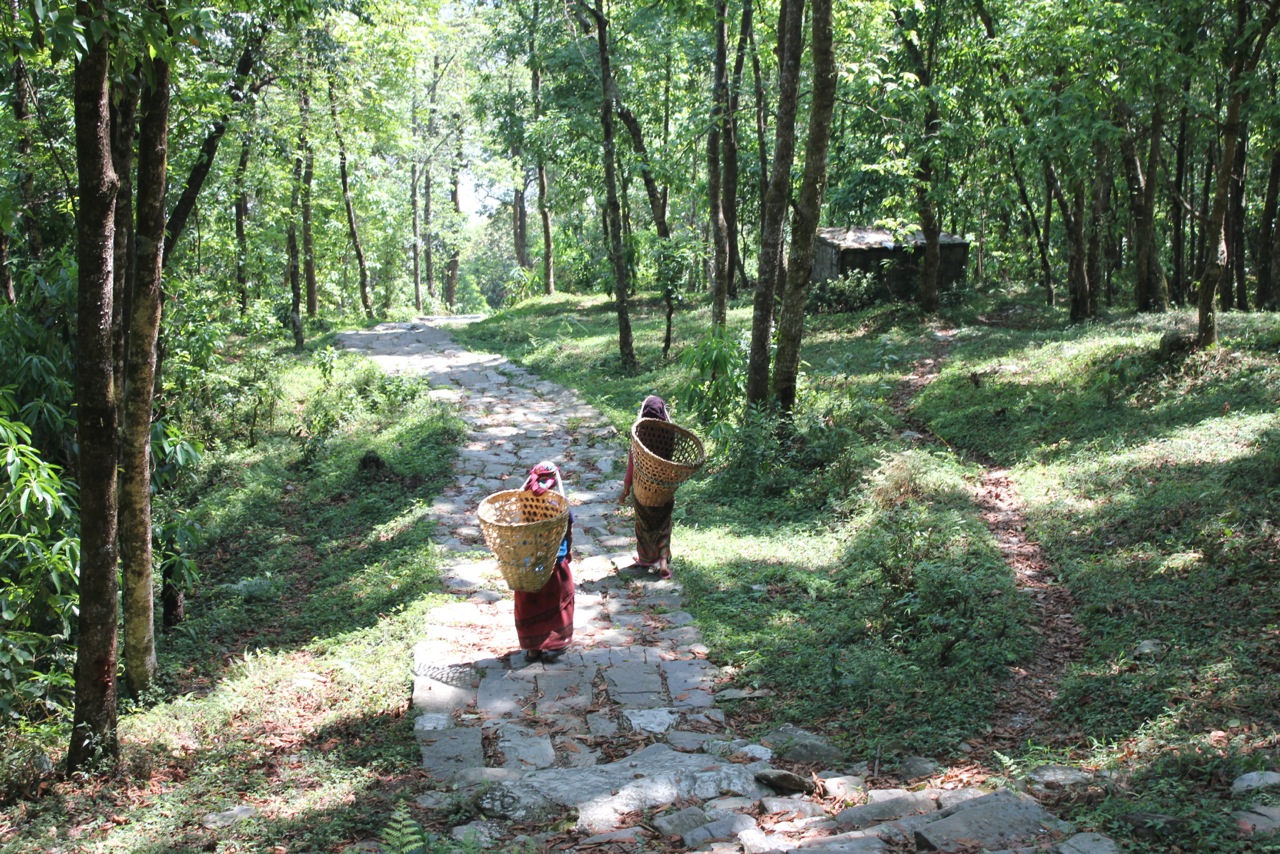
We took the forested footpath on north side, a walk I regularly make in about 35 minutes going down and one hour going up. It leaps (or drops, depending on which direction you’re going in) directly from the flat valley to the spiny ridge top.
IMG_2858

As we neared the bottom of the trail, Didi was walking a short way ahead when Aamaa pointed to a lone man in an empty rice paddy on the valley floor.

“That’s the field where Didi was born,” she said.

I’ve always known that Didi was born during rice planting season, when Aamaa went to work and returned home instead with her first baby.  But I didn’t realize the field was so far away from the house. It belongs to a relative, and I’ve never been to it.

“That one?” I squinted and pointed like I was on safari in Zimbabwe.

“Yes.  And then we walked up this path that afternoon.”

“…What?”

“I came here the night before to plant rice, but I had Didi at 8am the next morning.  And at 4pm we walked back up this same way with the baby.”

“…THIS one?! How is that possible?”

“I know.  Can you believe it? I couldn’t do it now.”

I might as well insert here that my brother and sister-in-law welcomed my niece Eliza Jane Spero in to the world just a few days ago, on March 6, in Chapel Hill, North Carolina. Running around here in Nepal, my mind has been largely preoccupied with thoughts of soft blankets and white linens and wrinkled baby feet at home. So maybe it was just the way the moment came together. But I looked at Didi chasing Aidan and Pascal down the stones in front of us, and all of a sudden it seemed impossible all over again that all of us were there together.
IMG_7151Aamaa was 20 years old when she had Didi, and she endured many hardships after she hiked up this long, unforgiving path later that same afternoon.  I can only imagine how birthing a child must have been then, when medical facilities, telephones, basic shops, and decent roads—to the extent any of these existed at all—were at least a day’s walk away.

Now, 35 later, here we were walking on the same stones. Standing on them, it’s hard to comprehend that millions of people in the world still live in that kind of poverty today, when it seems like an unbearable situation for one single individual. Every once and a while, all those millions are suddenly the one person in front of me, and today, it was Didi. She seemed like a miracle. And the path – which I’ve skipped down and climbed up hundreds of times – just stays there while people go up and down it, carrying their stories from one decade to the next.

It was 6pm by the time Aamaa and I got home with our 20kg loads of cauliflower. We have a lot of slicing to do.

*


IMG_7454

Holi

IMG_4612

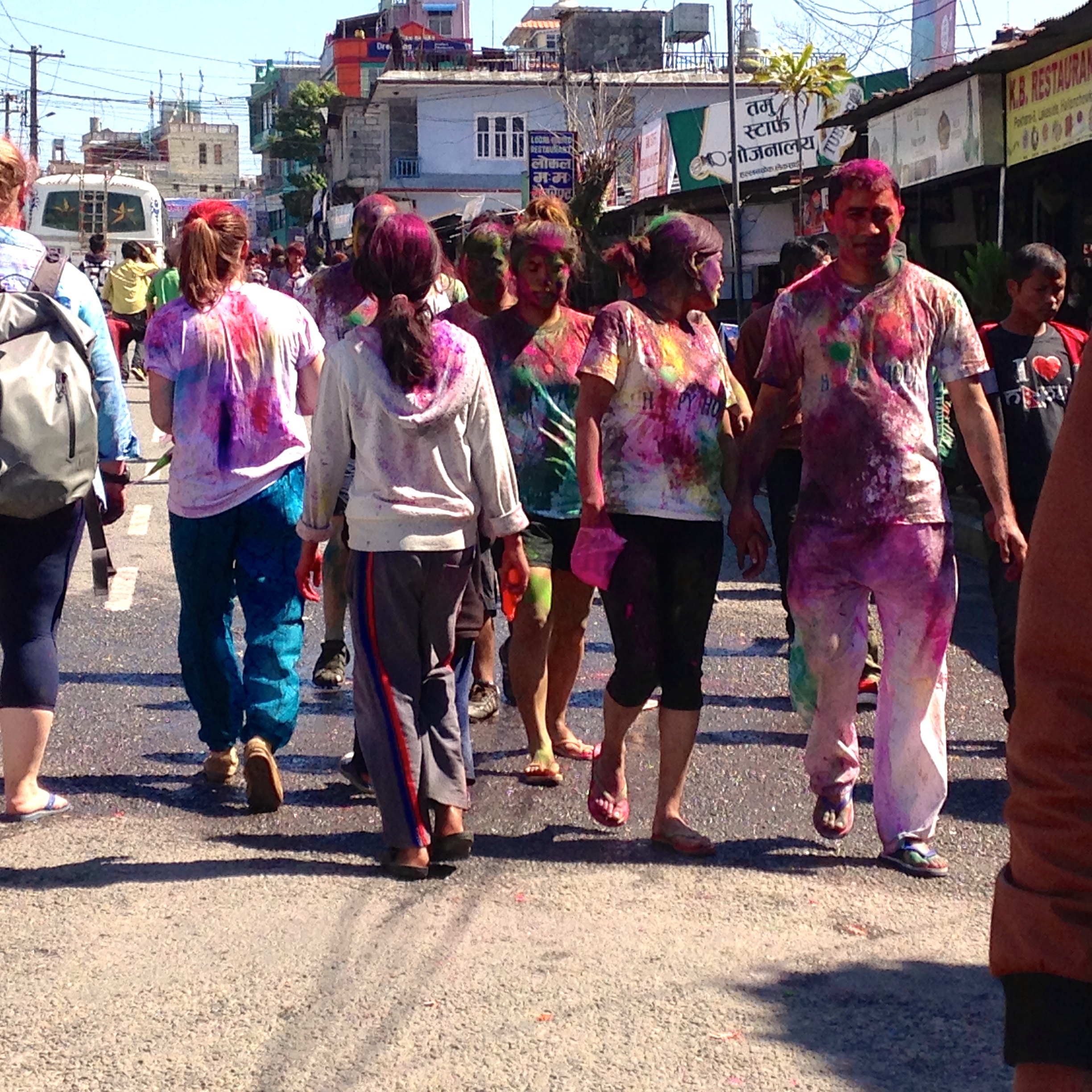
Today was the festival of Holi. Weirdly enough, I’ve only been in Nepal once for Holi in twelve years, and that was back in 2004, when I was in Kaskikot and basically missed it. So this was the first time I’ve really seen all the action, and it was pretty much the awesomest holiday in the history of ever.

Holi is a Hindu festival that celebrates the equinox, the start of spring, the renewal of relationships, and most importantly, the triumph of good over evil. In a brilliant stroke of luck, this is done by having people throw colored dust and water on each other in the streets all day.  Water balloons are allowed.  Anyone is fair game. Dude taking out the trash? Fair game. Small child sucking their thumb on the curb? Fair game. Foreigner walking home with morning coffee and a laptop in her backpack? Especially fair game. Leave the laptop at home, idiot.

IMG_4601


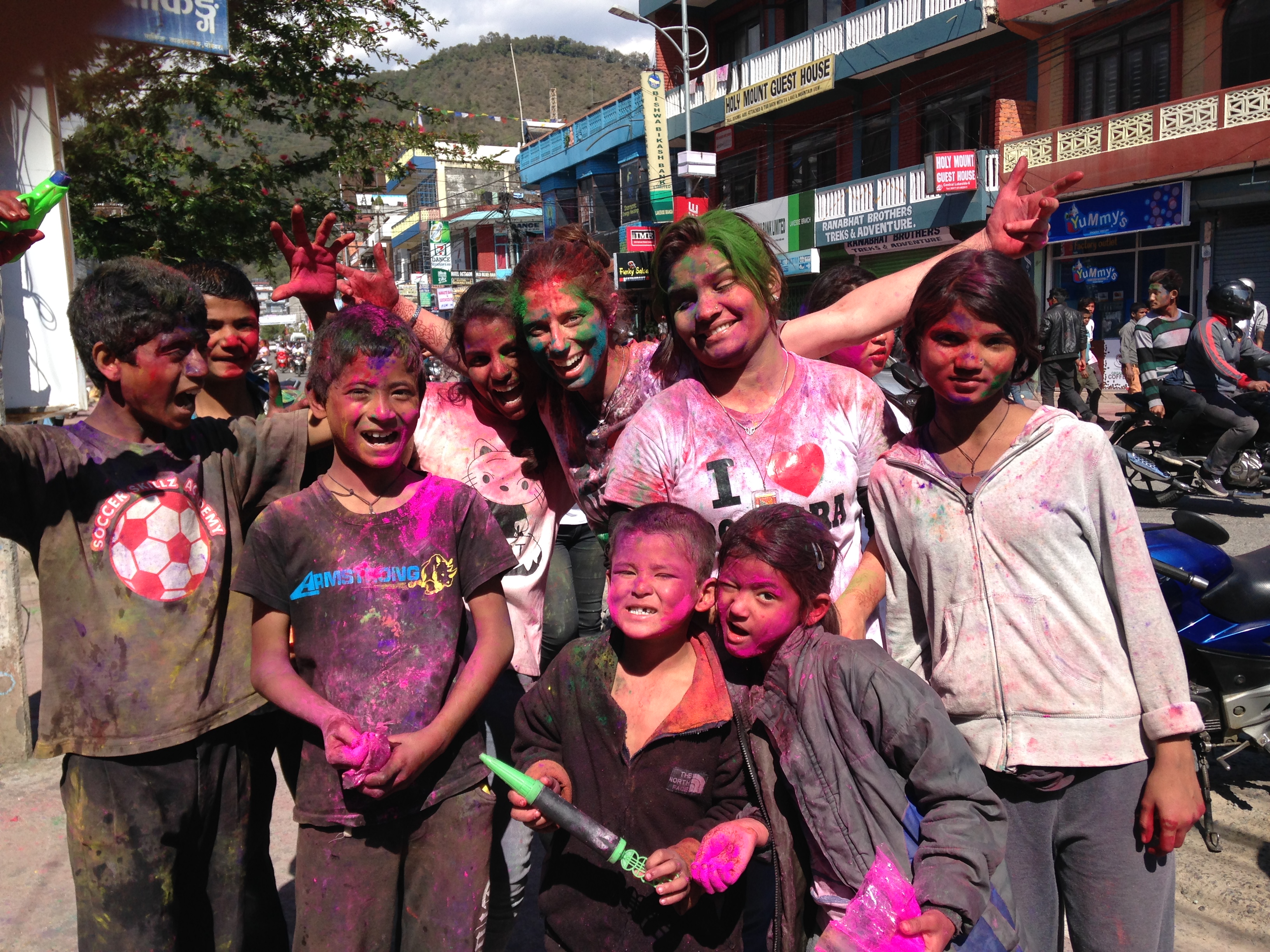
For weeks leading up to Holi, white clothes were on sale in every version and size. I got myself an “I Heart Pokhara” t-shirt and a cheap pair of pants, and on the morning of Holi I picked up some squirt guns and packets of brightly colored powder for the kids. I returned to the children’s home with my stash and presented them to the kids. They just looked at me like: you only got one squirt gun? What’s wrong with you? Sanjay filled up an empty plastic water bottle and dumped a packet of purple powder in to it. Someone had the excellent idea to poke a hole in the cap, and this bottle was to become our most potent weapon.

When we ventured out in to the street around noon, people were walking around with super soakers. I mean that kind where you spray the entire jumbo water cartridge continuously until it is empty. Poor little Laxu was carrying the mini squirt gun I’d given him that had to be refilled every three minutes through a flubbering hole in the side. We quickly began looking for a good deal on six more squirt guns.

IMG_4611We walked the streets for two hours, and then our Gaky’s Light Fellows showed up and I went back in  for round two. For a culture that’s fairly concerned with propriety as a general matter, Holi is an unruly and joyous anarchy – all the best of the bright pandemonium that is Nepal. Clouds of yellow and pink and green puffing up in to the air over the crowded sidewalks while colored water sprays haphazardly on to soaked shirts and faces. Strangers running up to each other and smearing hot pink powder on each other’s cheeks. Hooting and yelling and rainbows exploding every which way. I was with a group of kids ranging from age 7 to 13, and everyone in the packed streets was acting just like them. It was magic.

I did learn a few critical pieces of wisdom that I hereby pass on to you.

  1. Keep your mouth closed. I realize that when someone is throwing a fistful of green powder on you or blasting your armpit with orange water, your instinct is going to be to squeeze your eyes an open your mouth in a gleeful expression of frolickness. But, your mouth is going to get full of green powder (that’s really bad) or orange water (which is just gross on principle). So frolic with your lips tightly sealed.
  2. IMG_4638Don’t be the douchebag who does the move where you grab someone else’s water bottle, bend it towards them, and spray them with their own water. Because first of all, I’m already wet, so you’re not as special as you think you are, and second of all, Sanjay made this water bottle and you’re ruining it, douchebag. Make your own water bottle and squirt me with that.
  3. Pay attention to the color distribution on your target’s shirt. Your target, if your target is me, wants to save this I Heart Pokhara shirt forever and ever, and it’s no fun if the entire thing just turns brown. Am I missing yellow? Would a splash of blue do well to bring out the hot pink? And aim for the empty areas, for Pete’s sake. I paid $3 for this t-shirt and I want it properly ruined with some sense of artistry.
  4. Hit me from ahead where I can see you. Because the first person to grab me from behind and putt purple powder on my face and up my nose will probably get away with it – partially because I’m not ready to drop my mini flubbering squirt gun to whoop your ass, since I’m holding on to it for this small kid I came here with. However, if you’re the second or third person, I reserve the right to take out a can of taekwondo on your poorly executed headlock, and that’s not going to work out well for you. I don’t like purple powder in my nose. Thanks.

Happy Holi, fools.

IMG_4631

Another Relaxing Day Off

Yesterday I did what I usually do to relax on my day off: go with Aamaa and about thirty neighbors to chop and haul firewood for six hours.  As Aamaa and I were headed down the hillside in the morning, carrying our ropes and sickles, a buffalo was baying loudly in the distance.  Aamaa stopped for a second and listened.
“…Oh, it’s a buffalo,” she said.
“Of course it’s a buffalo,” I said.
“For a minute I thought it was a cell phone.”
“You thought cell phone before you thought buffalo?”
“Sometimes cell phones make that noise…bzzzt, bzzzt.”
Cultural moment.
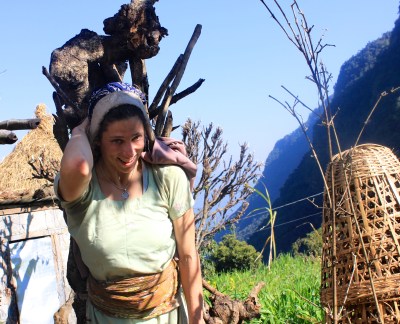
Woodcutting is highly regulated and occurs en masse, and it is a brilliant example of the chaos and color of rural Nepali life.  Today there are about 35 people in the steep, unruly forest shouting and singing and chopping with axes and saws and sickles.  Every now and then there is a loud whoop and a huge tree falls over.  Then you have the random American running around in the middle of this scene.  I am wearing one of my old “work” outfits – a hot pink and green kurta sulwaar from 8 years ago that’s got a rip here or there.  I am ready for action, baby.
I get assigned to a group of women bundling wood and carrying loads uphill to a clearing.  I would like to say that, after twelve years of voluntarily putting myself in these situations, I’ve actually earned a fair amount of respect – I do pretty well for a foreigner.  But there’s just a baseline level of awe that comes along with having a 5’8” white girl waving a sickle around in the woods a tuesday afternoon in the hills of Nepal.  Also, it’s the obvious topic of conversation.
IMG_7056For one thing, “Laura” is, exactly, the Nepali word for “stick.”  This is an endlessly entertaining point.  I look like a stick and I’m carrying sticks and my name means stick.  Unfortunately for me there is also a lot of discussion about actual sticks (after all we are in the forest chopping wood) and I am constantly answering “Yes?” in response to people saying things like, “Hey, give me that stick.”

After a few hauling trips, we’re resting in the clearing when the ladies get to talking about how nobody should submit to pressure from the choppers to carry too much at once.  Loads should be adjusted to the size and strength of each person – after all, it’s really hard work and we have people of all ages and levels of health among us.
Lady one: “I mean look at this foreigner here from Japan.”
Lady two: “It’s America.”
Lady one: “Whatever.”
On most trips I get paired up with Saraswoti or Aamaa, who I follow around like a baby cub. And I appreciate that all the wives look out for me.  However I do get a little fed up with being babied on tasks I’ve sweated significantly to master, such as carrying stacks of wood slung from a rope on my head.  So late in the day, when fatigue and disorder have evolved to a stage where I find myself momentarily separated from the group as everyone is bundling their loads, I find a huge log and wonder if I can lift it.  I manage to get it upright but can’t sling from my head because it keeps falling over.
“PUT DOWN THE HUGE LOG!” yells a guy from across a ravine.  I call this guy Michael Jackson, but that’s another story.  Michael Jackson makes the mistake of shouting across an entire forest that the log is too heavy for me to lift.
I set the log up again.  Michael Jackson abandons his first strategy and calls to Barat to come hold the log so that at least it doesn’t roll away while I’m making a bad decision.  I manage to stand up in the steep underbrush with this huge chunk of tree slung from my forehead.  It’s added at least 75 lbs to my bodyweight.
For future reference, putting DOWN a 75 lb log slung from your head is almost as hard as picking it up.  So I just start walking up the hill with it.  I have no idea whether I can carry this thing all the way up to the clearing, which requires climbing over terraced fields on narrow footholds.  But so far, Michael Jackson is losing, even with my Japanese disadvantage, and that is all that matters.
I plod along until a line of women with their own bundles of wood catch up behind me.  They begin scolding me to put down the gigantic log, and to be fair I kept thinking that, over the next ledge, I would give it up.  But everyone was moving forward as a group, and it was never exactly the right moment to stop, and each time I hit a ledge I would think I’m putting this stupid log down on the other side, but then the other side would be flat enough to take a few steps and I’d find myself at the next ledge.  So we just kept moving up the hill one ledge at a time.
We get to a particularly difficult terrace that has a narrow foothold and a large height difference.  With the added weight, these high steps are treacherous because I literally can’t lift myself.  So instead of stepping up over the edge of the terrace, I put my knee over the top and get myself over on all fours.
For the record, this is a fair tactic.  I watched Sandrakali didi do it earlier in the day.  But it is super awkward, and leaves you waving your butt over the edge of the field at all the people behind you.  Which is really okay in most circumstances, but as it happens, my work pants from eight years ago are ripped right at the butt crack.  So I am waving my underwear at a line of women behind me carrying bundles of wood, while I am crouched under a 75 lb log that is attached to my head by a rope.
This actually happened in my life.  Yesterday.
“Laura, PUT DOWN THE LOG,” all the women are chastising me.  Out of love of course.  What would my Japanese mother think?
“I’ve got it guys, I’ve got it,” I reply, from under the log.
With a burst of leg strength I stand up and make my way up to the clearing, which is now close at hand.  As I approach, Michael Jackson has his cell phone out and is taking a video.
I put the log down and throw my hands up in the air in triumph.  For the rest of the afternoon, everyone is talking about my wood carrying prowess, while simultaneously scolding me for my poor judgement.  THAT log, everyone says, pointing to it.
Also, Srijana tells me to take Aamaa’s shawl and wrap it around my butt.  My pants are ripped and the entire world knows.
We’re off for the next load.  I’ll be ready for the office again tomorrow.
.     .     .

The List


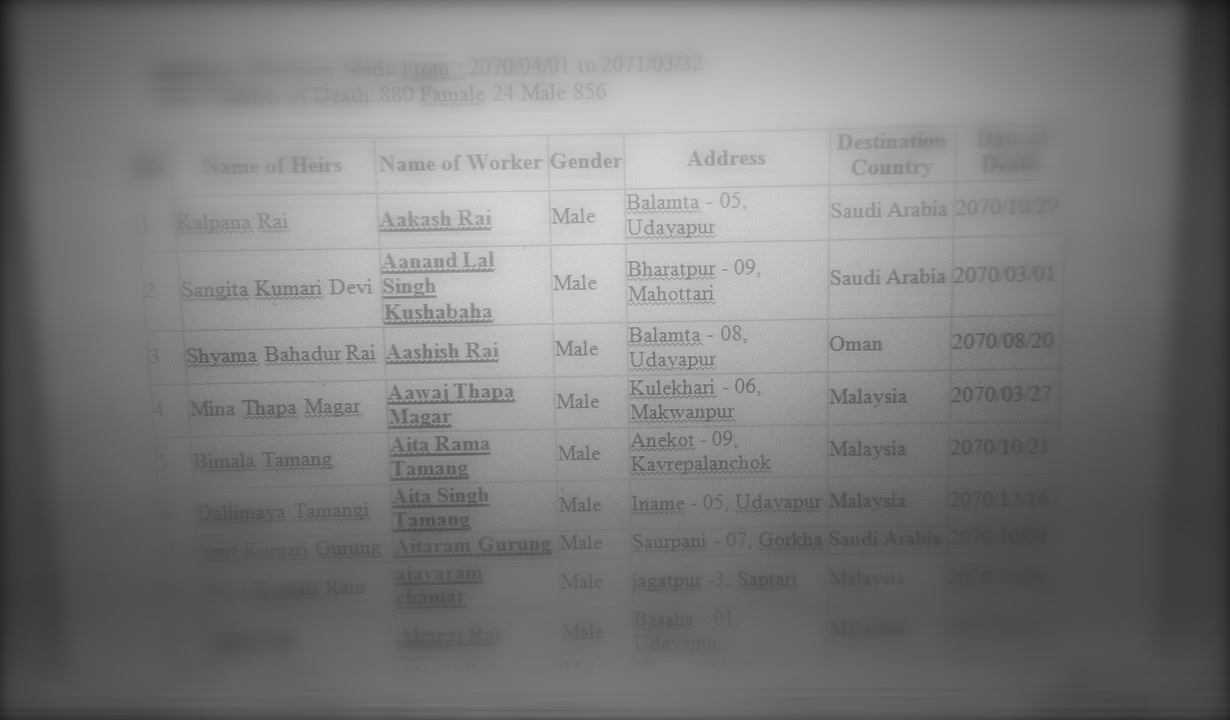
Since the day I arrived in Nepal, I have been trying to get a list of migrant laborers who have died abroad. Partly this is so that I can find a family willing to tell me about their son’s life. And partly it’s because everybody has a different opinion on how common it is for migrant laborers to die abroad.

The night I landed in Kathmandu’s national airport back in December, I spoke with an airlines agent, who told me that bodies arrive at the airport daily. Someone else milling about the office said they receive a body every few months. When I asked for a record to sort it out, they said each airline keeps a separate list, and to get a combined total of bodies received, I’d have to go to customs.

A few days later I went to customs, which eventually sent me to the cargo office, which eventually sent me to an insurance company, all in search of this List. Our cousin Laxu, who was helping me, agreed to go to the insurance company while I was back in Pokhara. He texted me later saying that the insurance company had sent him to the government’s Foreign Employment Office, where families of the deceased to go pick up renumeration.

On an afternoon in early January, a month after my first night at the airlines office in Tribhuvan Airport, Laxu and I went to the Foreign Employment Office. We arrived to find it closed for a holiday. There was nobody there except for a guard standing outside.

The elusive List still beyond our reach, I asked the guard what he’d noticed about families coming to deal with the legalities of a loved one who’d died abroad. He said the families are easy to recognize. They come regularly.

Who, I asked, is “they?”

Usually, the guard told us, the immediate family of the deceased arrives with someone who can help navigate the system and explain things. This is something I’ve heard a lot. The families of many migrant laborers are minimally educated and have little experience outside their home villages or communities. Handling the logistics of a death is complicated under the best of circumstances, and for many of these families, it is impossible without someone to help with things as simple as travel and reading.

I asked how people normally transport the body of their loved one home to perform rites. This is one of the central my questions of this project, because transporting bodies around is so starkly incompatible with the traditional ritual treatment of the sacred dead body.  And, it’s expensive. It’s important to understand who pays to make kriya possible by getting everyone in the right place. Is the labor industry involved in supporting the families of workers who die overseas? Is it the government of Nepal? Do poor families have to sort this out themselves?

“It’s the government that pays for transport back to villages, not the manpower companies,” the guard told us. Everyone I’ve talked to so far flatly disagrees on this point, so the truth is, it probably varies from company to company.

“Why would anyone go through a manpower company?” I demanded, suddenly gripped by a wave of frustration. “The first year of salary goes back to loans and is basically free work. All the risk seems to be on the laborers. Why does anyone do it?”

“If you don’t go through a manpower company, it’s very difficult to work abroad,” the guard replied. “Very difficult. How many people are simply left abroad, in hospitals?”

He went on to explain in general terms that when laborers arrange their own jobs abroad, they are unaccounted for – even by the Nepali government. If anything unfortunate happens, it is much harder for freelance laborers to get home, or even for them to be identified. Their families, in all likelihood, would have no way to trace them. So the only way to do it is through a manpower company, because stacked insurance is a lot better than none.

It was clear that Laxu was going to have to come back another day to get The List. Before we left, I asked the guard how many families he thinks come to the Foreign Employment Office each day to receive insurance payments.

Eh, they come, he said, they come. We went back and forth a few times; I thought he was being vague because it wasn’t all that often, and our conversation was overdue to end. Then he looked straight at me.

“Every day,” he said. “Ten to fifteen per day.”

*

10906845_906068726083503_1237497870_o 2

Shooting Lights at the Sky


Didi, Pascal and Aidan and I left for the New Year’s street festival right around dusk. It was already jammed with people and food stalls, a challenge for us because, while Pascal carefully soberly dodges people’s legs and ponders over his food options, Aidan absolutely doesn’t care where he’s going, and he’s only about 3.5 feet tall, and he wants to eat everything he sees, and he can’t take his eyes off anything.  We got some ice cream, and some hot dogs, and some cotton candy.

At 9pm the Gaky’s Light Fellows showed up with arms locked in a blob. It was such a fantastic moment – they were all dressed up and so excited to be there together, and then they practically mowed me down in the street in a mob of happiness.  On the corner a crowd of people was dancing to some impromptu devotional drumming and singing.  So that’s how I ended up on New Years spinning around with Aidan on my shoulders and Pascal on my leg and our fellows clinging to my hands while we all danced in the street to a bajan.

The street crowd grew so thick that it became river.  I left Didi and the boys and waded in with our fellows – we were literally all holding on to each other and being carried down the street by a massive crowd.  Every once and a while someone would pick the person right in front of them and, just for fun, shout: “SANDIP IS LOST!” or “SOMEONE HOLD ON TO PABITRA, SHE’S SMALL AND WILL GET LOST!”  Samundra, our program director, had a scarf wrapped tightly around his neck.  “SAMUNDRA’S NECK IS LOST!” I cried.

Eventually, we got lost.  There were just too many people, our group was cleaved, and I ended up swimming along with Sabina and Asmita and Anju.  All the phone networks were jammed and we couldn’t get through to any of the others.  We were finally catapulted through a gate to the fair – I mean washed over the threshold while clutching each others jackets, past a wall of police trying to look for tickets. We came tumbling out next to a ferris wheel like Alice in Wonderland.

We dusted our selves off and looked around.  It was 10:30pm.  There were lights and huge objects everywhere, surreal and dizzying.  The four of us stood locked together so we wouldn’t be separated in the hectic sea of people, until we boarded a boat that swings back and forth on a pendulum.  We let people in line pass us until we could get a spot all the way at the tip of the boat, where we had the highest view, where all the strange fair lights streak across the sky and the top of the ferris wheel is right there, and you can’t ignore the moment the boat reverses direction and you’re suspended for an instant in mid-air with nothing under you.

By this morning, Pokhara looked like the day after the worst frat party you’ve ever seen.  Trash, tables askew, dejected looking tents, all kinds of equipment and decorative paraphernalia sagging with a January 1st hangover.  Even the sunrise seemed weary.  But it was pretty worth it while it was happening.  Welcome to 2015, World.

Which reminds me of something.  When we’d left for the street festival, Aidan had been begging for a new light.  Throughout the festival they’ve been selling slingshot lights with wings that sail way up in the air and then slowly float down, so the night was full of beautiful falling blue lights.  Pascal, like me, is enthralled with the light but cautious of losing it, and kept his slingshot safe in his pocket most of the time.  Aidan on the other hand is completely reckless.  He’s too excited about shooting the light up in to the air to worry about what happens to it, and we had rescued his flying toy from more than one rooftop on tuesday night.  Each time it got lost he was utterly dejected, and then we’d retrieve it, and he would go right back to catapulting it at the night with unbridled enthusiasm.

“Laura auntie,” Aidan explained to me as we walked in to the street again on New Year’s Eve, “when you shoot the light, it goes up toward the sky like this.”  His put his hands over his head and pointed his little fingers toward his palm, in an angled T-shape, to show the way a light sails toward the sky.  “But then just when it’s about to touch the sky…” his eyes got big and his palm drifted up “…the sky MOVES, Laura auntie!  The sky MOVES!”

.      .      .

IMG_4160


Bitter Medicine


The last day of kriya for Malika’s father has been moved to Tuesday night, because the morning of the thirteenth day has fallen on a Wednesday, when it is inauspicious to end kriya. I ask Aamaa and Didi why, and they say, Wednesdays are inauspicious for many things.

“It’s tradition. It has been this way for a long time, “ Didi explains.

So after dark on Tuesday night, Kanchaa and I walk down to Malika’s house, where tonight, everyone will drink gaunut—cow urine. As we pass the water tap, Kanchaa explains to me that gaunut has tremendous medicinal cleansing properties. He says that he had jaundice when he was fourteen, and for six months he didn’t eat salt, and every single day he took a shot of cow urine, and he completely recovered from the jaundice.

The priest is preparing the puja on the porch and neighbors are milling about in the yard. The atmosphere is anticipatory and almost festive. After two weeks of austerity, life seems to be rushing back in to this house with inexorable force.  There is a vacuum.

I’m inside when I hear Kanchaa call my name. It’s my turn to drink cow urine. I squeeze my eyes closed and throw it back. The gaunut is thin and bitter.

IMG_6425Everything looks mysterious and beautiful because of the nighttime. Kanchaa tells me I can take photos, but I’m worried that’s inappropriate, especially if I have to use a flash. At my bidding, he asks Malika’s brothers if they mind the camera, and reports back that they don’t mind. Unconvinced, I ask them myself. It’s really fine, they say.
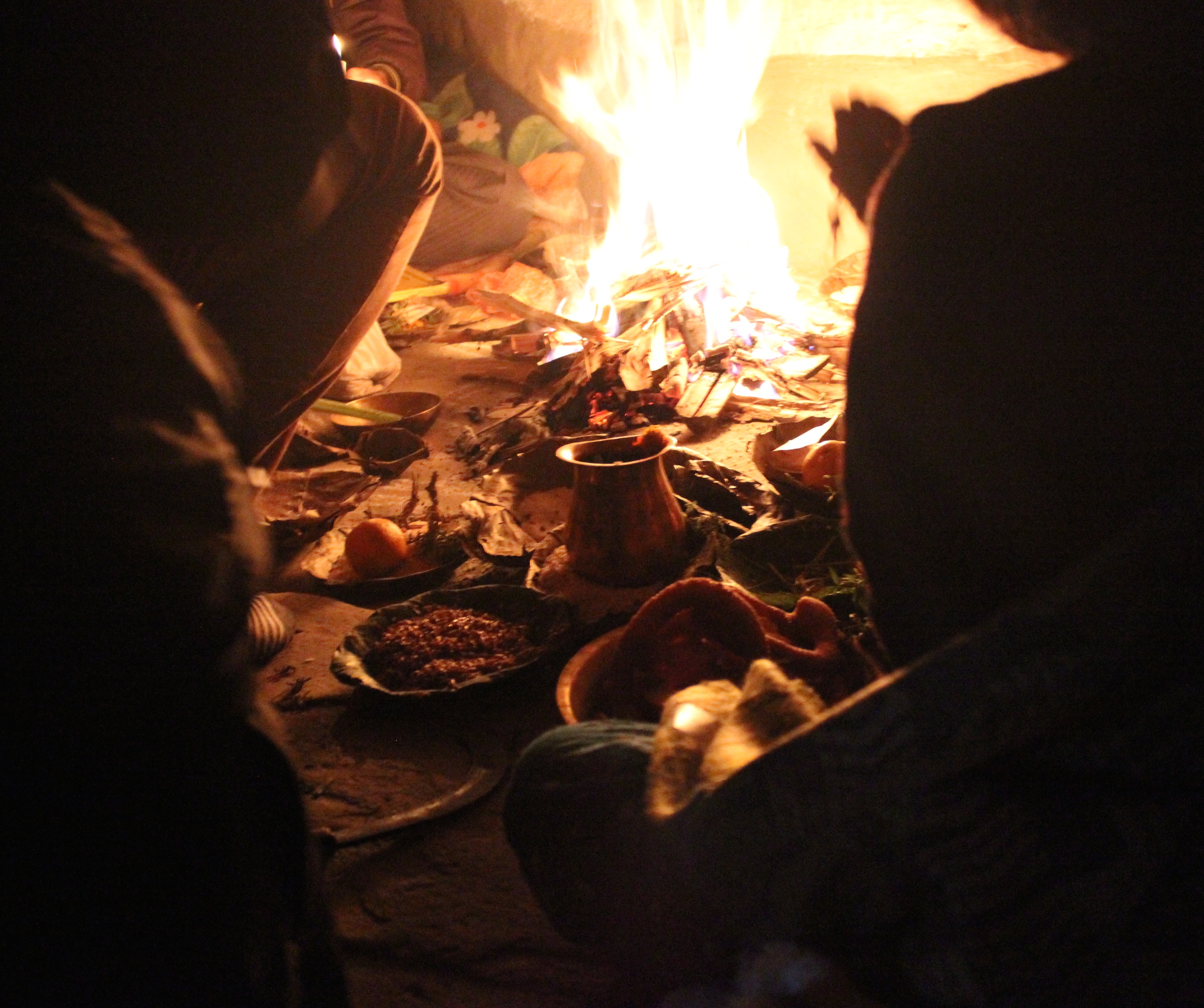
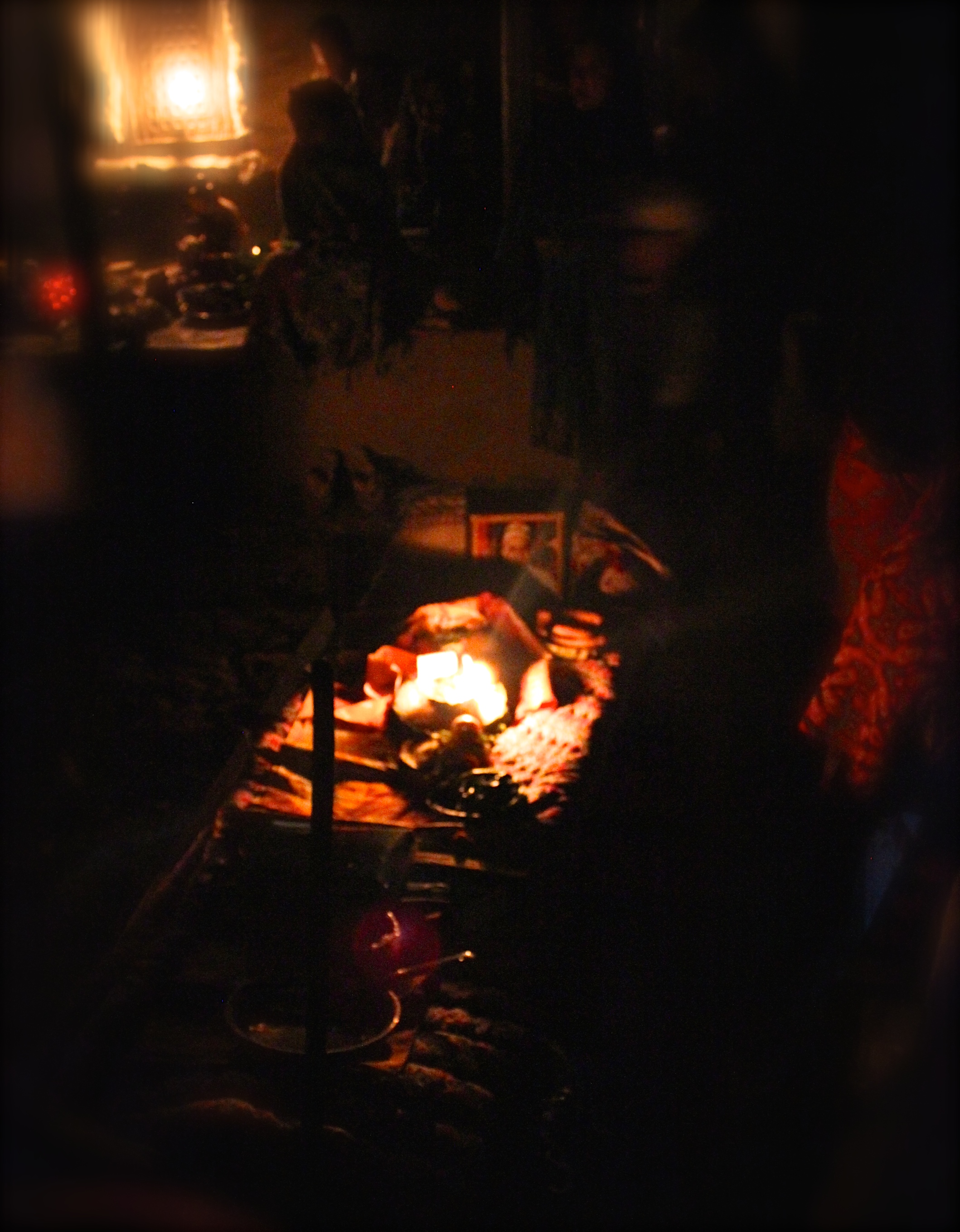
So when the puja starts, I fiddle with my camera, testing different settings to see what works at night. I find a setting that I can use without the flash, and am clicking away at the tilting shadows on the wall when all of a sudden I hear Krishna dai’s voice cut exuberantly through the reverent stillness:

“So many photos – somebody is going to make a lot of money!”

I feel like I have been struck by lightening. Everything is silent; everyone is staring at me.

“Come over here!” Krishna dai cries. “This is the best view!”

Slowly I lower my camera. “Please, dai,” I say softly. He is supposed to be my friend.

“Come come come!” Krishna dai bellows. “Take some photos from here.”

“Please dai, I’m embarrassed,” I whisper, frozen.

“Don’t be embarrassed! No problem!” he shouts.

I hear murmuring behind me. What am I doing taking photos where a man has died?

For a few minutes I literally can’t move, even to go put my camera away. Eventually I slide in to the shadows and find my camera bag. It’s a few more minutes before I get the courage to find Kanchaa, who is tending a fire. I tell him what happened.

“I’m sorry Laura didi, don’t mind Krishna dai. Some people just don’t understand.”

“I feel awful. I said I wouldn’t if—“

“It’s not a problem Laura didi. Some people have this concept that foreigners sell photos of them. Krishna dai doesn’t understand. Nobody else minds. You can take pictures.”

But of course I can’t bring myself to take out my camera again. I knew when I began this project how easy it would be for it to become voyeuristic or exploitative. Before this evening, I spent twelve years in Nepal, learned the language, and have known the daughter of this house for that long. On two evenings I paid respects without so much as a pencil in my hand. I have been conscientious of placing myself discreetly out of the way with my recorder or camera, and have chosen to use only photos of Malika’s family where their faces are obscured, not because they asked, but because it seems right.

But at the end of the day, I am still an outsider looking in on their pain. And what’s more, I can’t promise that, if given the opportunity to publish this work and be paid, I wouldn’t do it, because, of course, I would.

I tell myself that to bear witness is to honor someone’s experience. But only when we don’t impose anything or expect anything back. Do I meet that standard? Maybe Krishna dai is right.  Maybe more than right; photos are hardly the point. Perhaps I am deceiving myself of a much more basic indulgence.

I will worry about that for the entirety of this project. But in the end, I know I will be drawn back every time, and Krishna dai will never see it as honorable. I can’t change who either of us are. It is bitter medicine, but it will keep me honest.

It is about an hour later when I find myself sitting next to Malika’s eldest sister and apologize profusely. But it is no problem, she insists once more, for me to take photos. After multiple reassurances, the seeker in me wins out. Which was predictable.

IMG_6400

So I have my camera discreetly in my hands while five separate cooking fires are lit, mountains of vegetables are sliced, huge pots of oil heated, and vats of tea are brewed. The hushed tones of the last two weeks have blossomed in to busy conversations. Gigantic heaps of celebratory cel roti begin to pile up as the puja comes to an end.

I have my camera when it is time to say goodbye. A brand new bed has been set up in the yard. Malika’s father’s picture is at the head, and the bed is covered with gifts for the afterlife. At the foot of the bed, as per tradition, is the walking stick that he carried.


A candle is lit in the middle of the bed, and the family members circle it, touching their foreheads to it, the way one shows respect at the feet of a senior family member in life. The bed is so life-like, with the walking stick leaning against its side, that it is impossible not to feel the presence and the absence of the man.

For a moment the camera hangs around my neck, and I am still. And then, shielded by shadows, I pick it up. Sharing this moment is my way of paying tribute, so I put that thought in my heart and offer gratitude.  It is stunningly beautiful.

Tomorrow morning, the bed and its gifts will be taken from the house forever.

11:30pm. At last, it is time to eat.

.      .      .

IMG_6432 - Version 3


A Kilogram of Sugar


Yesterday Kanchaa and I were at Malika’s house most of the afternoon. It was 1:00 by the time Malika’s brothers had finished washing, praying, cooking, and eating their daily salt-less meal off banana leaves. We accompanied them back to the house and I noticed Malika a fastidiously maintained log of contributions in a school notebook: name, donation, location of house. People streamed in with gifts of incense, ghee, money and tea. In the morning I’d discreetly placed some oranges and bananas in a donation basket.

On the fifth day of kriya a priest begins a daily reading at the house. It’s in Sanskrit, which nobody can understand, so at intervals the priest translates and reflects on the reading.

IMG_6359A king from early times was walking through the forest, thirsty. In the woods, he encountered a spirit who blocked his way to the river. The spirit told the king that he was caught between worlds, unsatiated because his kriya had not been properly observed.
“Honor my kriya,” the spirit said, “and observe my annual ‘sarad’ on the anniversary of my death.” Then he let the king go to the river to drink. When the king returned home, he paid kriya respects, observing all the necessary rituals. And at last, the spirit was at rest.

Tonight I Kanchaa and Neru and I went back to the house after dinner again. I hadn’t remembered until I got home yesterday that while oranges and apples are a central part of the fasting diet, bananas are off limits during kriya. We stopped and Shiva dai’s house and I bought a kilogram of sugar and some incense. We turned on our flashlights and followed the stone path down to Rotepani, past the concrete shelter, past the tap, to the dimly lit house.

The crowd of women was gathered around the fire again, and Malika’s mother sleeping on the floor again, the brothers already asleep on their beds of straw outside. Malika looked weary. She and her sisters are still sleeping on mats on the floor, and it’s cold.

I took off my sandals and handed her my gifts, along with 200 rupees. She took out the school notebook, placed it on a low stool and bent over it with a pencil.

Laura Spero. Incense, 200 rupees, one kilogram of sugar. She paused and looked up.

“America,” she said. “I’m going to write ‘America,’ ok?”

.      .      .

IMG_6413

Kriya


Thursday was the seventh day of kriya for Malika’s father. Kanchaa and I arrived around 11am, long after Malika and her sisters had repainted the floors with a new layer of mud, gone to bathe at the tap, and returned home.

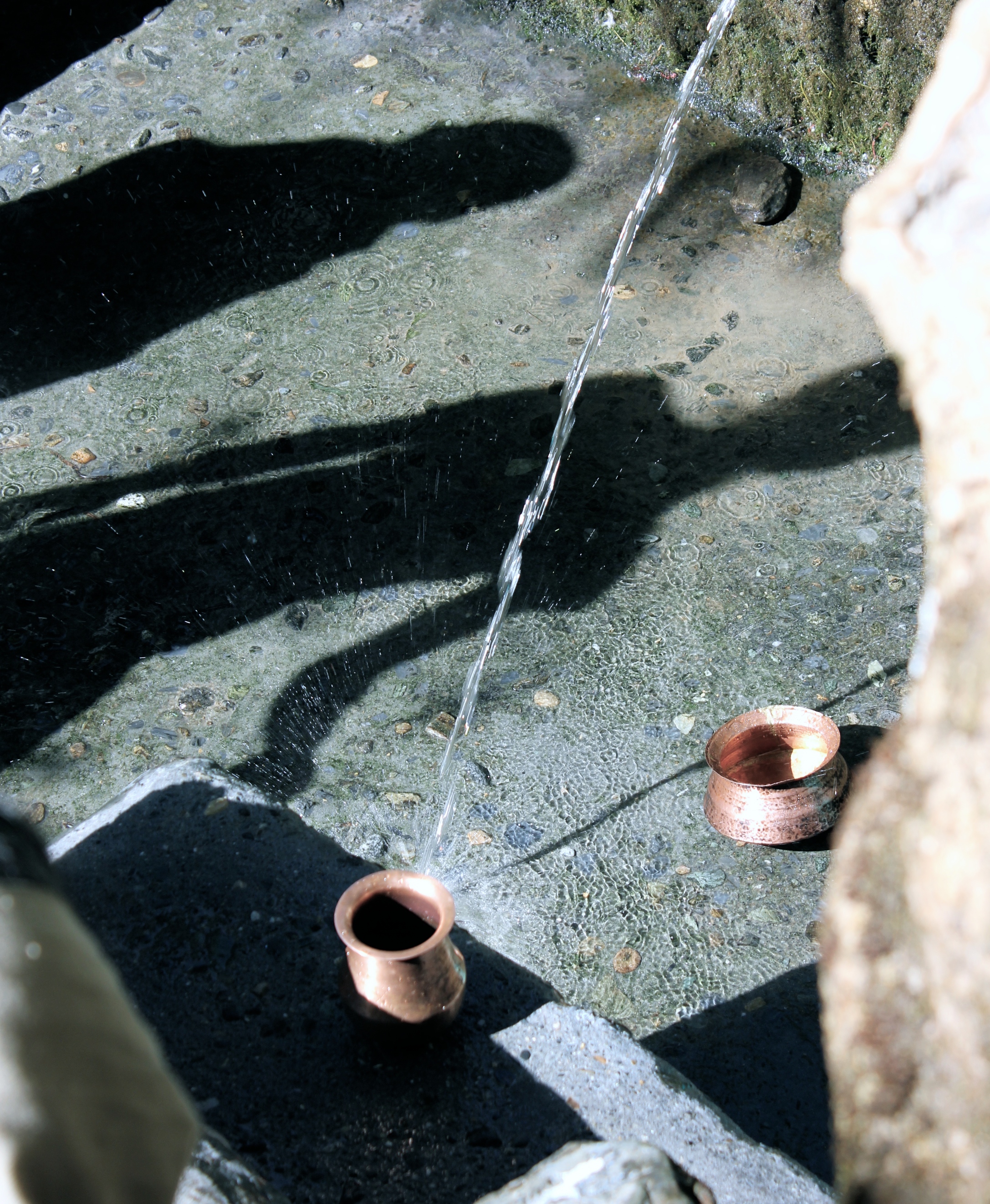
The sons’ turn to bathe comes at mid-day. We leave for the water tap with an entourage of men who bring along firewood and a basket of cooking supplies. Malika’s brothers carry only a special set of water vessels. They are not to touch any of the other items directly – not even the basket.

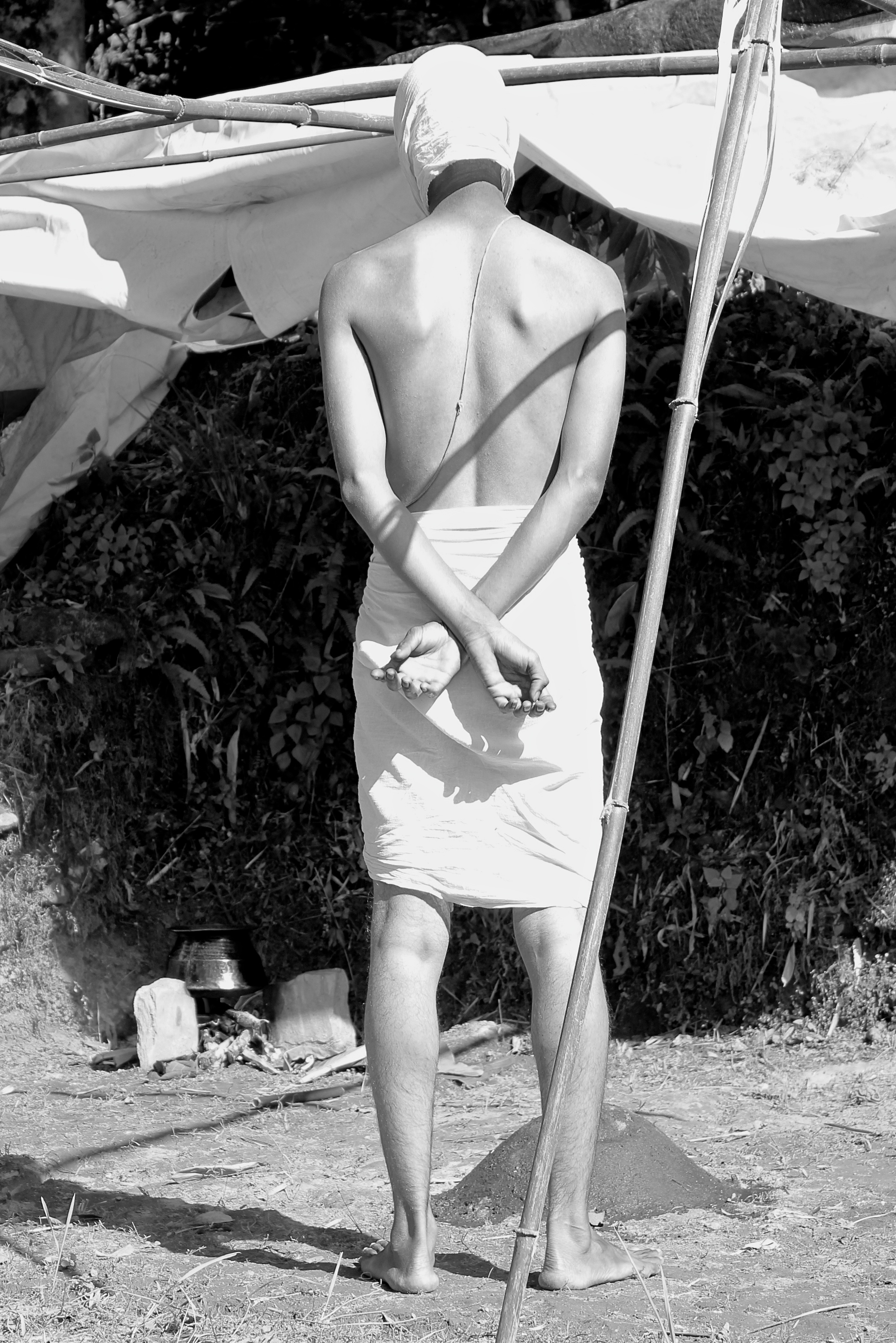
IMG_5955A tarp has been put up a respectable distance away from the water tap, and we set everything down. Just on the other side of the spring there is a sizeable concrete shelter for kriya mourners that was built with funds raised from the community. This gives you an idea of the deference paid to these customs.

Malika’s brothers leave for the water tap. Some of the other men get a cooking fire going, and the rest sit on the edge of the terrace having a rollicking conversation about politics. I can see Malika’s brothers from far away, through a haze of bamboo stalks and leaves. They go through a series of rituals with the water vessels, washing their white linens, and bathing in the discreet way that everyone learns to do in public. Their brother in law stands guard at the edge of the tap, but nobody approaching would be confused. They will wait.

When the brothers return, the youngest sets to cooking their daily meal over the fire that’s been started. The elder brother begins a puja over a small mound of dirt.

I spend a good bit of time gazing at the mound of dirt. It is about a foot wide. When we arrived it was protected with a branch lying over it. Malika’s brother smooths mud around its sides. It makes a rough, wet sound under his palms. A series of other rituals unfold, and each time he needs a new object – leaf, water, jug – one of the other men places it on the ground for him, careful that the two people do not touch anything at the same time.IMG_5950

The mound of dirt symbolizes his father’s body. On the tenth day of kriya, the oldest son will destroy
the dirt body with the crown of his head, and for the last three days of kriya, his puja will move to a different piece of ground, a few feet away. Where there is nothing.

The physicality and deliberateness of this performance is beautiful to me. When we lose someone, there is something missing between our hands, between our minutes, between our thoughts. No matter how long the process of departure takes, there is a moment of disappearance…and then emptiness.

Kriya is an unremitting physical process. Sitting around the edge of the terrace, we bear witness to the externalization of that mercilessly intangible absence. And this seems very important. Observers can carry the baskets, light the fires, put the prayer objects in reach. But they cannot inhabit these things. We are not naked, cold, untouchable; the body has not disappeared from our houses; we are only there to make this reality manifest. But we must be there. Otherwise the process is impossible to complete.

.      .      .

IMG_5968

If I Can’t Say Namaste


Last Saturday evening I came home with a fresh bundle of vegetables from the market, but Aamaa said we’d be cooking without salt. A man at the house near the water tap in Rotepani passed away yesterday. Aamaa and I ate plain rice with ghee for dinner.

It wasn’t until the next day that I realized I knew the one of the bereaved daughters. “Malika,” Aamaa said, “Don’t you know Malika?” Of course. I remember her hanging around with Didi and Bishnu back when we were all in our early 20s, before anyone was married. “The really skinny one?” I asked. Yes, that Malika. Her father, in his sixties, had been ill for about a month.

This has given me an opportunity to pay respects during a traditional period of kriya, when a man with grown children has lived an honorable life and passed away at an age that, in these parts, is considered decent.

On the sixth evening of kriya, after Aamaa and I had eaten dinner, I rounded up Neru and Kanchaa from next door. Lighting our way with flashlights down the stone path toward Rotepani, we left for Malika’s house.

As we approached the house, a warm mist of voices bubbled up in the cold black night. We found a tarp stretched out over the yard from the edge of the roof, to shelter the stream of visitors from sun during the day and provide some warmth at night.

Three men were sitting on the mud-smoothed porch, leaning against the wall of the house. I recognized Krishna dai, who I’ve known since the first week I came to Kaskikot twelve years ago.

“Namaste,” I said, raising my hands.

“We don’t say Namaste now,” Krishna dai said.

“Sorry.” I looked down.  I had trouble figuring out where to replace my hands.  Lesson one, of many.

Malika’s brothers were peering through the door of an attached room on the small house – I’m guessing that at some point it was used for goats – sitting on the ground with white blankets wrapped around them, like bowling pins. Until the thirteenth day they will only wear new white clothes with no seams, and they’ll wash these clothes daily.

We talked quietly with Krishna dai and the other men outside for about ten minutes. They are all friends and relatives of the deceased. Their role is to sleep on mats on the porch and guard the door of the house, because the sons are not to touch anyone or anything during kriya.

“For example, if a chicken comes by,” Krishna dai said, “we shoo it away. So it won’t touch them.”  This seemed awful and gorgeous.

Krishna dai asked about our mourning traditions in the United States. I said they vary a lot according to religion and habit, but that I am Jewish, and our rules mandate a quick burial – strictly speaking, we don’t cremate. I explained how we have a gathering where people stand up and tell stories about the life of the person who has died, so that everyone can share and honor these memories in one place. The sons leaned in closely by the door of the goat room to listen to me. I said we bury our dead in a special place that’s marked with a stone, where we can return to do puja and be with our loved one. That we return from the cemetery and wash our hands and fill our stomachs with food, and people stream through our houses with flowers and food while we sit shiva – a mourning period when we keep our homes full of life, because we must keep living. By contrast, kriya imposes strict and challenging rules on almost every movement of the bereaved: fasting, washing, praying, isolation, burning. In some ways, everyone has died.

It occurs to me now how little I know about the orthodox dictates of Judiasm and mourning. Is there a period of purification? I have no idea. I could look it up easily for this post. But it’s more interesting that I have no idea.  So I’ll look it up afterwards.

As we were talking, a slight woman with her uncombed hair falling over her shoulders came out of the house. Malika and I haven’t seen each other in about eight years, but she heard my voice from inside the house. Despite the circumstances, it was a really lovely moment. There wasn’t a lot that needed saying, other than, “I heard.”

We entered the small house. Malika’s widowed mother was sleeping by herself on a bed of straw – she too must observe kriya for thirteen days. “Say ‘Aamaa,’” Malika said.

“But what do I say if I can’t say Namaste?” I asked.

“Just say ‘Aamaa,'” Malika said.  So I softly said, “Aamaa,” and her mother sat up.  There wasn’t really much more to add after that.

But just on the other side of a low wall, a crowd of women was gathered around a fire, where a kettle of tea was brewing for all the visitors. Mourning customs for daughters are lighter than for sons and wives: Malika and her two sisters observed kriya for four days, and on the fifth day, they added salt to their food and were allowed to touch other people.  Their straw beds, upgraded now to straw mats, are still arranged on the floor of the house. They’ll sleep there together and continue cooking their own food and eating only once a day for thirteen days. Their hair will stay uncombed until then.

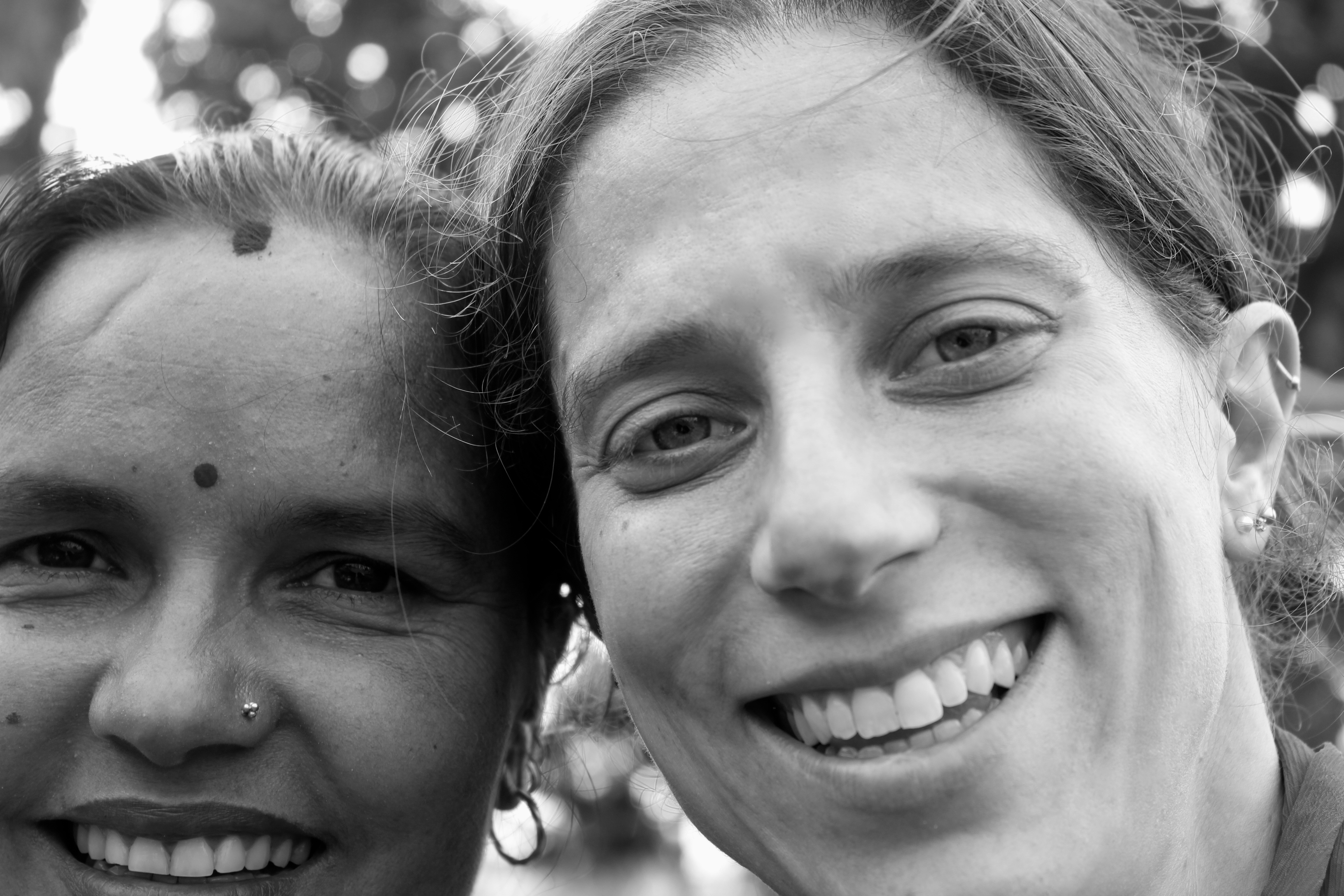
Neru and I sat by the fire for about an hour. Between other chatter, the huddle of women asked me all kinds of things about death rites in the U.S., and also about my family and what I’ve been up to. There was lots of quiet laughing. We spent a long time on the topic of marriage, which, in these parts, is almost always arranged by parents. People here are endlessly enthralled by the concept that I am tasked with finding my own spouse.

“Love marriage,” I said by way of explanation.  Here the phrase has an illicit undertone, like eloping. “That’s our culture.”

An old lady next to me was having trouble following. The expectation she’s always known is that you are paired with a spouse who is astrologically compatible with you and socially compatible with your family, and then you sign up for a life together, and then you go from there. A younger auntie jumped in to help out.

“Love,” the auntie said, looking up at us from her seat by the fire. “When two people make things work between them—that’s love, right?”

.      .      .

IMG_6015