Small Bundles in Big Spaces


IMG_9794

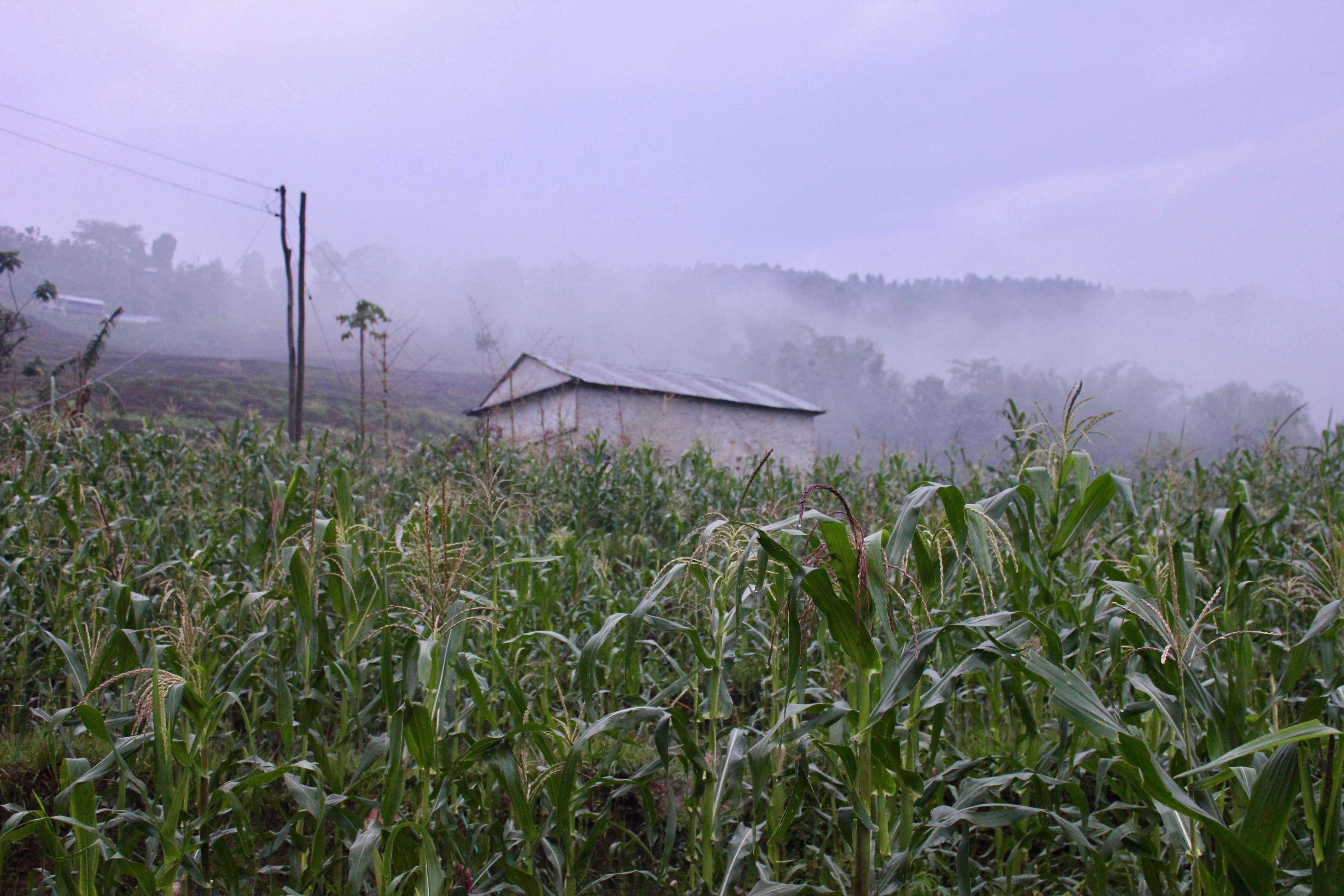
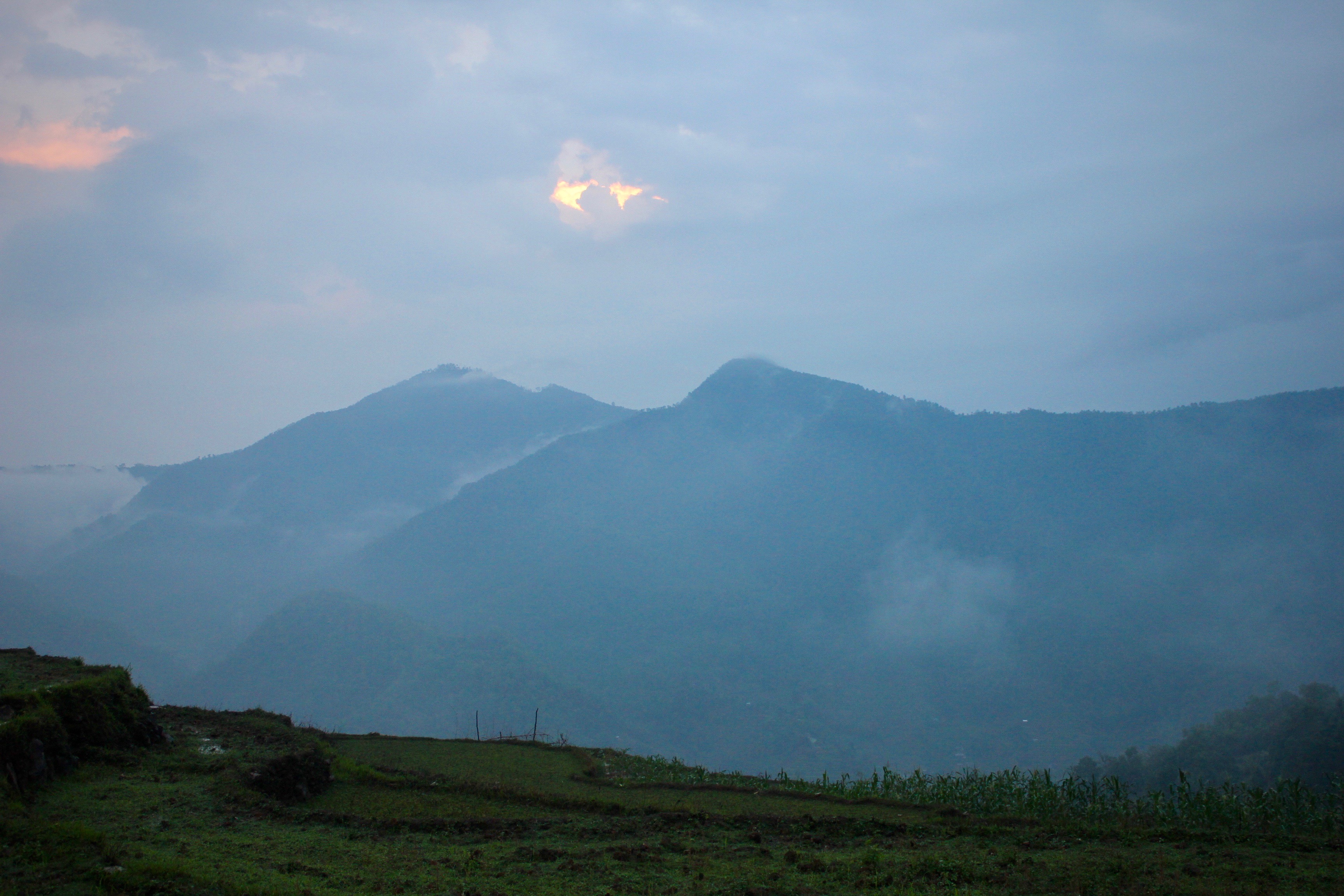
View across the valley, from Bharte

After my visit to Bharte, I went up to Besisahar to spend the night. Many of the international NGOs working in Lamjung operate out of a hotel called the Himalaya Gateway, and I wanted to sit in on a training by the Danish Red Cross on shelter distribution. Plus, I had to retrieve our first delivery of tin: two bundles for Uttam’s family.

I arrived bedraggled and hungry at the hotel at 8:15 pm after many hours of hiking up and down in Bharte in my flip flops (points for irony on the hotel name, Himalaya Gateway). I sat down and talked for a while with Laurienne, the head of CARE’s relief effort in Lamjung. I’d met her at one of the shelter cluster meetings and found her to be a really nice person, so I’ve kept in touch. It’s pretty funny that I’m running around in my flip flops in Bharte and taking a bus to Besisahar to a pick up our first two bundles of tin, while Laurienne is coordinating the transport of 1200 bundles of tin on 28 tractors – TWENTY EIGHT TRACTORS – we had a good laugh over just the image of 28 tractors climbing up the narrow jeep “roads” of Lamjung district. A bit of a nervous laugh, too. The delivery of all this tin is probably going to take a toll on Nepal’s fragile environment. The Red Cross has committed to almost four times that many homes in Lamjung alone – one of the less affected districts.

Speaking of damage, I got myself a pint of ice cream (“Ma’am, how many scoops would you like?…The whole container?…????…Certainly.”). I turned on the air conditioning in my hotel room which noisily and enthusiastically set to delivering air at the same temperature as the rest of the room. I took a shower and fell asleep on the fluffy bed.

The next morning I went to the Red Cross shelter training. It was super interesting, but probably not something I will be able to use much. The topic was how to conduct efficient mass distribution of tin sheets, building kits, and envelopes of cash. For your kind information, and so I can make some use of my training, I offer you the following tips on distributing thousands of corrugated tin sheets to remote Nepal: distribution area has one entry and one exit; recipients move through in a single straight line only, no criss-crossing; vests must be worn at all times and a flag clearly visible to signal that this is a humanitarian space; a question and complaint-receiver stays outside the delivery area.

Also, it is suggested that your team (and, one assumes, your tractors) arrive at your distribution area the night before.  Because there might be some problems with travel.  Maybe.

Mean time, I was coordinating our first delivery of a grand total of two bundles of tin for Archalbot. In the morning, I ran in to the Chief District Officer of Lamjung at the hotel, and of course, we are old friends. I said I was delivering two bundles of tin today in Archalbot and asked if he had any transport suggestions.

The Chief District Officer looked at me funny and said, “Two?” Awkward pause. “That…doesn’t seem like a enough.”

Right right, I said.  True enough.  But see it’s part of this thing that’s going step by step. I promised there’d be more.  There will totally be more.  Also, I’m two bundles ahead of the Red Cross, and I’m going to enjoy every bundle of my lead for each hour that it lasts.

It was about 2:00 by the time I hopped in to a truck with our two bundles of tin. The hardware store owner had a delivery vehicle that was headed south anyway, and agreed to take our tin sheets (and me) for free. And thank goodness this truck was large enough to house a killer whale, because only thing inside it was our two little bundles of tin, which you literally couldn’t even see in the gaping darkness.

We hit the road and I called Kripa to say I was on my way with Uttam’s roof.
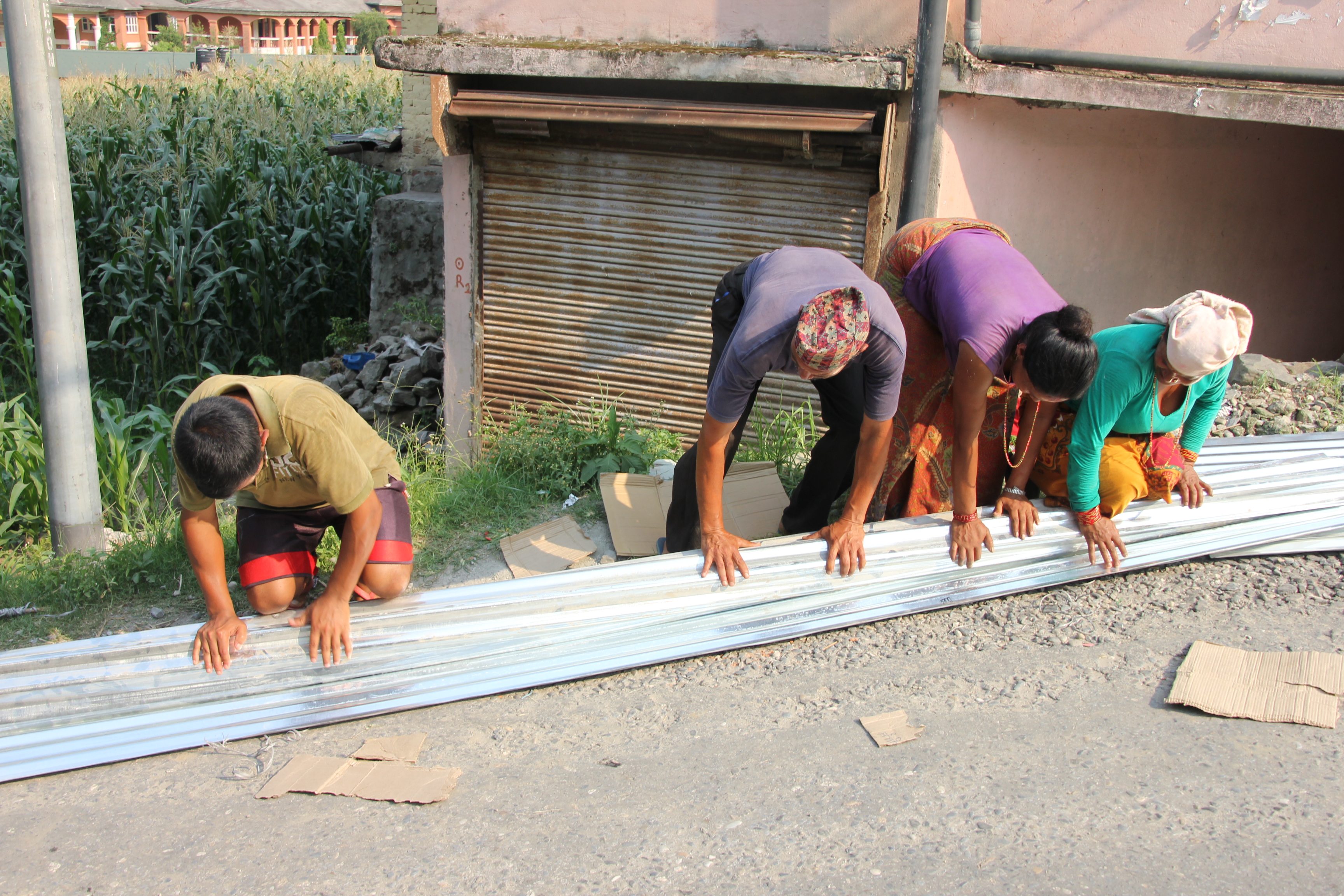
IMG_9669When we arrived in Bote Orar to unload the tin by the side of the road, about eight people from Archalbot had come down to roll the sheets and carry them up to the village (note to self: get a tractor when it’s time to deliver tin to the other 15 families). I hoisted an end of one tin roll over my shoulder, uttam’s sister in law took the other, and we were off.

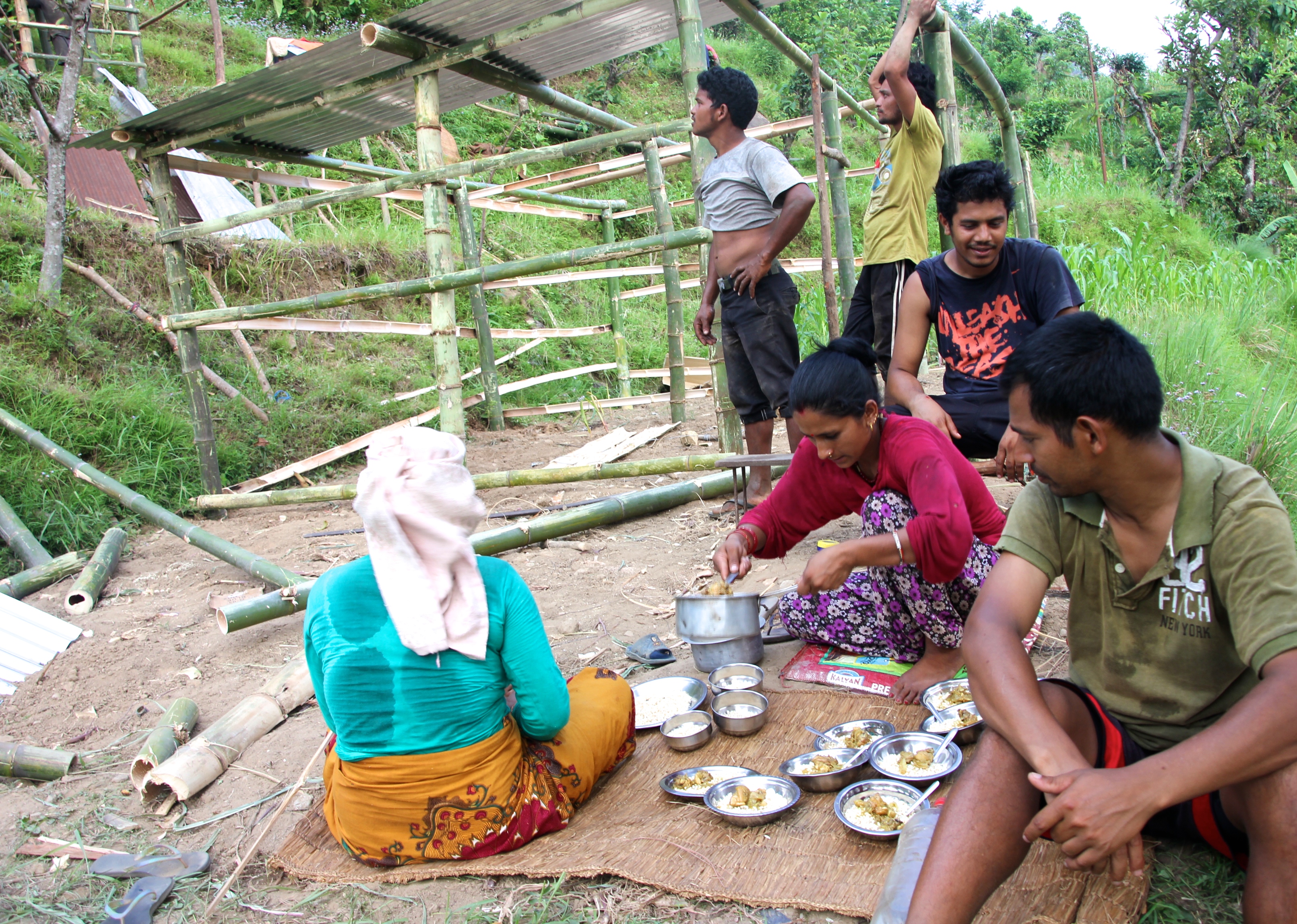
I could hardly believe it when I arrived at Uttam’s house.  I’d only been away for 24 hours, but what used to be the tarp shelter in one field was now two bamboo frames under construction, with lots of people about.

The family called me for snacks. They had gone to buy a few kilograms of meat – a pricey indulgence – to feed to all the people.
IMG_9695

Later, I was talking with Uttam’s brother. Even after all the days we’d been in Archalbot, working on the earth bag house, sleeping in Kripa’s home, stopping by to visit people in their yards and encouraging them to go cut bamboo, eating and bathing and washing our clothes with everyone else – after all this, Uttam’s family wasn’t completely convinced that we’d really show up with their tin.

It wasn’t until I’d called from the truck a few hours earlier, to say I was on my way from Besisahar with the tin, that the mood turned celebratory. That’s when someone was sent out to buy the meat.

Oh, and also, added Uttam’s brother, they’d made this excellent and spacious bamboo frame, and as I could plainly see, one bundle of tin wasn’t going to be enough to cover it.  They would need another, he informed me.

Very clever, Uttam’s brother.

Uttam and his brother building their bamboo house

Uttam and his brother building their bamboo house

If there’s one moment that will stay with me the most, it’s when I asked Uttam’s oldest brother, who is building the IMG_9677smaller upper house, to explain what each area of the inside would be when it was done.  He and his wife had clearly thought about this.  He pointed to the place where the kitchen fire would be, and the sleeping area (there weren’t exactly a lot of rooms, but that’s not the point).  I motioned to a spot at the edge of the house that was a few feet wide.  From the frame it was clear that the roof would slope down over it.
“What is this for?” I asked.

“That’s a place to stay if someone comes to visit,” he said.

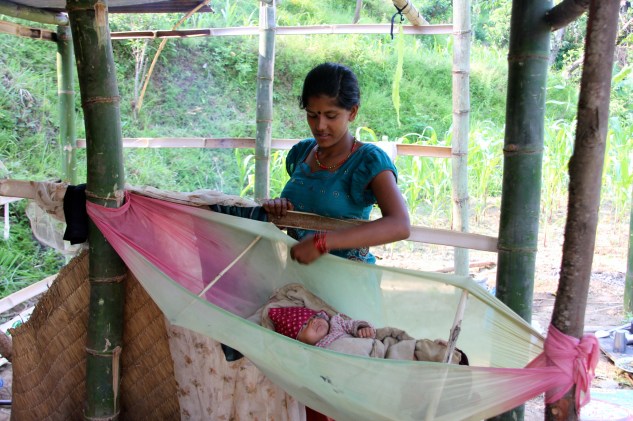
Uttam’s family’s two houses are still going up, but before I left the next morning, I was happy to take this picture of his wife and two month old baby.  Another small bundle in a big space…nice improvement.

.      .      .
IMG_9711

IMG_9440

Coordination Tactics

On Tuesday, the first thing I woke up to was a call from an unknown number at 6:45am. I silenced my phone but got three more calls from the same number, so I picked it up.

“Hello?”

“Hello.”

“Who is this?” I could already tell who it was.

“Archalbot.” It was the little boy, Kushal, from our visit to Archalbot yesterday.

“Hello Archalbot,” I said. “How are you?

“Fine.”

I waited. “Ok….Well….I’m fine too.”

“Ok.”

“All right then, talk to you later?”

“Ok.”

“Bye, Archalbot,” I said.

“Bye!”

Later in the morning, Dilmaya and I debriefed with Robin and Colin over coffee. We reconfirmed the plan we’d come up with yesterday. Dilmaya was to call our main contact, Kripa, and I’d coordinate with the government. If everything was organized, we’d start Thursday.

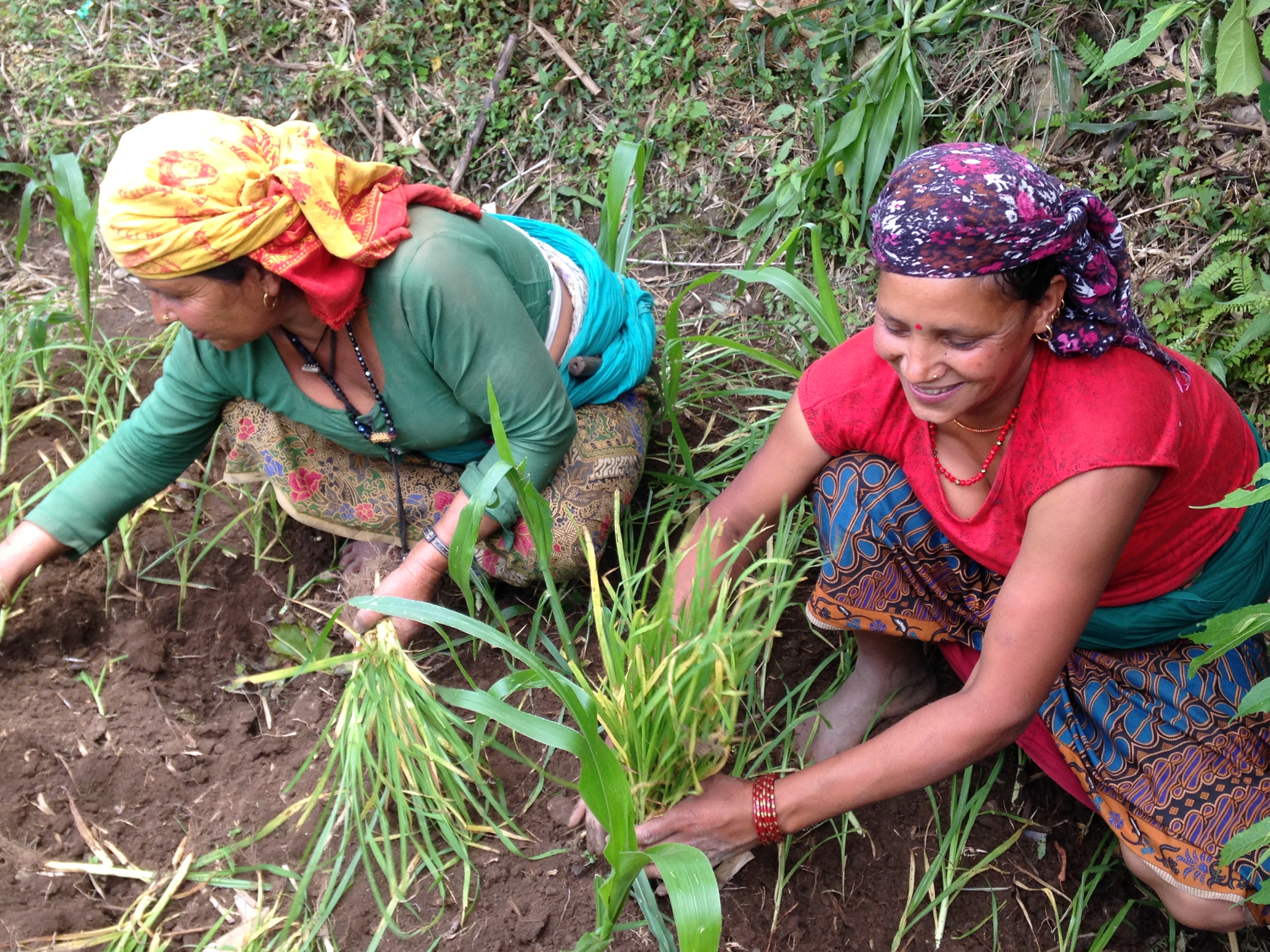
IMG_5049I’ve been here three and a half weeks and I haven’t spent a single day in Kaski. Wednesday is millet planting day, so I promised Aamaa that I would take a day off from coordinating housing outreach and tooth brushing programs to come churn up dirt between the corn stalks and shove little millet seedlings in to it. I spent the rest of Tuesday running around, planning for a day in Kaskikot away from internet like it was year on Mars. Finally I ran to the bus park at 5:30pm, just as a downpour began.
The bus left an hour late, at 6:30pm. That’s where I was when I realized that I was supposed to submit my enrollment for graduate school classes in September at exactly 6:45pm my time, 9am EST. If you don’t do this right when registration opens, it’s likely that the classes or sections you want will fill up within an hour or two.

I tried to log in from my phone, but not surprisingly, the cell connection wasn’t strong enough. So I called my parents to see if they could log in to my account from in Maryland and click “submit.” I got my dad on the phone, but in order to log in he needed a password. And the meticulously written document I’d made before I left for Nepal with all my logins and passwords in it had evaporated from my computer. I searched and searched and it was nowhere to be found.

So I hung up and waited a precious 45 minutes until I got to Kaski, where there’s one hotel that sometimes has internet, and my password is saved in my browser so I can log in without the missing document. I got to the Kaski hotel and the internet wasn’t working. I called my dad back while the hotel owner tried to restart the internet, which took about 15 minutes. Then the UConn registration site let me take every step except for actually hitting “submit,” because the site itself was having technical problems, which I now knew because my dad was on the phone with the registrar.

Which is to say that by this point my dad was holding the phone up between the registrar in Hartford and me in Kaskikot, while we discussed options for resetting my password, which required me explaining to my dad that the registrar was saying she was going to send him an email with a reset link; now I’m walking home from the hotel to the house so Aamaa doesn’t think I’ve fallen off a mountain, and the registrar needs to get someone else on the phone so she adds yet another person to this phone chain. Then my iphone won’t download the new password, and then when it does, and I read it over the phone from our house in Kaski to the person four phones away in Hartford, it gets rejected.

It’s like the Nepal jeep travel version of online class registration.

In the end, the registrar’s office took pity on us and just overrode their system to register me for my classes. It was 9:30pm here. Aamaa and finally sit down for dinner. Bring it on, millet planting season.

.      .      .


Stone Paths


Yesterday, I went with Aamaa and Neru and Didi to carry 40 kg of cauliflower up the mountain from Pokhara, because, as we know, that’s the kind of thing I do to relax.  Why, you ask? Fair question. At Milan Chowk people are selling cauliflower and potatoes at seasonal wholesale rates, and because our relatives are there, we got an even sweeter deal.  Tell me you’ve ever purchased cauliflower for less than 6 cents per kilogram, baby.

What are we going to do with 40 kilograms of cauliflower? Ah, I thought you’d want to know. First, we’re going to schlep it up to Kaskikot. Then we can chop it in to thin pieces and dry it in the sun to eat later in the fall. And that brings us to yet another day of long steep stone paths, ropes, and heavy loads.

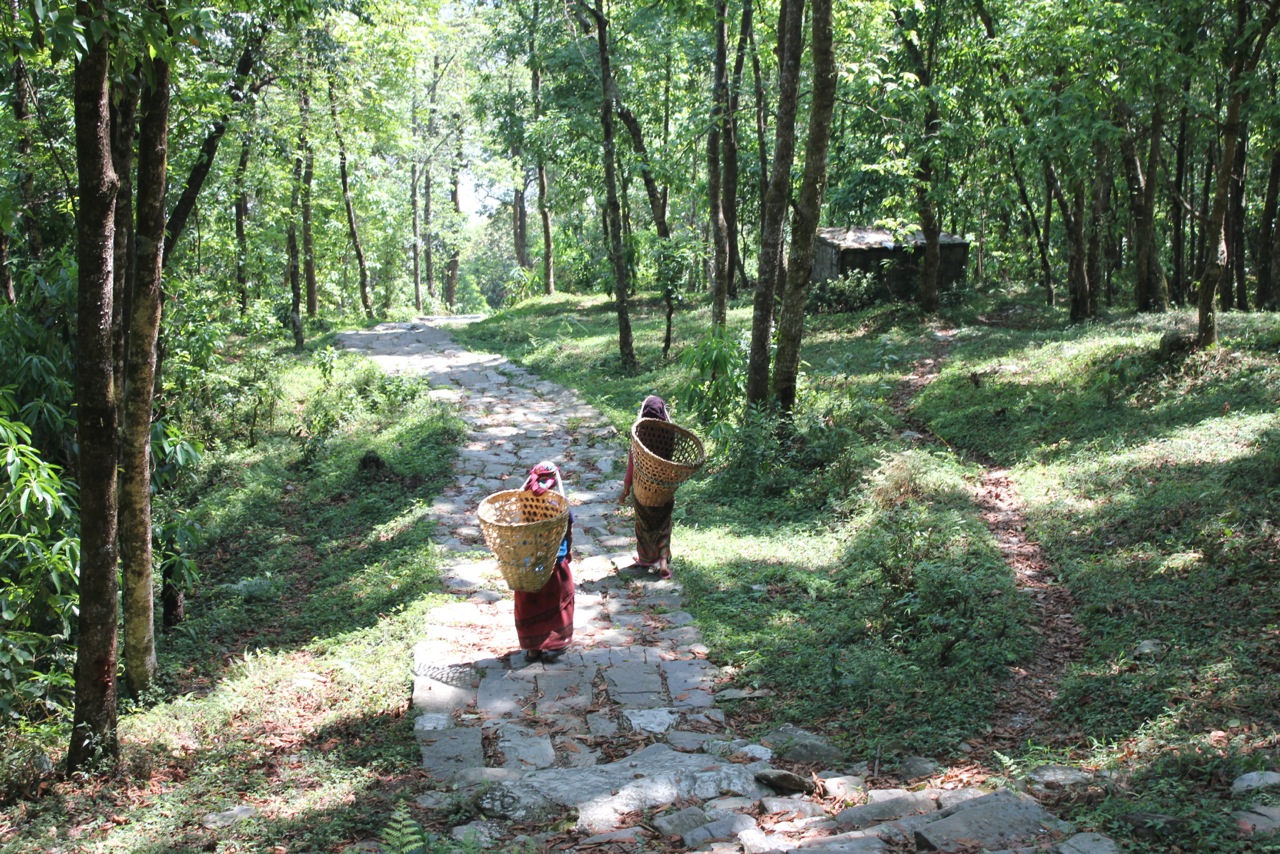
We took the forested footpath on north side, a walk I regularly make in about 35 minutes going down and one hour going up. It leaps (or drops, depending on which direction you’re going in) directly from the flat valley to the spiny ridge top.

IMG_2858

As we neared the bottom of the trail, Didi was walking a short way ahead when Aamaa pointed to a lone man in an empty rice paddy on the valley floor.

“That’s the field where Didi was born,” she said.

I’ve always known that Didi was born during rice planting season, when Aamaa went to work and returned home instead with her first baby.  But I didn’t realize the field was so far away from the house. It belongs to a relative, and I’ve never been to it.

“That one?” I squinted and pointed like I was on safari in Zimbabwe.

“Yes.  And then we walked up this path that afternoon.”

“…What?”

“I came here the night before to plant rice, but I had Didi at 8am the next morning.  And at 4pm we walked back up this same way with the baby.”

“…THIS one?! How is that possible?”

“I know.  Can you believe it? I couldn’t do it now.”

I might as well insert here that my brother and sister-in-law welcomed my niece Eliza Jane Spero in to the world just a few days ago, on March 6, in Chapel Hill, North Carolina. Running around here in Nepal, my mind has been largely preoccupied with thoughts of soft blankets and white linens and wrinkled baby feet at home. So maybe it was just the way the moment came together. But I looked at Didi chasing Aidan and Pascal down the stones in front of us, and all of a sudden it seemed impossible all over again that all of us were there together.

IMG_7151Aamaa was 20 years old when she had Didi, and she endured many hardships after she hiked up this long, unforgiving path later that same afternoon.  I can only imagine how birthing a child must have been then, when medical facilities, telephones, basic shops, and decent roads—to the extent any of these existed at all—were at least a day’s walk away.

Now, 35 later, here we were walking on the same stones. Standing on them, it’s hard to comprehend that millions of people in the world still live in that kind of poverty today, when it seems like an unbearable situation for one single individual. Every once and a while, all those millions are suddenly the one person in front of me, and today, it was Didi. She seemed like a miracle. And the path – which I’ve skipped down and climbed up hundreds of times – just stays there while people go up and down it, carrying their stories from one decade to the next.

It was 6pm by the time Aamaa and I got home with our 20kg loads of cauliflower. We have a lot of slicing to do.

*


IMG_7454

Another Relaxing Day Off

Yesterday I did what I usually do to relax on my day off: go with Aamaa and about thirty neighbors to chop and haul firewood for six hours.  As Aamaa and I were headed down the hillside in the morning, carrying our ropes and sickles, a buffalo was baying loudly in the distance.  Aamaa stopped for a second and listened.
“…Oh, it’s a buffalo,” she said.
“Of course it’s a buffalo,” I said.
“For a minute I thought it was a cell phone.”
“You thought cell phone before you thought buffalo?”
“Sometimes cell phones make that noise…bzzzt, bzzzt.”
Cultural moment.
Woodcutting is highly regulated and occurs en masse, and it is a brilliant example of the chaos and color of rural Nepali life.  Today there are about 35 people in the steep, unruly forest shouting and singing and chopping with axes and saws and sickles.  Every now and then there is a loud whoop and a huge tree falls over.  Then you have the random American running around in the middle of this scene.  I am wearing one of my old “work” outfits – a hot pink and green kurta sulwaar from 8 years ago that’s got a rip here or there.  I am ready for action, baby.
I get assigned to a group of women bundling wood and carrying loads uphill to a clearing.  I would like to say that, after twelve years of voluntarily putting myself in these situations, I’ve actually earned a fair amount of respect – I do pretty well for a foreigner.  But there’s just a baseline level of awe that comes along with having a 5’8” white girl waving a sickle around in the woods a tuesday afternoon in the hills of Nepal.  Also, it’s the obvious topic of conversation.
IMG_7056For one thing, “Laura” is, exactly, the Nepali word for “stick.”  This is an endlessly entertaining point.  I look like a stick and I’m carrying sticks and my name means stick.  Unfortunately for me there is also a lot of discussion about actual sticks (after all we are in the forest chopping wood) and I am constantly answering “Yes?” in response to people saying things like, “Hey, give me that stick.”
After a few hauling trips, we’re resting in the clearing when the ladies get to talking about how nobody should submit to pressure from the choppers to carry too much at once.  Loads should be adjusted to the size and strength of each person – after all, it’s really hard work and we have people of all ages and levels of health among us.
Lady one: “I mean look at this foreigner here from Japan.”
Lady two: “It’s America.”
Lady one: “Whatever.”
On most trips I get paired up with Saraswoti or Aamaa, who I follow around like a baby cub. And I appreciate that all the wives look out for me.  However I do get a little fed up with being babied on tasks I’ve sweated significantly to master, such as carrying stacks of wood slung from a rope on my head.  So late in the day, when fatigue and disorder have evolved to a stage where I find myself momentarily separated from the group as everyone is bundling their loads, I find a huge log and wonder if I can lift it.  I manage to get it upright but can’t sling from my head because it keeps falling over.
“PUT DOWN THE HUGE LOG!” yells a guy from across a ravine.  I call this guy Michael Jackson, but that’s another story.  Michael Jackson makes the mistake of shouting across an entire forest that the log is too heavy for me to lift.
I set the log up again.  Michael Jackson abandons his first strategy and calls to Barat to come hold the log so that at least it doesn’t roll away while I’m making a bad decision.  I manage to stand up in the steep underbrush with this huge chunk of tree slung from my forehead.  It’s added at least 75 lbs to my bodyweight.
For future reference, putting DOWN a 75 lb log slung from your head is almost as hard as picking it up.  So I just start walking up the hill with it.  I have no idea whether I can carry this thing all the way up to the clearing, which requires climbing over terraced fields on narrow footholds.  But so far, Michael Jackson is losing, even with my Japanese disadvantage, and that is all that matters.
I plod along until a line of women with their own bundles of wood catch up behind me.  They begin scolding me to put down the gigantic log, and to be fair I kept thinking that, over the next ledge, I would give it up.  But everyone was moving forward as a group, and it was never exactly the right moment to stop, and each time I hit a ledge I would think I’m putting this stupid log down on the other side, but then the other side would be flat enough to take a few steps and I’d find myself at the next ledge.  So we just kept moving up the hill one ledge at a time.
We get to a particularly difficult terrace that has a narrow foothold and a large height difference.  With the added weight, these high steps are treacherous because I literally can’t lift myself.  So instead of stepping up over the edge of the terrace, I put my knee over the top and get myself over on all fours.
For the record, this is a fair tactic.  I watched Sandrakali didi do it earlier in the day.  But it is super awkward, and leaves you waving your butt over the edge of the field at all the people behind you.  Which is really okay in most circumstances, but as it happens, my work pants from eight years ago are ripped right at the butt crack.  So I am waving my underwear at a line of women behind me carrying bundles of wood, while I am crouched under a 75 lb log that is attached to my head by a rope.
This actually happened in my life.  Yesterday.
“Laura, PUT DOWN THE LOG,” all the women are chastising me.  Out of love of course.  What would my Japanese mother think?
“I’ve got it guys, I’ve got it,” I reply, from under the log.
With a burst of leg strength I stand up and make my way up to the clearing, which is now close at hand.  As I approach, Michael Jackson has his cell phone out and is taking a video.
I put the log down and throw my hands up in the air in triumph.  For the rest of the afternoon, everyone is talking about my wood carrying prowess, while simultaneously scolding me for my poor judgement.  THAT log, everyone says, pointing to it.
Also, Srijana tells me to take Aamaa’s shawl and wrap it around my butt.  My pants are ripped and the entire world knows.
We’re off for the next load.  I’ll be ready for the office again tomorrow.
.     .     .

Rice Pot Literacy

IMG_2668A year or two ago, Aamaa starting making noises about getting an electric rice cooker.  Of all things, right?  I am constantly baffled by the perceived awesomeness of this contraption in a place with no plumbing, no heat in the winter or A/C in the summer, no political system, and widespread illiteracy, where the one thing that people have been doing for hundreds of years with no problem whatsoever is cooking rice. In pots. And never mind that in the winter, there’s load shedding for up to 16 hours a day.

Nevertheless, it is a thing.  By some mysterious process, the rice cooker has become the iPhone of the rural Nepali woman, just like TVs became standard in Kaski’s mud-and-stone houses when so many kids left the village to work abroad, where they send home just enough money to cover a few celebrity amenities.  Now a TV I can understand.  But a rice cooker?  I used to say that about cell phones – remember how we used to just call each other on landlines?  And that worked fine?  Aamaa used to cook rice in a pot, from 56 years ago until last June.  It’s not about whether it’s fine.  It’s about having a celebrity rice cooker.

So last year when Bishnu was visiting, she picked up a rice cooker for Aamaa.  And of course, Bishnu went for a large, impressive looking one – even though Bishnu should know better than that by now.  Because first of all, when you put rice for one or two people in a large, impressive rice cooker, you get a wide, unimpressive rice pancake.  And let’s not forget that there’s no electricity half the day.  So I arrived this year to find that when the electricity comes on, the first thing Aamaa does is rush to plug in the big electric rice cooker.

No matter what time of day it is.

IMG_1042This is how we have found ourselves eating a room-temperature rice pancake as our 2013 featured dinner entrée.  And the thing that blows my mind is that it’s not like Aamaa doesn’t know what hot, properly prepared rice tastes like. It’s the only meal she’s eaten for her entire life.  But this rice-cooker-chilled-pancake-system inexplicably retains its a status of superiority in the face of damning evidence that it is terrible.

“You know, Aamaa,” I said as we were eating the rice-pancake the other day (for the record, it can literally be cut like a pie), “the rice cooker is too big.  You should have a little one, like I have in Connecticut.”

Aamaa’s expression widened.  “Really?  Do they make small ones?”

Sometimes life is so strange.

“Yes Aamaa, they’re just—they’re just like that one, but smaller.  So you can cook less rice in it and it won’t come out like a roti.”

Ehhhhh,” Aamaa cooed.  “If you see one of those, will you get me one?”

I wasn’t sure how serious she was, but the next time I was in Pokhara, I decided to get Aamaa a 1-liter rice cooker.  Like the one I have, in Connecticut.

I brought the small rice cooker home the other day and we unwrapped it on the front porch.  It was like the Second Coming.

“Look at this pot Laura got me!” Aamaa has been telling the neighbors.  “It’s the perfect size.”

The fourth beloved grandchild of the family is introduced to all visitors. Aamaa takes it out and points to its dainty circumference and shiny exterior.  Then she and I regale the neighbors with stories about the failings of the large rice cooker – it makes rice like a roti, for goodness sake – and swoon over the shimmering, earth-shattering perfection of the small rice cooker.  Which is just right for two people.

Or one person.  Like my rice cooker, in Connecticut.

As we were eating our fluffy rice today, I couldn’t help being re-amazed that Aamaa, as my protector and general knower of all things, had no idea that the big awesome rice cooker was too big and awesome.  For somebody who can build anything, cook a complex meal over a fire with no measuring devices and not a single taste test, detect subtle changes in the mood of the buffalo, and nurture soil and seeds with a nuanced literacy that is invisible and incomprehensible to me, it seems completely incongruous that she didn’t look at the rice cooker and think, “That’s too big.”

I am so used to Aamaa’s highly technical and nimble mind that it never stops surprising me to run in to the boundaries of her experience. I remember during my first year in Nepal, I got first-grade primers so that Aamaa and I could learn to read together.  I started copying new letters and sounding out the phonetic alphabet.  It turned my world upside down the first time I watched Aamaa try the same thing and saw that she copied letters slowly and awkwardly like a child.  Why wouldn’t she?  I sifted grain like a child.

The rice cooker more than anything has reminded me that we simply have different types of literacy.  Most of Aamaa’s life has been extremely repetitive, and she moves in it with a technical and intuitive agility that I think few people in my world ever have the chance to know – if only because of the much wider range of experiences we have to integrate.  I think that makes us more adaptable across novelties and habituates us to thinking relationally; it’s what allows me to look at a new situation or task and decode it or try out variations in my mind.  But Aamaa just doesn’t encounter nearly as many new situations in her life, so instead, she knows the ones that are familiar to her with a level of subtlety that maybe only Olympic athletes and ultra-dorky mathematicians ever encounter where I come from.

So much so that even the rice cooker, which seemed just a few degrees removed from Aamaa’s mainstream world, turned out to be a static event for her, not something to be adapted or improved the way the millet seedlings can be tended to in the garden.  Now I’m trying to get her to use the “warming” feature, so that when dinner gets cooked at 3:06 pm, it stays warm as long as possible.  I mentioned this the other day when Aamaa rushed to unplug the cooker rather than leaving it with the warming light on.

“Aamaa, it’s going to get cold,” I said.

“I don’t want it to overcook,” she said.

“It’s just…” I sighed. “…Warming.”

Right.  It’s warming but not cooking…that makes no sense, does it?

IMG_2675

Putting Away a Chicken

This afternoon, a handful of serious looking men were sitting on the porch visiting with Aamaa, who is still not moving much after her operation a few weeks ago.  I was puttering around when Aamaa called me to put the chicken inside for the night.  Now, I’ve never put a chicken away before, but I was so pleased to be asked that, without any questions, I strode out to the porch and walked up to the chicken.  It promptly went skittering off.

Ah, I thought, I see.  This is going to be like climbing on to the upper roof.  Seems straightforward until you try to do it, at which point it’s too late; you’re already committed.  And standing on a middle roof.  With everyone looking at you.

As I pondered how one goes about putting away a skittering chicken, my doubt must have been obvious on my face because Aamaa immediately told me to forget about it and let Bishnu put the chicken away.  That’s the routine: I try to do something, we all realize just how much I don’t know how to do it, everyone tells me to stop, I insist, there is a contest of wills, and then something happens.  But one thing is certain: I’m not about to lay down and be defeated by an uppity chicken.

So the array of serious looking men, and Aamaa lying on a mat, watched as I chased the chicken around the yard, into the radish patch, through a thick of flowers, back into the yard and through the door of the house, where I thought I finally had it cornered, and then back outside, all the while trying to act casual.  I frittered after the disobedient little excuse for a bird, and eventually, after another trip through the flowers, managed to chase it back inside, where I finally got my hands on it with a decisive dive and firm grasp.  Like the surprisingly solid upper roof, it turns out that a chicken does not squirm as much as one would expect if one chooses to grab it forthrightly.

I emerged triumphantly onto the porch holding the gleeful chicken, which seemed very satisfied with the trouble it had caused, having certainly never enjoyed such an entertaining bedtime.  I went into the goat room to put it in its little chicken box, which I’d never really seen, because the goat room is unlit and I never have a reason to be in there.  I felt around for the chicken box, which turned out to have a top and a bottom compartment.  Not wanting to ask any questions, I promptly stuffed the chicken into the top compartment.  But it didn’t seem to want to fit and I had to push on its chicken butt while calling, “Aamaa, the top or the bottom?”  I got the chicken and its butt into the top compartment.

“The bottom,” Aamaa called from the porch.

I pulled the chicken out–it must have been quite perplexed by this point after years of daily extraction and replacement from its box in an efficient and reasonable manner–and then stuffed it into the bottom compartment.  I learned later that there’s a little piece of wood I’m supposed to put across the box for a door, but I didn’t now it at the time, so I was quite pleased with myself when I came stumbling out of the dark goat room back onto the porch.

There the gathered group of serious men sat there impassively, or stunned, if you will, no comments to be made.  As for Aamaa, she had a look I’ve become familiar with.  It says, “Well, that’s a hell of a way to put away a chicken.  But it appears to have worked.”

*

00012004050900500082

Bua


For some time now, Govinda has been asking me to join him on a trip to Begnas to meet his in-laws. We began planning our visit a few days ago. Govinda’s father in law, who he calls Bua, will be alone for a few days while other members of the family are traveling, so it was a good time for us to arrange a visit to keep him company.

There was some thought that we would travel with Guru sir, who is searching for a match for his daughter. This has raised for me many questions about match-matching procedures. Does one stand in the road and stop the first reasonably marriageable looking male? Go from house to house soliciting bachelors? Distribute letters of inquiry? And why travel all the way to Begnas for this undertaking, twenty kilometers east of Kaskikot? 

I asked around a bit. My investigation was admittedly hindered by a very limited cache of Nepali words related to arranged marriage, but I deduced that Guru sir’s first visit to Begnas was for the purpose of meeting his relatives to discuss the search. So that solved the geographic question, though as far as I could tell, it simply meant Guru sir’s relatives would be standing in the road picking up single men. You can see why I was quite looking forward to whatever was going to happen during our visit to Begnas with Guru sir. But at the last minute it turned out that Guru sir’s rice harvest bonanza would be the same day we had planned our outing, and he would not be able to join us. So I’m afraid that at this time I can’t offer any resolution on the question of Guru sir’s daughter’s marriage arrangement. 

Early in the morning, Govinda and I set off for Begnas on our own. We arrived in Pokhara mid-morning and stopped in to see the artist who is helping us with our school mural, and I paid him. We discussed the idea of having him come to Sada Shiva to give a talk about his profession, as part of the series of visits I’m working on for the kids to learn about topics of interest like how libraries work and what pilots do and how photos are made.

At the bus depot in Prithvi Chowk, where dozens of buses paw sullenly at the pavement and pant in the diesel-filled hot air, we boarded another bus to Begnas. It set off laboriously down the highway, and I felt sleepy in the warm, acrid air inside the bus. Govinda bought some peanuts, and we ate them together in companionable silence, throwing the shells out the window, as storefronts sped by and blended together in a haze of mid-day life: pencils, apples, kilos of sugar, shoes, sticky cartons of fruit juice, pencils, sugar, apples, shoes. Finally the highway dead-ended in another small depot, where a dirt road wandered away from a collection of food stalls and small shops. It disappeared gently up into the hills. We followed it and began a long, rather hot walk to Bua’s house. 

The walk was pleasant, even though I still felt lethargic from the unyielding sun. Govinda’s uneven, methodical gait kept time, spurring us on at a steady and unchangeable pace. Begnas is warmer than Kaskikot, and we passed mango and banana and guava trees; it is currently orange season, and everywhere we could see ripening fruit that will soon find its way back to the roadside stalls and slung baskets and curbside mats heaped with fruit that we passed on the journey in. We stopped at a tea shop for peas and hard boiled eggs, and I drank a moderately cold coke out of a glass bottle, which left me feeling reinvigorated. We bought some hard candy and crackers to gift to the family. When we set off again, a hush had set over the terraces and orange trees, and the city felt far away. Finally, as we approached Bua’s house, I could see Begnas Lake to the west and Rupa Lake further east. Govinda removed his hat, and fanned himself briefly in the yard.

No sooner had we arrived than we were gathered around a plate of oranges with Bua. Govinda’s father in law was a slender, wiry man with a square jaw and lined, approachable face. He had a boyish way of moving that reminded me of my monkey-like fifth graders. Bua had work to do around the house, so even though Guru sir wasn’t there to answer my questions, Govinda and I sat outside talking about marriage practices until the sun dropped below the hills and it got cold.

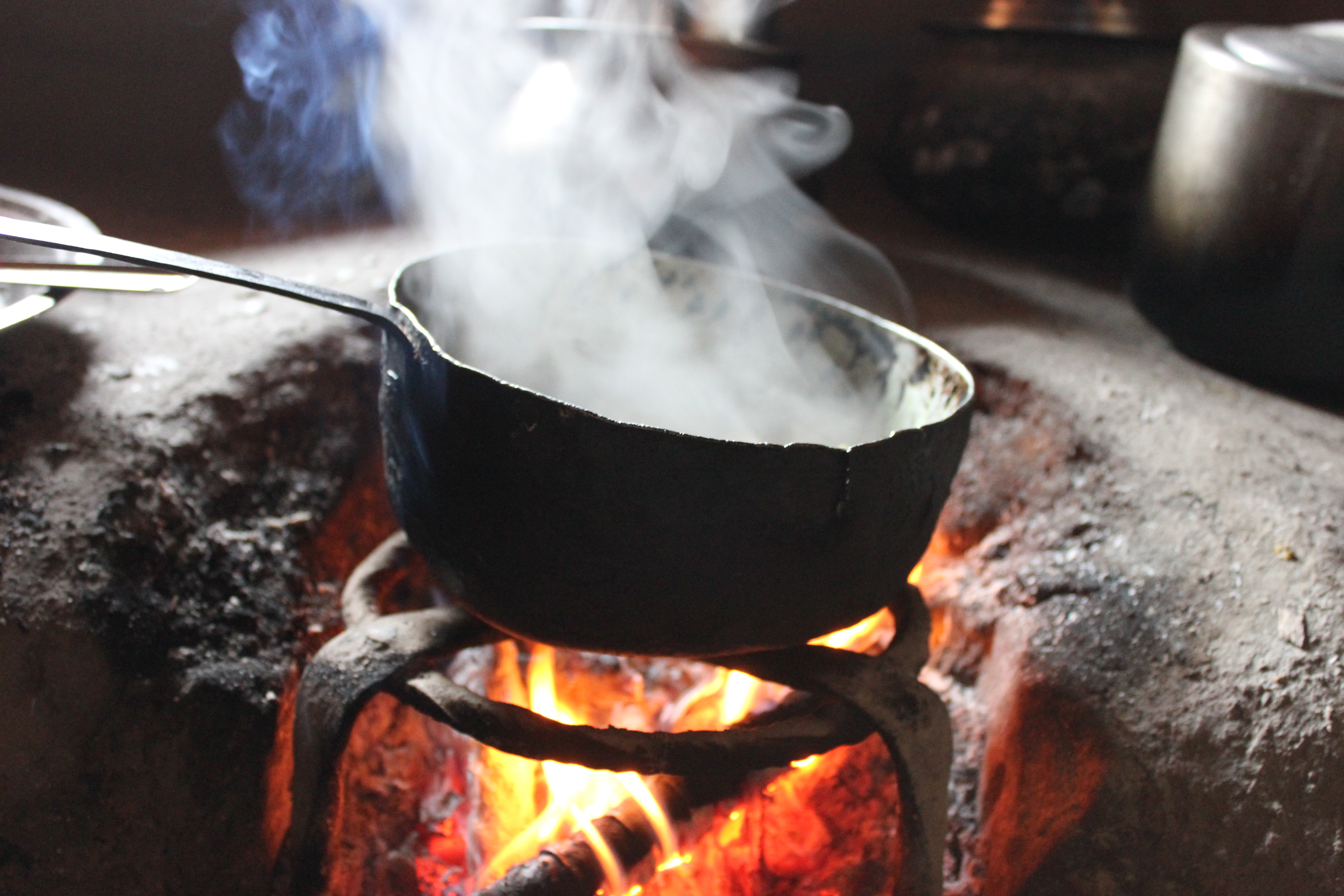
We went back into the house where Bua was just starting to cook dinner. The next two hours were the longest rice-preparation process I’d ever watched on a hungry stomach. We did have an interlude of tea and biscuits, but I’ve become used to watching rice-cooking as a well-rehearsed, mindless affair, something that occurs very efficiently in the cramped spaces between other work. But Bua cooked very slowly: first one item, then the next, often pausing to talk as he cut vegetables or mashed spices. He was at once nimble, even lively, and unmistakably weary. It was as if he had to keep re-convincing himself that quelling his hunger was worth all the effort, and yet in the absence of dinner, I felt he would have been quite content to simply sit and gaze at the darkening hills with us.

Begnas

While Bua cooked, Govinda and I sat at a table, I with my journal resting under my hands. But I didn’t do much writing because Bua began to ask me a series of questions about America. 

“Nani,” he said, addressing me as one does a grandchild, “I hear they have very tall buildings in your country. Very very tall. Is that true?”

“Well, in some places they do.”

“And I hear there are those things that can take you up in the building,” he added, raising his hands.

“Yes,” I replied, “they’re called elevators.”

“Nani, in your country, how do people make money?”

“Nani, in your country, are clothes made to be durable for a long time?”

Between questions, Bua moved around the cooking fire cutting vegetables with his sickle. He seemed a little sad, but without a trace of bitterness, and there was an authenticity about Bua that put me at ease. I don’t think I’d ever met someone who could be genuine and restless at the same time like Bua was when he asked me about worlds I have seen. As the evening wore on, we developed an uncomplicated rapport, Bua taking an interest in this and that, and me content to feel like the kind of guest that he enjoyed: a participator with no agenda. It was a relief not to be waited on in awkward silence, and to have the opportunity for manageable dialogue that left space for the clumsy maneuvering of language-learning. 

As Bua picked up a korela vegetable and pulled his sickle down the middle of its alligator-like lumpy green skin, Govinda rose to go outside. I gazed quietly at Bua in the orange glow of the cooking fire, waiting for the next topic of discussion. 

“I’m going to die here,” he said matter of factly. He lifted his long hand and indicated the house. 

I didn’t have a good answer, because he’s probably right. So I just waited while he picked up my journal and gazed at its pages and pages of tiny writing.

“You will do your writing, see our country, and go back to America,” he sighed. The ink-filled pages suddenly seemed a pathetic sum of Bua’s entire world. “Me…” he waved again at the dim narrow walls, “I will die here.”

Then he shook his head, and picked up his sickle again.

“Nani,” he said amicably. “In your country, what are houses made from?”


*


The Rice Harvest

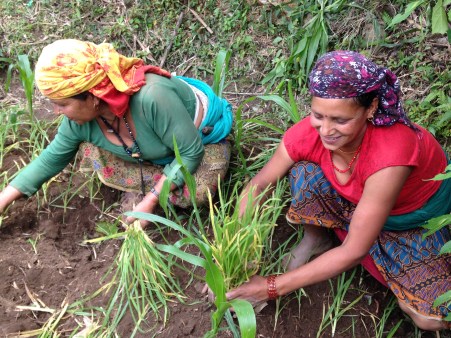
Bishnu and I got up early to do housework, and then we left with Saano Didi and her kids for today’s rice harvest in her fields. Saano and Bishnu carried big baskets loaded with pots and array of cooking materials; I had a bucket of spinach in one hand, a pot of tea in the other (life can be so odd), and my audio recorder slung over my shoulder.

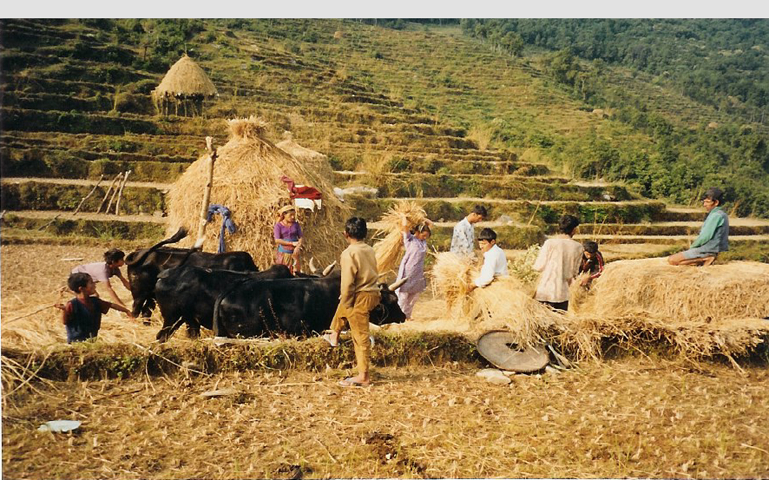
Saano’s boys and I stopped at the tap to wash the bucket of spinach.  The ground still hasn’t dried out from the monsoon, and path through the rice paddies was narrow, slippery, and sometimes non existent.  When we finally arrived, we found an elaborate and energetic rice thrashing, ox-circling, tea and rice cooking, straw flinging fiasco I am becoming familiar with.  Mahendra’s father was perched on top of the hut-sized pile of cut rice stalks, smoking a cigratte and handing down bundles of crop every twenty seconds or so.

I ended up in the rice thrashing group.  Our job is to pick up the bundles of cut rice stalks as Mahendra’s father unloaded them from the haystack.  We lift the bundles over our heads and slam the grain end on a flat rock to separate out the seeds.  Then we put the straw aside, where the straw flinging people shake it out and toss it over to where the are circling.  Saano Didi’s son Kancha drives the oxen in circles and they trample the straw to soften it, so it is easier to carry (for us) and easier to eat (for our baby buffalo Sticky and her parents).

It’s quite a scene.  Very spritely.

Dain

Today’s seen was mainly composed of boisterous men, slightly older than me and Bishnu, in their mid and late twenties.  I make great entertainment, banging rice from the unreasonable height reached by my upended arms, hay sticking out of my hair and attaching itself to my lungi.  Also, dudes in their mid and late twenties are just generally loud.

So for three hours while we thrashed and drove oxen and whatnot, we talked about America, our respective governments, poverty, wealth, opportunity, taboo subjects like royal murders.  I was so glad I wasn’t logging tape in a carpeted sound studio.

Mean time, Saano didi was putting the pots and spinach and teapot to work over a fire she’d built nearby.  When we had thrashed and trampled the entire haystack, we sat down right there in the fields to eat.  Then I had to leave for school.  While I was away they would have get all the grains into sacks and bundle the straw into loads, and spend the afternoon going back and forth carrying it all up to the house.

I returned late in the afternoon to see if there were more loads to carry.  It had begun to rain, and the narrow, field-winding route was even more treacherous.  I met up with the gang: Siete, a wiry young man about my age; Radju-daai, slightly older but youngish man, and Saano Didi’s husband, a solid ball of muscle a few inches and a few teeth shorter than I am.

I was a little surprised when Saano didi’s husband prepared for me to take over his enormous load, so that he could go get another.  I’m used to everyone bending over backwards to find me the easiest work, and arguing to do more; this time, exhausted and wary of the path up, I was prepared to happily accept something a little easier.  As they propped the fat white bag up on a ledge, someone asked if I’d rather take Siete’s load, which was a little smaller.  Well, working off principle rather than common sense (and noting, after all, that nobody ever offers me harder work than I can do–I always argue my way in over my head), I shrugged and said I’d try this one.

Let me pause to explain the mechanics of carrying a 100 pound sack of rice on your head.  One way to get started is to lift the heavy load from the ground. The bag sits there with a circular rope around it and you lean against it like a chair, stick your head in the sling, and as you lean forward you gradually take on more and more weight until you’re crouched beneath the sack.  Then with a massive effort and a burst of leg power you stand up – that’s the hardest part, because you’re 100 pounds heavier.

Alternatively, the bag can be placed on a ledge, where you can sling it from a standing position and avoid the killer leg press.  The tradeoff is that you don’t take on the gravity of the bag bit by bit using your muscles, either.  Conveniently, it can be pushed right off the ledge.  Onto you.

Today we decided to go with method number two.  So I leaned against the sack, on a ledge behind me, slung the rope on my forehead, and crouched just slightly, to about 3/4 standing. I’d still have to pop myself up to full walking height, but it’s much harder from the ground and I already had a 120 degree angle in the knees.  Raju dai moved the weight of the bag from the ledge to my back, neck, and 120 degree bent legs.

Go ahead and picture a perfectly balanced scale sitting next to a ledge.  Now picture that a 50 kg sack of rice is ever so gently tipped off the ledge onto one side.

That’s me.  One instant we are executing a delicate but routine operation; the next I am pinned to the ground by a sack of rice.  It never passed go, it just went directly off the ledge and crashing to the ground with me underneath it.  There no pause where my astonished quads considered staying at a 120 degree angle.  There was never the slightest consideration of straightening up.  Luckily, because I fell over on my side, my foot (the same one the ox tried to mangle a few days ago when I was a straw flinger) was the only thing besides my ego that got directly squashed.  Of course, what with the enormous sack of rice on my foot (and my ego), I couldn’t get up. Or get my foot out.  My excellent problem-solving skills eventually led me to remove my foot from my sandal.

Also, the sack of rice ripped.  Thanks a lot, sack of rice.

With my first try now finished, I took Siete’s smaller load.  He stayed behind to get a new bag for the one I’d ruined.  Raju and I set off.

For the first bit of the climb, there was no path at all.  We climbed up over the terraces, which are narrow and rocky, and by now it was raining and slick.  Often getting up to the next terrace required a big step up, for which one would use hands and feet together even without the added body weight of a 100 pound sack of rice.

Not to worry!  I gallantly wobbled and teetered my way up as awkwardly and pathetically as anyone has ever done in the history of rice cultivation.  We came to a terrace that was about my height.  Happily, I was able to pull myself up and over to the field above.  Unhappily, I could not quite get the weight of the rice on my back to tip forward with me onto the upper ledge.  So it did what a sack of rice does when it cannot tip forward onto a ledge.  It tipped backwards off the ledge.

Given that said bag was slung to my forehead, this was rather terrifying, but luckily the rope slipped right off my brow. The traitorous bag went tumbling down, and I landed in an upside down hanging position with my legs on the ledge and my torso dangling off.  A passer by (it’s a rather popular spot) might have thought me just shot by an arrow.  Raju might have considered it.

Fortunately the sack was still in tact this time.  I vehemently refused to let Raju carry it over the ledge for me, which I’m sure he found very thoughtful.  We put the whole operation back together and set off again.  By now my back was cramping and spasming despite the relatively easy load, and nobody needed to convince me not to go again when we reached Saano didi’s some untold hour later.

After getting over the initial shock of my actually having arrived alive, the tired crowd wasted no time rocking back on their stools and retelling tales of my performance over the course of the day.  Everyone kept asking if I’d hurt myself, but other than my foot, I was fine–nothing had been badly bashed except my pride. Everyone’s attention was soon diverted to a vat of boiling millet alcohol.  I have never enjoyed whiskey before, but it’s like they say when you’ve been twice attacked by a sack of rice: there is a time and a place for everything.

Roof Leaping

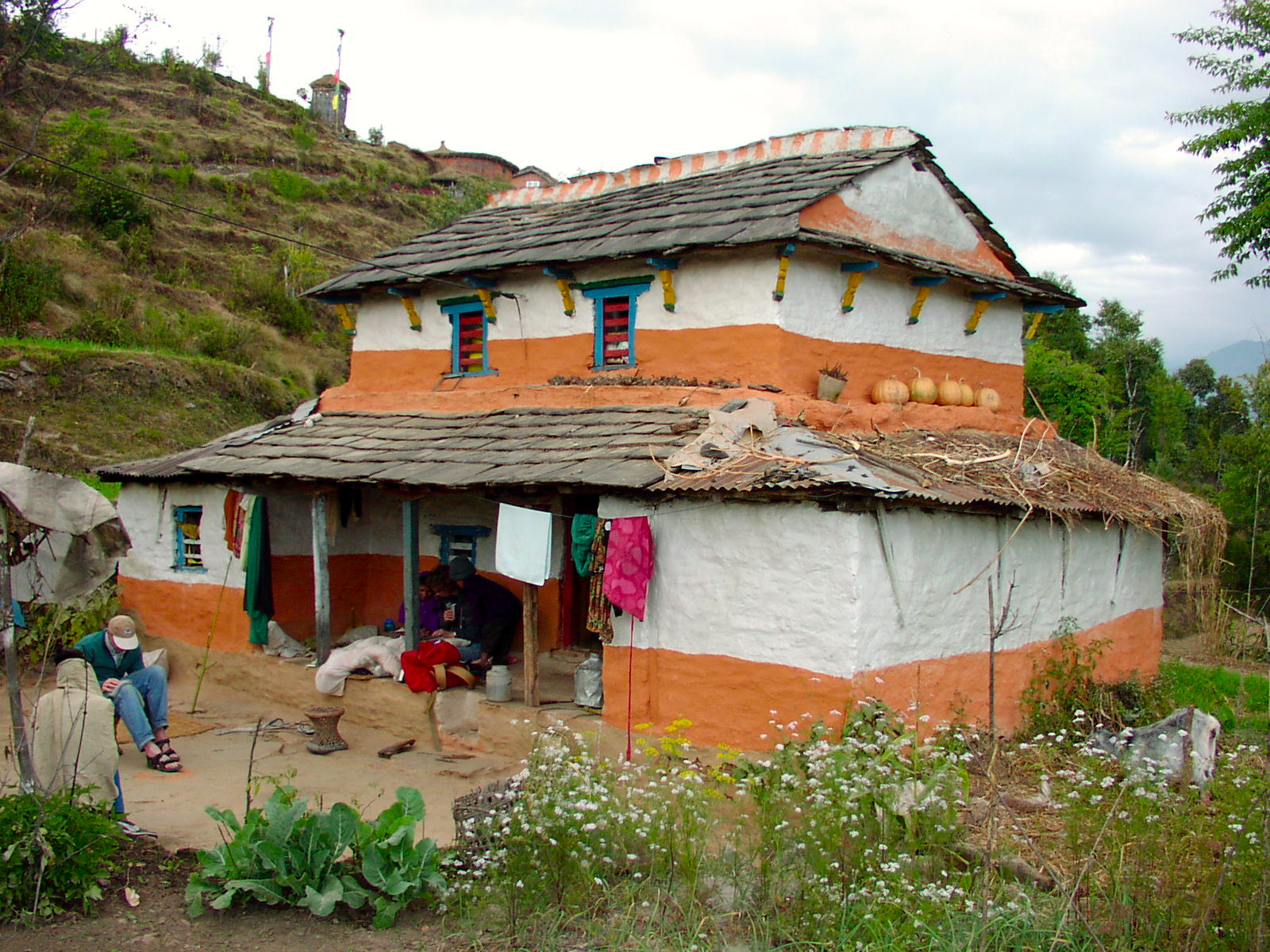
Bishnu and I went to the field at about 7am to cut grass before breakfast.  After we ate, it was time for more house painting.  Fortunately, the structural layer involving buffalo poo is all done, so now we just have to go over it again with thinner mud that has color mixed into it.  This is how the house ends up orange on the bottom and white from the middle up.

The village looked like a party.  The jaunty line where the orange and white paint meet seemed to be winding from house to house in the sunlight, leaving its fresh mark on one cheerful home after another.  Women splattered in paint and mud were scattered over rooftops and sticking out of the grass behind their houses, painting away.

OLYMPUS DIGITAL CAMERAOur house is shaped kind of like a house on a house.  There is the roof over the first floor, and then the attic built on top of that, and then a triangular roof on top of the attic.  I came outside to find Bishnu and Aamaa standing on the highest roof, painting the uppermost part of the house.

As I stood there planning my next move, Mahendra came over carrying a severed goat head and smeared blood over our door.  His family was roasting the body in their yard on the terrace behind and above our house, in preparation for today’s big meat-eating celebration.

I climbed up to the lower roof, where I go frequently to lay out laundry in the sun, and after a while I got bored waiting for Aamaa and Bishnu to give me something to do.  So I did what you would do if you were standing on a middle roof with nothing to do: I made to climb up a level to the upper roof.

Aamaa immediately had a fit about how I was going to fall and kill myself.  “You can’t, you can’t do it!” she cried, as if she didn’t know by now that the fastest way to get me to do something I’m unqualified for is exactly like that.  And Bishnu expressed her disdain in characteristic fashion by smirking and standing in that unsympathetic posture that says, “What are you going to do, American?”

This attracted the attention of Mahendra’s entire family on the terrace above us, where they had previously been observing the headless roasting goat.  Just as I was realizing that climbing on to the upper roof really wasn’t that easy, I also took some pleasure in being more interesting than a headless roasting goat.  I calculated that climbing up on to a roof wouldn’t be all that difficult if a) I hadn’t been wearing a lungi and b) I had full confidence in the stability of the upper shingles.

So there I was.  Ironically, the only one trying to help me was Baa!, Mahendra’s father, who as a general rule seems more ambivalent than anyone of my right to show up like this, to explore the poverty he got stuck with like it’s some kind of escapade.  Let’s just say that Baa! has shown a distinct lack of confidence in my ability to be a fast learner.  But from edge of the roasting goat pit, he was, quite generously, making emphatic motions indicating the pulling up of one’s lungi above the knees.

Let’s face it – there really is no way to climb up from a middle roof to a top roof in a lungi except by grabbing on to the shingles over your head and jumping.  You hope for the best and don’t ask yourself what’s really worth risking your life for.

I was up.  The shingles did not fall off the roof, but Aamaa was still yelling “YOU CAN’T!” in a prolonged and energetic babble that apparently couldn’t be cut off simply by being proved incorrect.  I stood to my full height–more than enough to be a chimney for this house–raised my hands up, and tromped around defiantly.  Great view up there.

And that ended the show.  Everybody went back to their business.  Roasting goats; smearing mud.  I, however, still had nothing to do.  So when Bishnu and Aamaa went around to the other side of the house, I decided it was time to go down.  I returned to the spot where I’d come up.

Well, let’s just say that leaping up is one thing.  Leaping down a different matter entirely.

The audience had dispersed.  So it was before the eyes of God alone that I saw myself peering off the edge of one little roof, down to the top of another, reaching one leg down and straining with my toe, which dangled a good foot above the sloped shingles below, at the bottom of which was a nice little drop to the ground.  I looked over my shoulder to make sure nobody was watching.  I tried everything: this leg, that angle, slide on my bum, brace to the left, hike up the goddamn lungi; I looked for another disembarkation spot, an invisible step; I considered the unthinkable—waiting for Bishnu to give me a hand.

With sudden clarity I thought of Katharine Hepburn climbing houses (I’ve been reading her memoir, of course), and wondered if the roof below me could support my weight if I just jumped.  I pictured myself tumbling off the edge below, breaking my leg, and thinking that any small concession would have been a better gamble than loosing every last shred of dignity (and my leg).  I really dwelled on that image – what it would feel like, lying there on the ground in my own pain and stupidity.

I jumped.  I landed softly on the lower roof and walked over to the other side of the house, where Aamaa and Bishnu were still painting, and demanded that they give me a job.