Throwing stones at Tin houses


Last Thursday, our meeting with two district officials in Lamjung was so encouraging that I’d been energized all weekend. I talked with a friend at home who did her thesis on post-earthquake housing in Haiti. My dad helped me get in touch with the inventor of earthbag building.  I pored over diagrams on the internet and learned the term “waddle and daub.” I was looking for every possible way to supplement a government housing kit consisting of tin roofing and tools. And of course, I talked with a few people about my safe-box idea.
Screen Shot 2015-05-29 at 11.40.19 PMAamod and I made our second trip out to Lamjung on Monday, for the shelter cluster meeting.   (Relief coordination between large iNGOs and the government is divided in to clusters of which shelter is one). We somehow managed to be an hour late again, which this time meant entering a room of a few dozen government officials and representatives from big international organizations.

We sat down in the corner and I took out my notebook. A slide up on the projector showed the names of about six multinational agencies, the villages where they’d been assigned to provide housing, and the number of households covered by each agency, which ranged from about 900 – 1500. Then on the bottom row was our name with two blank columns next to it – no villages yet assigned – and “100” in the righthand column under number of houses. Well, A for effort, anyway.

Besides, with the possibility of using the government’s housing kit, we were hoping to get that number up to about 300.

But the next hour was nothing like either our personalized visit with Lamjung’s district officials a few days earlier, or the big health cluster meeting I’d attended in Kathmandu. Today we were in a room of local politicians talking about use of resources. And my prior enthusiasm was quickly put in check.

Within minutes after we arrived, a discussion about reassigning some villages from one organization to another turned in to a 15-minute debate over whether aid agencies should be allowed to flash their logos while working. After all, it’s the government that should come out with the recognition – is housing aid to become no more than advertising anarchy?

All the big iNGOs have Nepal offices with all-Nepali staff. As I watched the Nepalis representing those agencies negotiate this discussion, even I started to get lost as to who was allied to what cause. I basically understood why these folks engaged a conversation about who would get credit instead of pointing out the more urgent matter of thousands of homeless people in Lamjung; let’s call that standard operating procedure, a necessary hurdle to eventually getting back to housing.

But when someone from one of these NGOs suggested that the Chamber of Commerce should broker
the massive upcoming procurement of corrugated tin roofing, I couldn’t keep up. This guy was working for a huge iNGO that needed to get tin in order to help build shelters.  To put this in context, Nepali P1070134villagers can build anything out of anything.  The overall approach being used with transitional housing is to provide a critical piece of hardware – THE ROOF – and let people build around it.

Foreigners in the room had already explained why their agencies were working on getting corrugated tin from multiple sources to meet the need as fast as possible. Why would this guy, tasked with representing his iNGO to the shelter cluster, encourage all these government officials to control and inevitably slow down the process?  Was he bluffing? Maybe he knew his suggestion would never work out, but would satisfy egos and clear the way. Or maybe he meant it. It was either brilliant or terrible, but I still don’t know which.

Finally, one of the European aid workers spoke up. I’d noticed him sitting off to the side, a burly, hearty looking man with clear blue eyes and a tousle of graying hair. He captured all my biases – obviously a disaster professional, not a Nepali-speaker, here for Earthquake and that alone, bored with these talking games that I’ve come to sort of enjoy as sport.  He was keeping a feel for the pulse of the conversation while mostly ignoring it, looking rather peeved.

In a few swift paragraphs, this guy listed the amount of corrugated tin available in Lamjung district, and in Nepal as a whole – about 10% of the tin needed for the number of houses destroyed. He knew exactly the number of trucks he needed to transport housing materials to his coverage area; the amount of square footage needed to store all the supplies. He pointed out that accomplishing all this was a massive task and that the monsoon will be starting imminently.

“If we could please finalize which of us are taking which areas, than we can all get to work,” he said.

Silence.

Even I was taken down a good notch, as I am so accustomed to all this politicking in Nepal that I’ve come to expect it, even though we’re in an emergency.

Corrugated Tin Roofing

Corrugated Tin Roofing

And there’s more. The government has established a policy to give two sheets of tin to each family that needs to rebuild – but there isn’t nearly enough tin in Nepal to deliver on this quickly without a lot of smart planning and international coordination. So instead, Nepal’s government has decided to give everyone $150 in cash to buy their own tin.

“And when you do that,” said the burly aid officer, “the price of tin is going to skyrocket, because there’s not enough tin available in the local market.”

“We have controls for that,” said an official.

“You can’t control that,” pointed out the aid officer. “When you put money in to a market where there isn’t enough product, the price will triple.”

The matter was never totally resolved.

Later, Aamod and I discussed why on earth Nepal’s leaders would willfully do something like that. The only reason can be to to pacify constituents quickly with cash rather than sorting out the more complex problem the population is actually facing. People will be pleased with receiving $150 and they won’t realize it’s useless because the thing they most need is nowhere to be found, or is now worth $450.

I wonder if this cash reimbursement matter is getting any coverage in the U.S. The only reason it won’t cause an economic collapse in Nepal is because there’s no more room to fall; people literally have nothing. So instead it will just put the most urgently needed commodity – sheets of corrugated tin, for goodness sake – out of reach by displacing the government’s responsibility to provide it on to people who can’t possibly solve a material shortage.

I actually watched a group of politicians look at each other, confront this fact, and, from what I could tell, decide to do it anyway. It felt as though this inflation matter was a good point, but a lot of trouble to solve. It’s a perfect example of the structural rot that weakened this country long before an earthquake shook its softened beams to the ground.

IMG_2599

Just to put icing on the cake, before we left, we found out that the district had changed its mind about providing a government housing kit for us to use. In fact, the friendly engineer we talked with the other day – Pradeep – a genuinely sincere guy who seemed to like our idea of collaboration, said the official policy is now that government is only to deliver its tin (or $150) in places where NGOs are NOT working. As for the entire housing kit, which includes things like nails, wire and hammer…that’s just a suggested kit. The big multinational agencies will use it, but the government won’t.

I knew it had all seemed to good to be true. Didn’t I say it was a miracle?

I made a hard pitch to Pradeep that he and I had the opportunity to set an example for how community organizations can collaborate to achieve the work of the government. There are countless groups like Eva Nepal running around providing aid with tremendous energy. He actually liked my idea a lot, but said I’d have to write a proposal and send it up the chain. We all know how long that will take, and in the mean time, people are living under tarps. It’s not the time to play games.

Looks like if we want to work on shelters in Lamjung, we’ll have to bring in all the materials ourselves.

.      .      .
 

Discovery of Shelter Kids


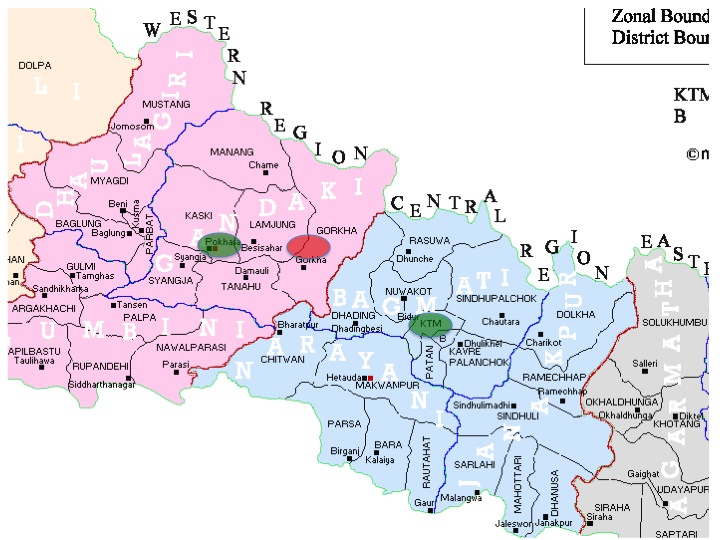
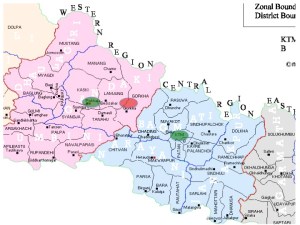
Slide24Lamjung district borders Kaski immediately to the East, and shares its other border with the district of Gorkha. The Lamjung/Gorkha border was the epicenter of the April 25 earthquake.

At 7:30pm last night, Aamod and I made a plan to drive out to Lamjung today and meet with the district government. We wanted to find out what plans the government has for transitional housing and who else is working on it.

As per Nepal style this plan was finalized only late yesterday evening. My job was to type up two official letters for the two government offices we’d be visiting. So got that done by 11pm, and I was planning to print the letters out in the morning, but at 6:15am my phone rang. Aamod had realized the letters should be in Nepali, and I can’t read or write in Nepali. So I emailed the English version to him and went back to sleep. Aamod translated the letter and emailed it to Neha, who was home sick, but nevertheless braved out to her office, but the electricity wasn’t working at her office, so she texted to say I should meet her at a cyber on my way out of town. But when I arrived at the cyber Neha was only just opening up Aamod’s translation, and there were problems with the computer and network and printer and….1.5 hours later, we printed two copies of the letter.

By the time we finally left Pokhara it was 1:45 instead of 11:30. We picked up Aamod in Damauli, and in Dhumre, turned off the east-west road between Kathmandu and Pokhara, and headed northward toward Lamjung. It began to rain.

As soon as we started toward Lamjung we found ourselves trundling along behind a line of relief trucks covered in orange tarps. Once we passed them, I watched the blooming green hills rolling by on the other side of a lush valley and was soothed at being on the road, moving toward some kind of answer, however small, after weeks of anxiety. The flying scenery seemed to catch some speeding thing in my mind and race alongside it, leaving me momentarily still.

IMG_4928

The road went on and on. It began to feel very late. And in the front seat, Aamod was sifting through the letters Neha and I had printed out in the morning. There were some mistakes.

Yep. Mistakes. Not kidding.

Now I personally felt that if we had letters with stamps on them, they would surely fulfill procedure. But one must remember that I couldn’t read these letters, so I might have been biased.   On the other hand, it was starting to feel like we were never actually going to arrive at our meeting with the District Health Office, and government offices aren’t known for staying open past working hours.

We pulled in to Besishar no earlier than 3:45pm. And Aamod, God bless him, had become committed to finding a place to reprint these blasted letters. We curbed up at a cyber, shoved my pen drive in the computer, Aamod hastily typed in some changes, the cyber owner went to click print…and the power promptly went out.

No reason. This wasn’t a scheduled outage for load shedding. Just good luck.

We wait for a minute to see if the power will come back on. It doesn’t. We leave and look for another cyber. Eventually we find a one and now I am running between the cyber and the taxi with Aamod’s bag while people in the street in Besishar are looking at the tall foreigner sprinting down the road in flip flops with Aamod’s backpack. The revised letters are finally delivered like manna from a printer in to Aamod’s hands. He gently tri-folds them, slides them in to some envelopes, and stamps our organization logo on the front. We jump back in the cab and drive to the District Health Office in Besishar.

Now it’s well after 4:15. As we pull in, the sun comes out, and suddenly it seems early in the day again and things are possible.

We sat down on a couch, and Aamod reached in to his backpack, pulled out an envelope, and handed it formally across the desk to the District Health Officer. This immediately made me want to start giggling like a six year old, because the letter had just gone IN the envelope about five minutes earlier.

Next, we waited quietly and watched the officer read the letter. This is the protocol. The District Health Officer was an affable guy and he took us to the office of the Chief District Officer, the head official of Lamjung. Where, of course, Aamod placed the second letter on the second desk, to be read in silence while we watched.

Just as we began talking at long last, with the late afternoon sun getting lower in the window, we were interrupted by the entrance of an animated employee, who strode in with a huge file and thunked it on the CDO’s desk. He then launched in to a torrential briefing for the Chief District Officer on housing.

He turned out to be the guy in charge of shelter coordination in Lamjung.

And this is how Aamod and I got an up-to-the-minute report on transitional housing in Lamjung District. It was PURE LUCK. If it hadn’t taken us 2.5 hours longer than planned to get to Lamjung, we would have missed this entire interaction. The man’s name was Pradeep Khanal, and we are going to be best friends.

Pradeep (and indeed, much of our afternoon in Lamjung) countered all the negative stereotypes of Nepal’s apathetic, dysfunctional bureaucracy.  He provided us a list of the six big agencies doing shelter in Lamjung, updated at a meeting just that morning, and directed us to villages not yet adopted by the large iNGOs doing housing. We looked at drawings of government shelter models and I was surprised to realize I could quickly tell which had advantages and why; which were too resource-heavy or laborious to construct except as a permanent house.

This surprised me as much as when I watched a Hindi film with the boys last winter, and discovered I understand a good bit of Hindi.  With no background in construction, the only reason I could interpret all this information from housing drawings is because I’ve lived in a rural house for 12 years, and done things like wood collecting and carrying heavy loads up long distances. Looking at these models, I had a pretty realistic sense of how the proposed spaces would be used daily, of what would be involved in constructing them, and how the result and effort required would compare to a permanent house.

See, you just never know when your niche specialty is going to turn out to be JUST THE THING, right?

We also learned that just that day the government had finalized shelter kits (or Shelter Kids, as the documents charmingly call them) which include tin, nails etc., for each family that needs to rebuild. The government will provide the raw materials, and let people figure out how to use them.

I asked if the government will still provide these kits in places where NGOs had taken on housing projects. They said no – no reason to duplicate money and materials.

Aamod and I scoured a list of districts, numbers of damaged houses, and a huge map on the wall of Lamjung district. We can only afford 100 – 200 housing structures; was there any place where that was the right number? The CDO asked us to please consider offering at least 300 houses, to properly cover a single village.

Suddenly something occurred to me. It was actually completely obvious.

When we do dental care, one of the most difficult parts of our job is motivating the government to collaborate on investment. But this government is already investing. Why would we steal their thunder?  If we can simply fill in around the government, we can use our resources to supplement and improve their plan instead of replicating it. What’s more, one of the major lessons from Haiti was that the NGO industry that usurped the government was a giant debacle, essentially displacing governance to outsiders and leaving public systems powerless.

“Sir,” I asked the District Health Officer, “how are you going to deliver these rebuilding kits?”

IMG_4968He said the district government would bring housing kits to the village governments for distribution. I can tell you right now that we’ll be reading stories about how housing kits didn’t reach people who needed them. You know how easy it is to carry hundreds of bundles of tin and nails around in the hills of Lamjung and Gorkha?  And what’s more, the government is under pressure to show transparency, so distribution of government aid is already being hampered by a requirement that people have identity cards.  Which obviously, have mostly been buried under rubble.

“I was wondering,” I said, “If we were to provide manpower for distribution and building, would the government still be able to provide materials?”

The DHO turned to the CDO sitting behind the desk.

“She’s wondering if we can provide materials in their working areas, if they help with distribution and building.” Is it possible nobody else has asked this question?

“Sure, of course,” said the CDO.  As if this wasn’t a miracle. If it was that easy with dental clinics…

Aamod and I practically bounced back out to the taxi. There are countless advantages to channeling the resources of the government to an efficient, people-centered result, over acting independently. One is supporting the government, which, for all its problems, is in charge of the welfare of its people. And instead of buying tin sheets and nails, we can use our relief fund to think about quality of life. Instead of roofs, we can think about walls. Instead of crisis shelter, we can learn about design that can be transferred over time to permanent housing.

Also, we have communities in our own working areas in Kaski and Parbat, where the government currently has no plans to offer housing kits, asking for tents. Instead of using funds on tents, we can reallocate the money saved in Lamjung to mimic the housing kits in our villages, see how people use them, and learn how to supplement supplies and design ideas.

On the way home we talked for 3 hours nonstop about ideas that seemed accessible now: creating day-labor employment, paired-village building, little things that could be easily discounted or added to make all the difference. Out the window, the hills rolled by in reverse, and night fell.

“I was thinking,” I said from the back seat, “about this idea of a safe box for valuables. What do you think?”

.      .      .

IMG_4916

Dreaming of Safe Boxes


With a lot of thought going in to our current Kaski Oral Health working areas, we’ve also had quite a bit of discussion about whether, how, and why to get involved in a village closer to the center of the damage, where a higher percentage of houses – in some cases up to 90% – have been destroyed.  Lamjung, the next district over, shares its eastern border with Gorkha and this border was the epicenter of the earthquake.

Slide24

With all this going on, I’m gradually appreciating how much experience we’ve developed in community-centered design that incorporates multiple systems and people to address even a very specific issue like dental care.  I think that if we can work in one of these districts, we should because we can.  I also feel it’s important to have local, grassroots organizations involved and setting examples in the places where large agencies are doing a lot of work.

As I ponder how we can turn this expertise in to something useful for earthquake-relief (and I think we should have a moment of appreciation for the activity of pondering about turning expertise in rural South-Asian dental care in to earthquake relief), it seems the first step is to be working with a single community in a defined area.

I am hoping that if we can locate a community that’s a manageable size for our capacity and funds, we can at least do a really good job of using a community-centered approach to set up transitional housing in one Lamjung village, with the goal of creating an example to be copied by agencies with more resources. Once we see how that goes, we can decide if it makes sense to bring in another layer in the same community, such as the counseling element that Dr. Aung from the WHO suggested.

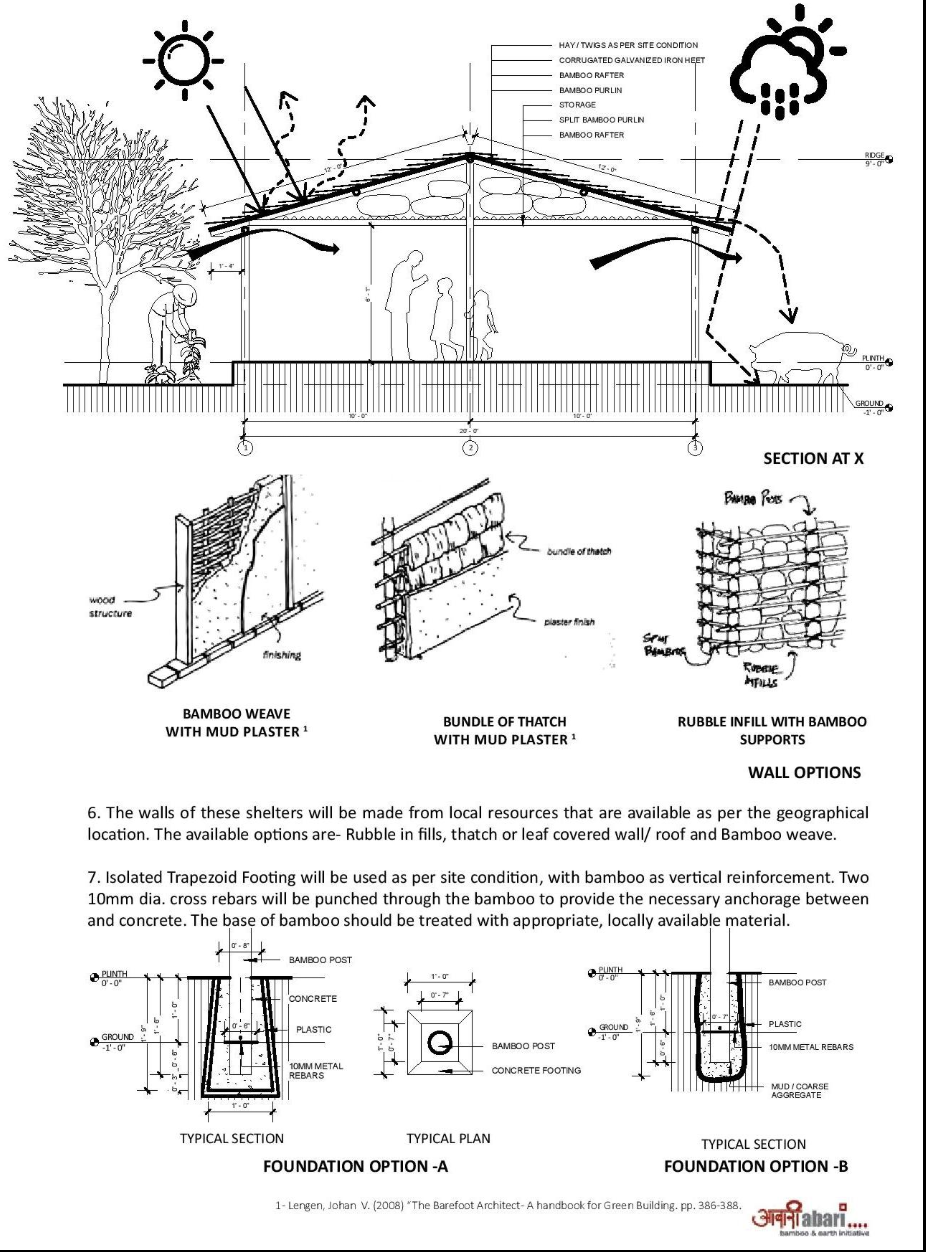
I’ve looked at four types of housing so far: Kiran’s tunnel, a simple tin tunnel, something called earthbag building that uses sacks of dirt and can be made to look very much like a traditional home – and then there’s the option of simply providing people with a corrugated tin and some other materials and letting them have at it.

All this was kicking around in my head the other night when I was in Kaski with Aamaa. While we were having dinner a crazy lightening storm started—the kind that’s more like a constant flickering than separate strikes of lightening. There is a lingering sense of nature’s awfulness in the air and everything feels foreboding, even the normal, dramatic patters of weather typical to this season. As we turned in for the night, it began to pour.

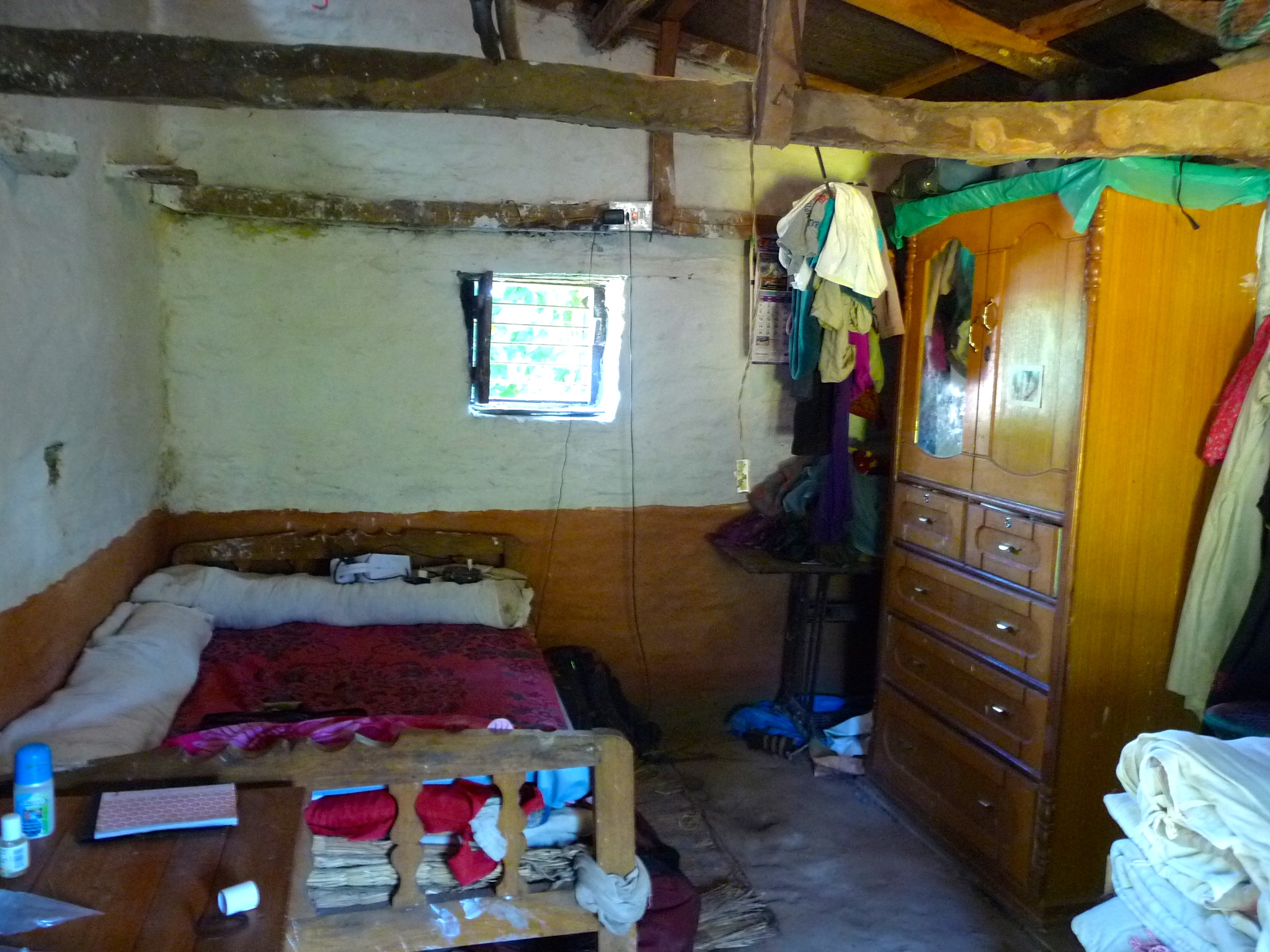
P1070133Lying in bed between the sturdy earth walls of our house, listening to rain clang on the tin roof, is one of my places of greatest serenity. This is my favorite way in the world to fall asleep, and my favorite way to wake up. You can hear the entire the distance from the ground under you up to the sky, but all the noise and space are close and balanced and soft like a blanket.

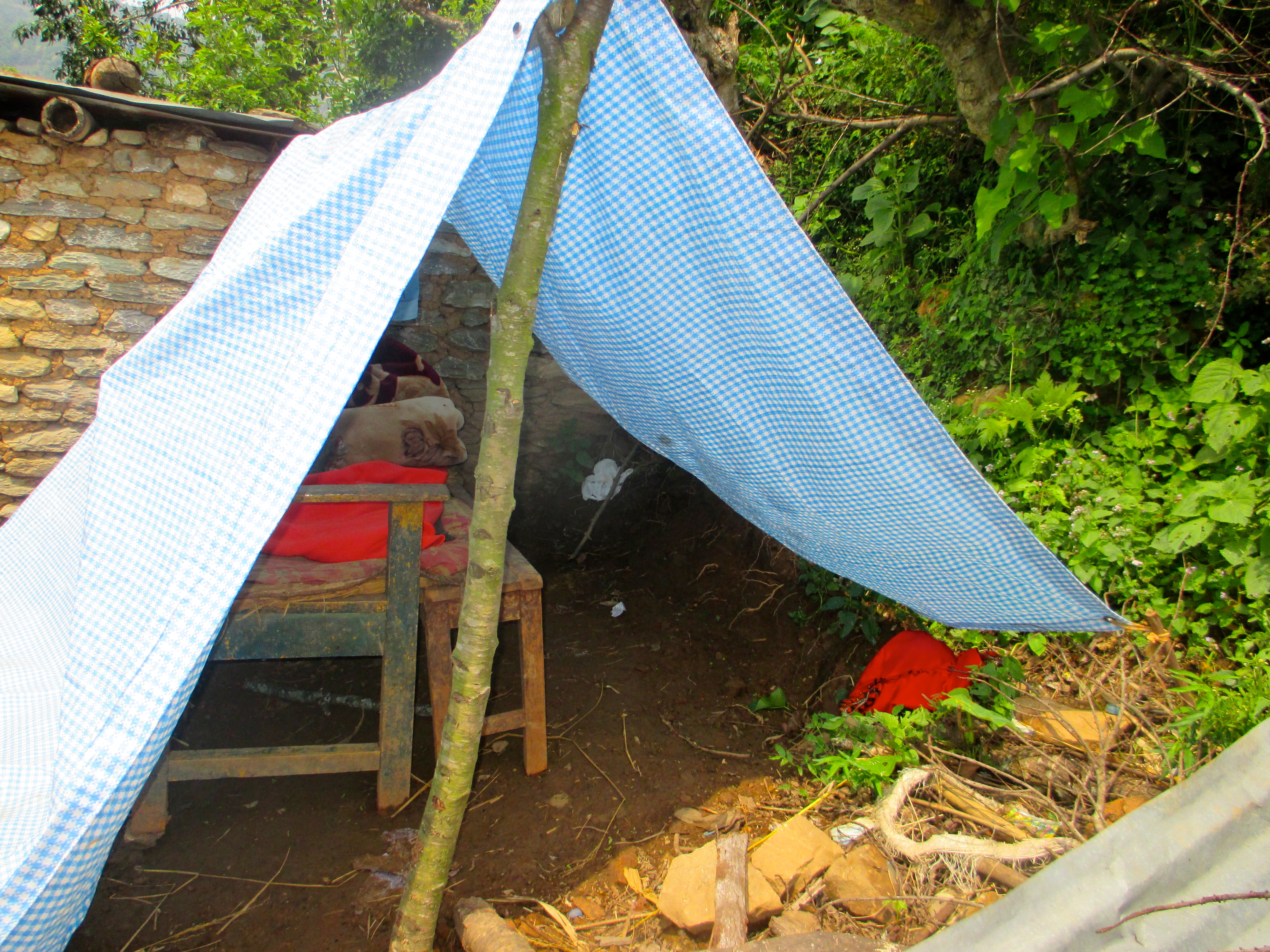
In my half-dream state, I found myself thinking about people lying in their makeshift shelters, with doors of plastic sheets or thin bamboo or synthetic, brightly-colored things, easily torn down or penetrated. Aamaa walks around all day with a key to this house hanging around her neck. She even sleeps with it.  It suddenly seemed like a great indignity to have no door to close, nothing to lock up, no single space to block out the rest of the unknown and uncaring world.

Not to mention the practicalities. Where are people storing any precious photos of grandparents extracted from the rubble? The few pieces of jewelry or any cash they are lucky enough to still possess? You’d have to walk around with all of this stuff on you all the time.

IMG_1719My mind reached about, searching for something that people could shut tightly, a safe box that can’t be stolen when there are no bolts or securities anywhere. Into my head floated a picture of a locked metal container with a pipe welded perpendicularly to the bottom, and a wide plate attached to the other end, like an upside down T. You could dig a hole, place the box in the ground so that the top of the T rests on the bottom of the hole, and then fill the hole in so only about half the box is above ground with the top accessible. There would be no way to lift this locked, anchored box, so if someone wanted to steal it they’d have to surreptitiously dig up the entire affair inside your tarp-house and then sneak out with a large metal T sticking out from under their shirt. Which, if they could pull it off, AND get your lock undone, then hats off to them.  Because the key would be on a string around your neck.

I fell asleep to the sound of the rain, wondering if we could produce a safe like that.

.      .      .