Kriya


Thursday was the seventh day of kriya for Malika’s father. Kanchaa and I arrived around 11am, long after Malika and her sisters had repainted the floors with a new layer of mud, gone to bathe at the tap, and returned home.

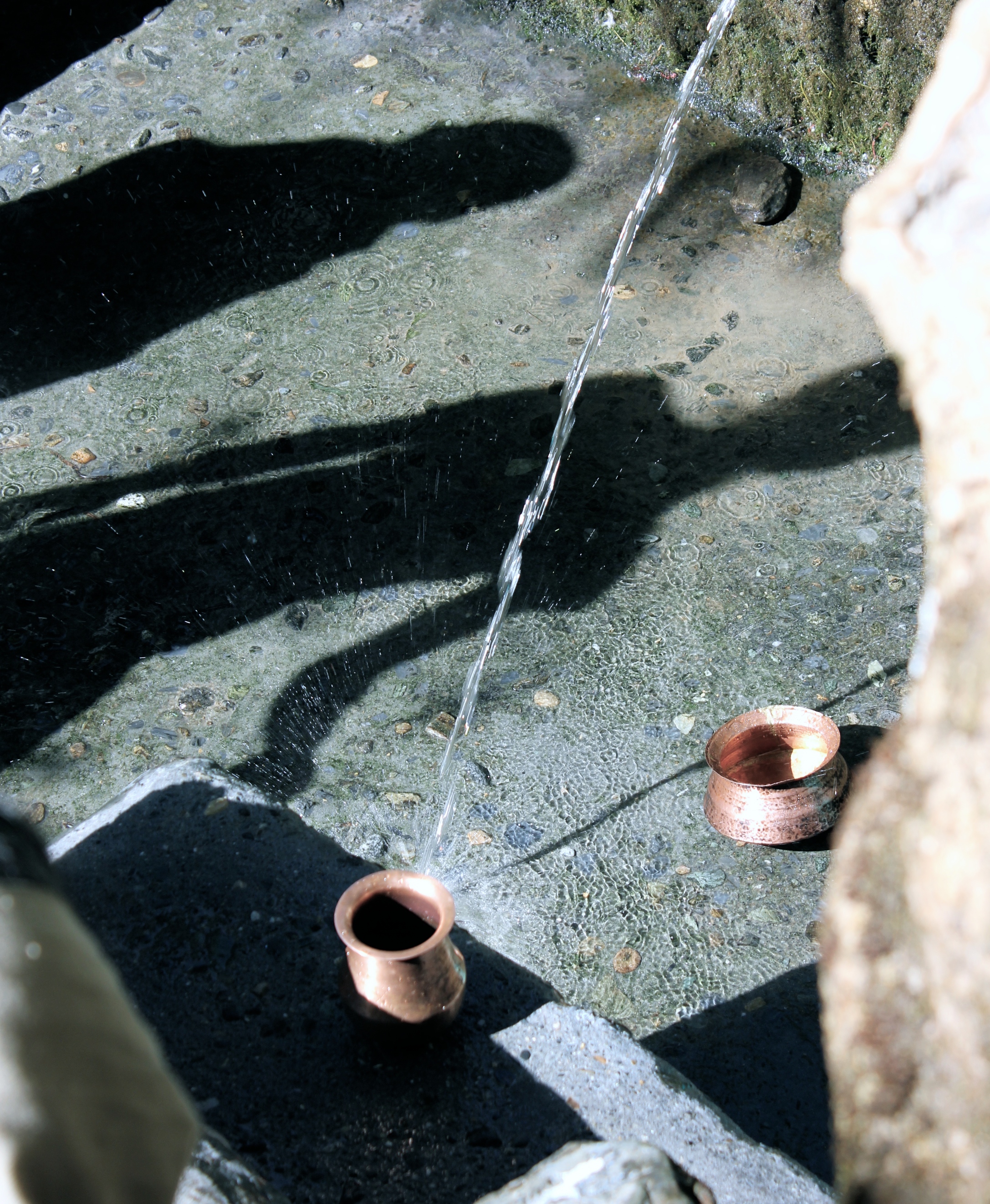
The sons’ turn to bathe comes at mid-day. We leave for the water tap with an entourage of men who bring along firewood and a basket of cooking supplies. Malika’s brothers carry only a special set of water vessels. They are not to touch any of the other items directly – not even the basket.

IMG_5955A tarp has been put up a respectable distance away from the water tap, and we set everything down. Just on the other side of the spring there is a sizeable concrete shelter for kriya mourners that was built with funds raised from the community. This gives you an idea of the deference paid to these customs.

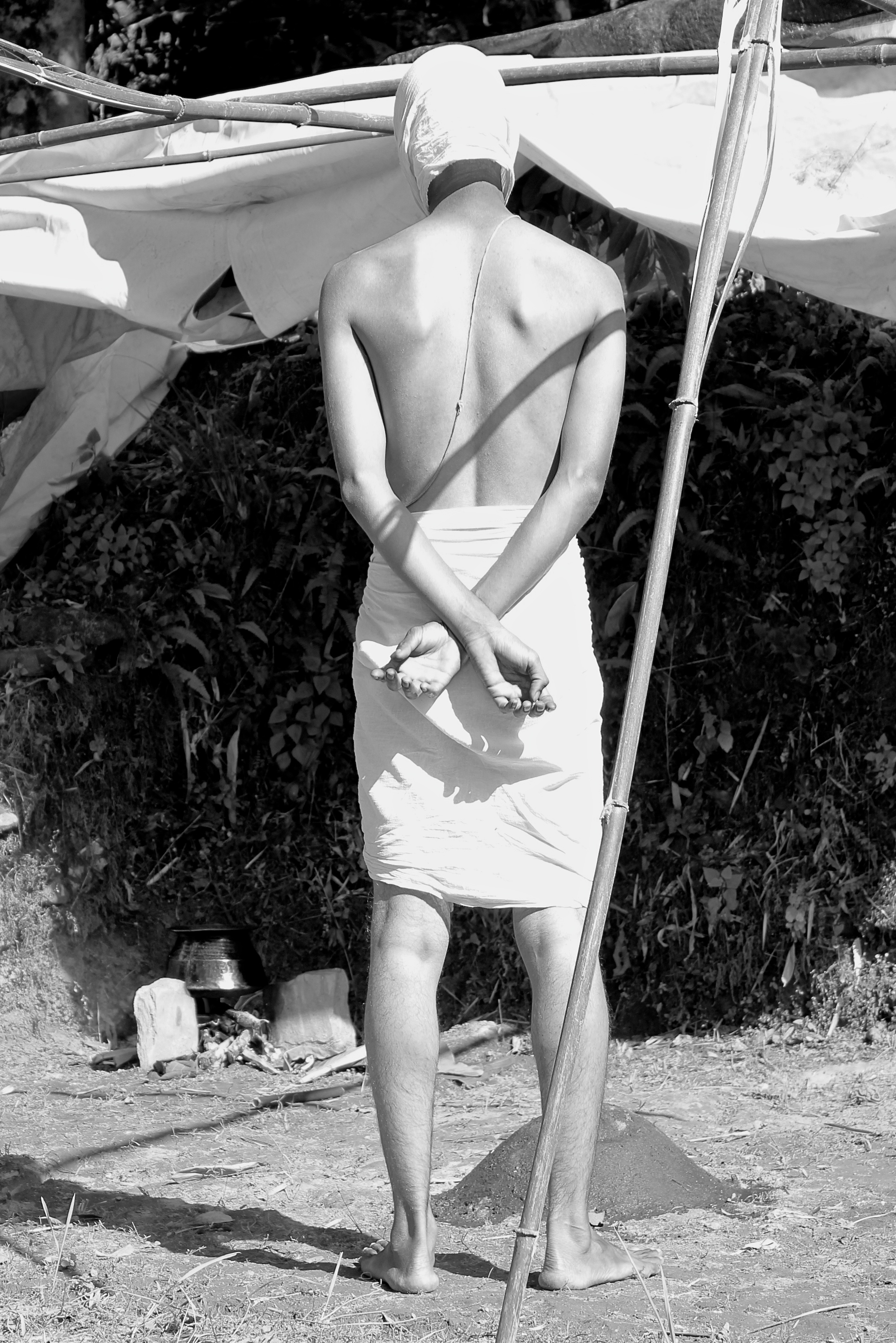
Malika’s brothers leave for the water tap. Some of the other men get a cooking fire going, and the rest sit on the edge of the terrace having a rollicking conversation about politics. I can see Malika’s brothers from far away, through a haze of bamboo stalks and leaves. They go through a series of rituals with the water vessels, washing their white linens, and bathing in the discreet way that everyone learns to do in public. Their brother in law stands guard at the edge of the tap, but nobody approaching would be confused. They will wait.

When the brothers return, the youngest sets to cooking their daily meal over the fire that’s been started. The elder brother begins a puja over a small mound of dirt.

I spend a good bit of time gazing at the mound of dirt. It is about a foot wide. When we arrived it was protected with a branch lying over it. Malika’s brother smooths mud around its sides. It makes a rough, wet sound under his palms. A series of other rituals unfold, and each time he needs a new object – leaf, water, jug – one of the other men places it on the ground for him, careful that the two people do not touch anything at the same time.IMG_5950

The mound of dirt symbolizes his father’s body. On the tenth day of kriya, the oldest son will destroy
the dirt body with the crown of his head, and for the last three days of kriya, his puja will move to a different piece of ground, a few feet away. Where there is nothing.

The physicality and deliberateness of this performance is beautiful to me. When we lose someone, there is something missing between our hands, between our minutes, between our thoughts. No matter how long the process of departure takes, there is a moment of disappearance…and then emptiness.

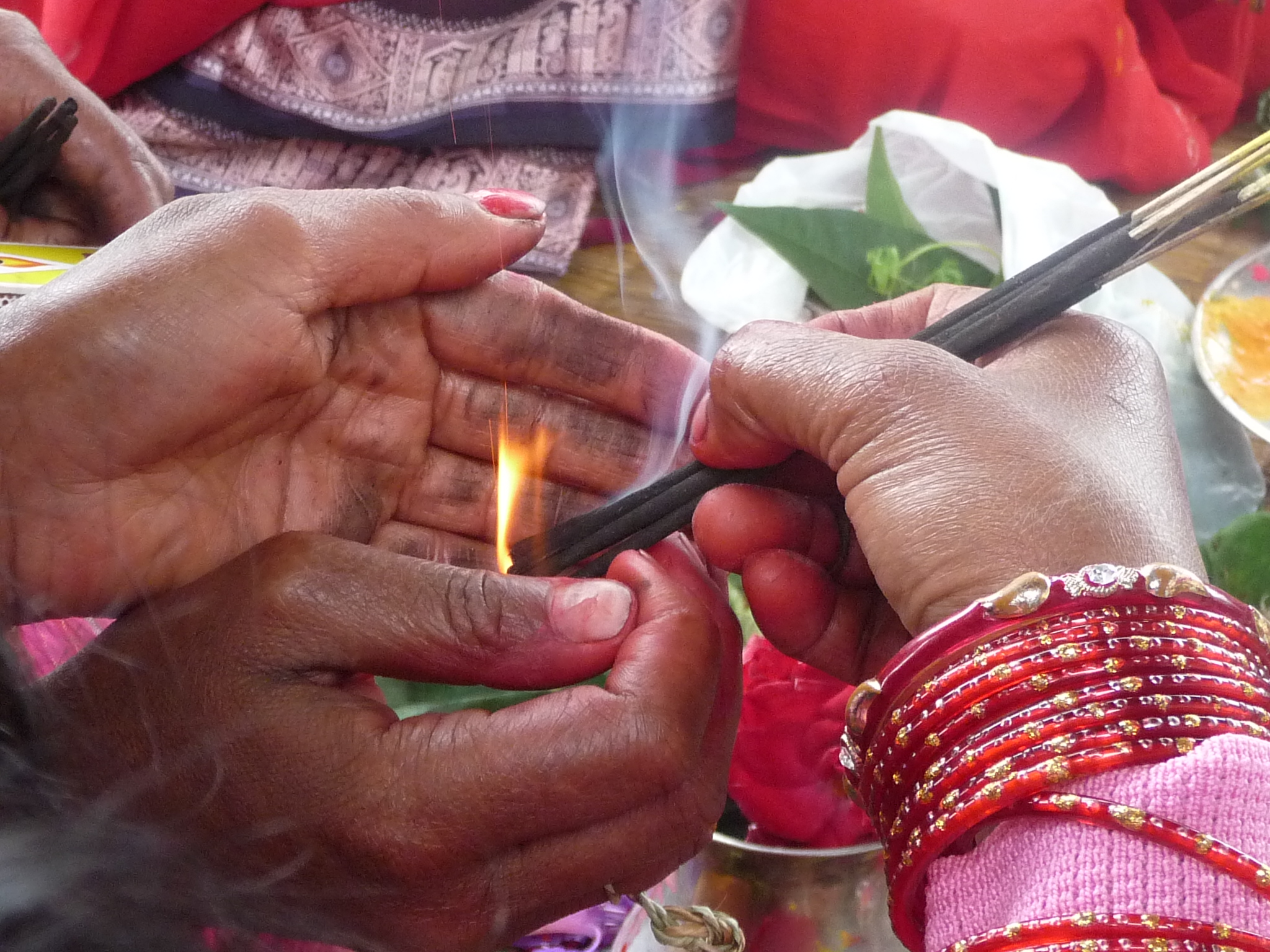
Kriya is an unremitting physical process. Sitting around the edge of the terrace, we bear witness to the externalization of that mercilessly intangible absence. And this seems very important. Observers can carry the baskets, light the fires, put the prayer objects in reach. But they cannot inhabit these things. We are not naked, cold, untouchable; the body has not disappeared from our houses; we are only there to make this reality manifest. But we must be there. Otherwise the process is impossible to complete.

.      .      .

IMG_5968

Midnight Confessions


Last night I arrived in Nepal on a flight from Dubai. It was nearly 11pm by the time I got through immigration and came out of the airport to meet our cousin Laxu. IMG_3894

As the baggage came bouncing on to the conveyer belt, dozens of televisions swirled by.  It was a funny moment, something like hearing my own song on the radio, because in the last ten years I’ve watched televisions appearing in one house after another Kaskikot. Next door at Saano Didi’s house, where Jivan and Madu have been working abroad for a few years now, they now have TWO televisions.  It is the single most reliable status symbol of a household with a family member working abroad, and for some reason it strikes me as funny that people actually bring the televisions back with them, rather than just purchasing TVs in Nepal after they get home.  Like many aspects of this whole system, it’s a thing.  It’s the ritual.

Before I left the airport, I decided should try to get a phone number for the baggage office. The purpose of this project is to look at how traditional death rites are altered when migrant laborers die abroad, which means, first of all, talking with someone who processes bodies that are shipped home to this very airport. Since it’s unclear how I’d explain this on the phone, it seemed like a good idea to get a name and phone number for the baggage office while I was already there.

I started at the baggage desk, where an agent gave me a cell phone number and a name and sent me to the airlines office building, which, oddly enough, was still open at 11pm. Laxu and I left my bags outside with his friend, and then waded through a series of muddled conversations about why we were there: with a police officer, a secretary, other people who had unclear reasons for being in the front hall of the airlines building so late at night. Eventually, we were led in to a narrow back cubicle, where we sat down at an empty desk, across from a clock that read 11:30pm. I had a feeling we’d be there a while, and probably with no result.

We waited.

What happened next was the typical Nepal phenomenon where nothing is happening for a long time, and just when you are certain your plan hasn’t worked, something appears out of nowhere.

The something was an airlines agent who did not want to be identified, but was very eager to talk to us about what it is like for him to receive and process bodies from abroad. He listed all the documents that come with bodies when they are shipped home, and the procedures for releasing them. He said it is “terrible scene” to deal with the families. He kept repeating “terrible scene.” As the clock ticked on, I was increasingly aware of the late hour and the hush outside the airport as everyone who’d been on my flight departed.

The agent was especially intent on explaining the travesty of the labor system to me. Every time I directed our conversation back to the baggage procedures that in this dreadful and bizarre situation have essentially usurped sacred death rituals, the agent would find his way back to condemning the exploitative labor trade.

I noticed that he insisted that the families he sees coming to retrieve their loved ones are “very poor,” “low caste,” and “uneducated.” I know this not to be true; almost every household in Kaskikot, like in so much of rural Nepal, has a young male family member abroad, and almost all of them, while poor, are educated (and high caste, while we’re at it). It’s the country that, in a global context, is colossally poor.

I wondered about this trenchant misconception later. It’s easy, after all, to deplore a system that preys on wholly ignorant people. But my impression is the vast majority of Nepali laborers, while disenfranchised, are nevertheless aware of the general inequity of the migrant labor system. Like Mandira, they make the bargain with their eyes open, usually multiple times. It’s too simplistic to assume that half a million people per year are too naive to realize what a high price they are paying, and doing so avoids the more complex question: Why is it worth it? What is in it for these youth and their families?  Hundreds of thousands of them?

By the end of my interview in the airlines office, it was after midnight, and a crowd of employees—inexplicably still at work—had crowded in to the office to listen. Our topic had obviously struck a cord. I turned off my recorder. Laxu and I dispersed in to the eerie, deserted airport parking lot, and caught a cab home.

And so it starts.

.      .      .

Kathmandu Airport

Kathmandu Airport, Home from Dubai

Magical Thinking

Tuesday morning, we’d only been up for a short time when Bhinaju told me that just around the corner, Shaula dai had gone in to the bathroom this morning, given a shout, and was immobile.  At first, from the way Bhinaju described it, I thought Shaula dai had somehow just stopped speaking.  But then Bhinaju went over to see what was going on, and when he came back, it was pretty clear that Shaula dai was dead.

At first I wasn’t going to do anything.  But as I finished packing for our three days in Pokhara I realized that made no sense.  To be honest, I still wasn’t sure who Shaula dai was, because I call almost all the men of a certain age simply “dai,” or “brother.”  Bhinaju had said, “The one in Deurali, with no teeth,” which could have been a lot of people, and I was sorting through them all in my mind.

It wasn’t till Bhinaju and I were walking over and we turned onto the small path that goes around Gita bouju’s house that I realized Shaula dai was Kopila and Kalpana’s father.  I chatted with him the other day while he and his wife were tilling corn.

At their house, a lot of people were crowded around the yard and in the dirt road in front of it.  Bhinaju and I made our way up to the porch, where Shaula dai had already been covered in a white piece of cloth.  I noticed a curtain was missing from in front of the house door, and for a minute I was fixated on this, the image of someone taking down the white curtain at the front door to cover Shaula dai’s body on the porch, leaving just one flowered white curtain at the entrance to the house.

Would they replace it?

At first, Ujali bouju – Shaula dai’s wife – looked bizarrely nonplussed, standing on the porch, calling out to various people in the crowd.  While she was off to the side, I asked Bhinaju if we could see Shaula dai’s face, and unfortunately just then Ujali bouju came to sit by her husband’s head, her obligation until the arrival of a son.  Before I could stop him, Bhinaju asked Ujali to pull back the sheet.  She did it gingerly, and suddenly her shock and terror were visible in the way she handled that gesture, as if the sheet was on fire.  As she tucked it back under his head our eyes locked for a long, confused moment.

I didn’t know if it was wrong to look her in the eye like that.

As we stood around, phone calls were made.  Shiva dai came over and Ujali bouju said not to call any of the kids who are living in Japan.  Especially not the girls – there was no way for Kopila and Kalpana to get here in time for the funeral rites.  So they were absolutely not to be called.  In the way that multiple experiences can suddenly collide and line up in an instant, I recognized Joan Didion’s The Year of Magical Thinking, which I read recently and have been thinking about a lot.  As if it made sense not to call the daughters, who should not know their father was dead if there was no way to get home for the funeral rites.  As if he could stay alive for them, as long as they didn’t know.

Last night, we had a guest in our house.  He had wanted to sleep in his own bed sheets, and had arrived with a white sleeping bag liner that was light and suited to the warm weather.  He fit right inside of the white liner and lay down on his back, with his legs straight together and hands folded on his chest, and put a pale shawl over the liner, and became perfectly still.  Bhinaju and I were sitting on the other bed and he leaned over to me and whispered – Laura – our guest looks exactly the way a dressed body looks – and we both shuddered and couldn’t look at the sleeping figure on the other bed after that.

Now, the next morning, there was Shaula dai before our eyes in exactly same posture. Bhinaju leaned over to me and whispered – Laura – our guest just last night – and we both shuddered again.  And I realized that Ujali bouju, sitting by Shaula dai’s head, had not even changed out of her red sari, and it was jarring to see the red sari next to the white curtain covering Shaula dai, because white, the color of purity, is the color of death, and the celebratory color red is forbidden to widows.  In that moment, I saw Ujali bouju arrested in a transformed world, sitting in her red sari beside the still white covering.  Soon, somebody was going tell her it was time to change, and like Aamaa, she would never wear a red sari again.

.     .     .

P1030466

An Eclipse For Small People

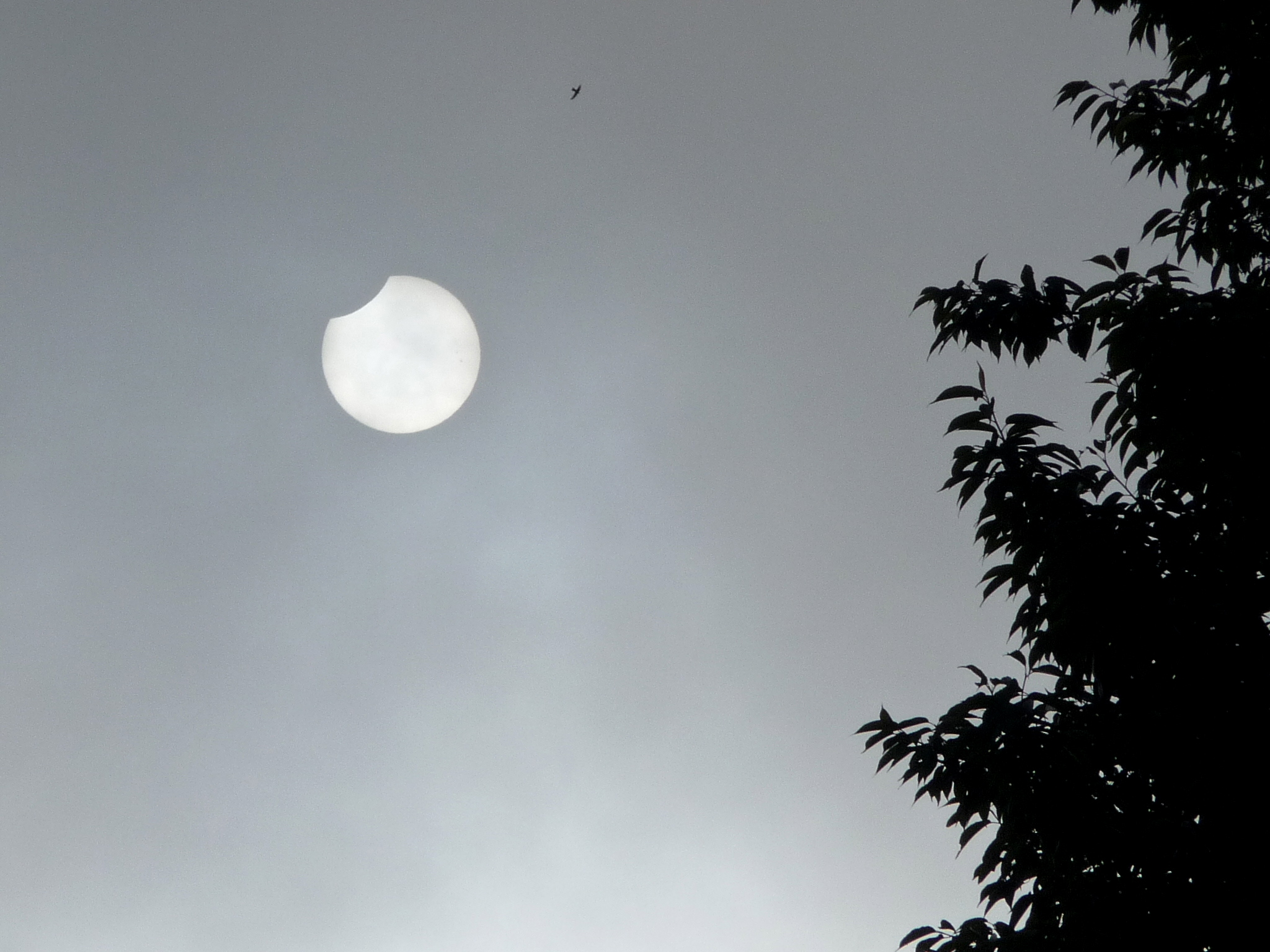
P1010918My first solar eclipse was in sixth grade.  Our science teacher, Max – I went to a progressive school where we called our teachers by their first names, so I actually had a real science teacher named Max – took us outside and we sat in the grass, next to a blacktop, near the soccer fields.  In groups, we held something up in the air and peered through it, a notecard with a hole in it, or something like that.  I don’t recall exactly.  The entire memory is just an image of us, kids, sitting by the blacktop, holding a thing up in the air and squinting.  I found it rather tedious.

My second solar eclipse fell on the festival of Maghe Sakranti.  Before the solar eclipse, there had been a number of times when Maghe Sakranti had coincided with the day of my departure from Nepal, so over time, during visits when I found myself still there for this festival, Maghe Sakranti and its associated rituals had taken on a special flavor of celebration.  We were still together.

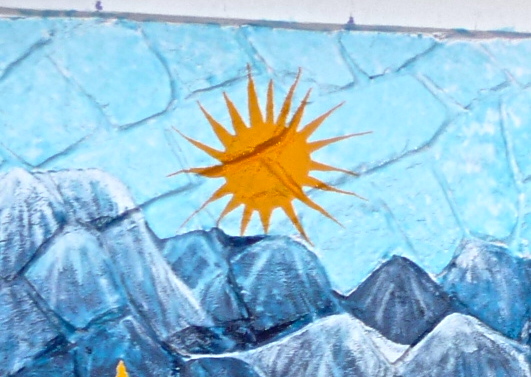
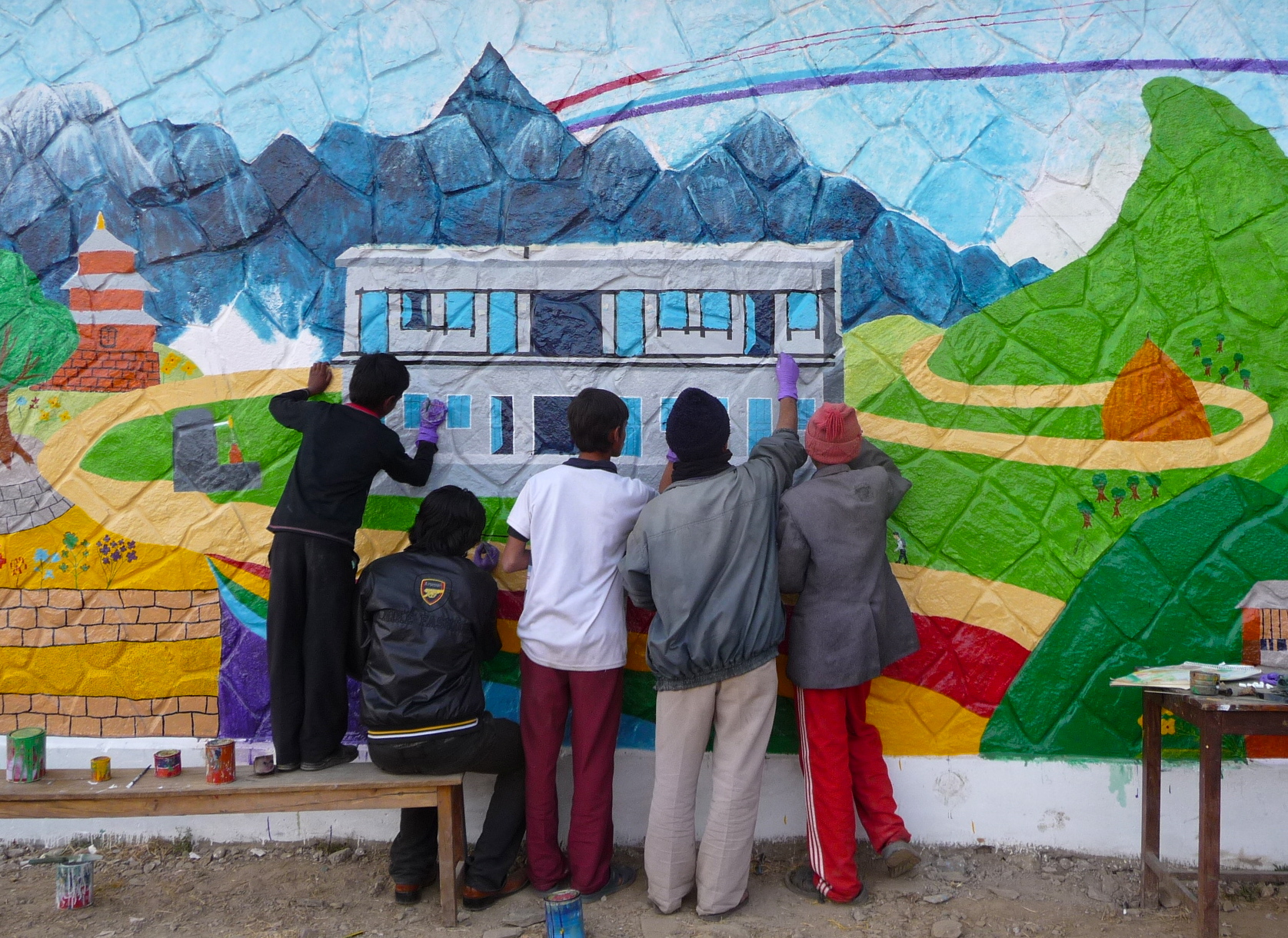
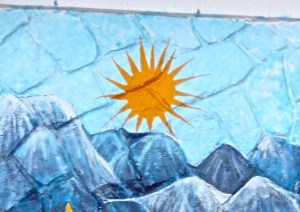
In the days leading up to the eclipse, I was at school from early in the morning right up until dusk, painting. Govinda and the kids and I were rushing to finish a mural before yet another departure.  It was a picture of their community: haystacks and houses, the whipped-cream shaped Kalika Hill with its little temple at the top, a paraglider sailing overhead, and road winding around from one place to the next, with a dominating school at the center.

P1010876 - Version 2

As the day of the eclipse approached, there was a great deal of anticipation.  Everyone was talking about it.  Once, Aamaa said, she’d been out during a solar eclipse and, just like that, it had turned to night.  They’d been forced to wait for a few hours until it got light again so they could go home.

Now that was something I wanted to see.

I went to visit Thakur sir, the astrologer, to get his opinion on a gift.  Back home, a great healer and teacher of mine was losing her eyesight.  I had purchased a necklace with the symbol kali chakra on it, and I wanted to ask about taking it up to the temple to be blessed, or infused, or something of that sort.  I wasn’t exactly sure, but I thought Thakur sir would know what I meant to ask.  A solar eclipse, he said, would be a very auspicious day to bless a necklace, even though it wasn’t allowed to do a puja during the hours of the eclipse itself.  And, once the necklace was up there at the temple, at the top of the Kalika hill, I couldn’t take it away until the eclipse was over.

The movement of necklaces was one of many things couldn’t happen during the eclipse.  Everyone would fast, of course, from exactly 12:36pm to 3:30pm, and many people would fast the whole day.  Any water in the house would have to be poured out after it was over, and replaced with fresh water from the tap.  It is wood cutting season, and trips to the forest were put on hold for the day.  And Maghe Sakranti was, for all intents and purposes, cancelled.

In the U.S., a solar eclipse is, for the majority of busy people, a science project for kids.  But here, where astrological charts are consulted for even the opening of businesses and choosing of brides, everything seemed to slow down as the days spiraled towards a grand and humbling halt.  Gazing at the top of the Kalika hill against the sky, I could feel the world catapulting through the solar system to a particular magical position—a great thing getting closer and closer to us, small people, standing where we would witness the movements of the galaxy.

By the prior night, there were three buses waiting to take people all the way to Chitwan in the morning so they could bathe at the place where the Trishuli, Gandaki and Kali rivers meet.  First thing in the morning, Aamaa repainted the floors with a fresh layer of mud.  It would be a day filled with ritual.

Like the rest of the world, I had hoped to stay put for the solar eclipse…but the mural wasn’t finished.  We had painted and painted that week, trying to finish in time, but when we pounded the lids in to the tops of the metal paint canisters the night before what should have been Maghe Sakranti, our creation still wasn’t complete.  So I departed for school early in the morning, swearing to Aamaa I’d be back by noon so that I could eat before the fast.

I met Govinda in the road with the necklace in my pocket.  When I’d taken it out that morning, I’d been surprised to see how mysterious and powerful the kali chakra looked, separated now from the rows of silver and symbols in the glass case at the shop.  When we passed Thakur sir’s house, I put it in his hand and he gave it a long look.  I wasn’t sure if I’d actually end up giving it to my teacher back home. I thought I’d send it up to the temple during the solar eclipse, and then give it away later if it seemed appropriate.  I was afraid it might seem kind of silly, and ridiculously enough, decided I would ask the priest at the temple for an opinion when I went to retrieve it later; after the solar eclipse.

Govinda and I arrived at school to find the kids waiting anxiously, and out came the paint. I had stayed out past the witching hour, painting a mural, many times over my years in Kaskikot.  But there was no thought of that today, not in the quivering air, under the glare of that acute collective focus on the cosmos.  I was incredibly P1010864excited.  It felt huge and magical and a little ominous, and made me think about what it must have been like for ancient cultures that didn’t know the science behind such events.  It must have been incredulous and awful to see the sun – so reliable! – disappear in the middle of the day!

And that’s how we found ourselves rushing to complete our masterpiece before the stroke of noon, small people painting small people, the sun under the brush racing the sun circling in the sky.  “The eclipse is coming!” passers-by admonished us.  What were we doing out?

At 11:15, we decided we were done, and with terrible haste threw remaining paint in to boxes, picked up old gloves, ran and locked the office, forgot something in the office (Unlock the office!  The eclipse is coming!) and, at last, set off running down the road to get home before the eclipse struck us dead in the road.  Kids peeled off at their homes.  As we raced by in the dust, people called to us from their houses: Hurry!  The eclipse is coming!  There had been conjecture that we would see stars.  The entire world was about to evaporate.

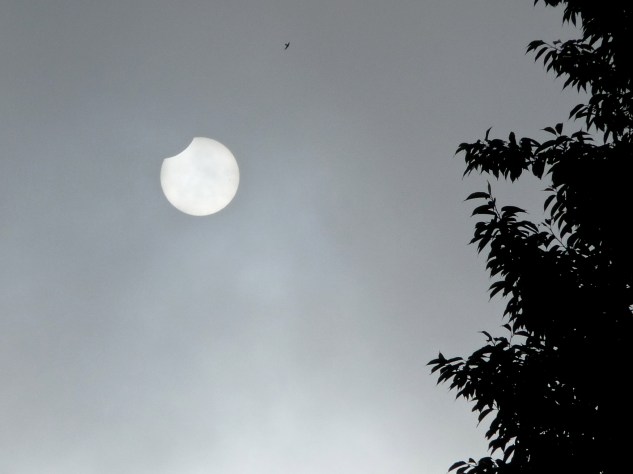
I made it home by noon, in time to eat. One o’clock in the afternoon, twenty-four minutes after the official start of the eclipse, brought a subtle change in the quality of the light.

Bhinaju and Bishnu and I decided we would climb up the hill behind the house and watch from the resort.  We set to discussing what we should bring along.  A flashlight?  Poncho?  Extra sweater?  Rubber bands?  Camera?  (Would it be too dark for photos?)  We rummaged around and put some belongings together.  We climbed up to the top of the hill. And there I was, surrounded by a Himalayan panorama during a solar eclipse!  I wondered if I would be permanently altered, perhaps suffused with some kind of wisdom?

We sat in the grass.  We waited.

We stared earnestly at the sun for 30 minutes before admitting that we could see nothing.

We came home and sat on the porch.  It was a devastating disappointment.  I took out my journal.  I became impatient for tea.  As I looked a the water vessels and thought sullenly that we’d have to fetch new water before we could make tea, I considered the idea of “touched” water – that’s the word, chueko, “touched” water, the same word used for the impurity that a menstruating woman imparts to the things she contacts – and it occurred to me that all of these rituals – abstaining from pujas, fasting, dumping touched water – were fundamentally based in a fear of the awesome, not a celebration of it.  Too bad I wouldn’t see anything.  Even Maghe Sakranti had been cancelled.

For some reason, some of Aamaa’s old, beat-up x-rays were lying in a large envelope on the porch.  I have no idea why.  She’d had them taken when she was first sick, eight years ago; one of the slides showed her ribs and abdomen, a faded spine in the background, and another, a ball and socket joint.  Maybe they’d been deposited in this random location during a recent tidying, or while we’d been arranging articles to bring on our failed observation mission an hour earlier.

I was writing when Bhinaju suddenly said, “Laura, come here.”  He was standing in the yard, holding up the ribs and studying them.  I thought he wanted to continue a recent debate we’d had about the number of vertebrae in the spine.

“Why,” I mumbled.  “Vertebrae?”  I was in no mood to be proved wrong.

“Just come here.”  He switched to the ball and socket.

I got up and went to stand beside him.  And right there in Aamaa’s humeral head was a clean outline of the sun with a smooth bite out of the upper left-hand corner.

For the last twenty minutes of the solar eclipse, as the bite of shadow moved eastward and the sun became whole again, Bishnu and Bhinaju and I leaned together, small people, holding the x-ray over our heads and squinting.  We exclaimed and pointed and cried to each other: “The x-ray!  The x-ray!  It was here the entire time!  If we’d had it on the hill, what would we have seen?  What??”

P1020034

Putting Away a Chicken

This afternoon, a handful of serious looking men were sitting on the porch visiting with Aamaa, who is still not moving much after her operation a few weeks ago.  I was puttering around when Aamaa called me to put the chicken inside for the night.  Now, I’ve never put a chicken away before, but I was so pleased to be asked that, without any questions, I strode out to the porch and walked up to the chicken.  It promptly went skittering off.

Ah, I thought, I see.  This is going to be like climbing on to the upper roof.  Seems straightforward until you try to do it, at which point it’s too late; you’re already committed.  And standing on a middle roof.  With everyone looking at you.

As I pondered how one goes about putting away a skittering chicken, my doubt must have been obvious on my face because Aamaa immediately told me to forget about it and let Bishnu put the chicken away.  That’s the routine: I try to do something, we all realize just how much I don’t know how to do it, everyone tells me to stop, I insist, there is a contest of wills, and then something happens.  But one thing is certain: I’m not about to lay down and be defeated by an uppity chicken.

So the array of serious looking men, and Aamaa lying on a mat, watched as I chased the chicken around the yard, into the radish patch, through a thick of flowers, back into the yard and through the door of the house, where I thought I finally had it cornered, and then back outside, all the while trying to act casual.  I frittered after the disobedient little excuse for a bird, and eventually, after another trip through the flowers, managed to chase it back inside, where I finally got my hands on it with a decisive dive and firm grasp.  Like the surprisingly solid upper roof, it turns out that a chicken does not squirm as much as one would expect if one chooses to grab it forthrightly.

I emerged triumphantly onto the porch holding the gleeful chicken, which seemed very satisfied with the trouble it had caused, having certainly never enjoyed such an entertaining bedtime.  I went into the goat room to put it in its little chicken box, which I’d never really seen, because the goat room is unlit and I never have a reason to be in there.  I felt around for the chicken box, which turned out to have a top and a bottom compartment.  Not wanting to ask any questions, I promptly stuffed the chicken into the top compartment.  But it didn’t seem to want to fit and I had to push on its chicken butt while calling, “Aamaa, the top or the bottom?”  I got the chicken and its butt into the top compartment.

“The bottom,” Aamaa called from the porch.

I pulled the chicken out–it must have been quite perplexed by this point after years of daily extraction and replacement from its box in an efficient and reasonable manner–and then stuffed it into the bottom compartment.  I learned later that there’s a little piece of wood I’m supposed to put across the box for a door, but I didn’t now it at the time, so I was quite pleased with myself when I came stumbling out of the dark goat room back onto the porch.

There the gathered group of serious men sat there impassively, or stunned, if you will, no comments to be made.  As for Aamaa, she had a look I’ve become familiar with.  It says, “Well, that’s a hell of a way to put away a chicken.  But it appears to have worked.”

*

00012004050900500082

Bua


For some time now, Govinda has been asking me to join him on a trip to Begnas to meet his in-laws. We began planning our visit a few days ago. Govinda’s father in law, who he calls Bua, will be alone for a few days while other members of the family are traveling, so it was a good time for us to arrange a visit to keep him company.

There was some thought that we would travel with Guru sir, who is searching for a match for his daughter. This has raised for me many questions about match-matching procedures. Does one stand in the road and stop the first reasonably marriageable looking male? Go from house to house soliciting bachelors? Distribute letters of inquiry? And why travel all the way to Begnas for this undertaking, twenty kilometers east of Kaskikot? 

I asked around a bit. My investigation was admittedly hindered by a very limited cache of Nepali words related to arranged marriage, but I deduced that Guru sir’s first visit to Begnas was for the purpose of meeting his relatives to discuss the search. So that solved the geographic question, though as far as I could tell, it simply meant Guru sir’s relatives would be standing in the road picking up single men. You can see why I was quite looking forward to whatever was going to happen during our visit to Begnas with Guru sir. But at the last minute it turned out that Guru sir’s rice harvest bonanza would be the same day we had planned our outing, and he would not be able to join us. So I’m afraid that at this time I can’t offer any resolution on the question of Guru sir’s daughter’s marriage arrangement. 

Early in the morning, Govinda and I set off for Begnas on our own. We arrived in Pokhara mid-morning and stopped in to see the artist who is helping us with our school mural, and I paid him. We discussed the idea of having him come to Sada Shiva to give a talk about his profession, as part of the series of visits I’m working on for the kids to learn about topics of interest like how libraries work and what pilots do and how photos are made.

At the bus depot in Prithvi Chowk, where dozens of buses paw sullenly at the pavement and pant in the diesel-filled hot air, we boarded another bus to Begnas. It set off laboriously down the highway, and I felt sleepy in the warm, acrid air inside the bus. Govinda bought some peanuts, and we ate them together in companionable silence, throwing the shells out the window, as storefronts sped by and blended together in a haze of mid-day life: pencils, apples, kilos of sugar, shoes, sticky cartons of fruit juice, pencils, sugar, apples, shoes. Finally the highway dead-ended in another small depot, where a dirt road wandered away from a collection of food stalls and small shops. It disappeared gently up into the hills. We followed it and began a long, rather hot walk to Bua’s house. 

The walk was pleasant, even though I still felt lethargic from the unyielding sun. Govinda’s uneven, methodical gait kept time, spurring us on at a steady and unchangeable pace. Begnas is warmer than Kaskikot, and we passed mango and banana and guava trees; it is currently orange season, and everywhere we could see ripening fruit that will soon find its way back to the roadside stalls and slung baskets and curbside mats heaped with fruit that we passed on the journey in. We stopped at a tea shop for peas and hard boiled eggs, and I drank a moderately cold coke out of a glass bottle, which left me feeling reinvigorated. We bought some hard candy and crackers to gift to the family. When we set off again, a hush had set over the terraces and orange trees, and the city felt far away. Finally, as we approached Bua’s house, I could see Begnas Lake to the west and Rupa Lake further east. Govinda removed his hat, and fanned himself briefly in the yard.

No sooner had we arrived than we were gathered around a plate of oranges with Bua. Govinda’s father in law was a slender, wiry man with a square jaw and lined, approachable face. He had a boyish way of moving that reminded me of my monkey-like fifth graders. Bua had work to do around the house, so even though Guru sir wasn’t there to answer my questions, Govinda and I sat outside talking about marriage practices until the sun dropped below the hills and it got cold.

We went back into the house where Bua was just starting to cook dinner. The next two hours were the longest rice-preparation process I’d ever watched on a hungry stomach. We did have an interlude of tea and biscuits, but I’ve become used to watching rice-cooking as a well-rehearsed, mindless affair, something that occurs very efficiently in the cramped spaces between other work. But Bua cooked very slowly: first one item, then the next, often pausing to talk as he cut vegetables or mashed spices. He was at once nimble, even lively, and unmistakably weary. It was as if he had to keep re-convincing himself that quelling his hunger was worth all the effort, and yet in the absence of dinner, I felt he would have been quite content to simply sit and gaze at the darkening hills with us.

Begnas

While Bua cooked, Govinda and I sat at a table, I with my journal resting under my hands. But I didn’t do much writing because Bua began to ask me a series of questions about America. 

“Nani,” he said, addressing me as one does a grandchild, “I hear they have very tall buildings in your country. Very very tall. Is that true?”

“Well, in some places they do.”

“And I hear there are those things that can take you up in the building,” he added, raising his hands.

“Yes,” I replied, “they’re called elevators.”

“Nani, in your country, how do people make money?”

“Nani, in your country, are clothes made to be durable for a long time?”

Between questions, Bua moved around the cooking fire cutting vegetables with his sickle. He seemed a little sad, but without a trace of bitterness, and there was an authenticity about Bua that put me at ease. I don’t think I’d ever met someone who could be genuine and restless at the same time like Bua was when he asked me about worlds I have seen. As the evening wore on, we developed an uncomplicated rapport, Bua taking an interest in this and that, and me content to feel like the kind of guest that he enjoyed: a participator with no agenda. It was a relief not to be waited on in awkward silence, and to have the opportunity for manageable dialogue that left space for the clumsy maneuvering of language-learning. 

As Bua picked up a korela vegetable and pulled his sickle down the middle of its alligator-like lumpy green skin, Govinda rose to go outside. I gazed quietly at Bua in the orange glow of the cooking fire, waiting for the next topic of discussion. 

“I’m going to die here,” he said matter of factly. He lifted his long hand and indicated the house. 

I didn’t have a good answer, because he’s probably right. So I just waited while he picked up my journal and gazed at its pages and pages of tiny writing.

“You will do your writing, see our country, and go back to America,” he sighed. The ink-filled pages suddenly seemed a pathetic sum of Bua’s entire world. “Me…” he waved again at the dim narrow walls, “I will die here.”

Then he shook his head, and picked up his sickle again.

“Nani,” he said amicably. “In your country, what are houses made from?”


*


The Rice Harvest

Bishnu and I got up early to do housework, and then we left with Saano Didi and her kids for today’s rice harvest in her fields. Saano and Bishnu carried big baskets loaded with pots and array of cooking materials; I had a bucket of spinach in one hand, a pot of tea in the other (life can be so odd), and my audio recorder slung over my shoulder.

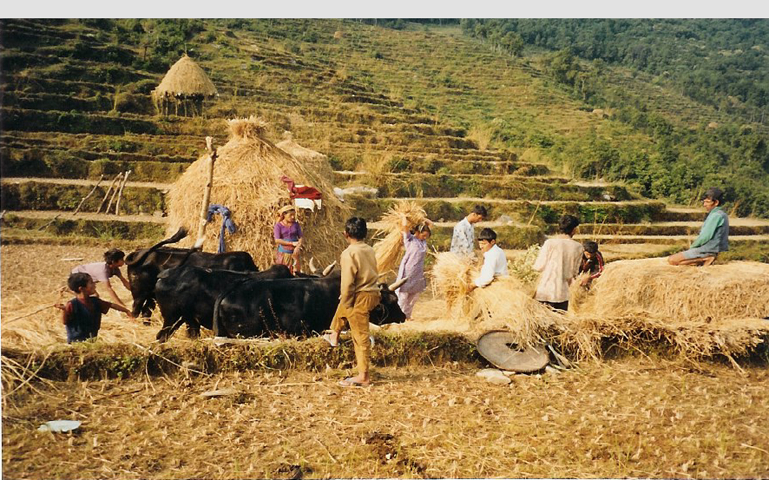
Saano’s boys and I stopped at the tap to wash the bucket of spinach.  The ground still hasn’t dried out from the monsoon, and path through the rice paddies was narrow, slippery, and sometimes non existent.  When we finally arrived, we found an elaborate and energetic rice thrashing, ox-circling, tea and rice cooking, straw flinging fiasco I am becoming familiar with.  Mahendra’s father was perched on top of the hut-sized pile of cut rice stalks, smoking a cigratte and handing down bundles of crop every twenty seconds or so.

I ended up in the rice thrashing group.  Our job is to pick up the bundles of cut rice stalks as Mahendra’s father unloaded them from the haystack.  We lift the bundles over our heads and slam the grain end on a flat rock to separate out the seeds.  Then we put the straw aside, where the straw flinging people shake it out and toss it over to where the are circling.  Saano Didi’s son Kancha drives the oxen in circles and they trample the straw to soften it, so it is easier to carry (for us) and easier to eat (for our baby buffalo Sticky and her parents).

It’s quite a scene.  Very spritely.

Dain

Today’s seen was mainly composed of boisterous men, slightly older than me and Bishnu, in their mid and late twenties.  I make great entertainment, banging rice from the unreasonable height reached by my upended arms, hay sticking out of my hair and attaching itself to my lungi.  Also, dudes in their mid and late twenties are just generally loud.

So for three hours while we thrashed and drove oxen and whatnot, we talked about America, our respective governments, poverty, wealth, opportunity, taboo subjects like royal murders.  I was so glad I wasn’t logging tape in a carpeted sound studio.

Mean time, Saano didi was putting the pots and spinach and teapot to work over a fire she’d built nearby.  When we had thrashed and trampled the entire haystack, we sat down right there in the fields to eat.  Then I had to leave for school.  While I was away they would have get all the grains into sacks and bundle the straw into loads, and spend the afternoon going back and forth carrying it all up to the house.

I returned late in the afternoon to see if there were more loads to carry.  It had begun to rain, and the narrow, field-winding route was even more treacherous.  I met up with the gang: Siete, a wiry young man about my age; Radju-daai, slightly older but youngish man, and Saano Didi’s husband, a solid ball of muscle a few inches and a few teeth shorter than I am.

I was a little surprised when Saano didi’s husband prepared for me to take over his enormous load, so that he could go get another.  I’m used to everyone bending over backwards to find me the easiest work, and arguing to do more; this time, exhausted and wary of the path up, I was prepared to happily accept something a little easier.  As they propped the fat white bag up on a ledge, someone asked if I’d rather take Siete’s load, which was a little smaller.  Well, working off principle rather than common sense (and noting, after all, that nobody ever offers me harder work than I can do–I always argue my way in over my head), I shrugged and said I’d try this one.

Let me pause to explain the mechanics of carrying a 100 pound sack of rice on your head.  One way to get started is to lift the heavy load from the ground. The bag sits there with a circular rope around it and you lean against it like a chair, stick your head in the sling, and as you lean forward you gradually take on more and more weight until you’re crouched beneath the sack.  Then with a massive effort and a burst of leg power you stand up – that’s the hardest part, because you’re 100 pounds heavier.

Alternatively, the bag can be placed on a ledge, where you can sling it from a standing position and avoid the killer leg press.  The tradeoff is that you don’t take on the gravity of the bag bit by bit using your muscles, either.  Conveniently, it can be pushed right off the ledge.  Onto you.

Today we decided to go with method number two.  So I leaned against the sack, on a ledge behind me, slung the rope on my forehead, and crouched just slightly, to about 3/4 standing. I’d still have to pop myself up to full walking height, but it’s much harder from the ground and I already had a 120 degree angle in the knees.  Raju dai moved the weight of the bag from the ledge to my back, neck, and 120 degree bent legs.

Go ahead and picture a perfectly balanced scale sitting next to a ledge.  Now picture that a 50 kg sack of rice is ever so gently tipped off the ledge onto one side.

That’s me.  One instant we are executing a delicate but routine operation; the next I am pinned to the ground by a sack of rice.  It never passed go, it just went directly off the ledge and crashing to the ground with me underneath it.  There no pause where my astonished quads considered staying at a 120 degree angle.  There was never the slightest consideration of straightening up.  Luckily, because I fell over on my side, my foot (the same one the ox tried to mangle a few days ago when I was a straw flinger) was the only thing besides my ego that got directly squashed.  Of course, what with the enormous sack of rice on my foot (and my ego), I couldn’t get up. Or get my foot out.  My excellent problem-solving skills eventually led me to remove my foot from my sandal.

Also, the sack of rice ripped.  Thanks a lot, sack of rice.

With my first try now finished, I took Siete’s smaller load.  He stayed behind to get a new bag for the one I’d ruined.  Raju and I set off.

For the first bit of the climb, there was no path at all.  We climbed up over the terraces, which are narrow and rocky, and by now it was raining and slick.  Often getting up to the next terrace required a big step up, for which one would use hands and feet together even without the added body weight of a 100 pound sack of rice.

Not to worry!  I gallantly wobbled and teetered my way up as awkwardly and pathetically as anyone has ever done in the history of rice cultivation.  We came to a terrace that was about my height.  Happily, I was able to pull myself up and over to the field above.  Unhappily, I could not quite get the weight of the rice on my back to tip forward with me onto the upper ledge.  So it did what a sack of rice does when it cannot tip forward onto a ledge.  It tipped backwards off the ledge.

Given that said bag was slung to my forehead, this was rather terrifying, but luckily the rope slipped right off my brow. The traitorous bag went tumbling down, and I landed in an upside down hanging position with my legs on the ledge and my torso dangling off.  A passer by (it’s a rather popular spot) might have thought me just shot by an arrow.  Raju might have considered it.

Fortunately the sack was still in tact this time.  I vehemently refused to let Raju carry it over the ledge for me, which I’m sure he found very thoughtful.  We put the whole operation back together and set off again.  By now my back was cramping and spasming despite the relatively easy load, and nobody needed to convince me not to go again when we reached Saano didi’s some untold hour later.

After getting over the initial shock of my actually having arrived alive, the tired crowd wasted no time rocking back on their stools and retelling tales of my performance over the course of the day.  Everyone kept asking if I’d hurt myself, but other than my foot, I was fine–nothing had been badly bashed except my pride. Everyone’s attention was soon diverted to a vat of boiling millet alcohol.  I have never enjoyed whiskey before, but it’s like they say when you’ve been twice attacked by a sack of rice: there is a time and a place for everything.

Roof Leaping

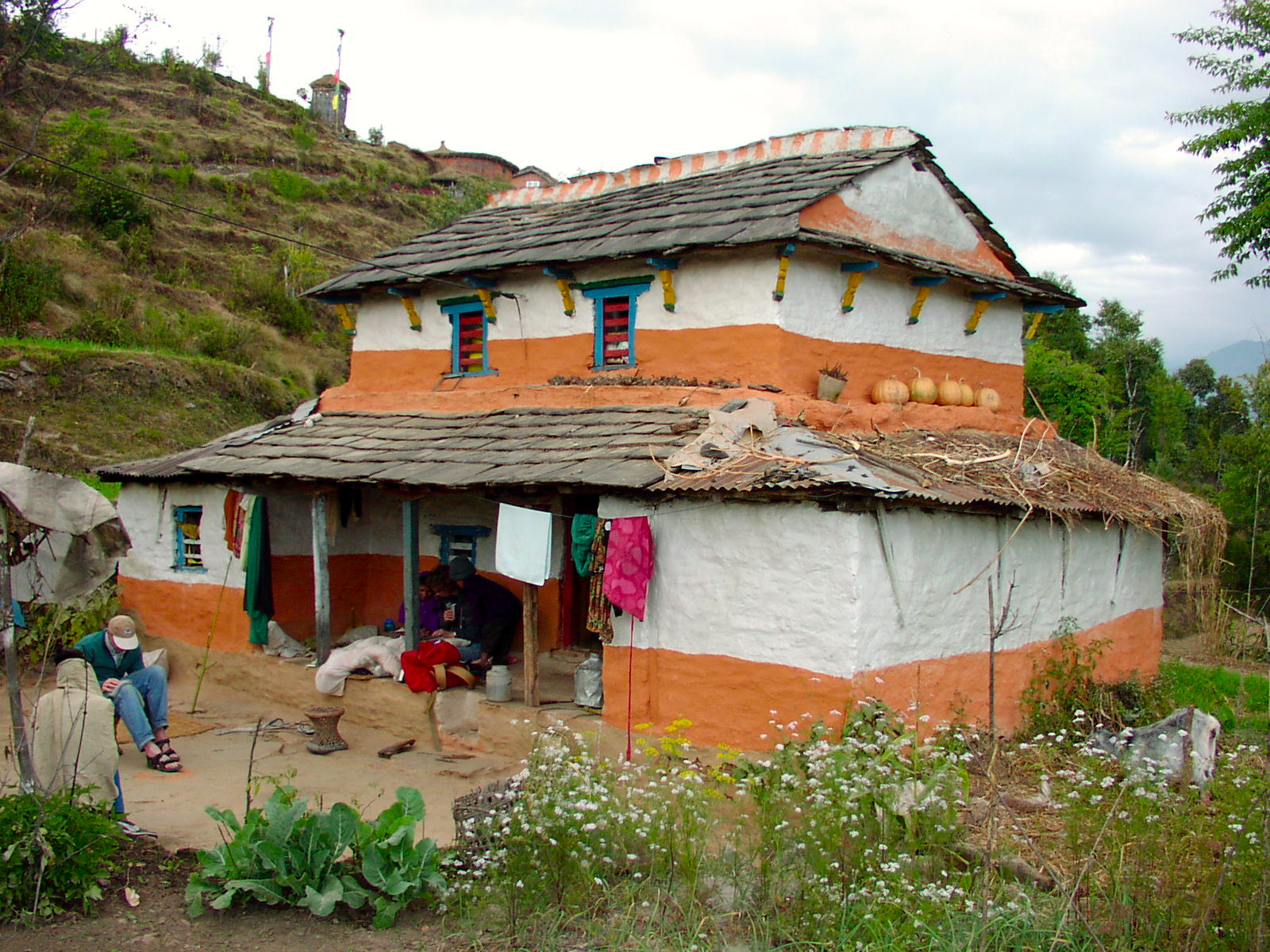
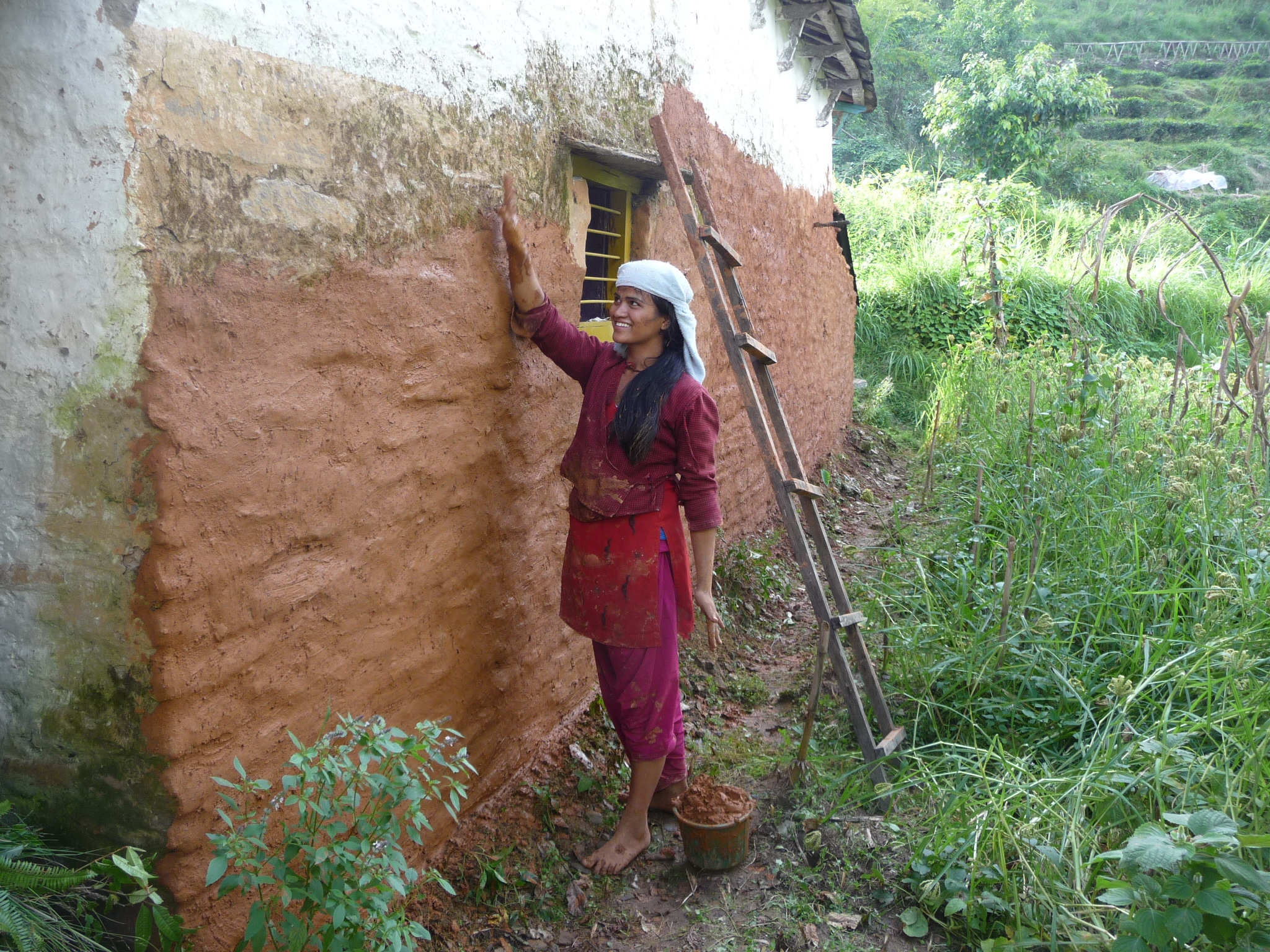
Bishnu and I went to the field at about 7am to cut grass before breakfast.  After we ate, it was time for more house painting.  Fortunately, the structural layer involving buffalo poo is all done, so now we just have to go over it again with thinner mud that has color mixed into it.  This is how the house ends up orange on the bottom and white from the middle up.

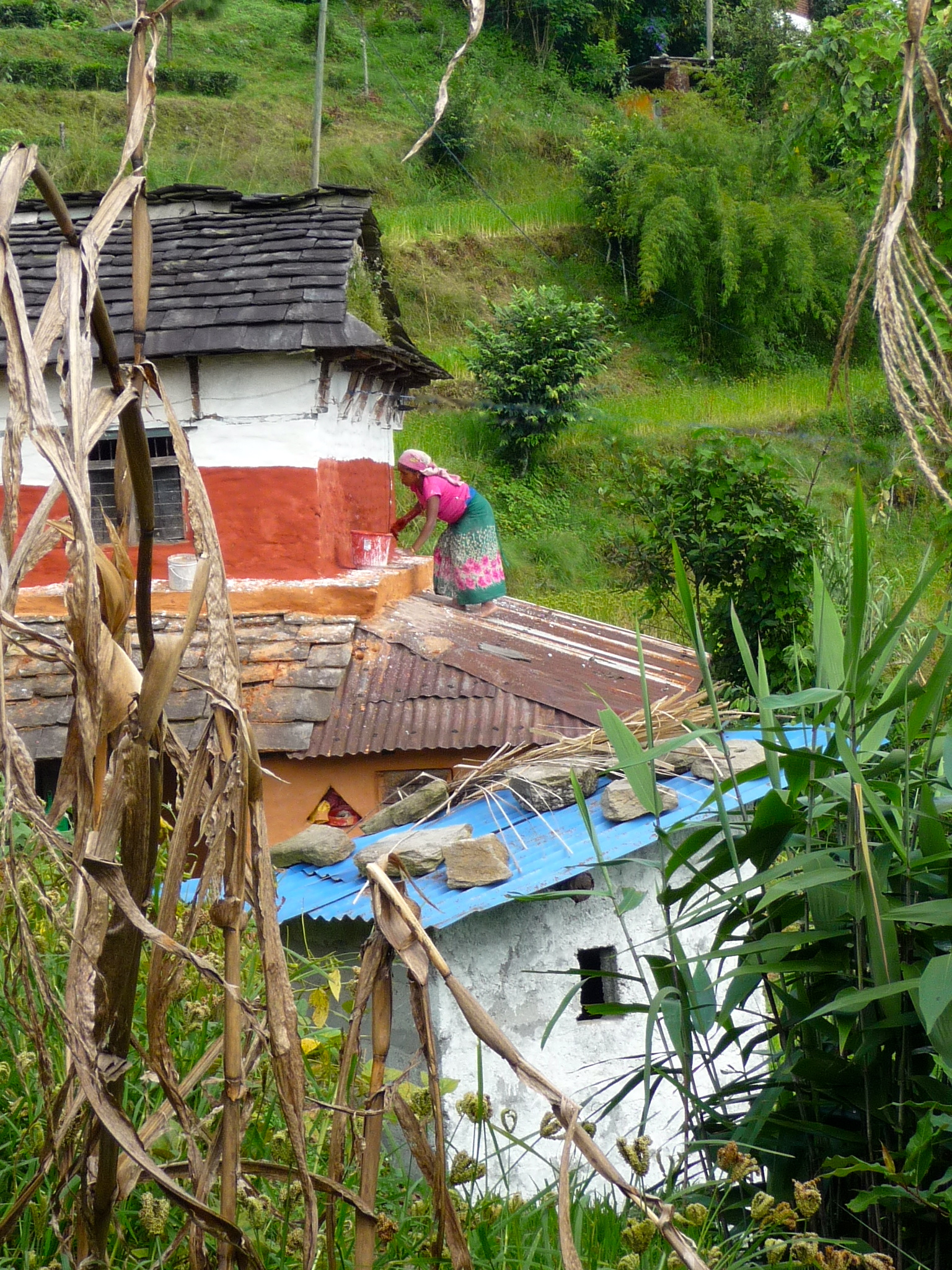
The village looked like a party.  The jaunty line where the orange and white paint meet seemed to be winding from house to house in the sunlight, leaving its fresh mark on one cheerful home after another.  Women splattered in paint and mud were scattered over rooftops and sticking out of the grass behind their houses, painting away.

OLYMPUS DIGITAL CAMERAOur house is shaped kind of like a house on a house.  There is the roof over the first floor, and then the attic built on top of that, and then a triangular roof on top of the attic.  I came outside to find Bishnu and Aamaa standing on the highest roof, painting the uppermost part of the house.

As I stood there planning my next move, Mahendra came over carrying a severed goat head and smeared blood over our door.  His family was roasting the body in their yard on the terrace behind and above our house, in preparation for today’s big meat-eating celebration.

I climbed up to the lower roof, where I go frequently to lay out laundry in the sun, and after a while I got bored waiting for Aamaa and Bishnu to give me something to do.  So I did what you would do if you were standing on a middle roof with nothing to do: I made to climb up a level to the upper roof.

Aamaa immediately had a fit about how I was going to fall and kill myself.  “You can’t, you can’t do it!” she cried, as if she didn’t know by now that the fastest way to get me to do something I’m unqualified for is exactly like that.  And Bishnu expressed her disdain in characteristic fashion by smirking and standing in that unsympathetic posture that says, “What are you going to do, American?”

This attracted the attention of Mahendra’s entire family on the terrace above us, where they had previously been observing the headless roasting goat.  Just as I was realizing that climbing on to the upper roof really wasn’t that easy, I also took some pleasure in being more interesting than a headless roasting goat.  I calculated that climbing up on to a roof wouldn’t be all that difficult if a) I hadn’t been wearing a lungi and b) I had full confidence in the stability of the upper shingles.

So there I was.  Ironically, the only one trying to help me was Baa!, Mahendra’s father, who as a general rule seems more ambivalent than anyone of my right to show up like this, to explore the poverty he got stuck with like it’s some kind of escapade.  Let’s just say that Baa! has shown a distinct lack of confidence in my ability to be a fast learner.  But from edge of the roasting goat pit, he was, quite generously, making emphatic motions indicating the pulling up of one’s lungi above the knees.

Let’s face it – there really is no way to climb up from a middle roof to a top roof in a lungi except by grabbing on to the shingles over your head and jumping.  You hope for the best and don’t ask yourself what’s really worth risking your life for.

I was up.  The shingles did not fall off the roof, but Aamaa was still yelling “YOU CAN’T!” in a prolonged and energetic babble that apparently couldn’t be cut off simply by being proved incorrect.  I stood to my full height–more than enough to be a chimney for this house–raised my hands up, and tromped around defiantly.  Great view up there.

And that ended the show.  Everybody went back to their business.  Roasting goats; smearing mud.  I, however, still had nothing to do.  So when Bishnu and Aamaa went around to the other side of the house, I decided it was time to go down.  I returned to the spot where I’d come up.

Well, let’s just say that leaping up is one thing.  Leaping down a different matter entirely.

The audience had dispersed.  So it was before the eyes of God alone that I saw myself peering off the edge of one little roof, down to the top of another, reaching one leg down and straining with my toe, which dangled a good foot above the sloped shingles below, at the bottom of which was a nice little drop to the ground.  I looked over my shoulder to make sure nobody was watching.  I tried everything: this leg, that angle, slide on my bum, brace to the left, hike up the goddamn lungi; I looked for another disembarkation spot, an invisible step; I considered the unthinkable—waiting for Bishnu to give me a hand.

With sudden clarity I thought of Katharine Hepburn climbing houses (I’ve been reading her memoir, of course), and wondered if the roof below me could support my weight if I just jumped.  I pictured myself tumbling off the edge below, breaking my leg, and thinking that any small concession would have been a better gamble than loosing every last shred of dignity (and my leg).  I really dwelled on that image – what it would feel like, lying there on the ground in my own pain and stupidity.

I jumped.  I landed softly on the lower roof and walked over to the other side of the house, where Aamaa and Bishnu were still painting, and demanded that they give me a job.

Matters of Poop

P1070066I came home to find Bishnu and Aamaa painting the house in preparation for the festival of Dashain.  Aamaa had a pot in one hand, and in the other, a rag dripping with goop that she was slapping and smearing over the walls.  Next door, Saano didi was doing the same thing – in fact, all over the village this week, women are standing on their roofs, sticking up like chimneys and shouting to each other across the open space.

Now, and this house-painting business is an interesting topic.  Because it’s something I really want to be a part of: the annual re-making of our house, renewing and refreshing the walls that shelter us.   It is both an extremely practical and very beautiful tradition, which we in our brick-and-plaster, carpeted houses are denied.  It a special opportunity to want to share in restoring the house and strengthening it for the coming year.

Unfortunately, the house is made of mud and buffalo shit.

See, I have this problem with shit.  I’ve really made some serious efforts to get over it.  I accepted Didi standing knee deep in a mound of shit and hacking at it with an axe, sending little bits of buffalo turd flying everywhere.  I accepted Aamaa walking into the house with an enormous heap of poop in her hands and cooking it in a vegetable pot in the kitchen and then putting it on Bishnu’s sprained ankle and then putting Bishnu in bed with me.  I’ve accepted that the hands that carry buffalo shit around the house are dark with grit beneath the nails and also cook the food that keeps me alive.  I even carried some shit in a basket hanging on my back and swung it bravely over my head to make it land in a tidy basket-sized pile of fertilizer in the wheat field.

But I cannot put my hands directly and purposefully on shit.  I can’t do it.

I know that the house is made of shit.  I know that I walk around in bare feet in the house made of shit; I eat off a plate on the floor of the house made of shit; I know that the wall that I lean on next to the bed is made of shit.  This is all perfectly okay with me.  But it is not okay with me to sink both hands into a pile of shit, mush it around with water and mud, and smear it against the wall.  I simply cannot touch shit in pure shit form.  It needs to at least be disguised as part of a house.

So instead of helping to paint the house, I took a nap inside, stewing in guilt and regret that could not quite defeat this final barrier in my relationship with shit.  And much later on, when Bishnu and Aamaa had come in for the day, and the ladder to the attic had been put back inside, and the mud and shit mixture was still drying on the rungs and I kept putting my hands in it and then washing them with soap and water, and our various water jugs—used both inside and out, for washing, cooking, and occasionally for giving liquid to the animal family members—had had the soupy brown water washed out of them, but had not been sterilized with hospital antiseptic, and everyone was going about the evening business of sitting around and cooking rice…even then, I still felt bad that I hadn’t helped paint the house.  But I felt worse that I’m afraid to just up and pick up a wad of shit—and worst of all, that I still didn’t want to.

And the conclusion that I came to is that I’m simply never going to want touch shit before I do it.  If I’m going to do it at all, and if I’m going to use my own two hands to renew the house for the new year, I’m just going to have to touch buffalo shit before I’ve decided that it’s okay with me.

P1060818