Midnight Confessions


Last night I arrived in Nepal on a flight from Dubai. It was nearly 11pm by the time I got through immigration and came out of the airport to meet our cousin Laxu. IMG_3894

As the baggage came bouncing on to the conveyer belt, dozens of televisions swirled by.  It was a funny moment, something like hearing my own song on the radio, because in the last ten years I’ve watched televisions appearing in one house after another Kaskikot. Next door at Saano Didi’s house, where Jivan and Madu have been working abroad for a few years now, they now have TWO televisions.  It is the single most reliable status symbol of a household with a family member working abroad, and for some reason it strikes me as funny that people actually bring the televisions back with them, rather than just purchasing TVs in Nepal after they get home.  Like many aspects of this whole system, it’s a thing.  It’s the ritual.

Before I left the airport, I decided should try to get a phone number for the baggage office. The purpose of this project is to look at how traditional death rites are altered when migrant laborers die abroad, which means, first of all, talking with someone who processes bodies that are shipped home to this very airport. Since it’s unclear how I’d explain this on the phone, it seemed like a good idea to get a name and phone number for the baggage office while I was already there.

I started at the baggage desk, where an agent gave me a cell phone number and a name and sent me to the airlines office building, which, oddly enough, was still open at 11pm. Laxu and I left my bags outside with his friend, and then waded through a series of muddled conversations about why we were there: with a police officer, a secretary, other people who had unclear reasons for being in the front hall of the airlines building so late at night. Eventually, we were led in to a narrow back cubicle, where we sat down at an empty desk, across from a clock that read 11:30pm. I had a feeling we’d be there a while, and probably with no result.

We waited.

What happened next was the typical Nepal phenomenon where nothing is happening for a long time, and just when you are certain your plan hasn’t worked, something appears out of nowhere.

The something was an airlines agent who did not want to be identified, but was very eager to talk to us about what it is like for him to receive and process bodies from abroad. He listed all the documents that come with bodies when they are shipped home, and the procedures for releasing them. He said it is “terrible scene” to deal with the families. He kept repeating “terrible scene.” As the clock ticked on, I was increasingly aware of the late hour and the hush outside the airport as everyone who’d been on my flight departed.

The agent was especially intent on explaining the travesty of the labor system to me. Every time I directed our conversation back to the baggage procedures that in this dreadful and bizarre situation have essentially usurped sacred death rituals, the agent would find his way back to condemning the exploitative labor trade.

I noticed that he insisted that the families he sees coming to retrieve their loved ones are “very poor,” “low caste,” and “uneducated.” I know this not to be true; almost every household in Kaskikot, like in so much of rural Nepal, has a young male family member abroad, and almost all of them, while poor, are educated (and high caste, while we’re at it). It’s the country that, in a global context, is colossally poor.

I wondered about this trenchant misconception later. It’s easy, after all, to deplore a system that preys on wholly ignorant people. But my impression is the vast majority of Nepali laborers, while disenfranchised, are nevertheless aware of the general inequity of the migrant labor system. Like Mandira, they make the bargain with their eyes open, usually multiple times. It’s too simplistic to assume that half a million people per year are too naive to realize what a high price they are paying, and doing so avoids the more complex question: Why is it worth it? What is in it for these youth and their families?  Hundreds of thousands of them?

By the end of my interview in the airlines office, it was after midnight, and a crowd of employees—inexplicably still at work—had crowded in to the office to listen. Our topic had obviously struck a cord. I turned off my recorder. Laxu and I dispersed in to the eerie, deserted airport parking lot, and caught a cab home.

And so it starts.

.      .      .

Kathmandu Airport

Kathmandu Airport, Home from Dubai

Dubai

IMG_4085My layover in Dubai was eight hours.  Long enough to trek back and forth many times along the glaring fluorescent strip of duty free shops betwen terminals one and two.  It was daytime in Dubai, but for me it was the no-time that happens during a trip from one hemisphere to another.

I wandered in to one of the bathrooms and soon found myself looking for an earring that had dropped.  A young employee who’d been sitting idly when I walked in came over to help me.  As I was shuffling through my belongings she noticed a coin.

“This is from Nepal,” she said.  “Have you been?”

Yes, I said, I’d been.  We got to talking in Nepali right away.  I wasn’t surprised to find out
that Mandira is 26 years old with a 1-year old baby she left in Nepal with her in-laws and her husband, who is also waiting for a visa to travel abroad.  When I asked what she’d paid a manpower company to broker her position in the Dubai Airport bathroom, I already knew roughly what the answer would be: about 10,000 dinars.  Her salary: 900 dinars per month.  It would take her a year to pay off her loan to the company before she started earning anything to send back to her family. It will be a few more years more before she can afford the 3.5 hour flight home to see her then four-year-old child.

It’s a typical story but it’s still amazing to see it in action without having to try. This kind of position has become so preferable to looking for local employment in Nepal that I don’t even have to leave the duty free section of the airport to find Mandira.

The flight from Dubai to Kathmandu is a special kind of cultural experience.  You step out of a hip multinational terminal in to a waiting area where almost everybody who isn’t a white person wearing hiking boots and tie-dye is a Nepali person returning home from a labor contract.  For many it is the second flight of their entire lives.  A large percentage of passengers have none of the practiced movement that comes with routine air travel.  There’s a lot of helping each other find seats, opening and closing latches to see what they do, gazing out the window at baggage trucks, calling to one another across the rows to look at this or that.  It’s about as close as you can get to walking out of an airport and getting on a city bus in Kathmandu that launches in to the air.

On the plane I immediately leaned against the window and tried to sleep.  I’d been traveling for 20 hours.  The young man next to me was quiet and stared straight ahead, and I assumed that he, too, was an amateur passenger just surviving the journey.  After an hour of half-sleeping, I sat up, and as I jostled my position, we exchanged a few words.

“My father just died,” he said.

I drew in my breath.  “I’m so sorry,” I said.

“I came straight from duty.  I don’t have a bag with me or anything.  I came straight to the airport and bought a ticket.”

“What happened?” I asked.

“He was in the U.K.  I work at a hotel in Dubai.  My family just got back to Nepal with his body.  After we land I have to take a 10 hour bus ride home, because they are waiting for me to start the rites.”  He stared ahead. “I usually talk to him quite often, but we hadn’t talked in about three days.  I don’t know why.”

The snack cart came along.

“Can I get you something?” he asked.  I declined, but he asked a few more times, and I declined again.  He bought a sandwich for himself. He asked the boy in the aisle seat – who didn’t look any older than 18 – what he wanted.

“Many of the new ones are scared,” he explained softly.  “So we help them out.”  He bought the boy a cup of tea.  “Are you sure you don’t want anything?”

“I’m really okay,” I said.

He opened and closed his sandwich.  “I’m not supposed to be eating this food,” he said.  “We have traditions – it’s called kriya.

I know about this of course.  It’s not just the sandwich.  The death of this young man’s father should have immediately been followed by 13 days of eating food cooked as part of a series of rituals, without salt, and by wearing only white clothes with no seams, and by sleeping on the ground, and by drinking special water, and by not touching any other people, and by daily pujas and bathing. He should have shaved his head.  But he was crammed next to me on a floating bus.

He took a bite of the sandwich.  “I haven’t had anything to eat or drink since yesterday,” he said.  “Actually, I haven’t talked to anyone.  Now I’m talking to you.”

“I can’t imagine how hard it must be in this strange situation,” I offered.  “It will be good to be in the right place with your family where you can do…all the things.”

“Are you sure you don’t want any of this sandwich?”

“I’m sure.  Thank you.”

“I usually talk to him often.  I don’t know why we hadn’t talked the last few days,” he repeated.

He gazed over the sandwich again to the back of the next seat.  “There’s no point in being sad now.”  He ate a chip.  “I can’t think of what to do.”  He offered me more of the sandwich.

I asked after the details of how he’d get from the airport to a friend’s house to the bus to his house.  It seemed like the only relevant thing to discuss.  Everything else was either too small or too big.

“So you will be with your mother and siblings by morning,” I said. I told myself that things would make more sense then. I wanted to believe that it would be better when he knew what to do.

“Yes.”  He gave the rest of his sandwich to the trash pick-up.  “But when I get there, you know…it will be real.”


Between Worlds

Read this series here.

IMG_2479Over the years, I have witnessed many passages in Nepal.  Marriages, coming of age ceremonies, births of animals and people, and deaths of many kinds. The weather itself has a careless drama about it, demanding reverence for the seasons and relentless passage of time…when it is hot, it’s time to plant millet; when there is a full moon, it’s time to fast; when a distant glacier becomes heavy, it’s time for it to break apart, time for the river it lands in to overflow in a torrent, time for an entire village to be swept away.  When it is morning, it’s time to get up and cook breakfast.

The intimate relationship between people and cycles in this part of the world is one of its most moving qualities.  I think it is a hard thing to see if you have always been inside it. But I am outside of it.  And peering in, I am endlessly preoccupied with how a single human existence can be subtly accepted as a grand and meaningless expression of a larger constellation of forces and relations and nature, awesome because it is small, not because it is unique.  I only notice this because I learned to see myself as separate from the moment I came in to the world.  In the West we gain power, intelligence and purpose from our individuality.  But it’s something I can’t explain to Aamaa.  There simply isn’t a vocabulary to say that my life possesses a greater idea than the idea of the universe itself.

I know I’ll never be comfortable with this fact.  Instead, I am perpetually drawn to these rites of passage, which integrate our small lives with those of our ancestors, with the cosmos, with God and with the future.  Perhaps it’s like continually trickling cool water into a wound that will always burn.

This winter I’ve decided to start a project that has been some time in the making. Since I first began coming to Nepal in 2002, young men have flooded out of the country for migrant labor in gulf countries; last year, over 300,000 people left for that purpose alone.  A surprisingly large number of these young men die abroad, and when they do, normal mourning rituals are turned completely upside-down.  Many of the essential features of customary mourning become impossible.  My project will document the way that families have adapted ritual grieving when their sons die overseas.

Nepal’s funerary customs in the weeks that immediately follow a death are called kriya.  There is great intelligence and beauty in these rituals, which provide a structured role for the community and extended family in sharing grief, reaffirming ties, and placing the life and death of the deceased in to a coherent cosmic story.  Many aspects of kriya are austere and demanding, putting physical and mental purification above comfort, and imposing isolation as a sanctuary for the emptiness that follows loss.  When the kriya period ends, other rituals last weeks, years, and in some cases, forever.  Aamaa, a widow since age 23, hasn’t worn red in 35 years.  Anyone who meets her can immediately know without a word that she is widowed – if they are attuned to this custom.

Stories of grief and loss in other places have immense importance for us. Ritual grieving in American culture is increasingly short-lived and mainly the private domain of the bereaved.  Death as a matter of politics or policy or violence is in our media every day.  But mourning, the outward expressions by which we integrate death in to the un-ended lives of the living, seems to be on the periphery of our inquiry, at best.  In some ways, mourning is treated as an obstacle to our collective concern with affirming and carrying out our individual significance.

But mourning is a choice we make to ascribe meaning to our grief. It is a willful sanctification of our mortality.  We hope for the grace to extract from this some kind of redemption, something beautiful about life.  Or perhaps simply the courage to keep living.

In the course of this series, I hope to honor the beauty of Nepal’s kriya traditions, as well as a generation of young people caught in the ambiguous place between a world that has shattered and one that does not yet exist—at the threshold, in that empty uncertainty, where we are reinvented.

.    .    .

IMG_0640


Read this series here.

Magical Thinking

Tuesday morning, we’d only been up for a short time when Bhinaju told me that just around the corner, Shaula dai had gone in to the bathroom this morning, given a shout, and was immobile.  At first, from the way Bhinaju described it, I thought Shaula dai had somehow just stopped speaking.  But then Bhinaju went over to see what was going on, and when he came back, it was pretty clear that Shaula dai was dead.

At first I wasn’t going to do anything.  But as I finished packing for our three days in Pokhara I realized that made no sense.  To be honest, I still wasn’t sure who Shaula dai was, because I call almost all the men of a certain age simply “dai,” or “brother.”  Bhinaju had said, “The one in Deurali, with no teeth,” which could have been a lot of people, and I was sorting through them all in my mind.

It wasn’t till Bhinaju and I were walking over and we turned onto the small path that goes around Gita bouju’s house that I realized Shaula dai was Kopila and Kalpana’s father.  I chatted with him the other day while he and his wife were tilling corn.

At their house, a lot of people were crowded around the yard and in the dirt road in front of it.  Bhinaju and I made our way up to the porch, where Shaula dai had already been covered in a white piece of cloth.  I noticed a curtain was missing from in front of the house door, and for a minute I was fixated on this, the image of someone taking down the white curtain at the front door to cover Shaula dai’s body on the porch, leaving just one flowered white curtain at the entrance to the house.

Would they replace it?

At first, Ujali bouju – Shaula dai’s wife – looked bizarrely nonplussed, standing on the porch, calling out to various people in the crowd.  While she was off to the side, I asked Bhinaju if we could see Shaula dai’s face, and unfortunately just then Ujali bouju came to sit by her husband’s head, her obligation until the arrival of a son.  Before I could stop him, Bhinaju asked Ujali to pull back the sheet.  She did it gingerly, and suddenly her shock and terror were visible in the way she handled that gesture, as if the sheet was on fire.  As she tucked it back under his head our eyes locked for a long, confused moment.

I didn’t know if it was wrong to look her in the eye like that.

As we stood around, phone calls were made.  Shiva dai came over and Ujali bouju said not to call any of the kids who are living in Japan.  Especially not the girls – there was no way for Kopila and Kalpana to get here in time for the funeral rites.  So they were absolutely not to be called.  In the way that multiple experiences can suddenly collide and line up in an instant, I recognized Joan Didion’s The Year of Magical Thinking, which I read recently and have been thinking about a lot.  As if it made sense not to call the daughters, who should not know their father was dead if there was no way to get home for the funeral rites.  As if he could stay alive for them, as long as they didn’t know.

Last night, we had a guest in our house.  He had wanted to sleep in his own bed sheets, and had arrived with a white sleeping bag liner that was light and suited to the warm weather.  He fit right inside of the white liner and lay down on his back, with his legs straight together and hands folded on his chest, and put a pale shawl over the liner, and became perfectly still.  Bhinaju and I were sitting on the other bed and he leaned over to me and whispered – Laura – our guest looks exactly the way a dressed body looks – and we both shuddered and couldn’t look at the sleeping figure on the other bed after that.

Now, the next morning, there was Shaula dai before our eyes in exactly same posture. Bhinaju leaned over to me and whispered – Laura – our guest just last night – and we both shuddered again.  And I realized that Ujali bouju, sitting by Shaula dai’s head, had not even changed out of her red sari, and it was jarring to see the red sari next to the white curtain covering Shaula dai, because white, the color of purity, is the color of death, and the celebratory color red is forbidden to widows.  In that moment, I saw Ujali bouju arrested in a transformed world, sitting in her red sari beside the still white covering.  Soon, somebody was going tell her it was time to change, and like Aamaa, she would never wear a red sari again.

.     .     .

P1030466

Playing in the Band

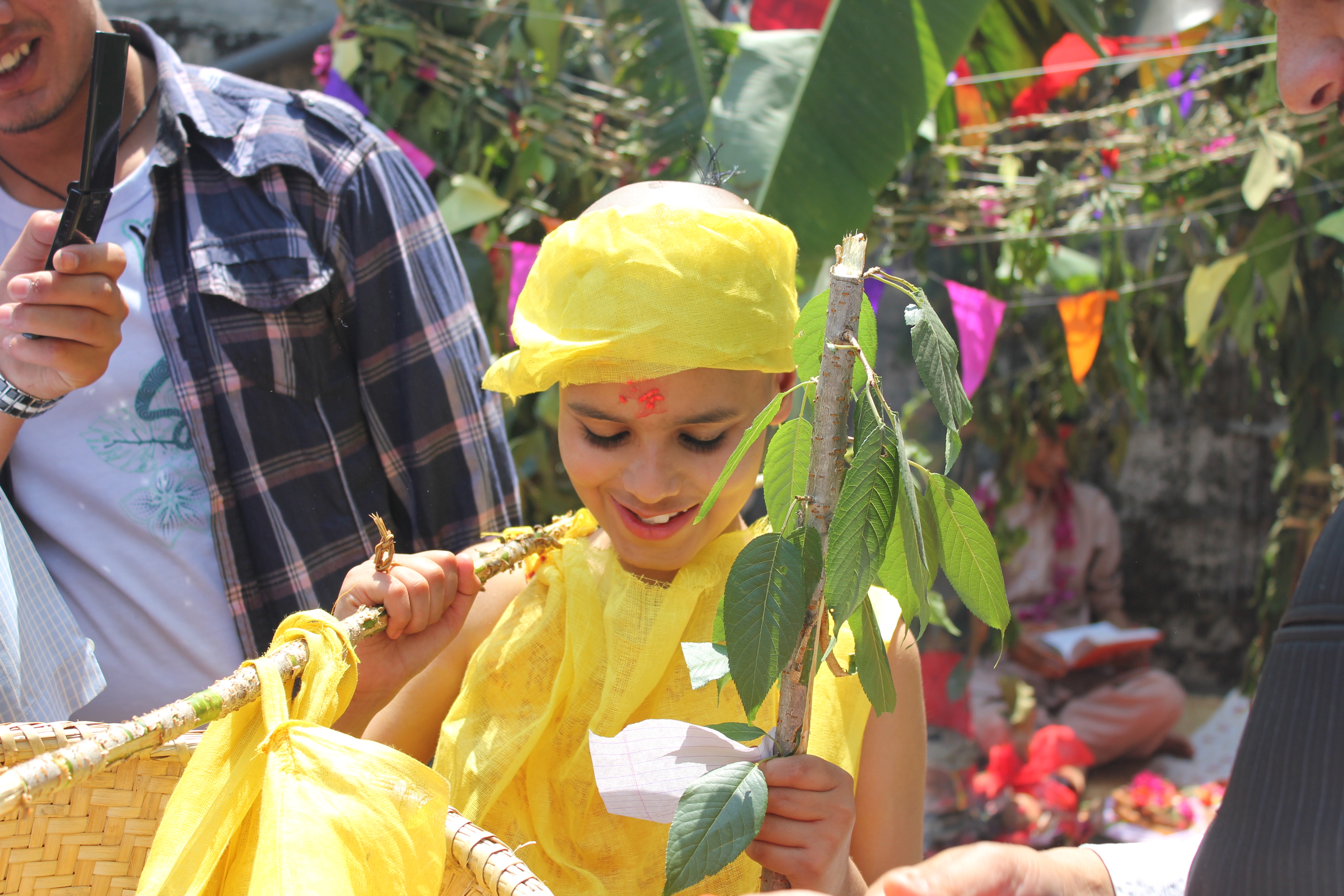
Yesterday, the boy who lives next door to Govinda dai’s house had his bartan, which is kind of like a Hindu Bar Mitzvah (except different).  In the evening, there was a bajan, drums and cymbols and chanting that create the most gorgeous and hypnotic devotional music you’ve ever heard.  So after dinner, around 9pm, Kaushik and I went over to listen.  I was actually tired and didn’t feel like heading out, but I knew that Govinda would be playing in the bajan and I didn’t want to let him down.

As we walked up the road, Govinda’s kids Sulo and Sudir came running towards us, and the sound of music followed soon after – driving, jubilant.  We turned in to the yard, which had been covered by a tarp.  Two men, one of them with a huge belly, were twirling with their hands in the air, amid a crowd of adults wrapped in shawls and children up past their bed time sitting on the ground.  The sparkle and joy of it washed over us and my heart lifted.

I sat near the bajan for a while with my recorder.  Govinda was on the symbols.  I have been coveting a recording of this wonderful music with its surrender and elation and praise all wrapped together.  Of course, Kaushik and I were both invited to dance.  But a lot of the time I was just listening, the night time around us, Sulo leaning on my bent shins and my arm across her chest, like Bishnu and I used to sit.

During a break, Govinda left his cymbols lying on the ground next to me.  I picked them up and started tinkering.  I tried to be discreet but in order to really play devotional cymbols, you just have to go for it; they don’t have a volume control and the physical movement of the hands only works out rhythmically if you play without restraint.

So soon I was just playing the cymbols while people chatted and rested around me.  But the sound started attracting attention, and them some smiles, and then a woman who’d joined the bajan picked up her cymbols too and matched my chime.  So the drummer started, and the next thing I knew, I was playing in the bajan.  I was a part of it.  The other pieces came up around me like a garden, and until I had to hand the little chimes back over a minute later, the music was coming right from me.


IMG_1576

An Eclipse For Small People

P1010918My first solar eclipse was in sixth grade.  Our science teacher, Max – I went to a progressive school where we called our teachers by their first names, so I actually had a real science teacher named Max – took us outside and we sat in the grass, next to a blacktop, near the soccer fields.  In groups, we held something up in the air and peered through it, a notecard with a hole in it, or something like that.  I don’t recall exactly.  The entire memory is just an image of us, kids, sitting by the blacktop, holding a thing up in the air and squinting.  I found it rather tedious.

My second solar eclipse fell on the festival of Maghe Sakranti.  Before the solar eclipse, there had been a number of times when Maghe Sakranti had coincided with the day of my departure from Nepal, so over time, during visits when I found myself still there for this festival, Maghe Sakranti and its associated rituals had taken on a special flavor of celebration.  We were still together.

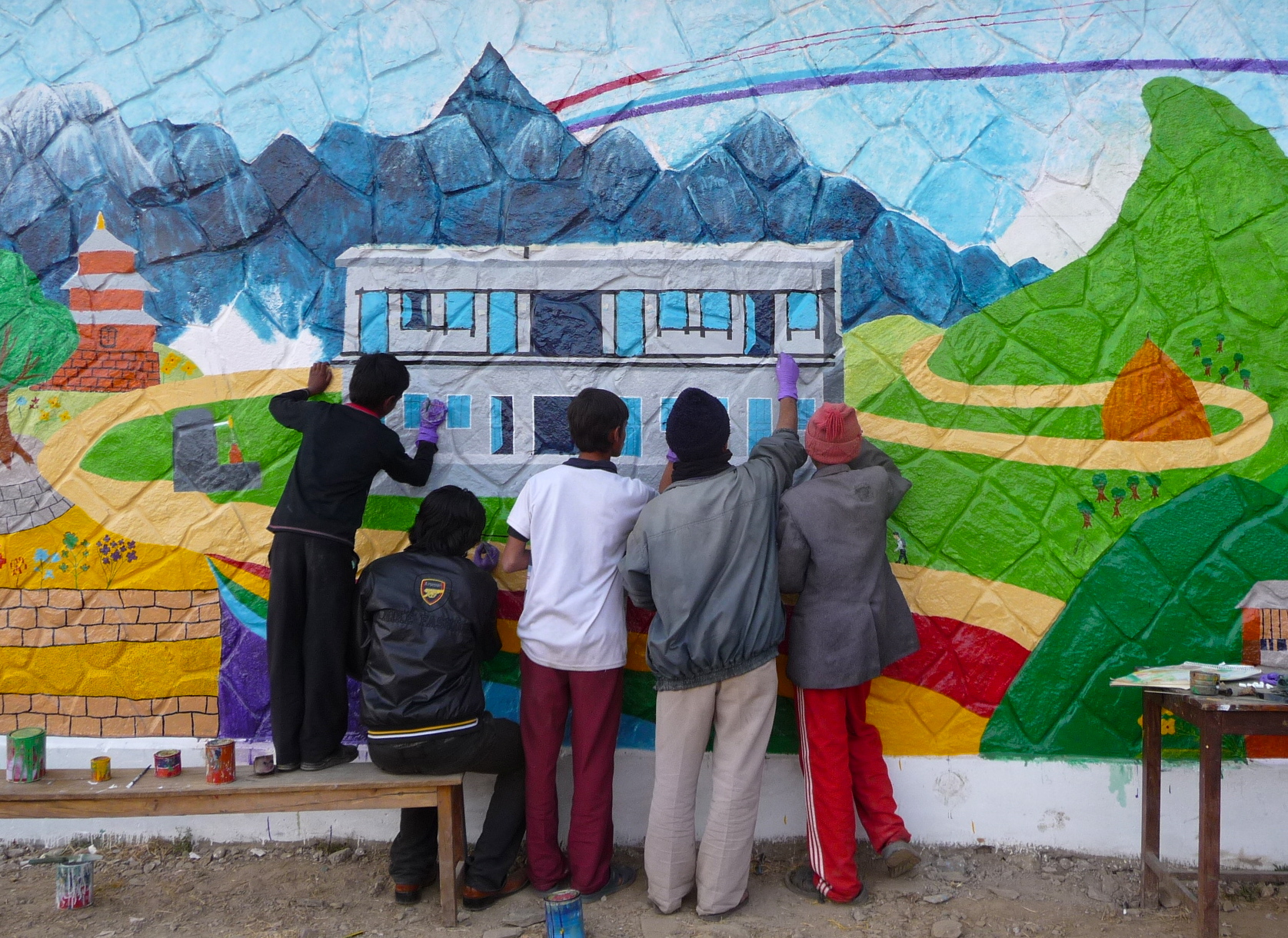
In the days leading up to the eclipse, I was at school from early in the morning right up until dusk, painting. Govinda and the kids and I were rushing to finish a mural before yet another departure.  It was a picture of their community: haystacks and houses, the whipped-cream shaped Kalika Hill with its little temple at the top, a paraglider sailing overhead, and road winding around from one place to the next, with a dominating school at the center.

P1010876 - Version 2

As the day of the eclipse approached, there was a great deal of anticipation.  Everyone was talking about it.  Once, Aamaa said, she’d been out during a solar eclipse and, just like that, it had turned to night.  They’d been forced to wait for a few hours until it got light again so they could go home.

Now that was something I wanted to see.

I went to visit Thakur sir, the astrologer, to get his opinion on a gift.  Back home, a great healer and teacher of mine was losing her eyesight.  I had purchased a necklace with the symbol kali chakra on it, and I wanted to ask about taking it up to the temple to be blessed, or infused, or something of that sort.  I wasn’t exactly sure, but I thought Thakur sir would know what I meant to ask.  A solar eclipse, he said, would be a very auspicious day to bless a necklace, even though it wasn’t allowed to do a puja during the hours of the eclipse itself.  And, once the necklace was up there at the temple, at the top of the Kalika hill, I couldn’t take it away until the eclipse was over.

The movement of necklaces was one of many things couldn’t happen during the eclipse.  Everyone would fast, of course, from exactly 12:36pm to 3:30pm, and many people would fast the whole day.  Any water in the house would have to be poured out after it was over, and replaced with fresh water from the tap.  It is wood cutting season, and trips to the forest were put on hold for the day.  And Maghe Sakranti was, for all intents and purposes, cancelled.

In the U.S., a solar eclipse is, for the majority of busy people, a science project for kids.  But here, where astrological charts are consulted for even the opening of businesses and choosing of brides, everything seemed to slow down as the days spiraled towards a grand and humbling halt.  Gazing at the top of the Kalika hill against the sky, I could feel the world catapulting through the solar system to a particular magical position—a great thing getting closer and closer to us, small people, standing where we would witness the movements of the galaxy.

By the prior night, there were three buses waiting to take people all the way to Chitwan in the morning so they could bathe at the place where the Trishuli, Gandaki and Kali rivers meet.  First thing in the morning, Aamaa repainted the floors with a fresh layer of mud.  It would be a day filled with ritual.

Like the rest of the world, I had hoped to stay put for the solar eclipse…but the mural wasn’t finished.  We had painted and painted that week, trying to finish in time, but when we pounded the lids in to the tops of the metal paint canisters the night before what should have been Maghe Sakranti, our creation still wasn’t complete.  So I departed for school early in the morning, swearing to Aamaa I’d be back by noon so that I could eat before the fast.

I met Govinda in the road with the necklace in my pocket.  When I’d taken it out that morning, I’d been surprised to see how mysterious and powerful the kali chakra looked, separated now from the rows of silver and symbols in the glass case at the shop.  When we passed Thakur sir’s house, I put it in his hand and he gave it a long look.  I wasn’t sure if I’d actually end up giving it to my teacher back home. I thought I’d send it up to the temple during the solar eclipse, and then give it away later if it seemed appropriate.  I was afraid it might seem kind of silly, and ridiculously enough, decided I would ask the priest at the temple for an opinion when I went to retrieve it later; after the solar eclipse.

Govinda and I arrived at school to find the kids waiting anxiously, and out came the paint. I had stayed out past the witching hour, painting a mural, many times over my years in Kaskikot.  But there was no thought of that today, not in the quivering air, under the glare of that acute collective focus on the cosmos.  I was incredibly P1010864excited.  It felt huge and magical and a little ominous, and made me think about what it must have been like for ancient cultures that didn’t know the science behind such events.  It must have been incredulous and awful to see the sun – so reliable! – disappear in the middle of the day!

And that’s how we found ourselves rushing to complete our masterpiece before the stroke of noon, small people painting small people, the sun under the brush racing the sun circling in the sky.  “The eclipse is coming!” passers-by admonished us.  What were we doing out?

At 11:15, we decided we were done, and with terrible haste threw remaining paint in to boxes, picked up old gloves, ran and locked the office, forgot something in the office (Unlock the office!  The eclipse is coming!) and, at last, set off running down the road to get home before the eclipse struck us dead in the road.  Kids peeled off at their homes.  As we raced by in the dust, people called to us from their houses: Hurry!  The eclipse is coming!  There had been conjecture that we would see stars.  The entire world was about to evaporate.

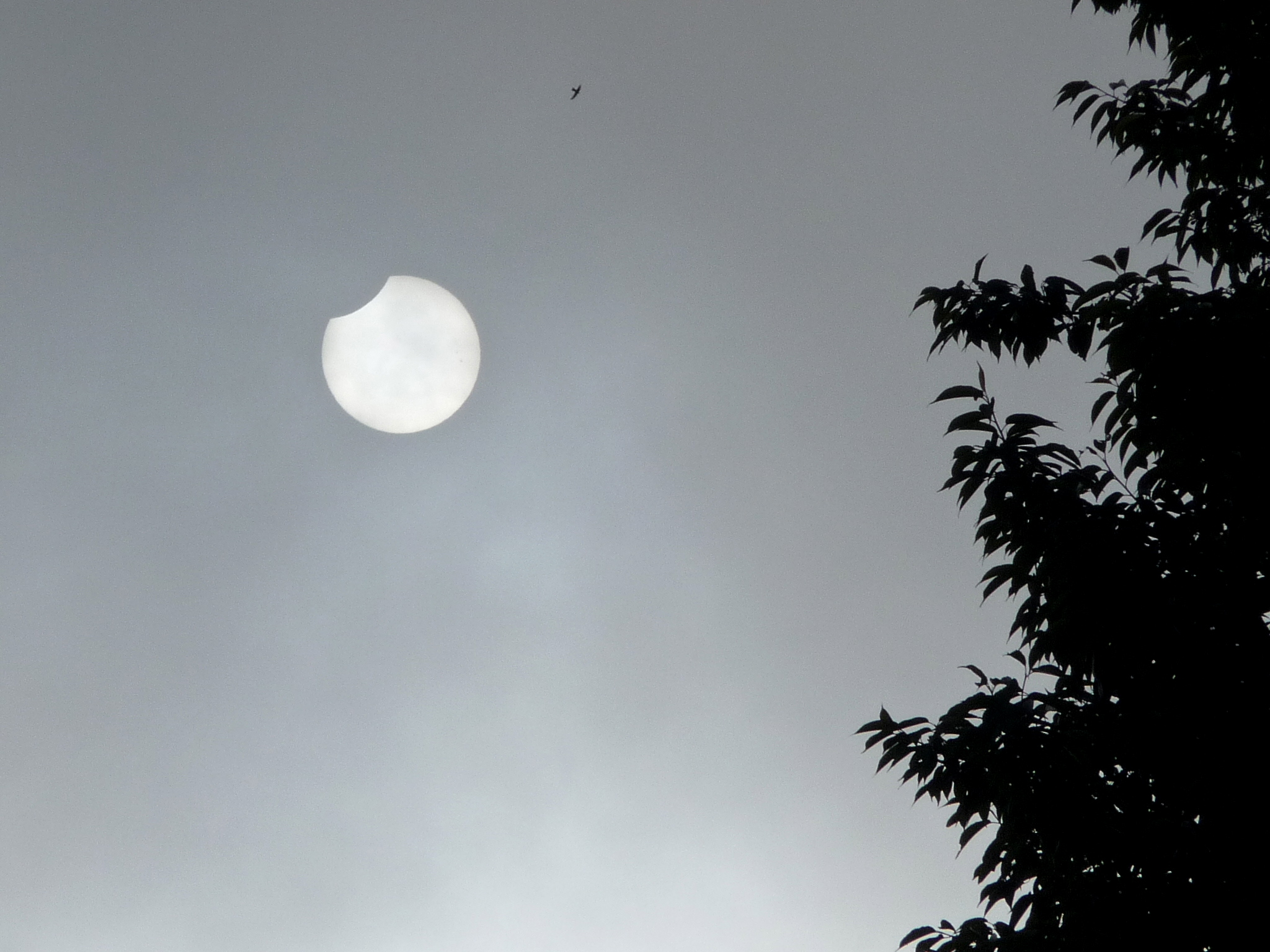
I made it home by noon, in time to eat. One o’clock in the afternoon, twenty-four minutes after the official start of the eclipse, brought a subtle change in the quality of the light.

Bhinaju and Bishnu and I decided we would climb up the hill behind the house and watch from the resort.  We set to discussing what we should bring along.  A flashlight?  Poncho?  Extra sweater?  Rubber bands?  Camera?  (Would it be too dark for photos?)  We rummaged around and put some belongings together.  We climbed up to the top of the hill. And there I was, surrounded by a Himalayan panorama during a solar eclipse!  I wondered if I would be permanently altered, perhaps suffused with some kind of wisdom?

We sat in the grass.  We waited.

We stared earnestly at the sun for 30 minutes before admitting that we could see nothing.

We came home and sat on the porch.  It was a devastating disappointment.  I took out my journal.  I became impatient for tea.  As I looked a the water vessels and thought sullenly that we’d have to fetch new water before we could make tea, I considered the idea of “touched” water – that’s the word, chueko, “touched” water, the same word used for the impurity that a menstruating woman imparts to the things she contacts – and it occurred to me that all of these rituals – abstaining from pujas, fasting, dumping touched water – were fundamentally based in a fear of the awesome, not a celebration of it.  Too bad I wouldn’t see anything.  Even Maghe Sakranti had been cancelled.

For some reason, some of Aamaa’s old, beat-up x-rays were lying in a large envelope on the porch.  I have no idea why.  She’d had them taken when she was first sick, eight years ago; one of the slides showed her ribs and abdomen, a faded spine in the background, and another, a ball and socket joint.  Maybe they’d been deposited in this random location during a recent tidying, or while we’d been arranging articles to bring on our failed observation mission an hour earlier.

I was writing when Bhinaju suddenly said, “Laura, come here.”  He was standing in the yard, holding up the ribs and studying them.  I thought he wanted to continue a recent debate we’d had about the number of vertebrae in the spine.

“Why,” I mumbled.  “Vertebrae?”  I was in no mood to be proved wrong.

“Just come here.”  He switched to the ball and socket.

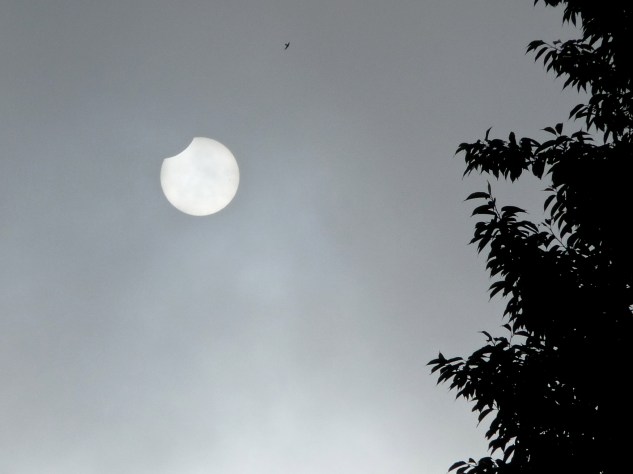
I got up and went to stand beside him.  And right there in Aamaa’s humeral head was a clean outline of the sun with a smooth bite out of the upper left-hand corner.

For the last twenty minutes of the solar eclipse, as the bite of shadow moved eastward and the sun became whole again, Bishnu and Bhinaju and I leaned together, small people, holding the x-ray over our heads and squinting.  We exclaimed and pointed and cried to each other: “The x-ray!  The x-ray!  It was here the entire time!  If we’d had it on the hill, what would we have seen?  What??”

P1020034

Thanksgiving


It’s Thanksgiving, and I had high hopes that the other teachers would participate in my holiday lesson. I arrived at school to find Govinda, Laximi, Guru sir, and Rita Madam already in the office, each at their usual stations. They seemed reasonably enthusiastic as I described Thanksgiving and my plans for class. Encouraged, I sorted out a few last vocabulary words and assigned various roles to everyone else. Even though my lesson wasn’t usually until recess, we decided to start Thanksgiving early because nobody was teaching their regular classes anyway and the kids were all running about.

I walked across the yard and burst into the classroom, declaring joyously that today is an American festival. Govinda and I wrote “Thanksgiving” in big letters in English and Nepali on the board, and below that, “I am grateful for____” in Nepali.  Then I explained the purpose and practice of Thanksgiving: how we gather with family and friends and think about the things we are thankful for in our lives.  I described a turkey, stuffing, and mashed potatoes. I briefly re-enacted the story of the Mayflower and Plymouth Rock, albeit in a simplistic way that swerved around colonization and focused instead on legendry itself.  The usually chattery room of lit faces quieted and watched me closely, with that deliciously infuriating mix of doubt, amusement, and insatiable interest which has driven me to madness a million times over. 

When I finished explaining Thanksgiving in America, I declared that today we would have Thanksgiving in Nepal.  First, I asked, what should we eat?  

I got a lot of blank stares.  

Listen, it’s important that there’s a lot of eating, I insisted. It’s Thanksgiving.

“…Rice?” someone finally ventured.  

“Rice!”  I agreed enthusiastically.  Govinda wrote it on the board.  The answers began to pour in.

“Vegetables!”

“Dal!”

“Roti!”  

“Excellent idea. But what kind of roti?” I asked.

They went for them all. “Fried roti!  Rice roti!  Millet roti!”

Soon the kids were shouting out every food they could think of too fast for Govinda to write them down.  “Rice Pudding!  Noodles!  Curd!”  The bare room clamoring with noise.  For encouragement, I swayed in anticipation of our upcoming feast.

When the menu was complete, and I passed out notecards so everyone could write what they were thankful for.  This took quite a while and, sadly, ended up being the least successful part of our Thanksgiving.  They didn’t understand it.  Maybe being thankful for certain things implies being less grateful for other ones, which upon reflection is something of an indulgence.

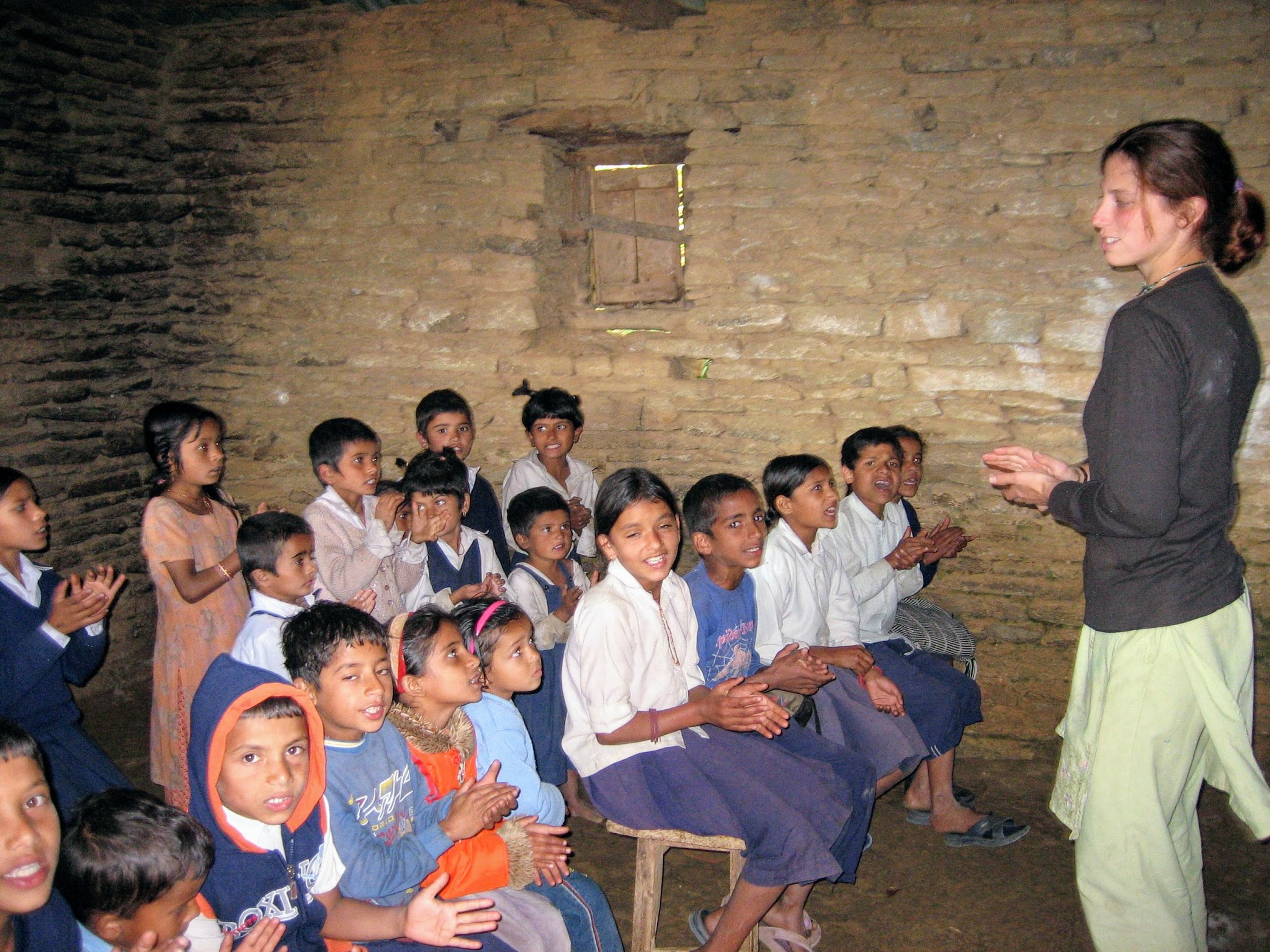
Finally all the kids stood up and we rearranged the benches into a makeshift table with everyone sitting along the sides. I was surprised at how satisfied I felt by the result.  It looked less like class and more like Thanksgiving, all these small bodies crammed in around our long table.  The stone walls became our castle and the dirt floor quieted down to observe with us.

Guru-Sir was in charge of the legend.  I don’t know what it was because he told it in Nepali, but all the kids listened with rapt attention to some story about the history of Nepal and Kaskikot.  Then we gave thanks—and while this was not, as I said, entirely satisfactory, most were thankful that Laura-Miss had come from America, so I forgave them for copying each other.

At last, it was time to eat.  

Leaning forward from my seat on the bench, I reached for an invisible bowl in the center of our improvised table.  I heaped a spoonful of air-rice on to my imaginary plate, piled a few kinds of roti next to it, and started eating.  Everyone blinked at me.

“Aren’t you all going to eat?!” I said through a mouth full of fruit.  “There’s a lot of food here.” I indicated our scribbled list on the blackboard.  

There was a bit more silence while I stuffed myself hopefully.

“THIS IS AN ORANGE!” Krishna shouted. (Krishna is incapable of speaking to me without shouting.)

“Oh!  Give me one!” I cried, cramming it into my face.  Soon I had kids shoving food at me from every direction. I did my best to add each offering to my plate, but the treats were coming at me so fast that I began to slouch, holding my stomach.  I took a bookbag and shoved it under my shirt, eliciting a satisfying explosion of laughter.  Then I couldn’t convince them I was full.  So I tried swaying, then sleeping, and then fainting, but I was still pressed to put some rice pudding in my pocket for later.  I finally had to stand up and say firmly, “Thanksgiving is over!  Go outside and play.”

*Sada Shiva Classroom


Matters of Poop

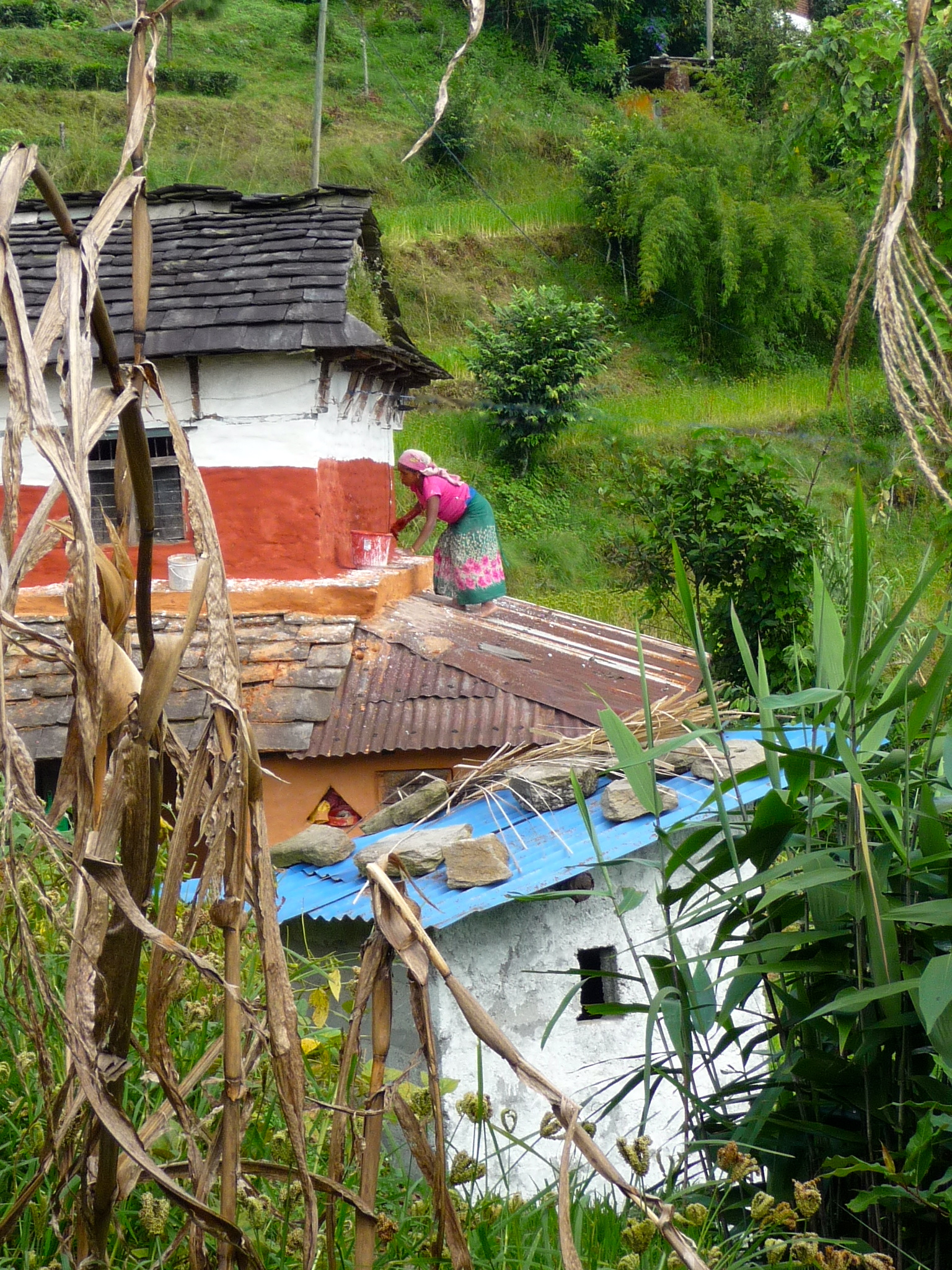
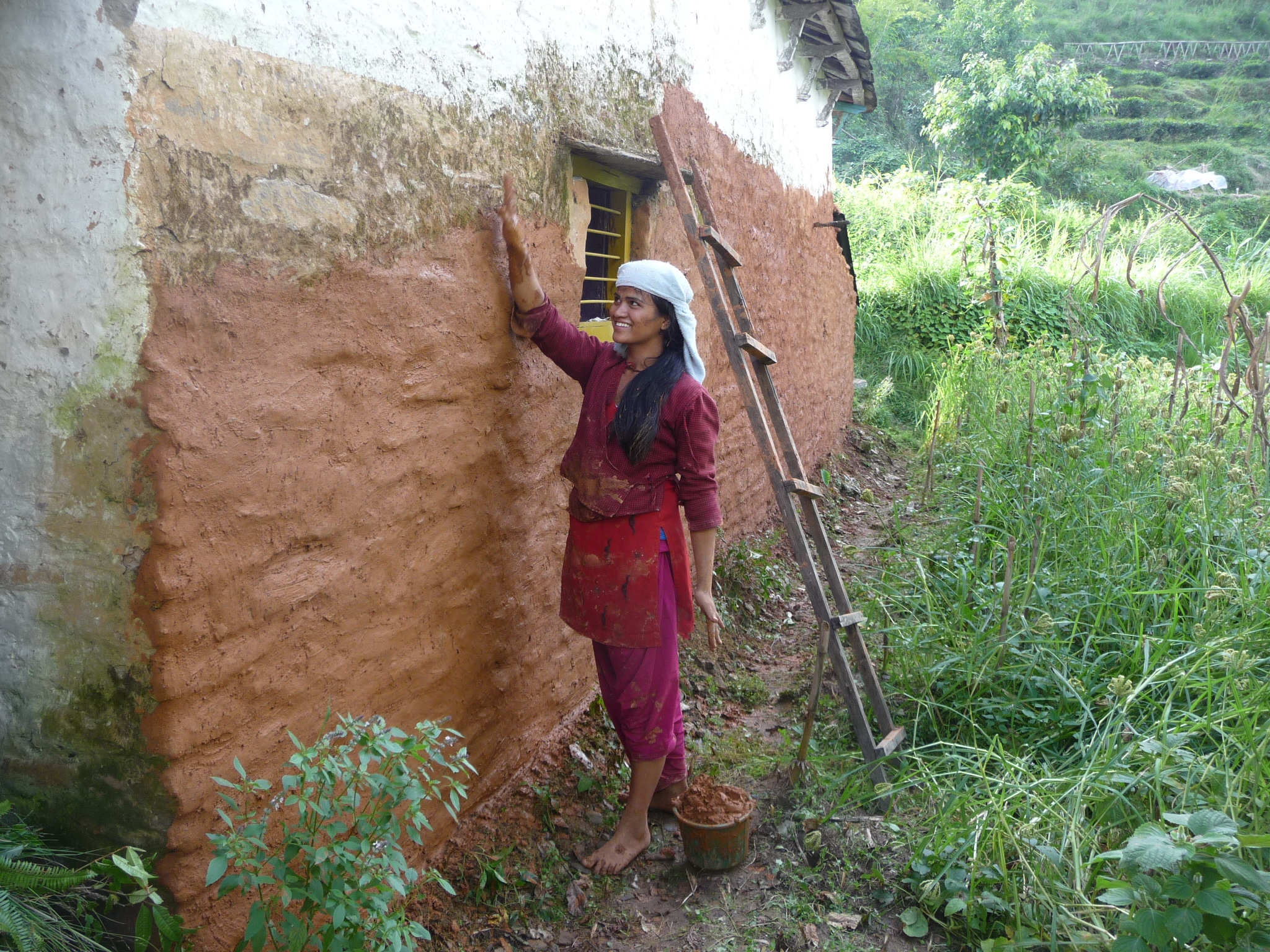
P1070066I came home to find Bishnu and Aamaa painting the house in preparation for the festival of Dashain.  Aamaa had a pot in one hand, and in the other, a rag dripping with goop that she was slapping and smearing over the walls.  Next door, Saano didi was doing the same thing – in fact, all over the village this week, women are standing on their roofs, sticking up like chimneys and shouting to each other across the open space.

Now, and this house-painting business is an interesting topic.  Because it’s something I really want to be a part of: the annual re-making of our house, renewing and refreshing the walls that shelter us.   It is both an extremely practical and very beautiful tradition, which we in our brick-and-plaster, carpeted houses are denied.  It a special opportunity to want to share in restoring the house and strengthening it for the coming year.

Unfortunately, the house is made of mud and buffalo shit.

See, I have this problem with shit.  I’ve really made some serious efforts to get over it.  I accepted Didi standing knee deep in a mound of shit and hacking at it with an axe, sending little bits of buffalo turd flying everywhere.  I accepted Aamaa walking into the house with an enormous heap of poop in her hands and cooking it in a vegetable pot in the kitchen and then putting it on Bishnu’s sprained ankle and then putting Bishnu in bed with me.  I’ve accepted that the hands that carry buffalo shit around the house are dark with grit beneath the nails and also cook the food that keeps me alive.  I even carried some shit in a basket hanging on my back and swung it bravely over my head to make it land in a tidy basket-sized pile of fertilizer in the wheat field.

But I cannot put my hands directly and purposefully on shit.  I can’t do it.

I know that the house is made of shit.  I know that I walk around in bare feet in the house made of shit; I eat off a plate on the floor of the house made of shit; I know that the wall that I lean on next to the bed is made of shit.  This is all perfectly okay with me.  But it is not okay with me to sink both hands into a pile of shit, mush it around with water and mud, and smear it against the wall.  I simply cannot touch shit in pure shit form.  It needs to at least be disguised as part of a house.

So instead of helping to paint the house, I took a nap inside, stewing in guilt and regret that could not quite defeat this final barrier in my relationship with shit.  And much later on, when Bishnu and Aamaa had come in for the day, and the ladder to the attic had been put back inside, and the mud and shit mixture was still drying on the rungs and I kept putting my hands in it and then washing them with soap and water, and our various water jugs—used both inside and out, for washing, cooking, and occasionally for giving liquid to the animal family members—had had the soupy brown water washed out of them, but had not been sterilized with hospital antiseptic, and everyone was going about the evening business of sitting around and cooking rice…even then, I still felt bad that I hadn’t helped paint the house.  But I felt worse that I’m afraid to just up and pick up a wad of shit—and worst of all, that I still didn’t want to.

And the conclusion that I came to is that I’m simply never going to want touch shit before I do it.  If I’m going to do it at all, and if I’m going to use my own two hands to renew the house for the new year, I’m just going to have to touch buffalo shit before I’ve decided that it’s okay with me.

P1060818