Fleeced and Ready


So we’re in the final countdown before 20 of our field staff and 12 dentists, public health specialists, and students arrive here on Monday night.  As I’ve previously explained, we are trying very hard to steel ourselves against the persistent unraveling of planning that seems to occur despite all efforts to the contrary in this neck of the woods.

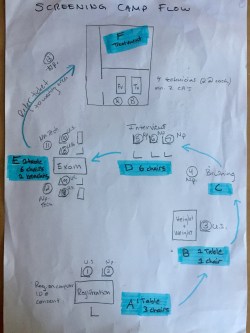
This steeling involves checking and rechecking that hundreds of people will show up in rural locations for dental screenings, and that our own field staff will make it here by Monday night (our best hope that everyone will be on img_0886time for the start of training on Tuesday morning…very crafty).  We’ve combed through a detailed inventory of supplies – mind you, none of us are dentists, yet we are in charge of the 2% Chlorhexidine solution – and we still have to shop for 50 teaspoons (don’t ask, this is my life, it’s real).  We found a training hall and a bus for forty people, and there are currently no political strikes or holidays scheduled.  I reviewed the whole thing with Dr. Sokal on skype and drew a layout of our workflow complete with the number of chairs and tables we need.  We booked nine people on one flight from Kathmandu to Pokhara, and hopefully, the flight will not be cancelled.
So this week it snowed in Connecticut, and with the bad weather, Dr. Discepolo, a pediatric dentist coming from UConn, missed her flight.  Because even Connecticut starts going haywire when Nepal gets involved.  Fortunately, Dr. Discepolo was scheduled to come in a day early, and will be here Monday instead, so we are ALL SET.

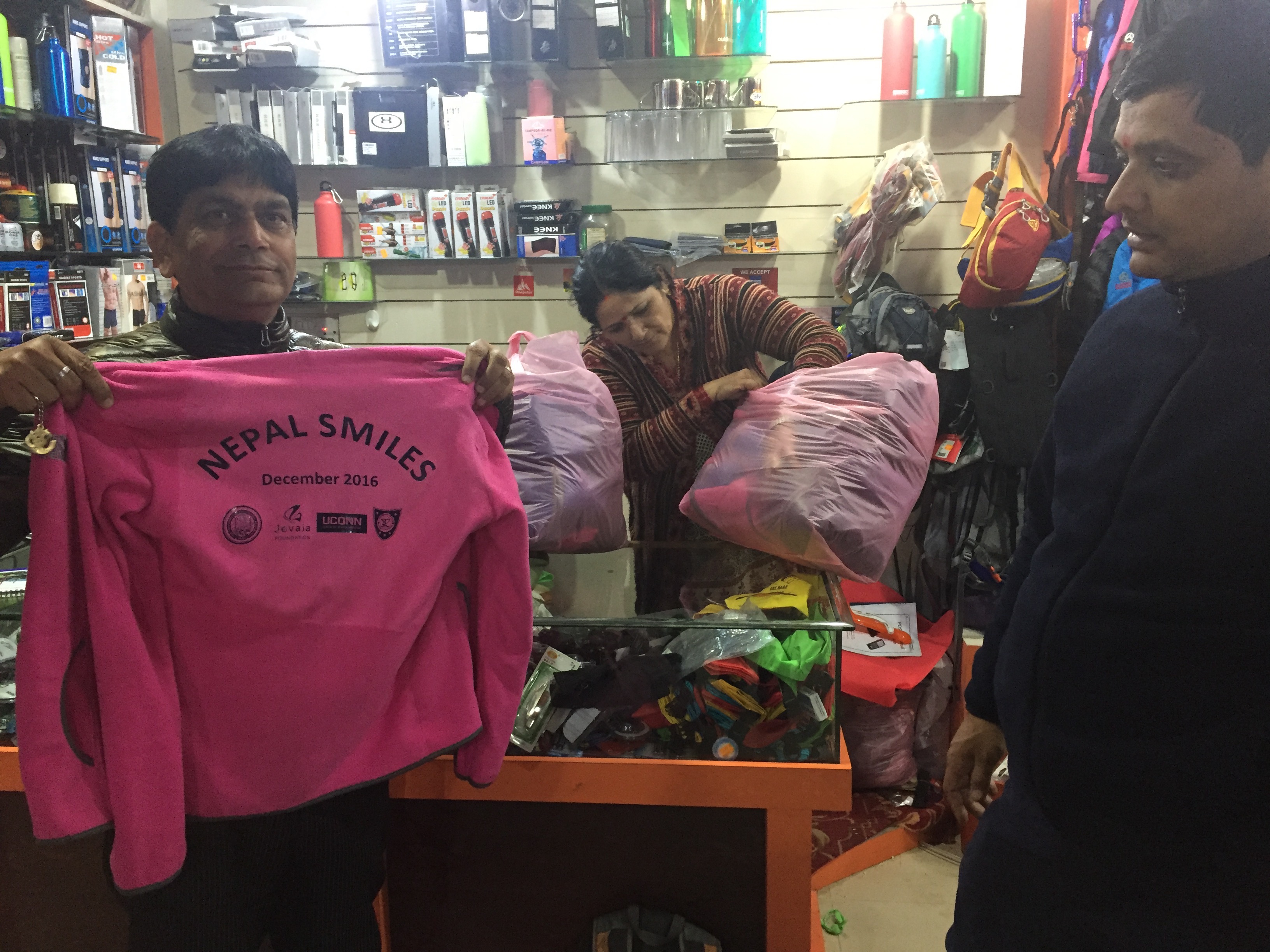
Today while Aamod and Gaurab were in Puranchaur meeting with people in the local health ministry about the upcoming project, and visiting primary schools (again) to make sure they’ll be sending mother/child pairs for screening, Muna and I were at the office fielding other essentials.  Among which was printing jackets for everybody, which we need by tomorrow night.  But after the Nepal Health Research Council and the 10-tab spreadsheet of budgets and reservations?  Jackets – no sweat!

We’d picked out a few samples on friday, and Muna called the printing press this morning to ask if we could send photos to inquire which jackets could be silkscreened.  The printer told us he had to physically see them.  So we went to the shop to get the jackets, and while Muna took a taxi to the printer to show them a puffy vest and a fleece, I commandeered basically everyone in the store to help me take 40 more puffy vests out of little stuffing bags so I could check off sizes on a spreadsheet.  Then we finished that and I tried on option two, the fleece number, so I’d know what sizes of those we’d need if the vests didn’t work.

Muna texted: “They said they can’t print on either type.  I am coming back.”

We put everything away again.

Muna returned.  “They told me, even if someone says they can print on this vest or this fleece, don’t let them.  It will be ruined.”  Ok then.  Back to the drawing board.  We tooled around looking for something else that could be printed on.

The store owner came in.  “I can bring this vest to my Son-in-Law,” he announced. “He has a factory, and I’m sure he can print this.”

“But the other printer said–”

“My  Son-in-Law can do it,” the owner declared.  “Even if we have to stay up all night, we will print your jackets by tomorrow evening.”

We considered.  It was decided that I would go with the store owner to visit the son-in-law’s factory to review the case.  But only after lunch.  The store owner had not eaten since early in the day.

Muna returned to the office to call all 20 of our field staff, again, to remind them when and where to appear tomorrow night, and I took my computer next door to the jacket shop to work on a Welcome Packet during lunch.  (I say it’s Welcome Packet, but in point of fact, I think I just need the list of 40 participants and the screening layout and the schedule where I can see it at all times.  It’s for me, forty times.)  After lunch, the store owner pulled up in a car and took me to his son in law’s factory.  We presented the vest option and the fleece option.  The vest proved unprintable, but the fleece was a definite.  Definitely a definite doable printing job.  I poked my head in to the “factory,” which was, in top Nepali style, basically a living room.

“I will take you to the printing shop to arrange the logos on the computer,” said the Son-in-Law. “We have to wait for my colleague to go ahead on his bicycle.”  Courteously, we waited for the colleague to get a ways ahead on the bicycle, and then we caught up on a motorbike.

We entered the printing shop and presented a sketch of the layout to be arranged for the jacket.

“Yes, I have this pattern,” said the printer.   He pulled up our jacket on his computer.  “This, right?”

Me: “…?”

“The young woman was in here earlier,” he explained.

I texted Muna.  “I’m back at the same printer you took the sample to this morning.”
Muna: “WHAT?  They said they couldn’t do it.”

Me: “…? …I know, right?”

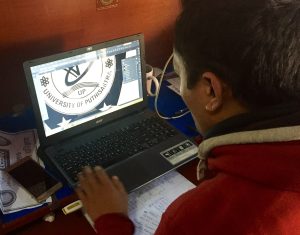
It takes about an hour an a half to arrange the logos, mainly because one of our visiting dentists teaches for a Cambodian University, and their logo has Khmer lettering that won’t come out right.  The printer guy painstakingly recreates each picture of the Khmer lettering in the logo for the Cambodian University.  He arranges all the pieces of the printing for our jacket and prints it out on laminate.  The son in law comes back and gets me and the laminate on his bike.  He deposits me on the main road so I can take a bus back to the store to get the rest of the jackets out while he prints a sample at the “factory.” I seriously have no idea how this day would have turned out if not for the shop owner and his son-in-law, who basically saved our butts.

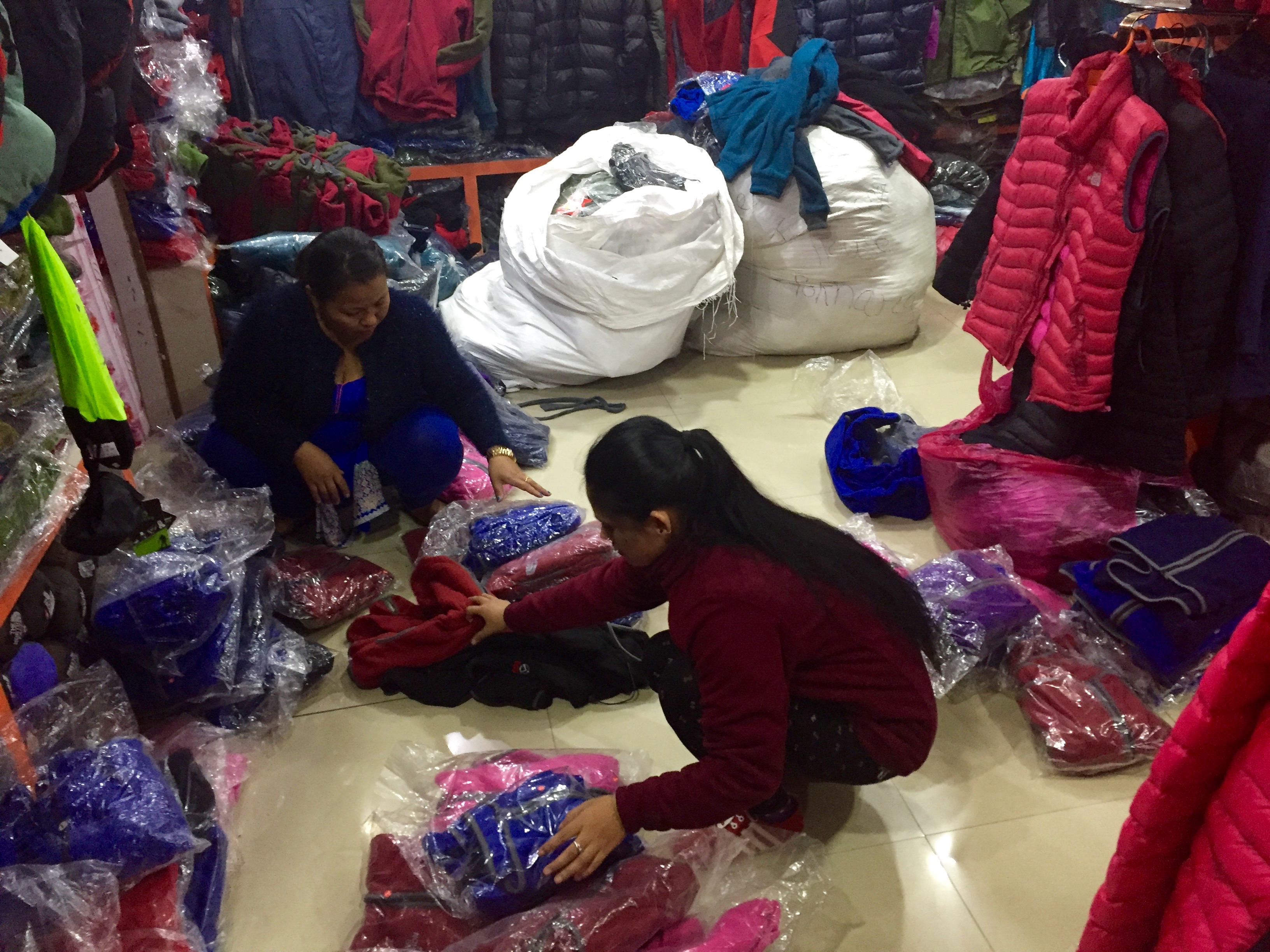
It’s now 4pm.  I take out my spreadsheet again.  The entire staff of the store that Muna and I entered at 11:30am today begins taking out fleece jackets from various unpredictable locations.  Fleece jackets appear from every heap and rack of mountain-wear, and they are sorted in to piles while I read from my spreadsheet, again.  Everyone is concerned that the men are not to wear hot pink fleece jackets, and this must be accounted for.  The floor is is covered in fleece jackets.
img_1046

I leave for an hour and a half to go do an interview with a local paper, and come back at 8pm.  The son in law has brought a sample jacket with him.  The only problem with it is that the whole thing is too high, and the hood falls over the printing.  Also, while putting the print on, they accidentally melted off one of the drawstrings at the hood and pressed it in to the shoulder of the jacket.  This too must be corrected.  They promise not to melt any parts of any of the other 39 jackets, which I send off in 4 oversize plastic bags.

At 8:45pm I head home for dinner.  Among the things I did not do as planned today: write a training schedule; print referral tickets; send an abstract to UCSF.

Why are you so late? Bhinaju asks.

*
img_1047


Meticulous Serendipity

I’m already in the last week of my visit, and as usual things have flown by too fast.  This monsoon has been more spirited than last year’s, blanketing us in torrential downpours every night and through each morning.  Finally this week the weather seems to have calmed down, but I’m missing the cool and comforting feeling of the rain closing us in with its clattering and clanging.

The main focus of our summer has been a new foray into the world of health care advocacy.  We have a model for rural dental medicine, and we want Nepal’s government to fund dental clinics in all of its village Health Posts.  Our idea is that if the government would set a standard at which it will finance rural dental services in the national health care system, then the global development industry will start doing what we’ve doing: training, mentoring, supervising and auditing rural dental technicians so they meet the standard (which we can help define).  As far as I know, we’re the only organization in Nepal working on this particular topic in this way.

IMG_3269

Salyan Dental Clinic at the Salyan Health Post

Like many developing world countries, there’s a complicated and often mutually distrustful relationship between the aid sector and the government of Nepal.  This largely results in aid agencies privatizing their projects as much as possible; I’ve done this myself, because it’s easier to just do something right yourself than manage a hassle of hectic and sometimes exploitative bureaucracy.  Mean time, weak governments spin out more and more self-serving regulations against a flood of foreign funding that is trying to silo itself.  Ultimately, it’s development itself that suffers, as decades-old aid industries, still chasing down base level poverty, make apparent.  So something that excites me about what we’re doing now is that, setting aside dental medicine itself, I see the process we’re in, if it works, as a strong example of effective collaboration between the private sector, which is great at risk-taking, innovation, and raising money, and a developing-world government, which, at least in Nepal, is by far the best option for scale and stability. I like to think this is a version of life where we all do what we’re good at, with respect for the reality that we need everybody if we’re going to think big and get somewhere.

Now then.  Should you choose to work on rights-based health care policy in the developing world, which you might have been considering, here is your primer on how to get started (after refining your particular service of choice for 10 years).

Our advocacy happens at three levels, beginning with the village level, where we’ve been pushing for permanent local government funding.  This is not for the faint of heart and best suited for people with a good sense of humor.  You’d better be down for a ride that’s 90% culture and 10% policy, and heavily focused on navigating relationships, social dynamics, and weather.  The village level is where we’ve focused most in the past, so we’re reasonably adept at this…except that the reality is that institutional services just aren’t very stable at this level.

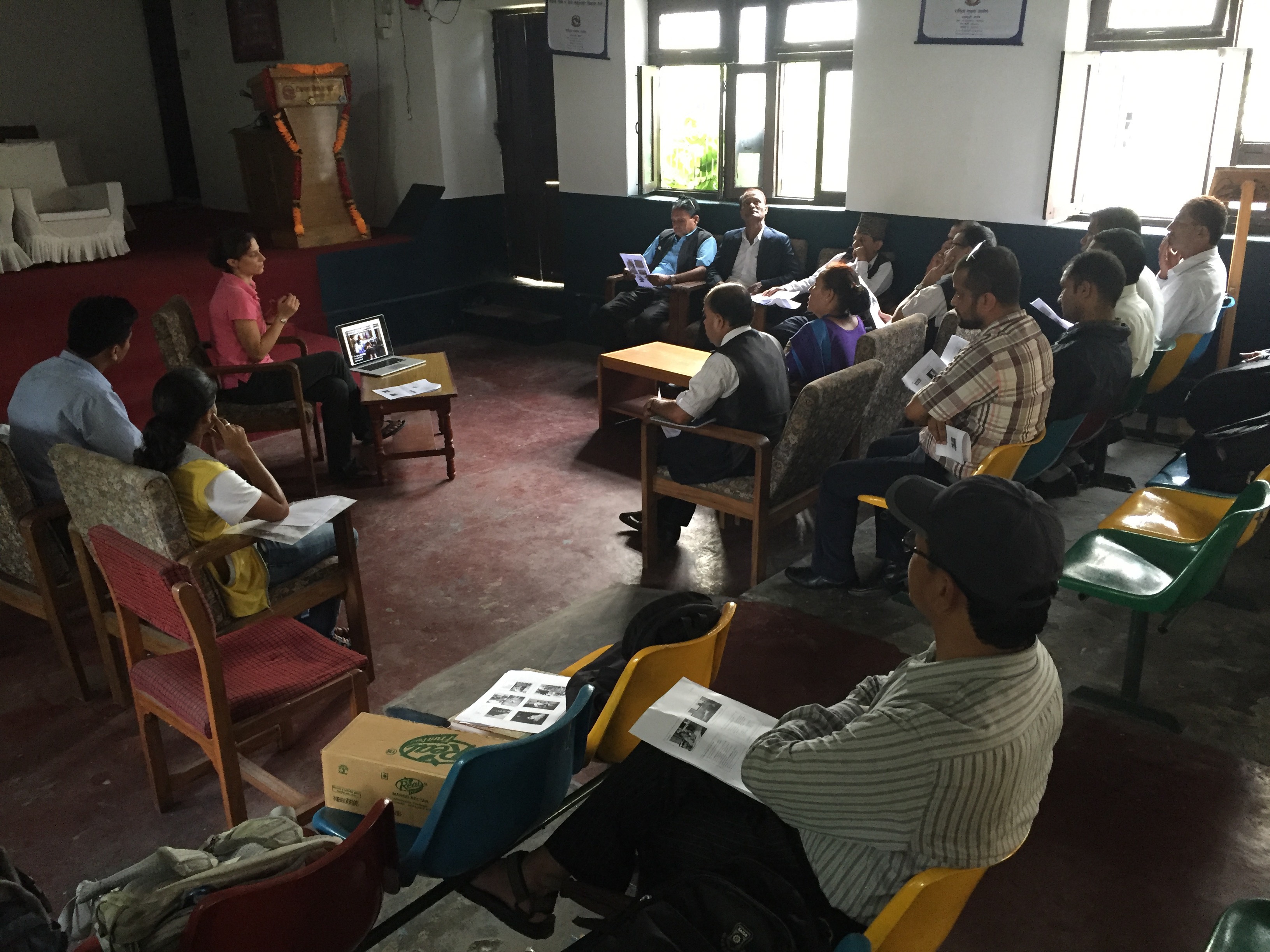
Next is the district government, where we’ve previously had only very simplistic coordination, such as required letters to required people.  But it’s the district government that sanctions and distributes village budgets, so without support here, it’s a lot harder to get anywhere at the local level. The other day we had a District Coordination Meeting where our program director and I presented (in Nepali!) on the role of the government in extending our oral health care model to its predominately rural population, filling a gaping hole in the primary health care system. This meeting exceeded our expectations – we received a lot of positive feedback and useful criticism.  I was lavishly complemented, of course, on my village accent.

IMG_9327

Lastly, the day before I leave Nepal, we’ll have our first workshop at the central level in Kathmandu, and with this, we’re leaping in to completely new territory.  But this is ultimately where it’s at: it’s the central government that fixes funding priorities and distributes earmarked budgets through the national health care system.  Recognition of our model at this level would set up a standardized place for rural technicians in Health Posts, providing a framework for agencies with a lot more money to invest in creating rural dental technicians who can then be permanently staffed by Nepal’s own government.

We’re feeling emboldened and encouraged after learning a lot from each and every meeting we’ve had so far.  Despite my own resistance in the past to clunky public systems, at this stage of the game, I’m finding some of the cumbersome government procedures to be oddly reassuring.  They give us steps to take.  We’ve met some very decent and hardworking public officials over the summer, even if they receive us with skepticism and give us some hard knocks. I think this has actually grown our confidence.  We can wait for the meetings, answer the questions, submit the documents, do all the things, because we have confidence in our product.  There’s also the humbling reality that the government has plenty of reasons to be cynical of the social work sector, so if we have to prove ourselves, that’s fair.  It’s forcing us to be both meticulous and more adaptable…eventually, we’re responsible for creating our own good luck.

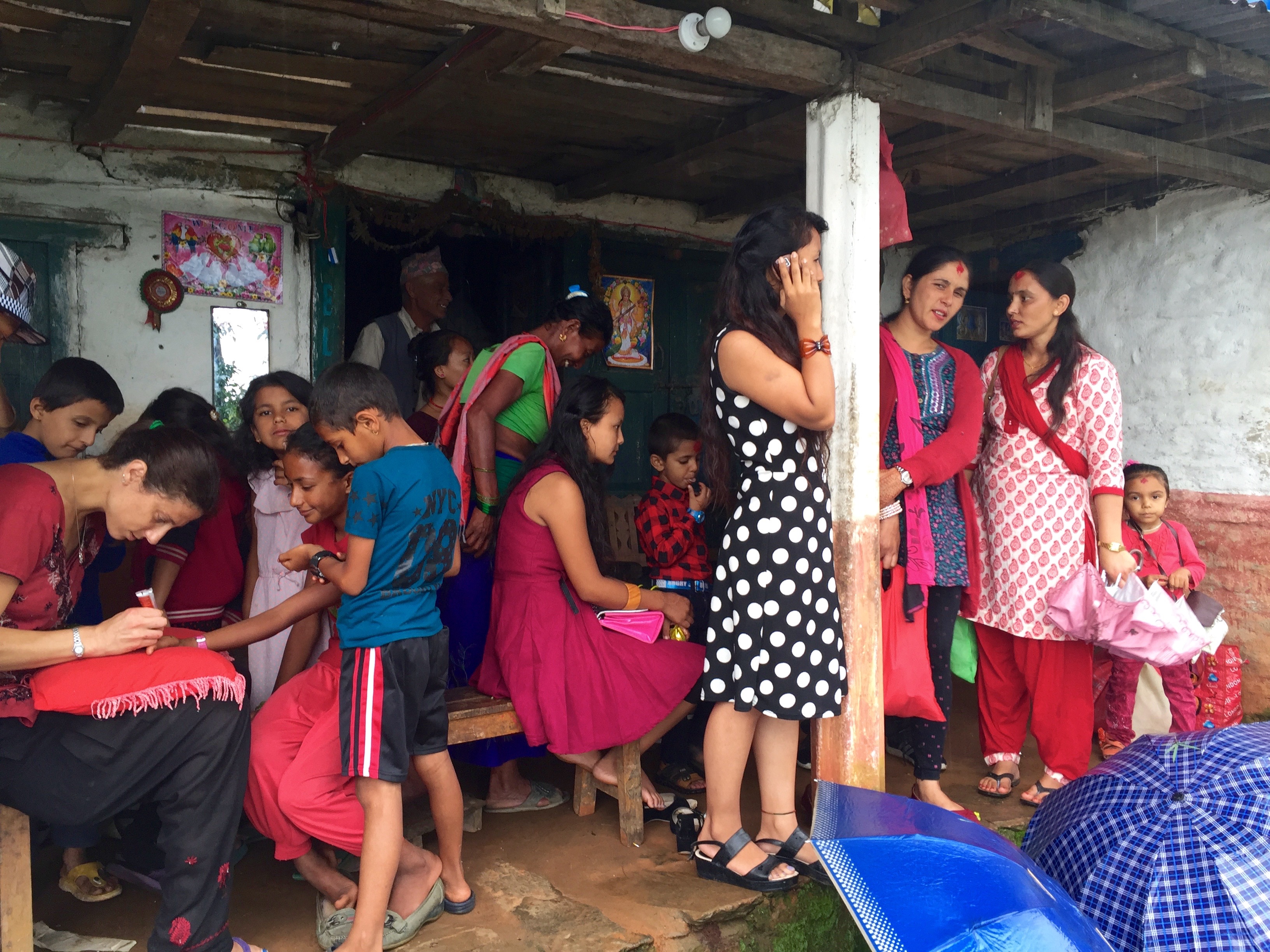
Besides that, rice planting season concludes with a wonderful festival where everyone puts on green bangles and paints their hands with henna.  Kaskikot’s premier henna-drawer has become none other than yours truly.  What did you expect with an activity where people let you doodle on them with temporarily-staining plants?!  Govinda’s porch had an hour long wait for these skillz on Saun 1.

IMG_8891 IMG_8905


The best thing about the henna designs is that you start with an idea, and then it becomes a meditation that designs itself, following a pattern in the creases and borders of someone’s palm, incorporating smudges and wayward marks in to unexpected flowers and vines.  You just can’t say before you start exactly what you’re gonna make.

Doodle doodle doodle…

*

 IMG_9420

Getting Schooled in Vendor Outreach


The only question I get asked more often than if we need dentists (answer: YES! as mentors and teachers for Nepali technicians) is if we need donations of toothbrushes or paste. While that’s a conservative yes, because we provide a limited number of those supplies to schools, most of the time, the answer is, not really, unless they are donations of something purchasable in Nepal. Because, if you think about it for a second, it’s pretty obvious that going to some village and handing out a bunch of disposable hygiene products once might make for good photos, but it doesn’t do much for anyone who needs to use these items every day forever.

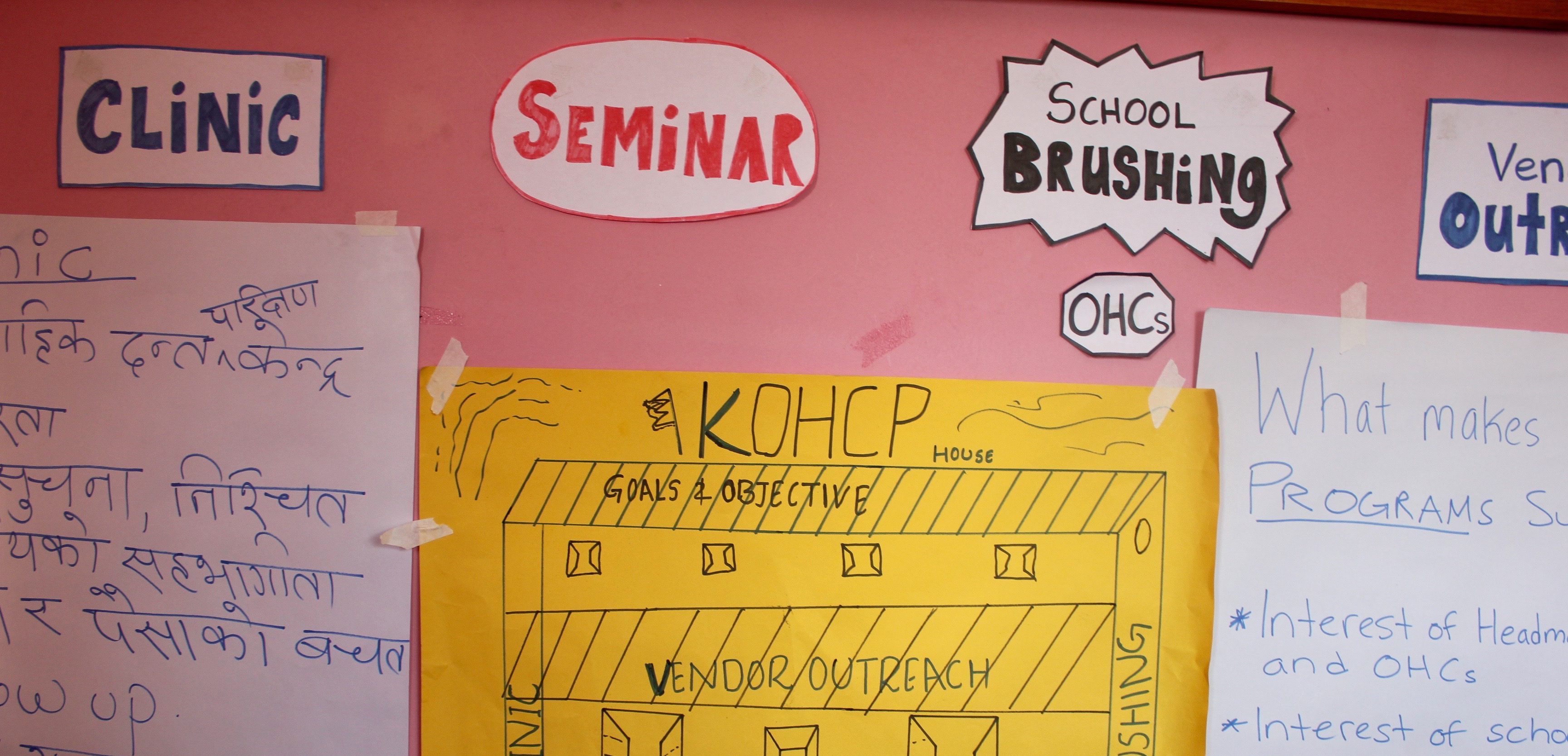
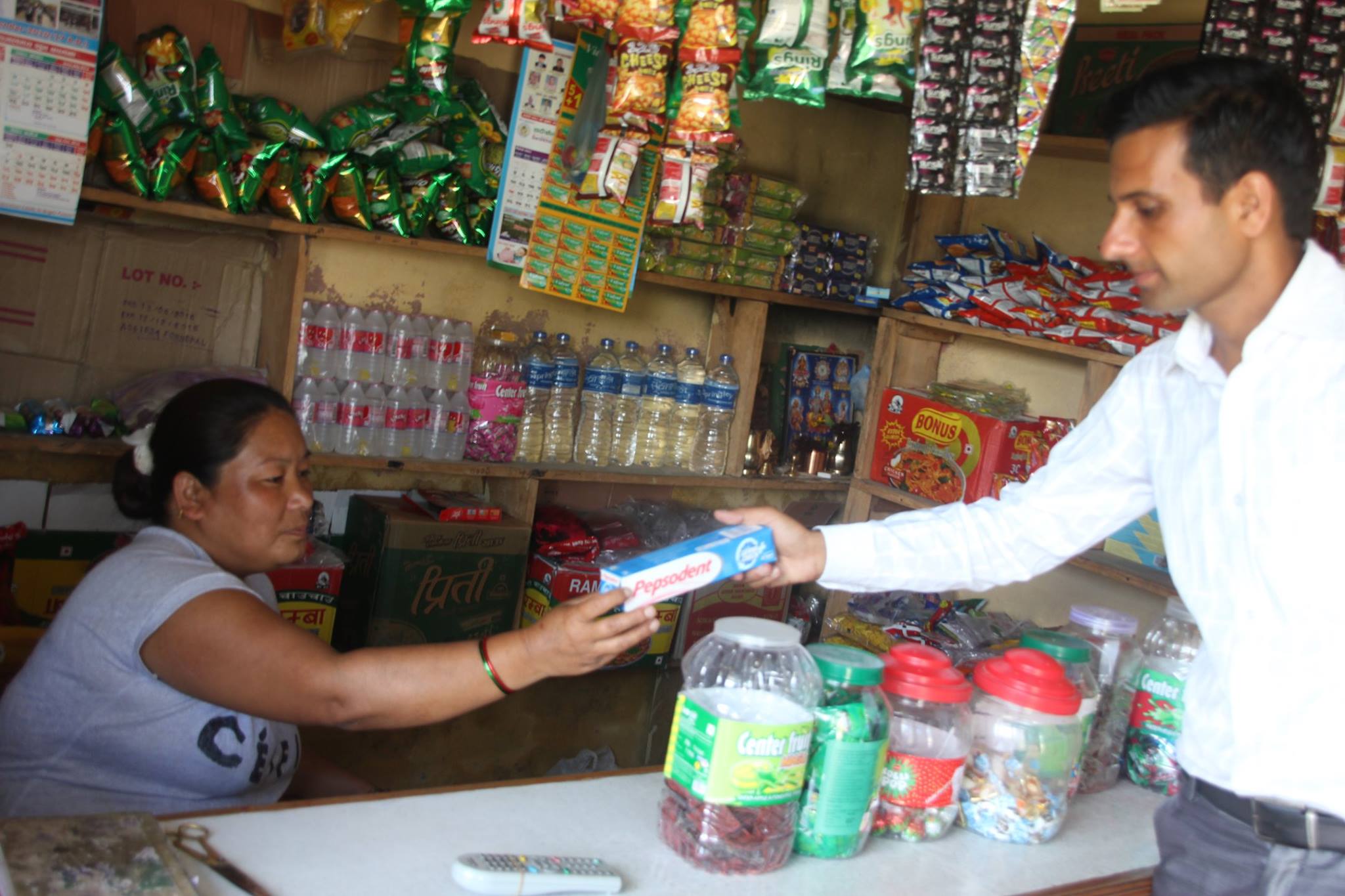
Instead, one of the four core activities in JOHC is called Vendor Outreach, where we work with village shopkeepers to make sure that dental hygiene products are locally available and affordable, the same way sugar, salt, incense, and laundry soap are.

In the past, vendor outreach has mainly consisted of having local JOHC teams – i.e. residents – visit the shops in their villages, look at products, talk to vendors about fluoridated toothpaste, and sometimes put up posters or stickers that help people identify toothpaste with fluoride. But this summer we’re working on stepping it up. The main reason is that schools need supplies to run their school brushing programs. For that, we provide brushes and paste on a declining schedule, but by the end of two years, either students or the schools have to finance $1 per student per year to run their brushing programs permanently. Even though this is extremely inexpensive, our experience has been that when supplies run out, often schools just don’t replace them. If we want schools to buy brushes and paste, they need to be extremely easy to get.

Therefore, in June, we started Vendor Outreach 2.0 by looking for the best-priced wholesale distributors in Pokhara, with the idea of setting up a direct link between village shopkeepers and the best possible deal on dental care products. But when we approached our first shopkeeper with this idea he told us he already buys his supplies from a wholesale truck that comes through his village on a regular schedule.

P1000170 copyOk, we said, could we get the truck to go to the best-priced wholesale places? We showed the vendor the prices. The vendor showed them to his truck guy. The truck guy offered a better rate.

So that was over.

Onward, then, to Salyan, one of our harder-to-access regions, where Gaurab was organizing a vendor outreach program for the following week. He had a list of about 25 shopkeepers and their phone numbers. It occurred to us that we should invite school teachers also, since the point was for the teachers who run the brushing programs to connect with the vendors who supply the products they need. This stroke of insight made us feel brilliant. Actually, that was a really good idea.

Before the Gaurab’s trip out to Salyan for Vendor Outreach 2.0, I suggested that he print out little slips of paper with the location and contact info of the best wholesalers we’d found in Pokhara. That way we’d make sure all Salyan’s shopkeepers had this info in a nice tidy fashion. For the best deal.

“So how’d it go?” I asked Gaurab back in the office on Tuesday.

“Great,” he says. “We had over 20 vendors and a lot of the teachers running their school brushing programs came too. We made visits to a number of shops, and I brought the poster with the fluoridated toothpaste packages.”

Vendor Outreach in Salyan

“Awesome, did you give out the contact info for the wholesalers?”

“Yes but…”

“What?”

“I mean, they said they already get brushes and paste at that rate from their wholesale trucks.”

“Are you serious?”

“They said they can totally visit the wholesalers we found if they happen to come to Pokhara,” he consoled me.

“So basically, we’ve spent the whole summer on this, and what you’re saying is…village shopkeepers already get brushes and paste at wholesale prices from trucks that deliver right to them.”

“Yes.”

“All these schools already have vendors down the street with access to these products at the cheapest prices we can find.”

“Yes.”

“…So Vendor Outreach is basically just…getting the teachers up the street together with vendors, and convincing them to purchase supplies down the street.”

“Yes.”

“Like all we have to do is get everyone together and talk about it.  Maybe assign a specific shop to each school.”

“Pretty much,” Dilmaya chimes in.

“Guys,” I said.

“I mean, they can use the wholesalers we found if they come to Pokhara,” Gaurab reminded me comfortingly.

“Why is everyone going around handing out free dental supplies?” I demanded to nobody.

Back to the drawing board.

We find this over and over. Our complicated ideas for fixing things are 99% irrelevant, with a critical 1% of something that is missing: information, a tool, a little encouragement, some social integration, a familiarizing element or formality. Vendor outreach will continue to involve oral health education for shopkeepers, because most people are not aware of the importance of fluoridated toothpaste in preventative care. But then it’s mostly a matter of building relationships between vendors and purchasers–especially between schools and specific local shops to source the supplies for their very affordable brushing programs.

In other words, we need tea parties more than we need supply chains, more than we need products, more than we need anything that’s not already there.

In conclusion, we’ll enthusiastically be taking donations of items such as art supplies for oral health games in schools, certificates of achievement for Oral Health Coordinators, funds we can spend on having local tailors sew brush holders, holding workshops, lobbying local leaders, creating teaching materials; and actually, if anyone wants to offer rides to our field officers out to Sindure and Rupakot and Salyan so they don’t have to spend so many hours walking or stuck on buses, that’d be great.  Also, snacks.  Help us out – there are many things we need to do our part well, and lots of opportunities to support communities in Nepal.

As far as brushes and paste though, I think local shopkeepers figured this out quite some time ago.  Duh.

*

Vendor Outreach in Sardikhola with technician Megnath Adhikari

Vendor Outreach in Sardikhola with technician Megnath Adhikari

Puranchaur Clinic


Today I made my first visit to our clinic in Puranchaur, which launched a year ago in winter 2015. We rode motorbikes – I hopped on one with our program director Aamod, and I stuck my friend Freeman on the back of the other bike with our field officer Gaurab. Freeman lived in rural Afghanistan for two years and his training involved things like “how to drive through a blockade,” so I figured it would be okay.

FYI, re: riding on the back of a motorbike:

  1. Paved road –> plus side: fast / minus side: scary
  2. Rutted dirt road –> plus side: good workout, bracing / minus side: rather sore bum, dust
  3. Previously paved road that has deteriorated and broken up in to a patchy mess with some dirt packed around in it –> plus side: there’s a road, so you’re not walking / minus side: everything else

IMG_6319The way to Puranchaur comes in at a solid #3 for a vigorous 64 minute joy ride.
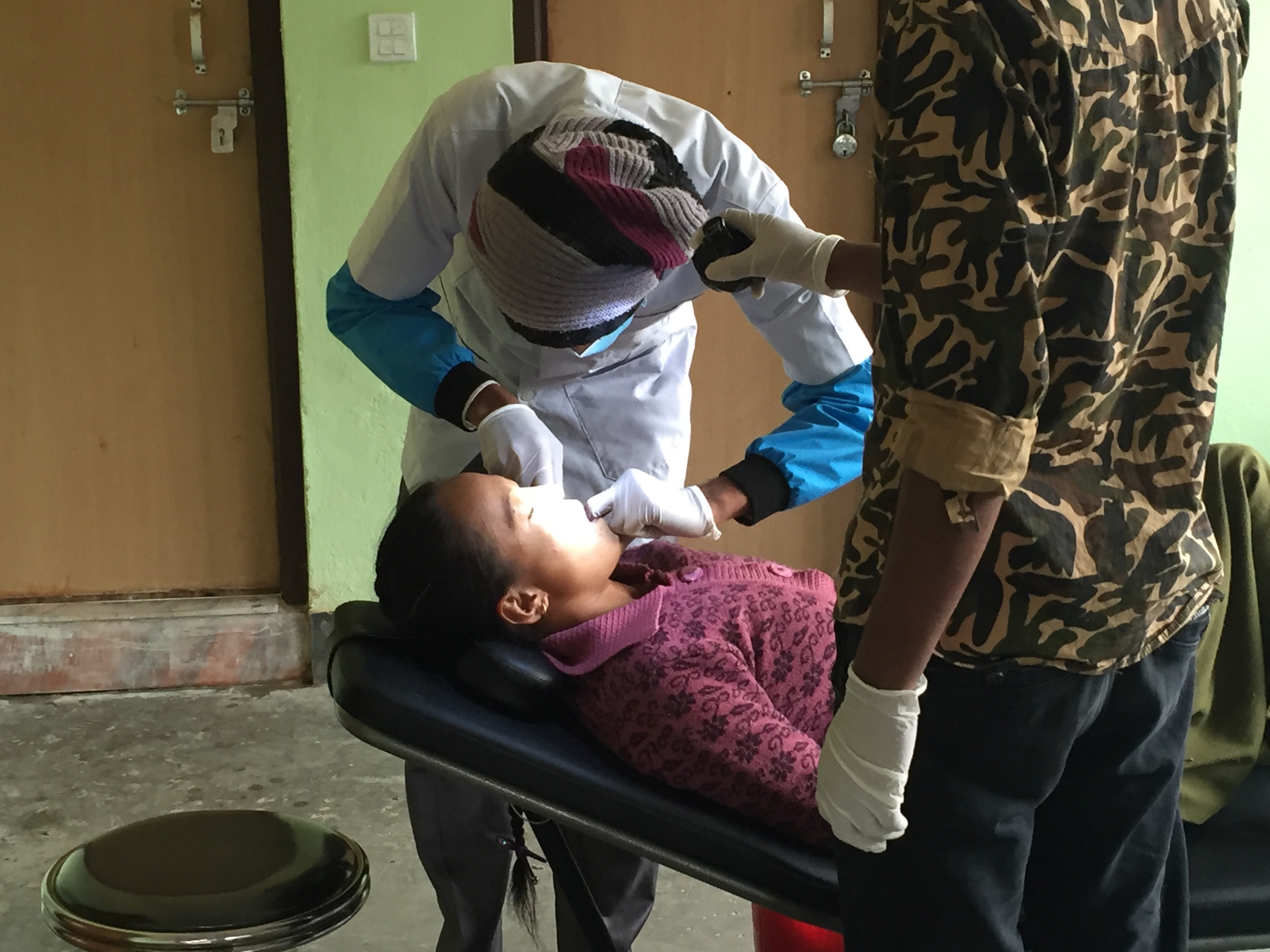
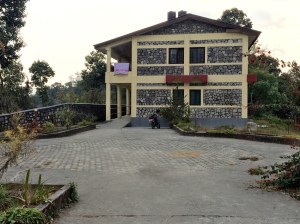
Fortunately, we were greeted at Puranchaur by the sight of a very well-built Health Post. All of our clinics are in buildings provided by the community, and where possible it is ideal if the building can be in or next to the existing government Health Post. But Health Posts aren’t usually this nice.

It was immediately clear that we’ve received good local support at this stage of the game in Puranchaur. There was a lively crowd of patients waiting on the balcony, and this clinic is run by one of our more experienced technicians, Megnath.

See for yourself:

We went through our supervision checklist, which includes a rigorous infection control protocol that I wrote myself by talking with dentists and rural trainers, then making modifications based on my own knowledge of the environment, because I realized that none of the existing guidelines were really adapted for these conditions. Amazingly, the only existing protocols I could get my hands on were for dental hospitals with electricity and technology – think, UV disinfection – or, alternatively, unwritten procedures used in temporary dental camps, which presume very high patient volume and the lack of any stable infrastructure. Can you believe that I could not locate a single infection control protocol designed for a permanent rural dental clinic in Nepal? 80% of Nepal’s population and nearly all the government Health Posts operate in rural conditions!

Which is why now I know more than I ever planned to about gloving and re-gloving, positioning of safety boxes, and timing of Virex disinfection, among other topics.

IMG_6304

Our rewarding visit to Puranchaur has me thinking more and more about the larger idea of our project. It’s great when we’re able to establish these services and it sure is gratifying to come all the way here, after hours and hours of sitting at a desk, meetings on Skype, researching oral health data, giving talks and raising money, and see patients coming in to a clinic in Puranchaur on a Wednesday afternoon. It’s also awesome to me that none of these people associate their clinic with me or my slideshows or any kind of charity, which is not what these services are intended to be. All that is good stuff.

On a bad day it seems like it just isn’t enough. There are so many problems here. A toothache is definitely one of the worst things in the world if it is in your mouth…but it’s not as bad as child trafficking. These clinics don’t solve problems of violence or lack of basic security or opportunity. Sometimes it seems like a lot of effort to still end up in a world that has those problems anyway.

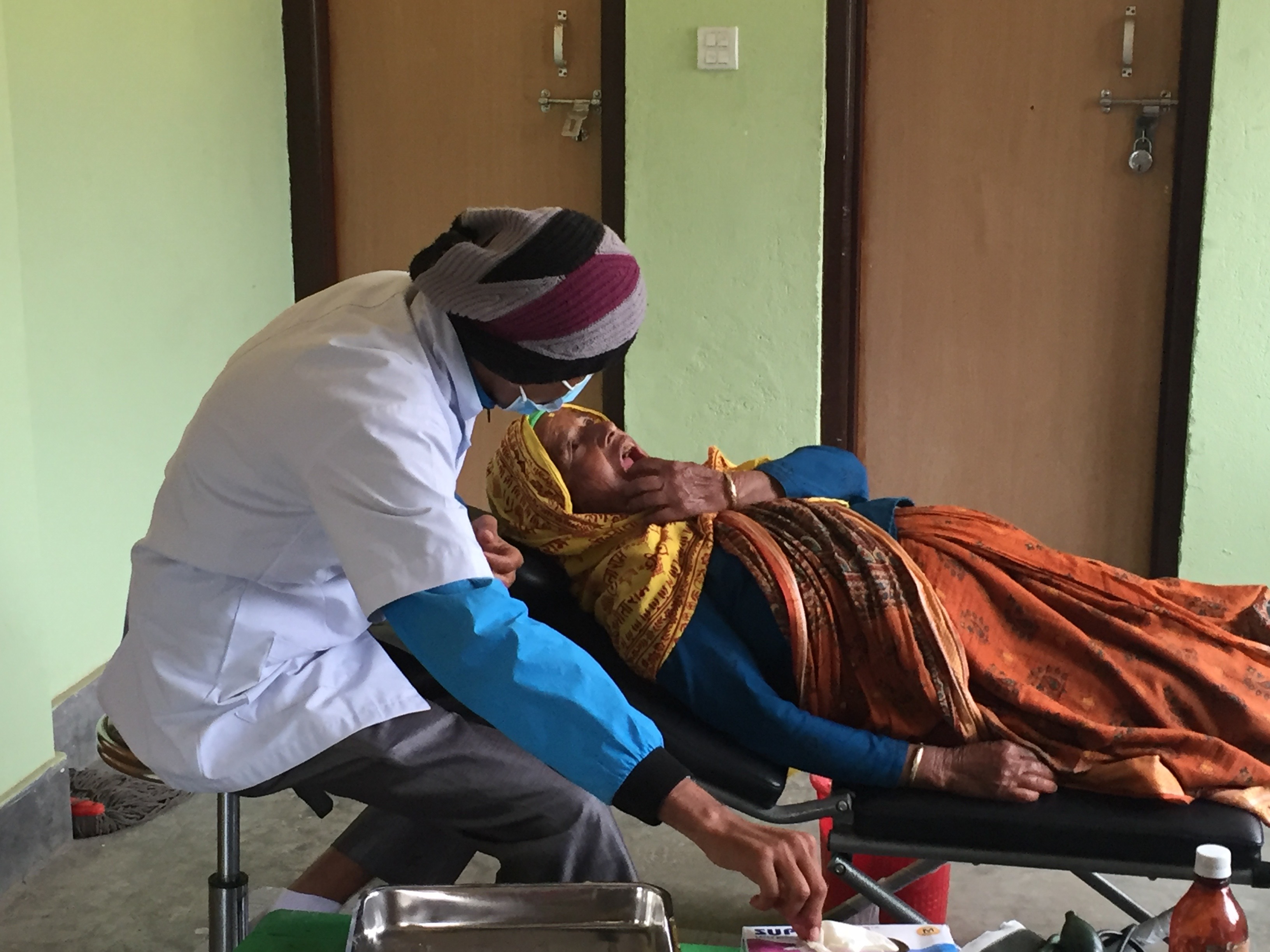
But one thing I think we’re isolating bit by bit has to do with recouping lost opportunities for self-determination. Something our little project does increasingly well that I don’t see very often in this sector is to understand and respect the present capacities of individual people and the communities where we work on all levels. That means letting go of the UV disinfection, but it also means having a proper replacement and monitoring it. It means making services accessible, but then holding people accountable for accessing them by choice, rather than spoon feeding and disempowering everyone for our own gratification. It means that explaining to an old lady that she will not be blind if we pull her tooth out, and making the service psychologically available, is just as important as having a dental clinic that’s physically available.
This is hard to do. It requires an unreasonable amount of patience and the willingness to constantly sort out where to impose control and where to throw everything you think is correct out the window. Inevitably, there are moments where it seems like you’re dong everything wrong and it’s all for nothing.  At some level, I think it only works if you find people as interesting and challenging and curious as the problem you are trying to address.

That’s what has me wondering what we’re really getting at here. I’ve always felt like, even with the visible services this dental project provides, for me as a person, it’s an exercise in something else I haven’t understood yet. Maybe this is just a story I tell myself after a good day, but we would live in and more dignified and peaceful world if we cared as much about actual people as we do about ideas of people.

Today, one old lady with a toothache spent a good bit of time explaining how she’d treated it by putting tobacco in there.  The tobacco helped. Megnath couldn’t extract her tooth because she had complicating heart issues that require referral to a hospital – but he had a nice long conversation with her about the tobacco, anyway.

*

IMG_6283