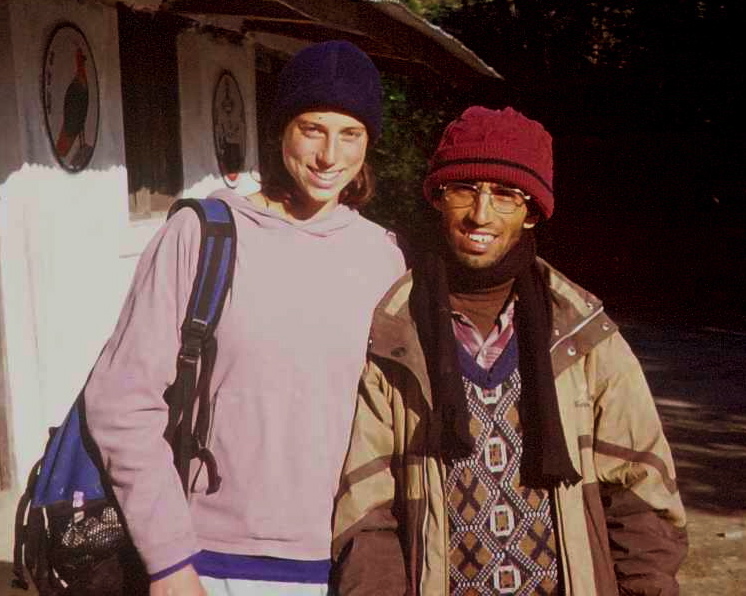
The Walk Home


There’s nothing like my first visit to Kaskikot after having recently arrived in Nepal. Granted, sometimes there’s a year in between visits, and in this case I was here just last summer after a long winter stay. But still – today did not disappoint.

I woke up to the charming experience of Pascal throwing his arm on my head. Let’s face it: this room where Didi and Bhinaju live is too small for all of us now, but we are persevering while the house is being built. It is the nights when I share a bed with Aidan and Pascal that I question my judgment in teaching them taekwondo while they are awake.

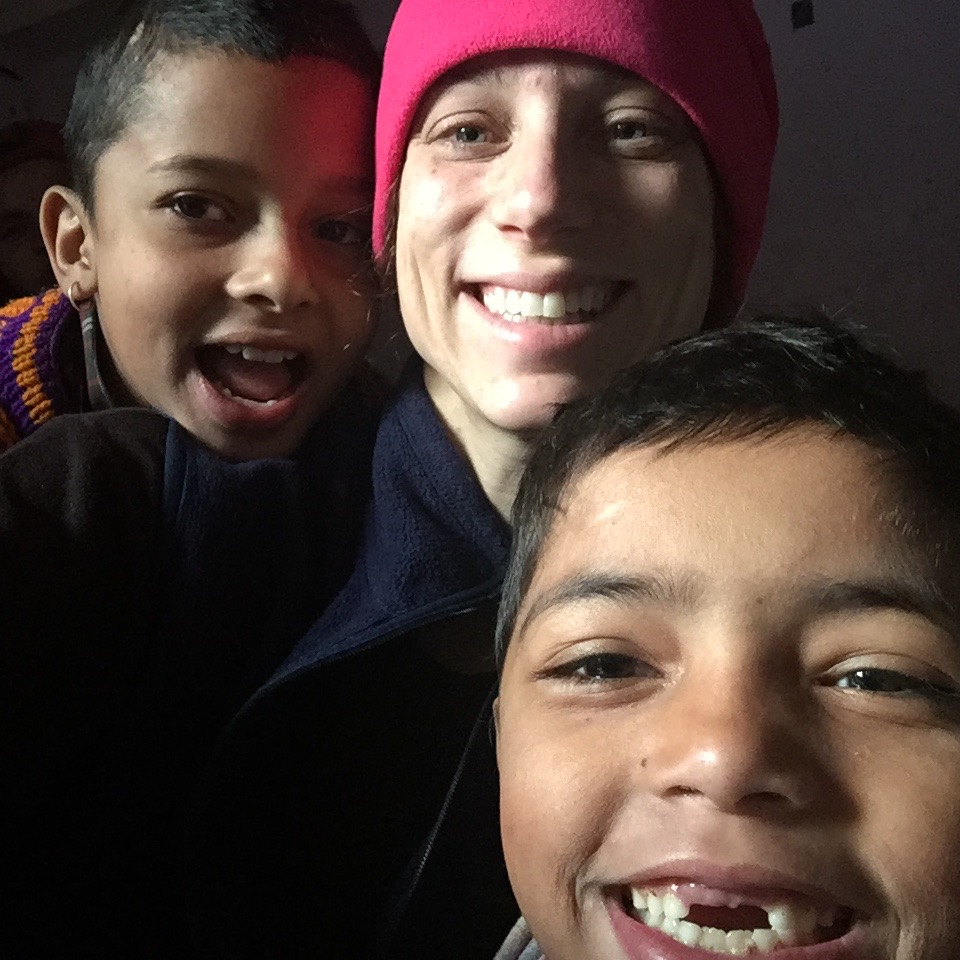
While Didi made tea, we all lay in bed debating whose fault it was that we’d all spent the night practicing kickball rather than sleeping. Then we documented our morning in selfies.

IMG_6095 IMG_6103IMG_6098


Late morning, I met up with some of our graduated Gaky’s Light Fellows for lunch. It was so great to see everyone and hear what they are doing. Sandip is marketing for an online news outlet. Ramesh is deciding where to apply for his bachelor’s in journalism. Nirajan is in Kathmandu, working for Teach for Nepal, and Nischal is entering his second year of bachelor’s. Umesh and Narayan have a solid paid gig singing traditional music each night, and Narayan has his own radio show. Bhagwan is a residential supervisor in a school hostel. When Puja and Asmita finally got there a few hours late, we all made plans to go boating later this week.

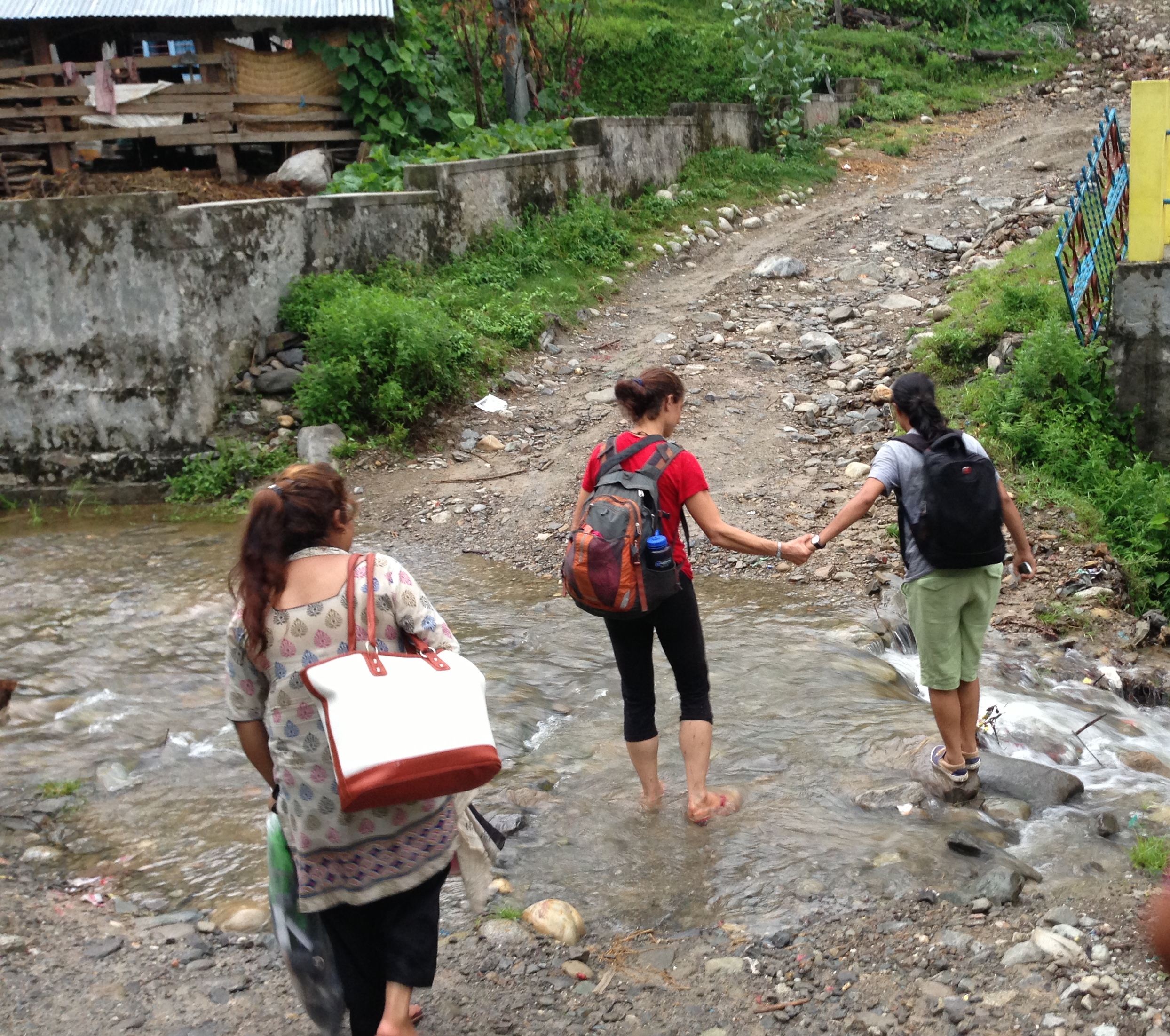
Next was getting up to Kaski. With the fuel shortages, this is more challenging than it’s been, as the bus is running infrequently. Not to worry!  I caught the back of a motorcycle ride and then secured a taxi to the bottom of “the jungle path” that climbs straight up from the valley to the house. Forget the bus, man.

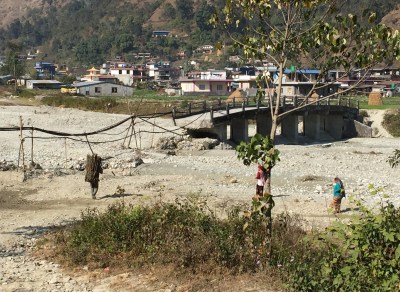
So first of all, at the beginning of this path you have to cross over the Gandaki river, which is usually dry at this time of year, but swells in the summer and fall. We used to wade through it, but a few years back it got this nice concrete bridge. So I’m crossing the bridge, and…it just stops in midair. The last half of the bridge is suddenly no longer there.

It takes me a few minutes to negotiate the drop over the ledge of the bridge with a torn ACL in my right knee that won’t let me jump down on to the rocky bed five or six feet below. I make my way over, progress to the bank a short way away, and there at the bottom of the path up to Kaskikot is this leathery guy resting next to a bundle of wood. He looks kind of resigned. I chat with him for a minute and then he asks for help lifting the bundle of wood.

“My son is really strong, he can carry this kind of load,” the man says woefully. “It’s just pretty heavy.”

Nevertheless, the bundle must be lifted, so we give it a try- fortunately I am more qualified than your average random American to hoist a bundle of wood on to someone’s back so it can be slung from their head and carried across a dry riverbed – but it is too heavy, he can’t get upright under the weight. He sets it back down, resumes his seat in the road, and looks resigned again.

“What’s with this bridge?” I ask. “Half of the bridge is missing.”

“I know!” He says. “The other night, I drank up a full belly and came here and fell right off of it.” He points to his forehead and says, “I got a bit of a bump right here.”
IMG_6126“I hear you,” I reply. “I’m not even drunk, and I nearly fell off the bridge too.”

“Just went right over,” he recalls.

“Should we try this bundle of wood again?” I ask.

“Ok, but you have to come around the front and give me a hand.”

I heave the wood on to his back again and this time give him a hand to brace against as a counter balance, and he stands up.

“Thanks, bye,” he says, as if it makes sense that I appeared for this interaction.  Off he goes.

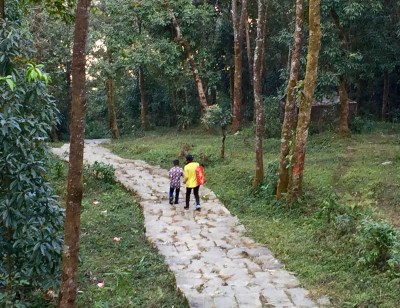
Partway up the jungle path I run in to two kids coming down.  They stop me.

“Where are you from?” they ask me in English.

“America. Where are you from?”

“Puranchaur,” the little boy answers.

“Oh, I’m going to Puranchaur on Tuesday,” I say. It’s one of the villages where we launched last year. I ask what grades they are in: four and eight. “So,” I say to the fourth grader, “do you brush your teeth at school?”

“Yep,” he answers.

“Huh. For about a year, right?”

“A little less than a year,” he says.

“Cool,” I answer, and down the path they go.
IMG_6128

Finally I come out the top of the jungle path and emerge at the water tap in Kaskikot.

“LAURIEEEE!” the ladies cry. “Here you are, just in time for wood cutting to start tomorrow! Last year you came to cut wood, and this year you’re here to cut wood!”

YES. This is the gold medal of the Welcome Olympics. And yes, when I go to cut wood, I understand that it is a memorable experience for all of us.

On my way to the house, a few other people – completely independently – express their approval that I have arrived just in time for wood chopping. I am winning at Nepal.

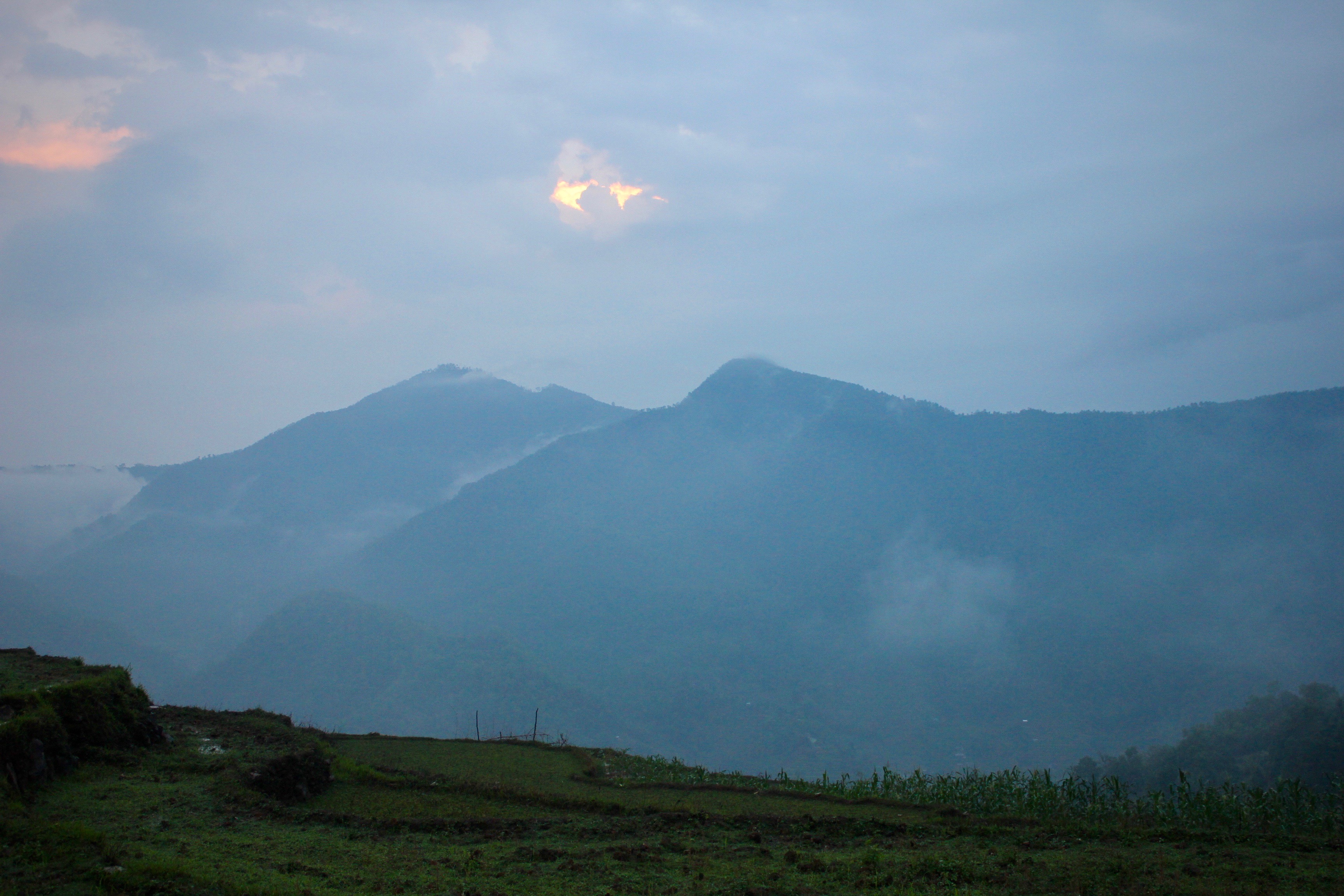
At last, I drop over the spine of the ridge and there is home. Baby O’Neil is tethered outside, her wet nose pointed quizzically my way; she has grown some brown fur.  The hillside is dotted with jubilant yellow mustard flowers.  There is the familiar line of the Annapurnas rising in to the dusky sky, distant and close. No matter the path that brings me to this piece of land, it always appears the same way, luminous and inevitable.

*

IMG_6148


Fall


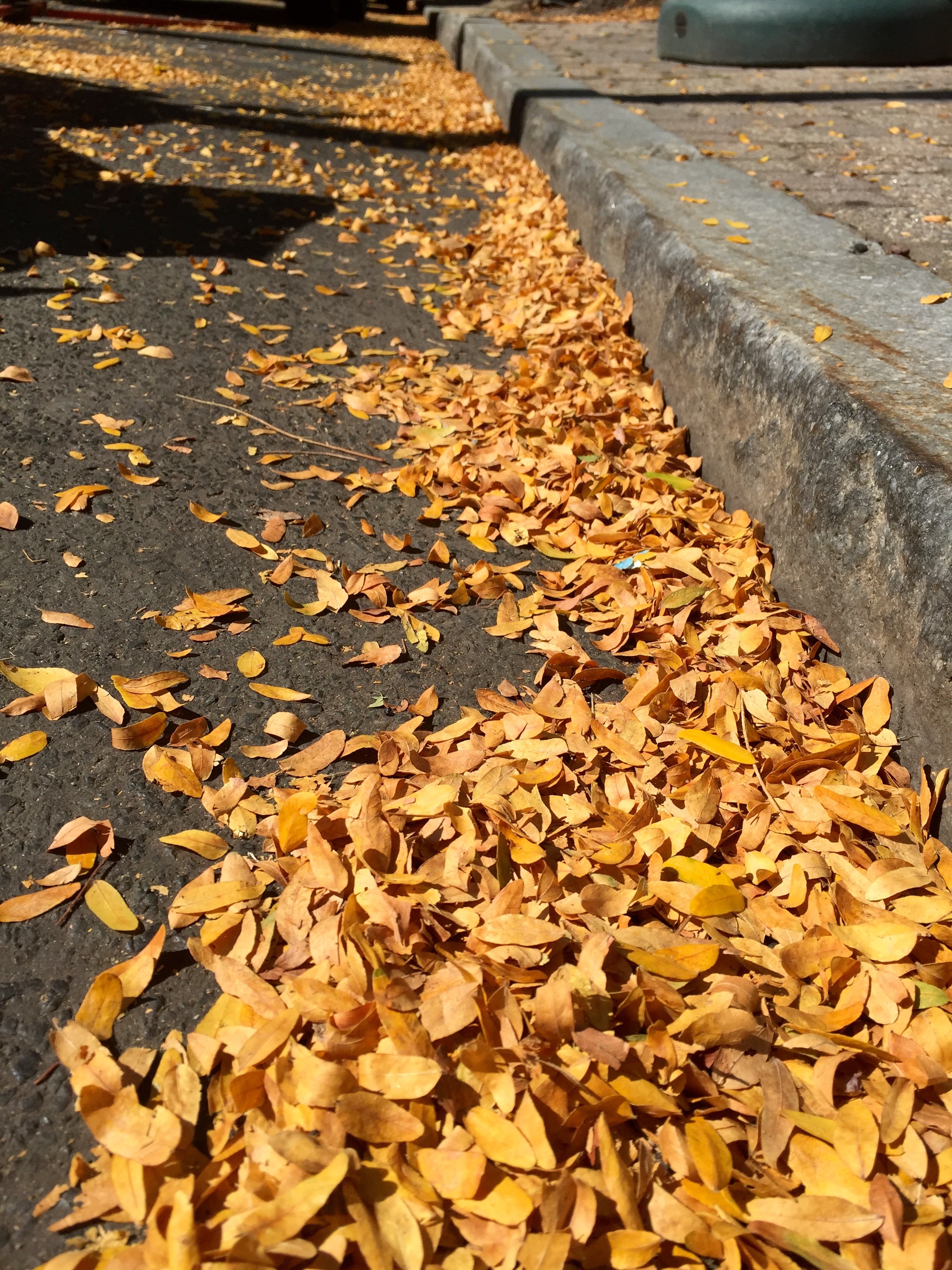
Tiny yellow petals have started collecting in the right angle between the sidewalk and the street. They are huddled there like a paper river, jumping around and changing places ever so slightly as the cars drive by. It is fall.

It was the end of summer before I started to feel like I had arrived here in Connecticut. Even though I’ve been moving between these two very different worlds for twelve years, it has been over a decade since I was abroad for so long at once – nearly seven months, with a brief six weeks back in the U.S. in April, which is when the earthquake hit in Nepal.

I’ve always felt that the gift of living in two worlds, if I am open to it, is the chance to deepen my appreciation of multiple realities. Certain particularities, like the soft muffle of people arriving to temple during the High Holidays, or the rustle of fall and how it smells like apples and makes me think of being outside with my dad, the amazing fact of the New York bagel, a spectacular city skyline twinkling at night, the miraculous convenience of speedy internet – these gifts and many more have been imbued with a resonance that comes only from heightened gratitude. What a tremendous blessing that this is my world, my life, my palette of choices.

Besides being near friends and family, it’s this intensifying of senses that makes me look forward to returning to the States when I’ve been in Nepal. Whatever the tradeoffs, they come with the euphoric feeling of appreciation. Maybe this is why I’ve come to realize that in some way my role on the planet will always be to move between disparate worlds, rather than settle comfortably in one and become stagnant.

This last arrival, however, has been different. It’s been harder for me to access the joys of this plentiful environment. Maybe we are in a new season in America, and maybe I am different, or maybe some of both. I arrived back to the U.S. during the week of Sandra Bland, just as Donald Trump was taking center stage. Everybody seemed so angry and so loud. Among the significant, real outrages and pathologies happening at our doorsteps – Sandra Bland! – precious few were garnering a majority of the words being expended in mainstream discussion. Outside my house, everybody was disconnected from each other, and inside, I couldn’t hear the wind blowing.

It was like being in solitary confinement and being assaulted at the same time.

I’ve started and stopped this post many times, wondering how to write about this season of being between realities without resorting to clichés. I was in rural Nepal working with people to rebuild their houses after an earthquake, sleeping under tin roofs while the early summer monsoon pounded the hills.  Now I’m in Connecticut listening to the Republican debate in my living room. It’s totally cliché.

And yet it’s not these visible differences that constituted the turbulent vacuum between my worlds this summer. Mostly the last two months have been an exercise in putting up barriers. Between myself and the pavement. Between myself and indifferent crowds. Between myself and a certain nothing that creeps in between the activities and compartments of cars and apartments. Between myself and a hailstorm of unmourned and even unacknowledged injury. Between my ears and the fantastic amount of noise, all the talking and procedure that is not about anything.  Between myself and the precious narcissism of our public discourse.

I realize that these barriers have their value. But it feels like a loss. I’m more aware than ever before how many ways American culture forces us to reduce our perceptiveness in order to survive. It’s true that the catastrophe of the earthquake created an especially unique doorway to a productive social consciousness: there was a gigantic and terrible event, but it was fairly concrete – at least on the surface – and I located myself and my community within it. I was one of many people who looked destruction in the face and began rebuilding with patience and humility and a willful connection with others.

But I didn’t really realize how much my sense of my self in the world and in society had swelled out beyond me in these last seven months – even to the earth and its power, to the inevitability of the monsoon, to the practical absurdity of dirt roads going up mountains – until I was back here, and my world became a cacophony of conflicting radio stations, all purporting to be of critical importance.

The summer has been an exercise in shutting down one channel after another, and then re-learning how to decide which ones to turn back on for brief and highly monitored periods of time.

The summer has been an exercise in dodging the frustration, despondency, and aggression that billows about on the street, unchecked, like car exhaust. Then re-learning how to locate and selectively engage sources of collaboration and joy. After all, it is still a blessing to have this palette of choices, whether or not we see it, whether or not anybody sees it. Gratitude is not something that can be faked – it comes directly from a place of knowing.

The summer has been an exercise in observing our political system, our environmental system, and our media, with the surprised naiveté of a newcomer, and hearing the same story repeated in different packages: in how we describe ourselves, our problems, our economic and racial tensions, the rest of the planet.  In the way we talk about the earthquake in Nepal and the victimized people of the third world.  It is a story of detachment, silence, and frustration transmuted in to righteousness.  And yet the power of our systems is tremendous, if only we could see them.  If only we could hear ourselves.

Our narcissism isn’t that we’re a bad society or a bad people.  We just can’t see it.

I have spent a great deal of time sitting quietly in my living room, wondering how we get outside of ourselves without leaving.  I think it is human nature to cling to anything that tells us what we already know about ourselves.  I’m no different than anyone else.  I’ve just spent a lot of time in situations where there wasn’t much to cling to, so there was no choice but to adjust.  We are much more arbitrary than we think we are.

I think about my dear friend Mary every day and I miss her.  I would like to tell her about these things, so she can remind me without saying so that I am just one more well-meaning narcissist, and we are all going to the same place, so we might as well be good to each other and enjoy the scenery.

Now it’s September and the brittle yellow leaves are collecting in the gutter.  They dance around when the cars and people rush by, but they could care less for the hurry that makes them play like that.  It’s just their season to fall from green branches, and become a river in the street.

.      .      .

IMG_5462


On Fractured Temples

IMG_0974

Normally when I leave Nepal, there is an extended process of departure – physical, psychological, emotional. But after being here for most of the last six months, minus six weeks in the middle, I ended up leaving with no procedure at all.

Actually I should amend that a little, since the morning of my flight from Pokhara to Kathmandu, I badgered this hairdresser lady – a friend of a friend – into showing up at 5:30am in her salon to straighten my hair for three and a half hours. That’s right! For two months I’ve been hauling around the hills of Nepal in the hot sun in my flip flops, renting tractors and sleeping under tarps and tin, carrying gurneys of rock with old ladies and filling up rice sacks with dirt to build an earth-bag house, sitting in hot stuffy buses for 5 hours and getting stuck in the mud and walking the last hour in the rain…and the one thing I HAD to do before I suddenly left Nepal to fly home for a funeral was get my hair permanently straightened. Why, you want to know? Because in the U.S. it costs $250 and in Nepal it costs $20. A deal is a deal. And besides, there’s nothing like a good hair day to lift a girl’s spirits.

IMG_5188So in the middle of everything – the whirlwind of our new office setup, the excel sheet full of names and bundles of tin and numbers of people, the scheduling of a planning workshop for our staff, setting up a new financial system – I dropped it all for my last three hours in town and had my hair straightened at 5:30 am. Then I said goodbye to Aidan and Pascal on their way to school, and then to Didi and Bhinaju, who took me to the airport. I didn’t get to say bye to the kids at the children’s home so I bought them some treats and told Ranjita to say how sorry I was I’d missed them, but I’ll be back in 6 months. I’d said goodbye to Aamaa and Hadjur Aama the night before, in Kaski.

And the next thing I knew, I was flying back to Kathmandu, in that reverse warp that happens when I leave Nepal. Except about six times faster. Normally on my way out I have a few days in Kathmandu and they are mostly filled with meetings. This time I had just a few hours between my flight from Pokhara and my flight home.

Everything looks different in Kathmandu than it did when I arrived on May 13, less than 48 hours after the second earthquake (remember the second earthquake???), when the city was filled with bright blue and orange tents clustered at intersections, and all the people were quivering like leaves, waiting for another hit. Things seem to have settled in to a process that is serving as the new norm. IMG_0904And the truth is that if you landed here now, from anywhere, you’d be amazed to find that the apocalyptic situation that’s on the TV is not how things look. That’s because the collapsed buildings that the photographers zoomed in on aren’t the whole story. In fact, they were the tremor after the earthquake of poverty and poor governance, which is too chronic and undramatic to capture our attention, but remains most of the problem.
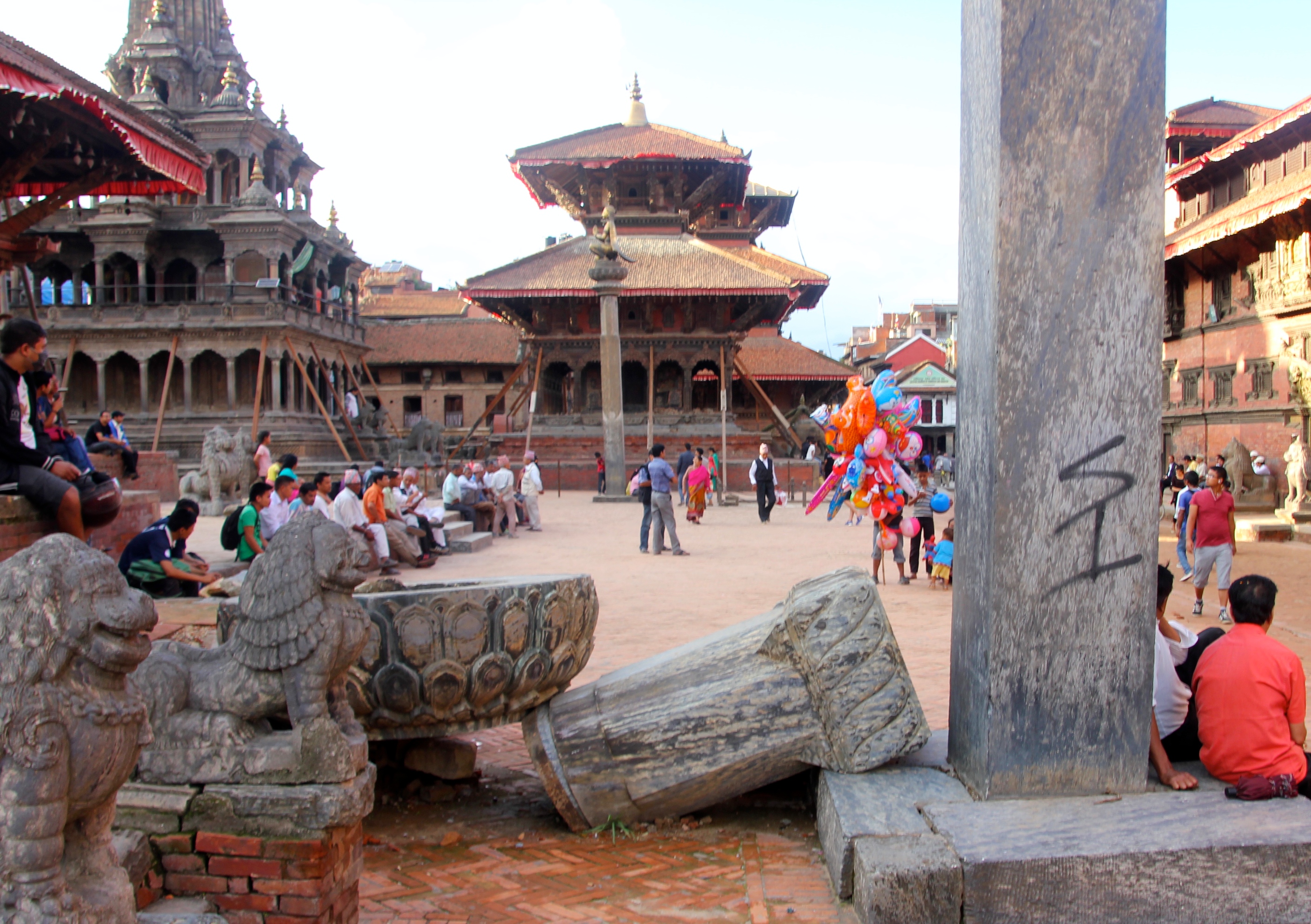
But the real difference is me.

When I arrived here two months ago, this situation felt vast and unknowable and as tragic as my imagination could make it. Now I can locate myself within it. Our piece, which will ultimately total around 150 homes and piles of stories, was small but meaningful. I have a sense of how people are moving forward with their lives one step at a time (although I should add that during these months, I met only one family that had lost people in the earthquake). Which is not to trivialize what’s been destroyed – only to say that, in the beginning, when everything collapses, it’s impossible to imagine a different future.   All the unseen things are terrible and insurmountable in your mind’s eye, and you can’t conceive of the steps between here and there. I couldn’t even visualize “there.” Now I feel like can at least be at peace with a changing target, because that shifty feeling of uncertainty and failure is a known thing, not a shadow. And so far, we’ve done our part despite it.

My last few hours in Nepal were perfect. I met up with two friends from the U.S., both doing doctoral work in Nepal, both fluent in Nepali. We walked down to Patan Durbar Square, my favorite section of old city, known not only for its temples but also its artisans and craftsmen. Patan is one of the areas that was featured heavily in the days after the earthquake, when the only photos of villages were from the air.

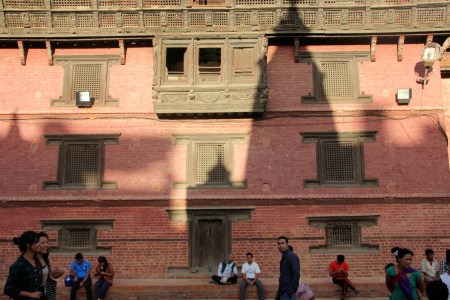
On this last afternoon, the rains held off, making way for a cool golden evening, the light waving in the folds of cloth that ripple along the edges of the temples. We sat high up on the foundation of what used to be a temple, observing the courtyards that were filled with people eating ice cream, buying balloons, whispering on dates, playing. Between the scaffolding that surrounds the damaged buildings, people were busy living in the very space that, I know full well, much of the world sees in its own mind as a pile of dust and despair.

IMG_0977

My thoughts drifted to conversations that Anne and I have had about the beauty and strangeness of Pashupathi Temple, Nepal’s holiest cremation site, where passers-by sit across the river and watch pyres burn during the day and night. Sometimes there are kids playing soccer, or folks out enjoying the sun or the beauty of this thousands-year-old place of pilgrimage. What’s always amazed us about this is that people can play soccer near death. Or go on dates near death. Or just gaze, for no reason at all, at death.

Of course, it’s there anyway, even if you’re not looking at it. And once you get used to the idea that you do not have to avert your gaze from a pyre, or from a mother wailing over a pyre, everything else looks different too. Suddenly that moment belongs, in some way, to everyone.

IMG_0956There is no caution tape around Patan Durbar Square, or even around the base of this foundation that used to have a temple on it. The reconstruction is public and unbashful, but it’s also not desperate. In a courtyard tucked away to the left, bricks are patiently stacked up and a young couple is talking furtively under a tree.
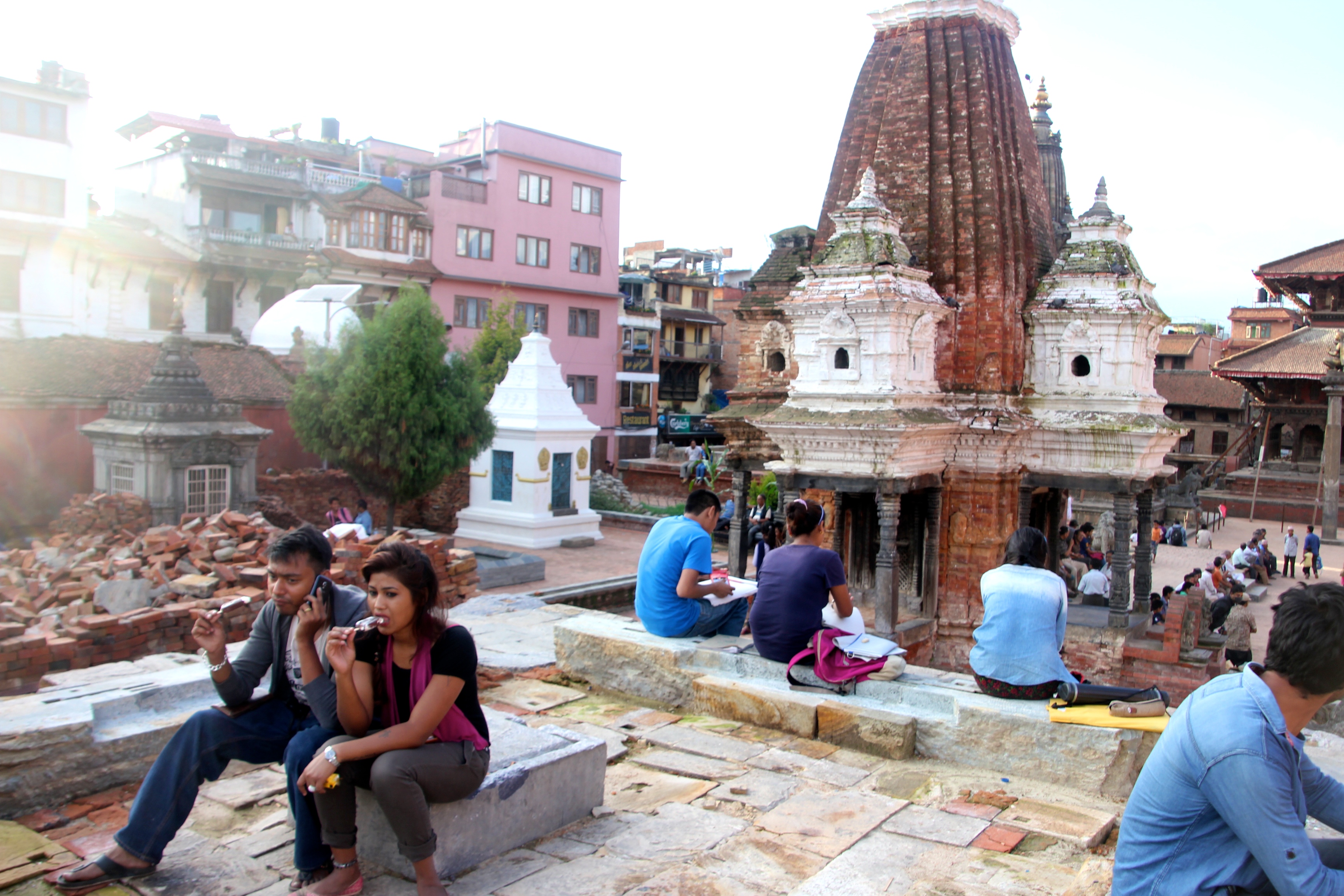
But who would think to take their picture for the news?

I think maybe, in the sterilized West, it is hard to believe in loss unless it looks like something we wouldn’t feel right resting our gaze upon in person. We see the spectacle and only the spectacle, because cracks don’t mean much, but the un-witnessable speaks to our understanding of destruction, and insulates it from the safe and organized world we know. But that’s impossible in this part of the world. Things are lost so often, so publicly, and with so little fanfare. All the falling and building is mixed up together with the balloons and scaffolding; the moment belongs to everyone.  So it is still okay to play.

We sat for two hours with all the other people doing normal things on the bald foundation of this temple, looking out over the square, talking in the warm breeze, and watching the balloons and ice cream and couples and pilgrims swirling around these fractured structures, which are on to the next chapter of their lives with minimal complaint or ceremony.

IMG_0940

When I boarded the plane to come home, my pants still had thorns in them from Tripureswor, Ward #6. These feisty little guys are so hard to get out you have to either pluck them one by one, or have a couple of ladies grooming them off you with a sickle like a baby chimpanzee.  I’ve been groomed a few times in the course of these last weeks, but I just kept walking through the thorns and re-collecting them, and now I’m taking them back to America.

Classy, right?

Hey, my hair looked good.

.      .      .

IMG_5191


The Road We Followed


A few weeks ago, I was sitting in a coffee shop in Lakeside, and overheard a woman at another table on the phone, trying to figure out how to help a village in Dhading. When she hung up she was frustrated and kind of flustered. We got to talking, and it turned out her name is Janet, she’s from Taiwan, and she has a friend named Bishnu in this village in Dhading, Tripureswor, Ward #6.  She explained all the ways she’d been trying, unsuccessfully to help Bishnu’s village.

I don’t know why, but after asking her a few questions, I told her I’d try to figure out what was going on in Tripureswor, Ward #6. Dhading is a few districts over from Pokhara, quite far from us, but I’ve learned enough about the system now that I figured I could at least make a few calls and get more information for Janet.

Plus, although I’m proud of the work we’ve been doing in the lower percentage of damage, I can’t help but feel drawn to at least see the higher percentage of damage first hand. So I was fascinated with Tripureswor Ward #6, because it fell in my lap.

I made some early phone calls a few weeks ago and confirmed, to my surprise, that Janet was correct in thinking that so far Oxfam had only provided 2 bags of rice, hygiene kits, and 20 kg of rice seed to residents of Tripureswor. Any other work there had been done by small, private groups.  I learned that out of 947 households in Tripureswor Village, 924 had been destroyed or damaged.  Fifteen people died.

I never actually saw Janet again in person, although I called to tell her what I’d found out, and she left to return to Taiwan a few weeks later, and recentlyIMG_5124 sent me a disappointed email saying she’d never been able to get anything together to help Bishnu’s village. One organization after another had either refused to help, or said they’d help and then backed out.

But Tripureswor Ward #6 has stayed in my mind. Since Lamjung is one district in the right direction and we were going there on Thursday and Friday to deliver tin, I called Janet’s friend Bishnu on Wednesday and introduced myself. On Saturday morning, Dilmaya and I decided to keep going on from Lamjung to Dhading.

Additionally, my good friend Anne has just arrived from the U.S. Anne and I met in the one Nepali class I’ve ever taken, during the summer of 2006 at Cornell. We are a great pair because she can read Sanskrit and speak royal Nepali, and I can’t read at all but I can talk with animals; she did her PhD and wrote a book on modern politics and public ritual in Nepal, making her an expert in local history and religion, and I am the world’s leading expert in carrying things on my head with village wives and cracking jokes in my rural accent. Between the two of us there’s pretty much no situation that we don’t have covered.

So on Saturday morning, Dilmaya and I took a bus east from Lamjung and Anne took a bus west from Kathmandu, and we met by the highway in Malekhu. And from there: to Dhading.

This is now the part of the story about a very, very long muddy road.  The second and main part of the journey, a few dozen kilometers from Dhading Besi to Khahare, took us five hours.

We passed this jam,

IMG_5131

and this jam,

IMG_5127

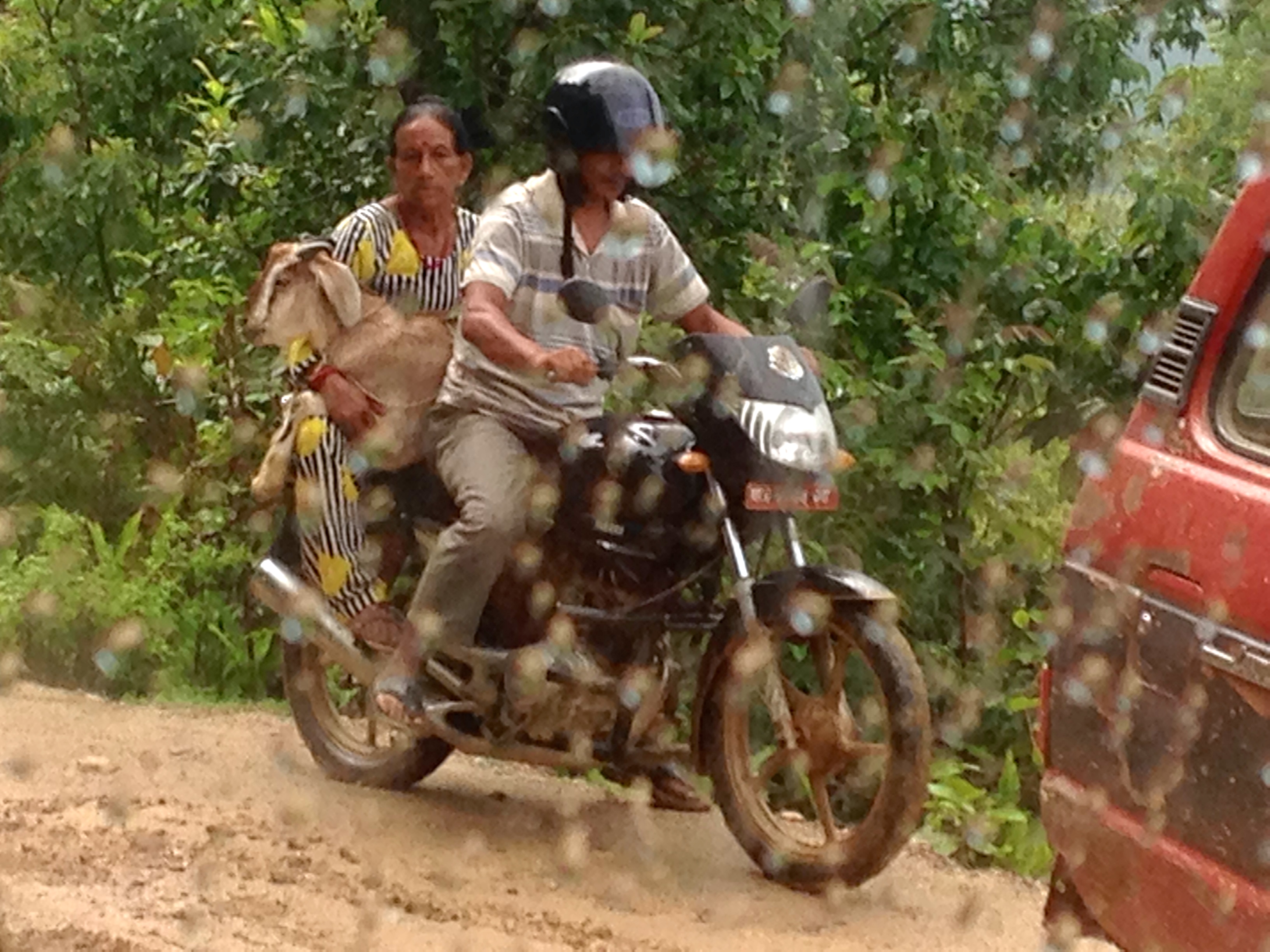
…let’s just zoom in on that grandma on the back of the motorbike with the goat.

IMG_5130


Inevitably, the bus gets stuck, because someone had decided that morning that it was a good idea to use a bulldozer to churn up the dirt on this road to improve it.  During the monsoon.


We sit in the bus for a long time, it is raining, I have no idea where we are, I play some Amy Winehouse on my phone and entertain everyone with my village accent. Eventually we get out of the bus and we start walking. We passed some people standing near the bus clucking their tongues, saying, “The dozer had just dug up this road and made it so nice and flat. And then just like that the rain came.”

I just want to use this opportunity to make a public service announcement: IT’S MONSOON SEASON, PEOPLE.  The rainy season.

IMG_2319

Dilmaya and me walking to Khahare (photo credit: Anne).


Now that we were all used to the idea that we would not be arriving in Tripureswor at 2pm or 5pm, but more like 8:30pm, or maybe never, the walk was nice. It gave us an opportunity to take in more and for me to take photos of the misty evening that had turned the glassy rice paddies blue and green.

IMG_0654


First of all: Dhading is nothing like Archalbot and Bharte. Almost all the houses collapsed or became tear-downs.

IMG_0636


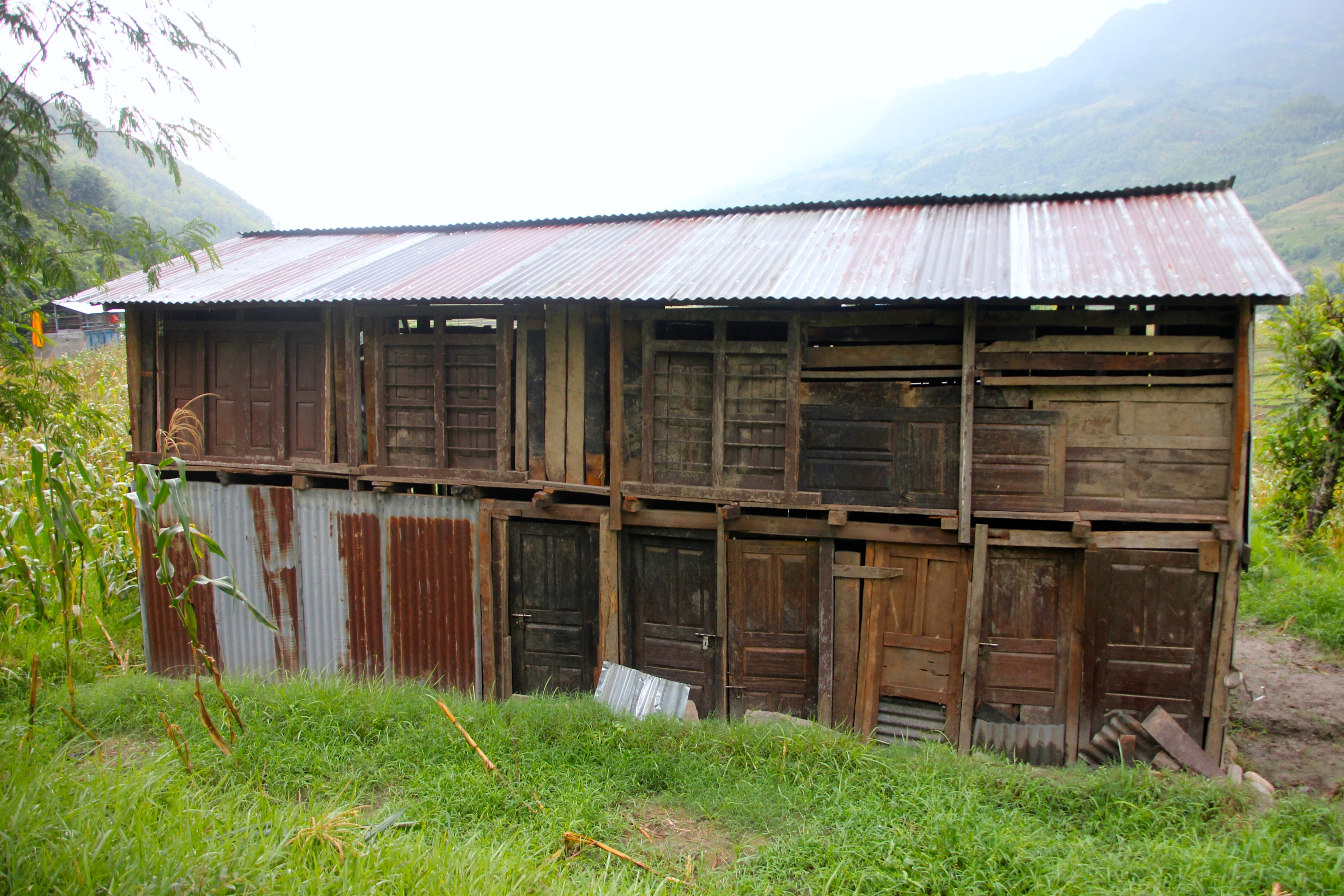
However, the rebuilding that’s already happened here is amazing. We realized right away that even though we don’t have the capacity to do tin delivery in a place like this, we don’t need to. House after house had been fully demolished by hand, materials organized in to piles, and new homes made from extremely innovative techniques. Our favorite was this one, made almost entirely out of doors and windows.

IMG_0635


We followed this road for what seemed like forever to its endpoint in Khahare. Bishnu’s mother came to meet us, and led us across a suspension footbridge over the river (this river and footbridge, has been one of the major obstacles to efficient aid delivery in this Tripureswor). And then there we were, at Bishnu’s house in Tripureswor Ward #6. We left Lamjung at 8am, and arrived here at 8:30pm.

IMG_0779


Not sure what we’re doing here, but I guess we’ll find out, and then I’ll tell Janet about it.

.      .      .

IMG_0745

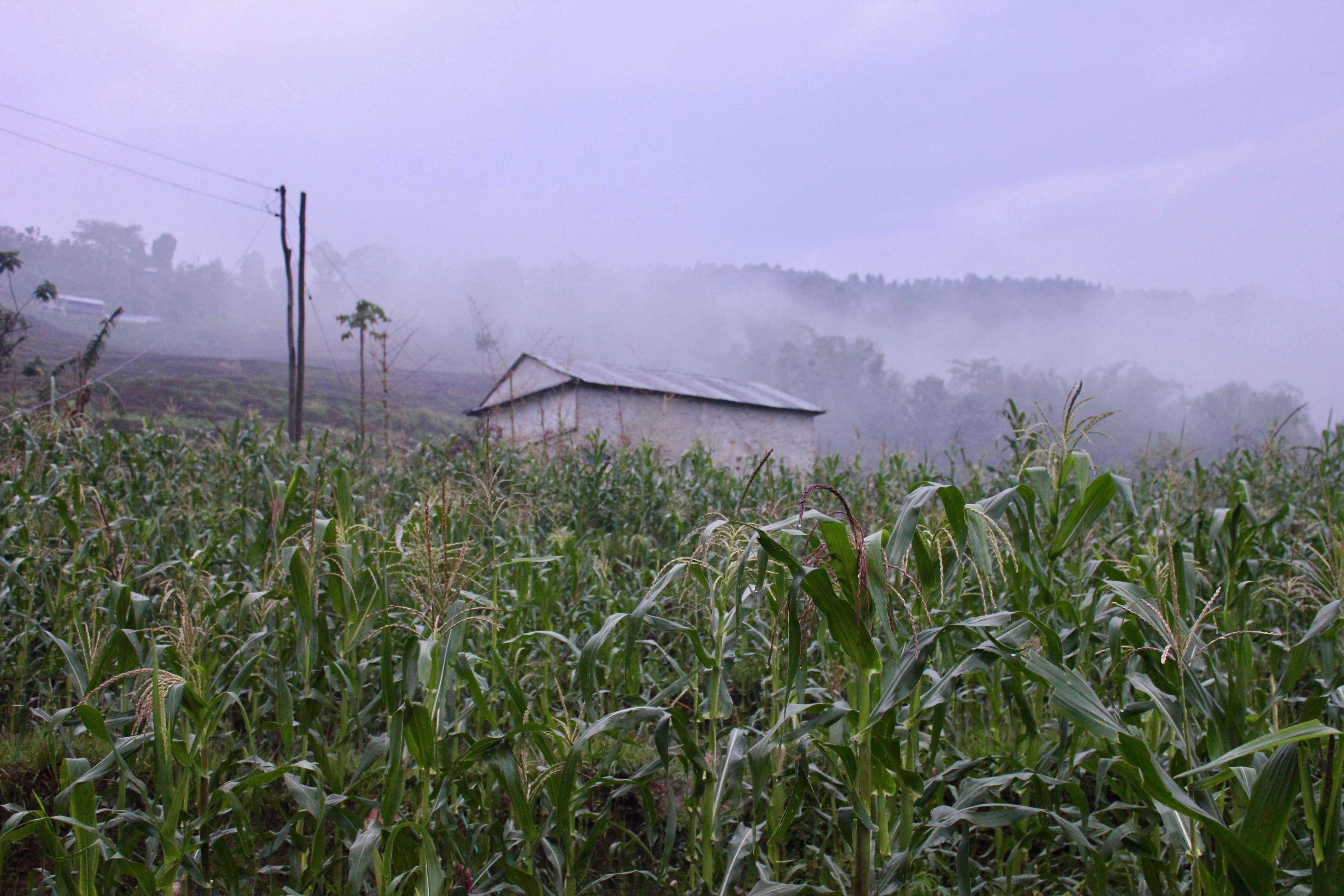
Bishnu’s recently built tin house, sitting among the corn fields in Tripureswor Ward #6.


Tractor Cowgirls


What a wonderful day!

After a week of endlessly trying to chase down corrugated tin, Dilmaya and I spend the entire day today riding around the hills of Nepal delivering roofs in Archalbot in Bharte.

IMG_0147

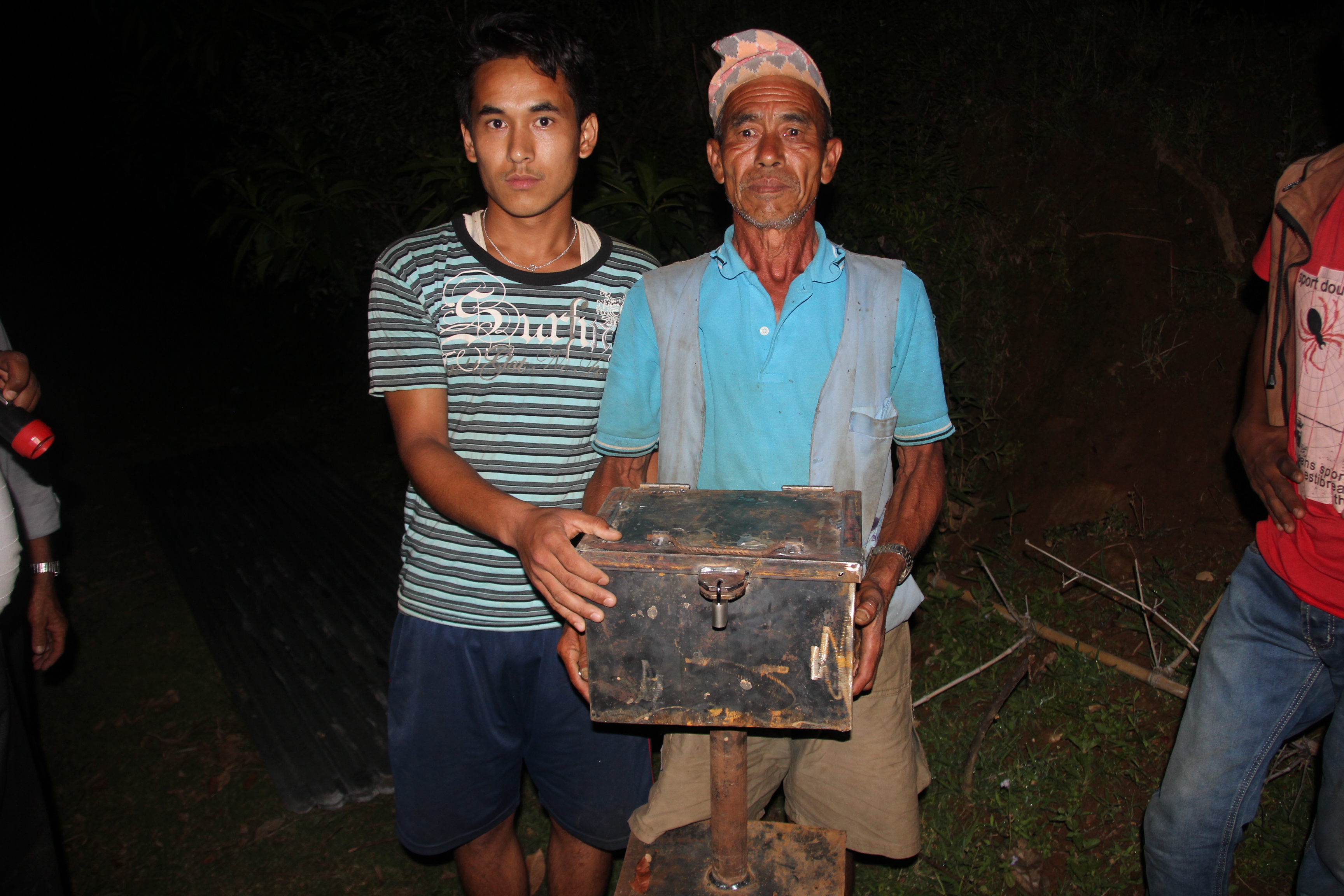
Our morning started off pretty slowly – I’ll spare you that part – but let’s just say there was heavy rain and 53 bundles of 12 foot, 60kg, corrugated tin involved – when you stack up even some of that tin and try to lift it, it’s as unmovable as a 12-foot block of concrete. There were two tractors and a jeep.  And, of course, one cute little Life Box.

IMG_0146We had a few special deliveries as well – cash relief for Bal Kumari, and a box of ceramic mugs for Muna Bujel’s family, which had completely rebuilt (minus tin) when I met them on that crazy ridgetop in Lakure. When I asked what else they needed, given that they’d done such an amazing job reorganizing their rubble in to a house already, Muna Bhujel looked around and kind of shrugged, like “Lady, look at this whole situation,” and said, “well a lot of our glasses were smashed.” So we threw a set of teacups for her.
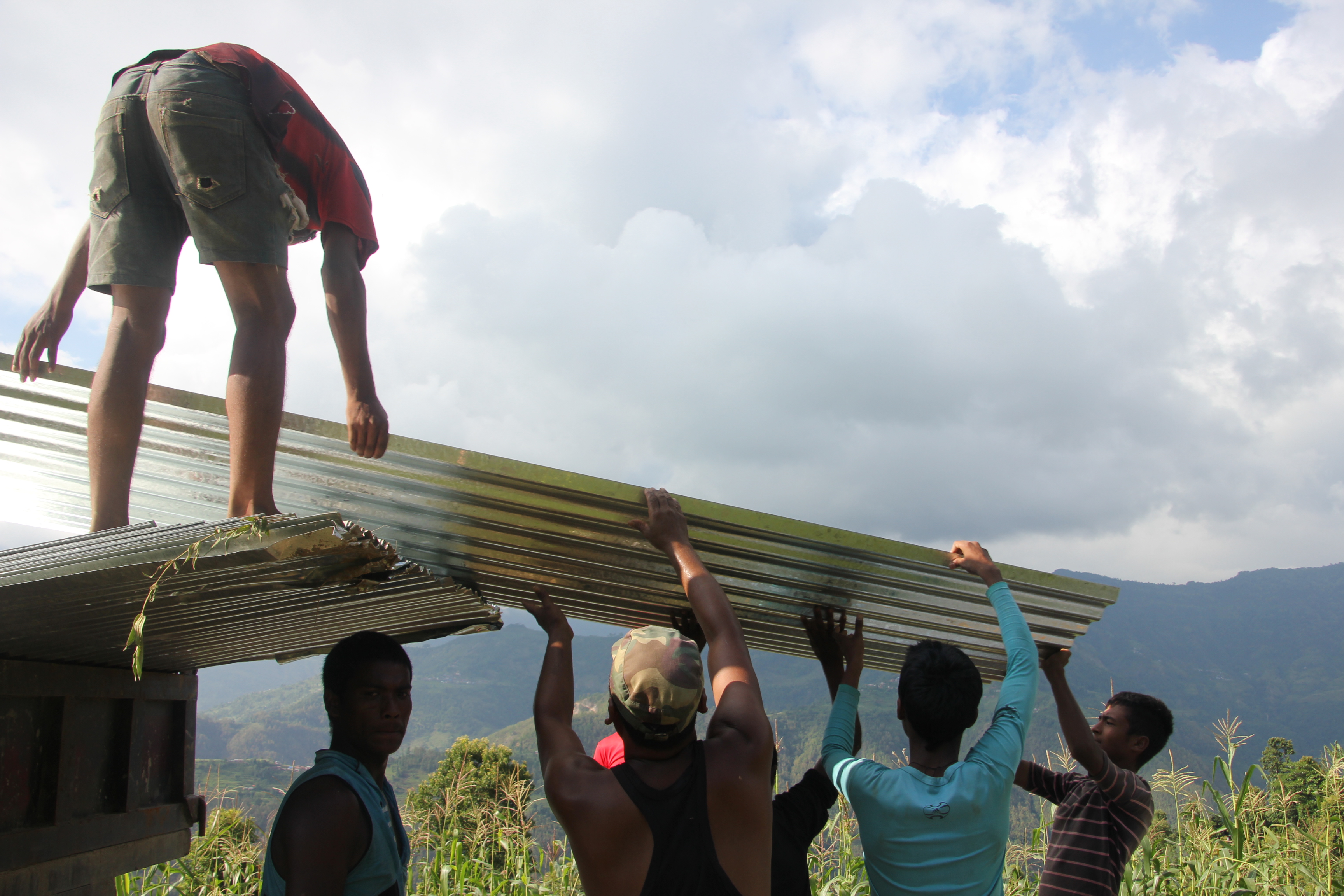
It was nearly 11pm by the time we hit the road in Udipur on tractor #1, which was carrying 17 bundles of tin for Archalbot. Voila, Archalbot tin delivery! While we were here, we met three more families requesting roofs. I visited their houses and told them to start building. We’ll be back next week to check on the rest of Archalbot, and we can bring roofs for a few more families if they build before then.

Next, we had to switch to tractor #2 which was loaded up with our major delivery for about 50 homes all over Bharte.  This led to a situation and the following clip of video that pretty much says it all.  Here is what it’s like to try to provide aid for half a million ruined and damaged homes in Nepal’s hills.  An anchoring wire on a footbridge had popped out of the mud softened by the rains, and our tractor couldn’t get over it.  This video takes place about half a mile from a paved highway, on a 10-meter stretch of the only road that leads up to the village.  We did this for ONE HOUR before crossing this little patch of road that is the access point for the entire hillside of Bharte.

We finally got to our first stop in Sirwari, which was totally awesome.  When I first visited Sirwari about a week and a half ago, three families were living together under this tarp.  We asked them to build a good quality bamboo house and promised a roof.  When we arrived today, they had built this gorgeous bamboo community home for all three families!  I love this photo because you can still see their old tarp in the middle, hanging out until we can put it out of business with corrugated tin.  We delivered said tin that very afternoon, and promised we’d come back to see the finished product and spend the night.

IMG_0202


We looked at some of the other bamboo frames in Sirwari, and of course I wanted to take lots of photos and hang out and talk with everyone and Dilmaya was texting me madly to hurry up because we still had two tractors and a jeep full of tin and a lot of deliveries to make.  On the way, we picked up Sarita, Kripa’s young sister in law, whose house we’ve been staying in in Archalbot, and who’s become our pal.  The three of us crammed in to the two-person seating area in the front of the jeep, and we were off again, eating some lychees.

Our next stop was Bharte Banjang.  As far as I could tell, it’s the poorest, most remote and devastated area that we’ve visited.  Lakure is also quite remote, but people there had mostly rebuilt, whereas in Banjang, we met families with lots of young kids living between rusty tin or having moved in to the buffalo shed, with the buffalo.

IMG_0219We brought new tin for 10 homes, housing 49 people, to Banjang.  By now we were in a hurry, so I don’t have as many photos, but the building quality wasn’t as good in this area.  People didn’t have access to long bamboo nearby, so even though our coordinator in Bharte offered long bamboo off his land for free, nobody went and got it.  Many of the frames this community had made were far to low to stand up in.  Instead of the bamboo wall technique we saw in Sirwari, which is tight and can be plastered with mud and made permanent like Tulasi’s house in Parbat, people had simply criss-crossed bamboo, like this, which is far less secure.  This is kind of a mystery to me.  I wasn’t IMG_0233sure why so many of the people in Banjang had made structures with such obvious problems.  We decided we’ll do our best to provide day employment for some of the Sirwari people to come up and help the people in Banjang.  We’ll see how that goes.  In any case, at least these folks will be able to move out of the buffalo sheds and such.  I will venture to say that if we had not required that people build before providing these roofing sheets, this is an area where a lot of our tin would likely have sat in the yard or been thrown on top of unsafe houses.
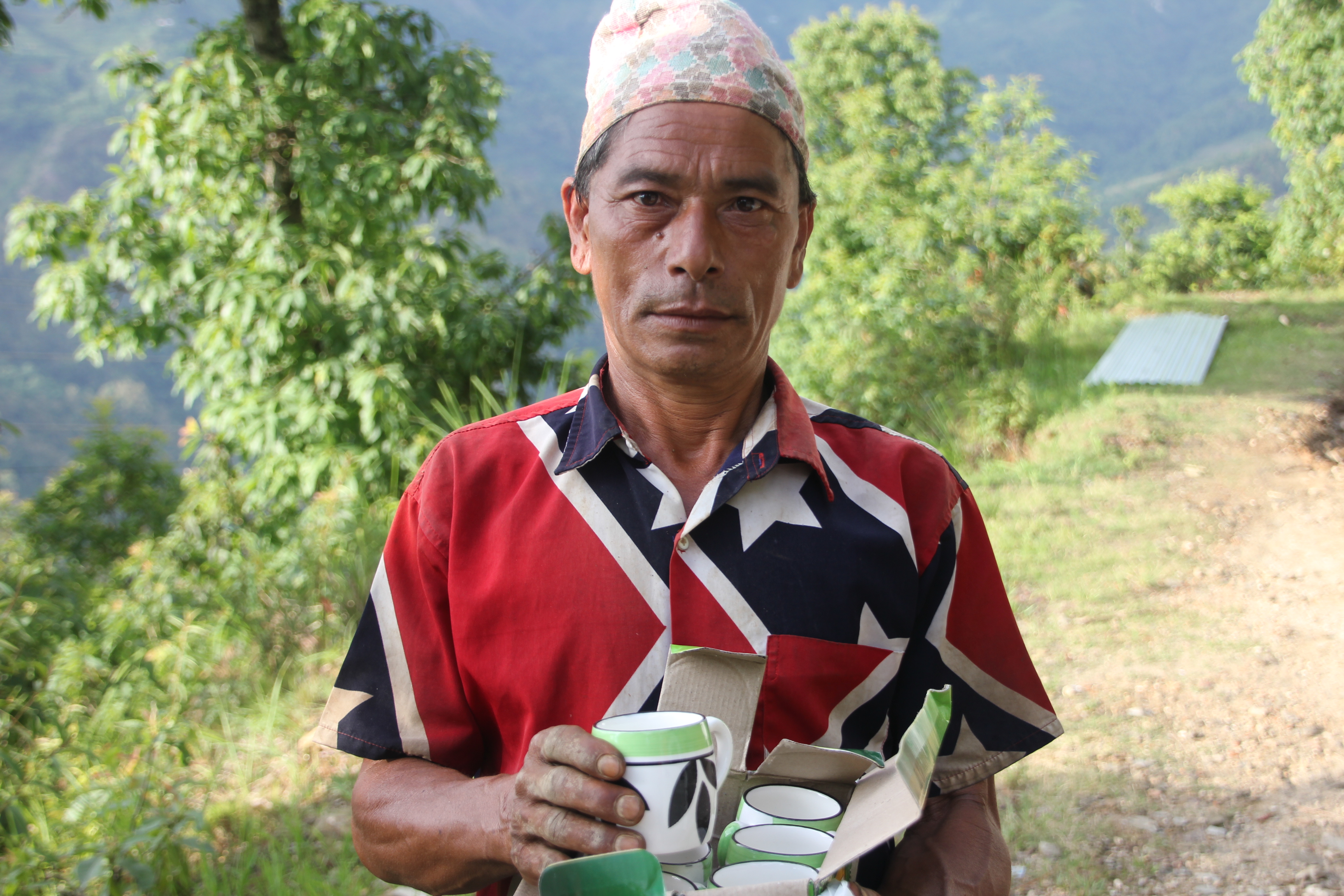
From there we went to Lakure, my favorite spot in Bharte, where we delivered tin to Bal Kumari, and gave her $300 in cash that she was not expecting, to repay her loans.  Here is Muna Bhujel’s father with the teacups we gave him.  As you can see, he is pretty much speechless.

IMG_0236Then it was time to go to Besigaun for another 12 homes.  By now it was dusk, and as we headed out to our final few stops, it was night.  We made our deliveries in the dark.

Now, are you realizing we’ve left something out here?

Life Box, man.  Life Box.

We took this box out here and there to show people, but it was all so hectic that we didn’t really have time to do much with it.  I mean there wasn’t exactly time to dig a hole in the ground and bury the thing.

At our very last stop, we realized we had an extra bundle of tin, and this nice guy, Lok Bahadur Bhujel, and his son, came out and found us in the road.  They had built a temporary house but for now they’d covered it with a tarp, and wanted to ask us for help.  Well, as it happened, we had an extra bundle of tin that needed a home, so off it went.  Along with the Life Box!

Well, that was one of the more interesting days of my life.  All together, we covered over 50 houses and about 250 heads.  We’ll come back to Bharte in a week or so to check on things and see how some of these homes turned out. Dilmaya and I ended up spending the night at Sarita’s birth home in Bharte, and let me tell you, we did not have any trouble falling asleep.

.      .      .

IMG_0271

Boxes and Glass Cases

It’s been a tough arrival.  The monsoon is still clinging to the hills, thick and cloistering, and each afternoon it dumps an unremitting rain that I swear to God follows everybody inside.  The air itself is full of water; there’s no place to be dry.

And the truth is, I am also a drop suspended in mid air.  I’ve moved out of my apartment in New York, but I haven’t moved in to a new apartment in Connecticut, so all my things are in boxes in my parents’ basement.  The plan is that when I get back in two months I’m going to be working in a manual therapy clinic in Hartford…but it hasn’t actually happened yet.  It’s an idea, hovering in good faith around some boxes in a basement, waiting to be taken out and used.

That feeling has trailed me all the way to Pokhara–the hint that my life is full of theories.  Even IMG_2479though my contact with my projects in Nepal has increased a great deal in the past year through Skype and regular written reporting, and I have files and files of documents proving to me that these creations are real, they still feel like experiments when I re-encounter them on the ground.  Plus, there’s a big disappointment right off the bat: our first program director has left unexpectedly, after growing the Kaski Oral Health Care Project much less than we’d hoped since last fall.  I’m tired and frustrated and it’s enough with the freelancing.  I am ready to feel like I know what I’m doing, and some of this fits together, and it’s leading somewhere that matters.

Today it led back up the road to Kaski.  I went to Vindivasini Temple this morning to catch the bus on its way down, so I could save a seat before the bus arrived at the park, where a crowd  gathers around the door and starts pushing in to secure real estate for the ride up before people can even get out.  As I waited, I sat on a stoop with my duffel by my feet, watching a man selling vegetables across the road.  And I wondered again if this is all some kind of act.  I’m just doing the same thing over and over.  I can’t keep my grasp on what it’s about.

Other than a story.  The word comes to me again, and then again: Story.  Right out of the blue, at nine in the morning, I’m sitting on a stoop waiting for a bus, watching a man weigh a cauliflower, and the next thing I know I’m watching a story, and my identity is divorced from my soul.  Poof!  I am a character.

It must be natural that when you go through enough repetitions of something, even something incredible, it becomes unmoored from any particular episode.  And with that goes its singular miraculousness, because it’s just what it is: a cycle.  How profound would the sunset be if you only saw it once in your life?

Sometimes the sense that everything is just a series of events, with nothing transcendent to tie them together, seems like the most awful thing possible.  Even the leaves clinging to the trees look worthless.  But in certain moments, that same arbitrariness erases the perpetual burden of discerning the purpose of each passing instant, and my role in things is set free from an anchor that, in truth, may never have been there.  What a relief.

This morning I watched the vegetable vendor.  The story settled around me, like snow in its glass case, shaken from the sky.  I waited, again, for the bus to take me up to Kaski, where I knew Aamaa would be waiting.  Again.  For me.

IMG_2638

A Story

Back in Kathmandu, Tom and Jerry ends, and we turn off the television.  We eat our rice.  I mush the grains between my fingers but resist the temptation to try to give the meal special attention.  You can’t grasp a thing at the last minute if you weren’t paying attention along the way.

I repack my bags, and don’t get in bed till after midnight.  With the heat and mosquitoes it’s a long time before I fall asleep.  I toss and turn, thinking about watching Bishnu and Bhinaju get in the bus back to Pokhara, and about the strange idea of being even farther away than I am now.  It seems like, for the rest of my life, I will keep getting farther and farther away.  Which is strange because, even from Kathmandu, in a big bedroom where I can hear Nepali music videos playing on TV, Kaskikot feels like a memory, a separate universe where I once was.  I was there only a few days ago.

You know, it never has been missing it that I dread, or the thought of loneliness that fills me with worry.  It’s the shift from real to remembered, from substance to recall; it’s that the absence has no bulk when you get far enough away, and that life goes on and—even if you can remember to miss it, it’s so disconnected, so unreal, that it’s mostly just a story.  And what of the part of you that has become the story, the skin that has touched this world and walked on it and dug fingernails into its mud?  When all of it is farther away than the moon—which at least your eyeballs can see at night—is that part of you just a story, too, that only exists to the extent that you still believe you were there?

Wouldn’t that be something, if after all this, all I could bring home with me was a story.

*

OLYMPUS DIGITAL CAMERA

Bua


For some time now, Govinda has been asking me to join him on a trip to Begnas to meet his in-laws. We began planning our visit a few days ago. Govinda’s father in law, who he calls Bua, will be alone for a few days while other members of the family are traveling, so it was a good time for us to arrange a visit to keep him company.

There was some thought that we would travel with Guru sir, who is searching for a match for his daughter. This has raised for me many questions about match-matching procedures. Does one stand in the road and stop the first reasonably marriageable looking male? Go from house to house soliciting bachelors? Distribute letters of inquiry? And why travel all the way to Begnas for this undertaking, twenty kilometers east of Kaskikot? 

I asked around a bit. My investigation was admittedly hindered by a very limited cache of Nepali words related to arranged marriage, but I deduced that Guru sir’s first visit to Begnas was for the purpose of meeting his relatives to discuss the search. So that solved the geographic question, though as far as I could tell, it simply meant Guru sir’s relatives would be standing in the road picking up single men. You can see why I was quite looking forward to whatever was going to happen during our visit to Begnas with Guru sir. But at the last minute it turned out that Guru sir’s rice harvest bonanza would be the same day we had planned our outing, and he would not be able to join us. So I’m afraid that at this time I can’t offer any resolution on the question of Guru sir’s daughter’s marriage arrangement. 

Early in the morning, Govinda and I set off for Begnas on our own. We arrived in Pokhara mid-morning and stopped in to see the artist who is helping us with our school mural, and I paid him. We discussed the idea of having him come to Sada Shiva to give a talk about his profession, as part of the series of visits I’m working on for the kids to learn about topics of interest like how libraries work and what pilots do and how photos are made.

At the bus depot in Prithvi Chowk, where dozens of buses paw sullenly at the pavement and pant in the diesel-filled hot air, we boarded another bus to Begnas. It set off laboriously down the highway, and I felt sleepy in the warm, acrid air inside the bus. Govinda bought some peanuts, and we ate them together in companionable silence, throwing the shells out the window, as storefronts sped by and blended together in a haze of mid-day life: pencils, apples, kilos of sugar, shoes, sticky cartons of fruit juice, pencils, sugar, apples, shoes. Finally the highway dead-ended in another small depot, where a dirt road wandered away from a collection of food stalls and small shops. It disappeared gently up into the hills. We followed it and began a long, rather hot walk to Bua’s house. 

The walk was pleasant, even though I still felt lethargic from the unyielding sun. Govinda’s uneven, methodical gait kept time, spurring us on at a steady and unchangeable pace. Begnas is warmer than Kaskikot, and we passed mango and banana and guava trees; it is currently orange season, and everywhere we could see ripening fruit that will soon find its way back to the roadside stalls and slung baskets and curbside mats heaped with fruit that we passed on the journey in. We stopped at a tea shop for peas and hard boiled eggs, and I drank a moderately cold coke out of a glass bottle, which left me feeling reinvigorated. We bought some hard candy and crackers to gift to the family. When we set off again, a hush had set over the terraces and orange trees, and the city felt far away. Finally, as we approached Bua’s house, I could see Begnas Lake to the west and Rupa Lake further east. Govinda removed his hat, and fanned himself briefly in the yard.

No sooner had we arrived than we were gathered around a plate of oranges with Bua. Govinda’s father in law was a slender, wiry man with a square jaw and lined, approachable face. He had a boyish way of moving that reminded me of my monkey-like fifth graders. Bua had work to do around the house, so even though Guru sir wasn’t there to answer my questions, Govinda and I sat outside talking about marriage practices until the sun dropped below the hills and it got cold.

We went back into the house where Bua was just starting to cook dinner. The next two hours were the longest rice-preparation process I’d ever watched on a hungry stomach. We did have an interlude of tea and biscuits, but I’ve become used to watching rice-cooking as a well-rehearsed, mindless affair, something that occurs very efficiently in the cramped spaces between other work. But Bua cooked very slowly: first one item, then the next, often pausing to talk as he cut vegetables or mashed spices. He was at once nimble, even lively, and unmistakably weary. It was as if he had to keep re-convincing himself that quelling his hunger was worth all the effort, and yet in the absence of dinner, I felt he would have been quite content to simply sit and gaze at the darkening hills with us.

Begnas

While Bua cooked, Govinda and I sat at a table, I with my journal resting under my hands. But I didn’t do much writing because Bua began to ask me a series of questions about America. 

“Nani,” he said, addressing me as one does a grandchild, “I hear they have very tall buildings in your country. Very very tall. Is that true?”

“Well, in some places they do.”

“And I hear there are those things that can take you up in the building,” he added, raising his hands.

“Yes,” I replied, “they’re called elevators.”

“Nani, in your country, how do people make money?”

“Nani, in your country, are clothes made to be durable for a long time?”

Between questions, Bua moved around the cooking fire cutting vegetables with his sickle. He seemed a little sad, but without a trace of bitterness, and there was an authenticity about Bua that put me at ease. I don’t think I’d ever met someone who could be genuine and restless at the same time like Bua was when he asked me about worlds I have seen. As the evening wore on, we developed an uncomplicated rapport, Bua taking an interest in this and that, and me content to feel like the kind of guest that he enjoyed: a participator with no agenda. It was a relief not to be waited on in awkward silence, and to have the opportunity for manageable dialogue that left space for the clumsy maneuvering of language-learning. 

As Bua picked up a korela vegetable and pulled his sickle down the middle of its alligator-like lumpy green skin, Govinda rose to go outside. I gazed quietly at Bua in the orange glow of the cooking fire, waiting for the next topic of discussion. 

“I’m going to die here,” he said matter of factly. He lifted his long hand and indicated the house. 

I didn’t have a good answer, because he’s probably right. So I just waited while he picked up my journal and gazed at its pages and pages of tiny writing.

“You will do your writing, see our country, and go back to America,” he sighed. The ink-filled pages suddenly seemed a pathetic sum of Bua’s entire world. “Me…” he waved again at the dim narrow walls, “I will die here.”

Then he shook his head, and picked up his sickle again.

“Nani,” he said amicably. “In your country, what are houses made from?”


*


Pictures of Schools

all 710I had heard that there was a small school in the woods, facing south, far below the road that cut through Kaskikot along the mountain ridge.  On a late fall morning in 2002 I went looking for it.

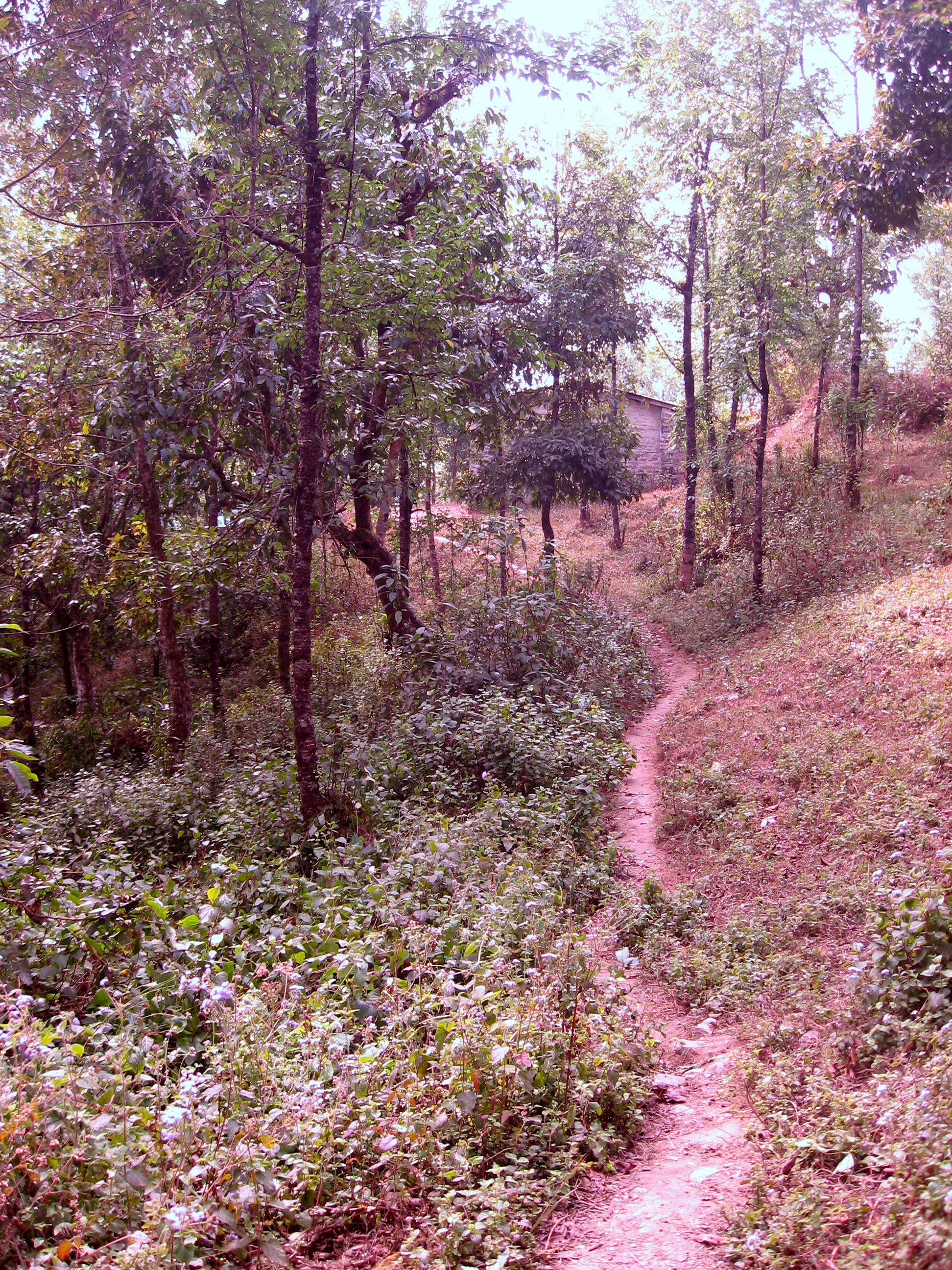
I followed a descending path of broad stones as far as the village mill, and from there I turned onto a winding footpath that halted and dropped and navigated roots in the ground and in some places seemed to disappear entirely.  Soon I heard no sounds except the whir of the trees and the suggestive rustle of an occasional monkey in the tall grass.  I passed a spring and a temple.  I came around a bend.  And then, demurely, as if waiting for a visitor, a stone wall appeared in a clearing up ahead.

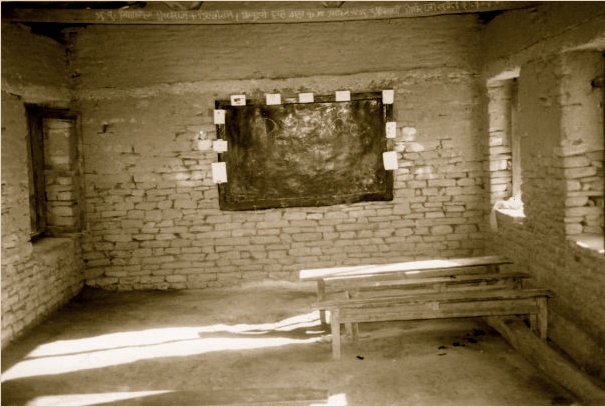
I approached the building and emerged from the hushed woods into its open yard, a bald mound of dry dirt looking out over forests and terraced fields.  The view extended all the way down to the valley floor, but the school ground still felt hidden among the trees.  There were two piled stone buildings with wooden shutters and doors, most of which were missing panels, the gaps blocky and conspicuous like missing teeth in the open-jawed windows.  I peeked in to some of the classrooms and saw benches sitting mid-wobble on the dirt floor, facing blackboards whose still-fading scribbles bespoke prior lessons.  These objects regarded each other diplomatically, as if ready for anything but expecting nothing soon.

When I’d left the United States, I hadn’t decided where I was going to end up.  China was a leading Sada Shiva (Class 3?) - Version 3contender.  I was offered a position in a school with 2000 students. My mother didn’t want me to go to Nepal—there was an insurgency happening.  I didn’t know anything about any of these places.  I didn’t speak Chinese, for example.  I spoke French.  I was a terrible candidate to do any reasoning on the topic.  One day, in Bhutan, I was sitting still doing nothing except worrying about where I was going next, when, with as little ceremony as a tenant entering his flat, a picture of a small classroom floated in to my mind and landed there.

To this day I can’t explain why, but I knew that classroom was in Nepal.  I was going to Nepal.

I wound my way back through the forest, past the spring and the temple and the mill, and up a different set of ascending broad stones, I emerged again onto the wide bus road along the ridge.  Directly across from me a man was sitting in front of his house on a low wall.  He was wearing simple brown pants and a V-neck sweater over a long sleeved shirt, and chatting with a round-bellied man dressed in the clothing of a Brahmin priest.

The two men called me over and asked when I had arrived in Kaskikot and what I would be doing there.  I told them I had just been to a small school in the woods, whose name I had forgotten, but where I was hoping to teach.  As it turned out, both of these men were teachers at that school, which was called Sada Shiva Primary.

The man in the V-neck sweater introduced himself as Govinda Prasad Paudel, the English teacher.  For the next two and a half months Govinda and I walked the wooded path back from school together every day.  During that time our friendship was formed, and instead of calling each other by name, we began to follow the Nepali tradition of addressing one another by a familial relation.  I called him daai, or “older brother,” and he called me bahini.

00012004050900500061