Dad Explains It


Let’s start with background info: my father is both an engineering physicist and a tech entrepreneur. Add to that Olympic athlete and type A+ personality, and you have a world-class Explainer.  My dad is so good at Explaining Things nobody even knew existed, much less needed explaining, that some time ago I started a Dad Explains It video collection.

In this collection you can find such explanations as the anti-slip rubberbander (see below); how to separate an egg using a plastic bottle (a favorite – highly recommend); why an empty wine glass will, albeit unsatisfactorily, substitute for spectacles in a pinch; how to fix your fire truck ladder with glue, and how glue works; how to make a one-flip pancake; advanced paper-lantern lighting in a five-pointed star from Nepal; why it is easy to rip saran wrap in one direction but not the other; and a best-hit, the benefits of curtain velcro.  My mom typically plays a key supporting role in these videos, as herself:


On the Explaining front, Dad and Aamaa turn out to be a match made in heaven.  Because Aamaa requires explanations of everything from traffic lights to faucets, and Dad has a limitless endurance – some might even say compulsion – to leave no beautiful creation of the universe Unexplained.  This is extremely handy for all of us.  We girls (Bishnu and Mom and I) just aim them at each other and go about our business.
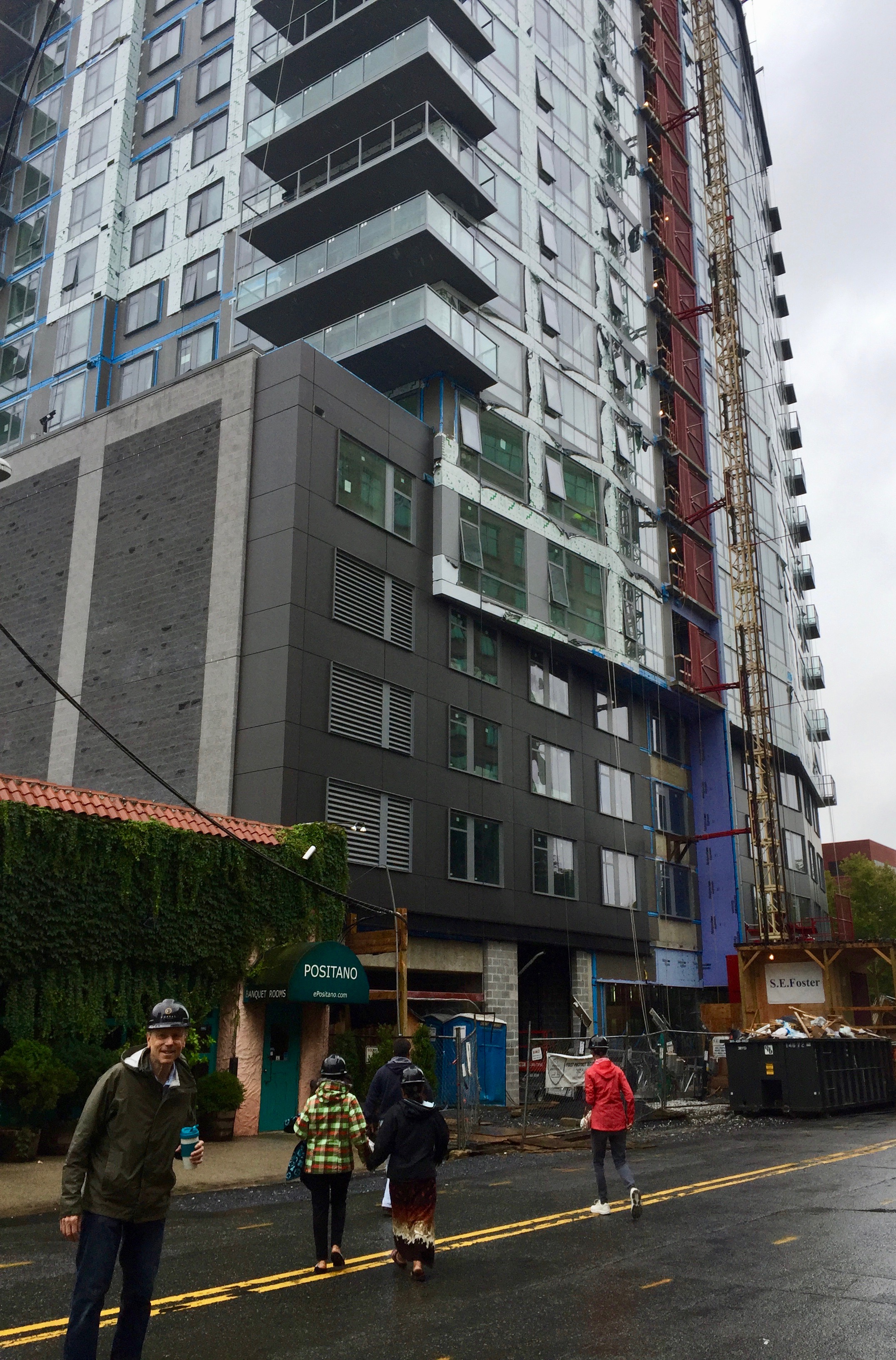
Over the weekend, we’ve made a family visit to a high rise apartment being constructed in downtown Bethesda. Aamaa is curious about all forms of construction. Like my nephew Jonah, she presses her nose to the window every time we drive past something being built. I decide this comes in the same vein as knowing the origins of food and other things that in Aamaa’s world travel very short distances from creation to use. There are comparatively few things in her life that just appear with no traceable origins–I mean, back in the day, Aamaa and Hadjur Aamaa used to walk to the border of Tibet with baskets to trade for salt. Even modern concrete houses in Kaski are constructed without machinery using materials readily available in the local environment. So a suburban high rise presents a mystery on many levels. How is it all put together? Where does it come from?

First we stop at the building company, where we are provided hard hats. We all agree that Aamaa kills in the hard hat.  (She has to sign a visitor agreement, and since Aamaa can’t write her name, she uses a kind of plus sign – it is always strange to see Aamaa’s incredibly dextrous hands fumble unfamiliarly with a pen.)  Then we head across the street to a service elevator that is in place just for purpose of constructing the high-rise. When Aamaa and I were in Kathmandu a few weeks ago, we visited the third-floor rooftop of a mall. “Holy crap this is high up,” Aamaa proclaimed. “All the buildings in Kathmandu are enormous.”

“Push the button for floor seventeen!” Mom cries as we enter the service elevator.

Aamaa grasps Mom with both hands and the elevator lifts us off the ground with a jolt.


We wander the half-built highrise apartment, whose main walls are still open to the sky. Aamaa and Dad are transformed in to a superhero team patrolling Gotham City: there are things that need explaining EVERYWHERE.   The space is divided by empty wall frames which have mammoth-size pallets of insulation stacked up between them. Dad and Aamaa commence an epic geek-out over insulation and plaster, and then shift their nerdfest to the feat of having transported the insulation – and the rest of this stuff – seventeen floors above the ground. Where will the plumbing go? And electricity?

This slideshow requires JavaScript.


The construction company employee treats us to a view of the roof. Aamaa has surprised us all with an ominously keen sense of direction in this unfamiliar world. The first few days after she arrived, we were driving around in Connecticut when we approached the drug store on the corner of my street. “This is your street, right?” Aamaa asked, before I had made the turn. I was absolutely baffled that she could get oriented so quickly when most of the visual landmarks are foreign objects with no inherent meaning, like a drug store. Now, on the roof of the high-rise apartment, Aamaa surveys the city below, which she has spent some time touring with Bishnu and me. She extends one finger toward the top of some buildings.

“The subway is in that direction, right?” she asks, correctly.

My Dad becomes ecstatic over Aamaa’s engineer-like spacial acuity. My Mom responds by scanning the horizon herself.

“And over there I see…Machhapuchhre!” she announces.

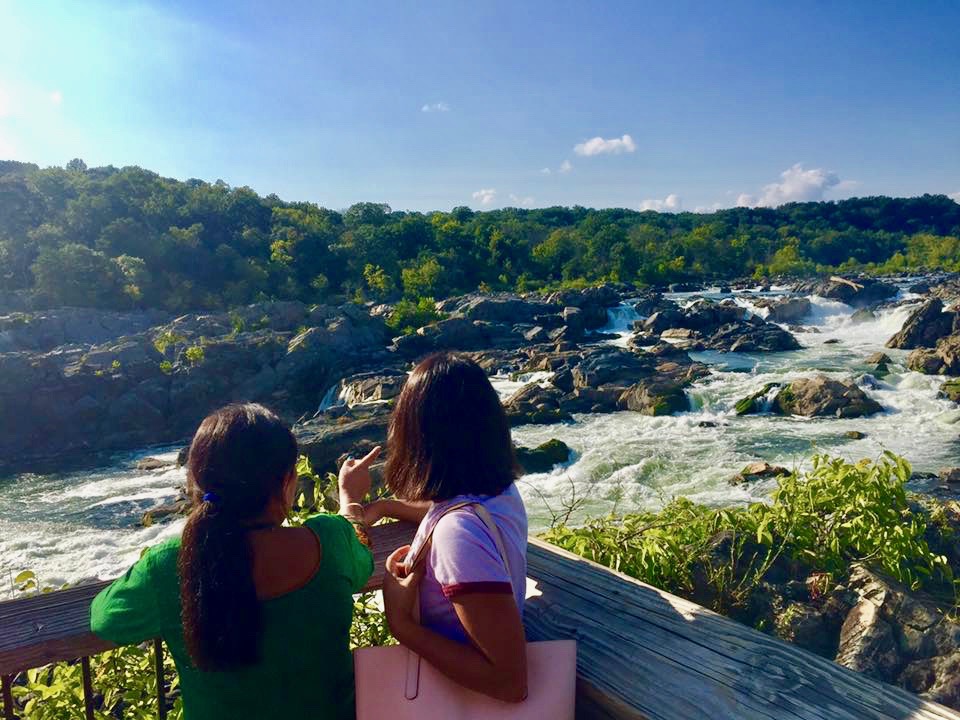
A few days later we went to go visit Great Falls and the Tow Path and along the Potomac River, where my parents used to take us for hikes on the weekends. Back then we had a special rock bench that my brother and I “discovered,” and which was, for purposes of eating a picnic of peanut butter sandwiches, the target of every summer expedition we made to Great Falls. My dad and I have both rowed many miles on the Potomac River, and on the fourth of July our family would come to the boat house and put on smelly life jackets and watch the fireworks from canoes on the water. This area is part of the circulatory system of our family.  We pulled in to the parking lot at Great Falls with Aamaa.

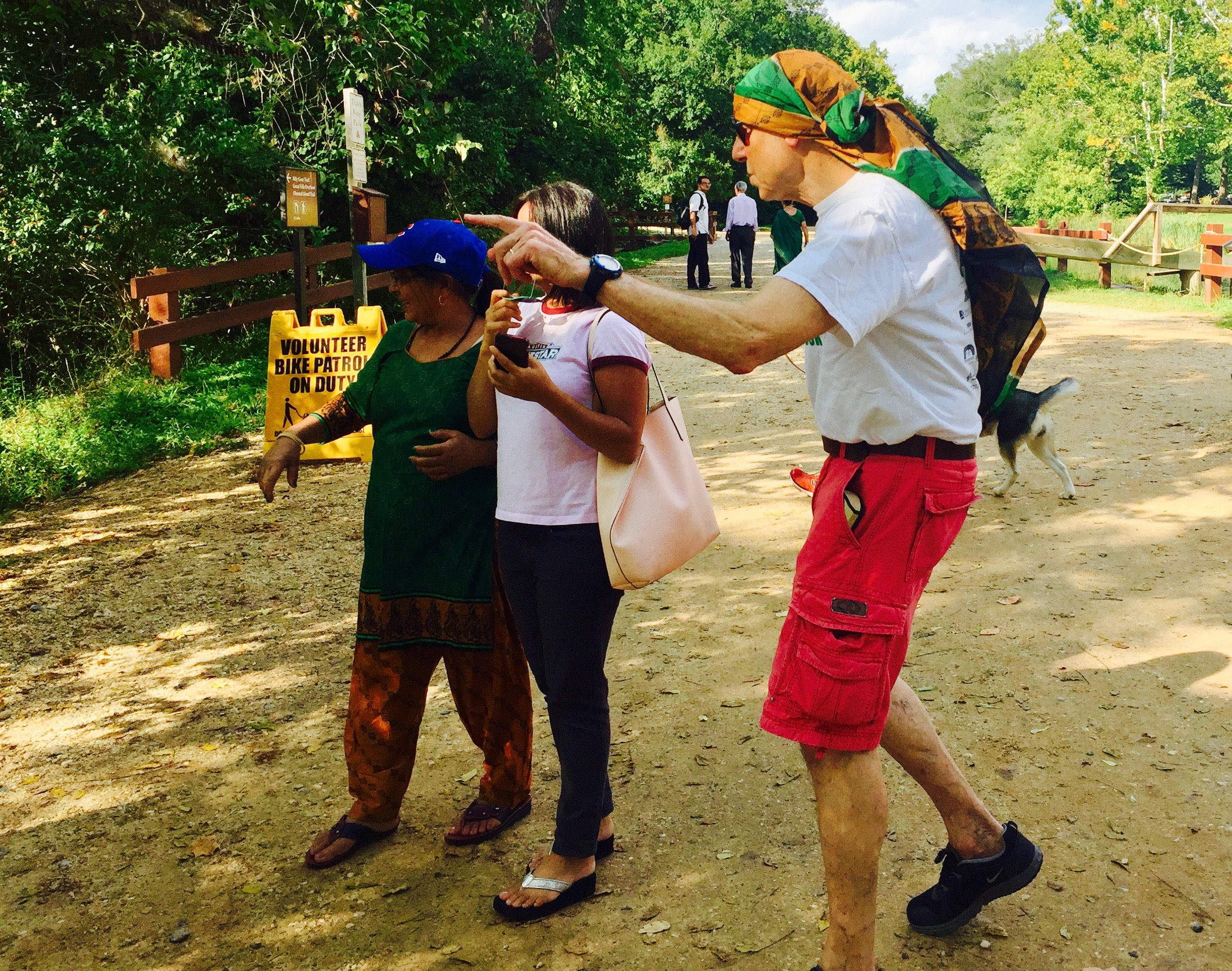
For some reason that now I can’t completely put together, one of the first things to occur was that Aamaa and Dad got to trading their shade-producing accessories.  I’ll just leave that there.

The only major bodies of water near Kaskikot are the Gandaki River and Phewa Lake. The first, we can cross through the riverbed in our flip flops unless a flood or unusually extreme rain has come through. The second can be crossed by paddle boat in about half an hour. So Great Falls was…great.
And now another confession. For all the years that my family has spent at Great Falls, for all the rowing and firework-watching and picnicking…my brother and I somehow both grew up thinking this was the “Toe Path.”

I know. It’s bad.  Because of the Explaining that is required with Aamaa there, this comes up in conversation.

“What?” my dad says, with the displeasure of a Master Explainer who has realized, at a time when his offspring are grown-ass adults raising children and trying to survive in the world on their own, that something so basic, and so explainable, and so important to the family history as the tow path, NEVER. GOT. EXPLAINED.

Dad explains the history of the C & O Canal as a trade route, complete with a detailed explanation of the the locking mechanisms that allowed canal boats to move upriver. And, swept up in all this Explaining, Dad finally breaks out in to song. This is a thing that happens sometimes.

And so on.  Lead the way, Dad!!

*
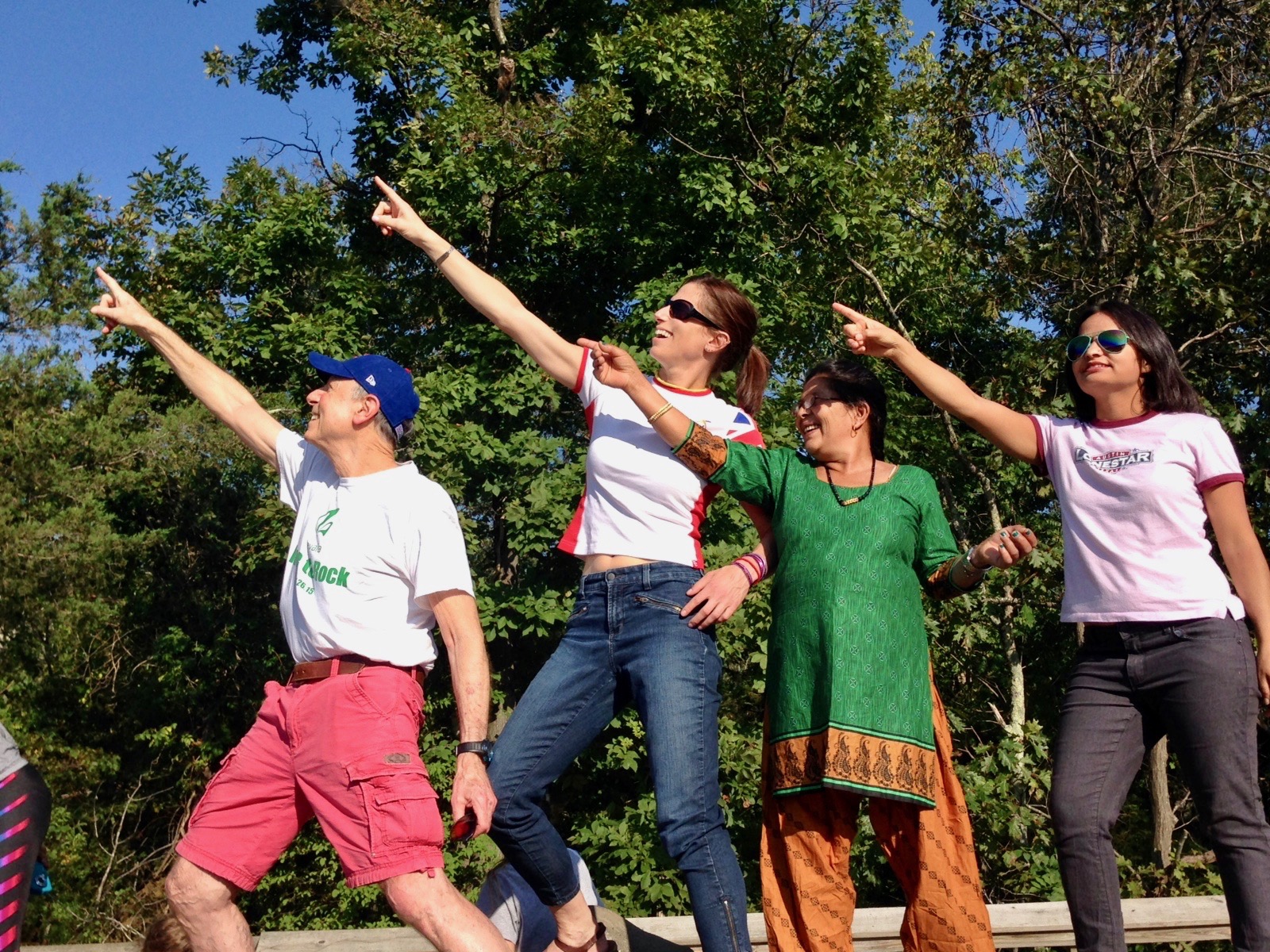
*Bonus reel (true undoctored historical evidence)*:
 

Confidence Under Construction


For about a year now, the Government of Nepal has been undergoing a decentralization of power. The country has been divided in to five provinces and outfitted with new government employees at the state level. It’s an exciting moment for a project like ours, which is aimed at capacity building in the government health system. Right now entire tier of government in Nepal is literally undergoing construction for the first time.

In the mean time, a large number of essential items are not yet decided even as the new government is deploying its duties. The desks are purchased and people have been assigned to sit behind them – literally – but exactly what these people are responsible for and how their responsibilities are to be executed is still a work in progress. Many operational policies are still not in place, and decision-making power isn’t yet clearly defined between different levels of government. Basically, we are in a car that is being built while rolling down the highway. You’ve probably been there too, right? And I accept that many people would find this alarming.

These people, however, find it AWESOME.

This a great time to be a grassroots organization in Nepal that has been working on health care with previously less-empowered leaders in villages. Jevaia Foundation has accumulated a lot of specialized knowledge on a key primary health issue that few if any other organizations are working on in Nepal. We have policy ideas that we’ve already modeled in multiple health posts, and there are elected officials in lower levels of government with an interest in getting this model supported by the Ministry of Health. And right around the corner from us is the capital of Province #4, where policies, budgetary headings, and guidelines that will decide these matters are currently being created.

Our hope is that in coming months, we’ll be able to play a role in influencing some of the new health policy. Currently oral health care in Nepal is available almost exclusively in private practice. The ministry of health doesn’t even have a budget heading for oral health at the primary care level, and in the villages where we work, leaders have cobbled funds from other budget categories to run dental clinics in their Health Posts. In the new provincial system, we’re hoping to organize local officials and communities to demand the creation of oral health budgets from the Ministry of Health at the province level.  Cool, right?

So even though everything’s a bit weird here at the moment, a time of change and uncertainty is of course always, potentially, a time of heightened opportunity. It is certainly a million times better than an unyielding stasis, as anyone who has been in one of those surely knows.

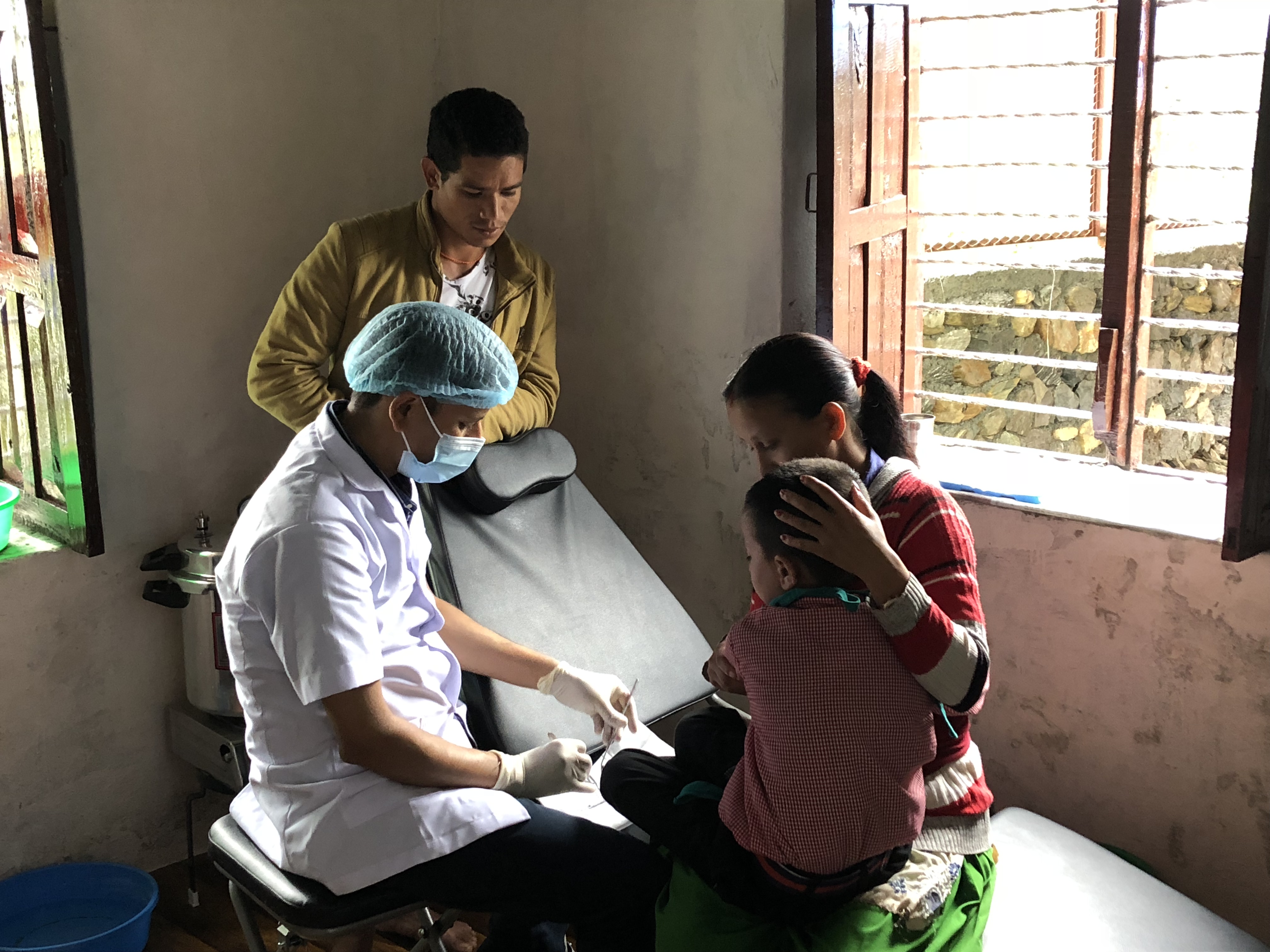
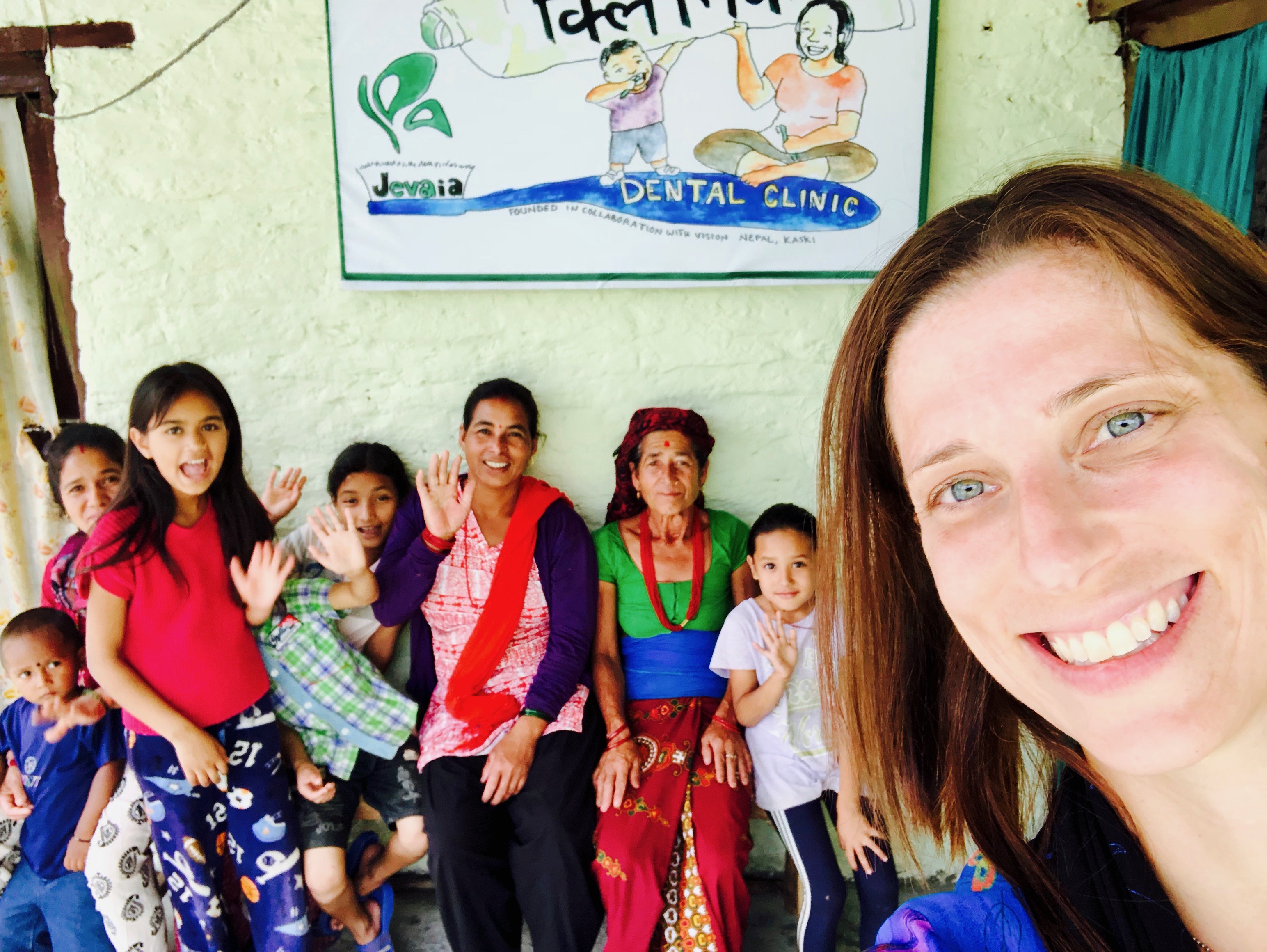
Now let’s bring this all back down to the ground for a second, in my home village of Kaskikot, where the newly elected village leaders reopened the dental clinic we started…which had been closed for SIX YEARS. (Here’s the Washington Post story about our handover of the Kaskikot clinic in 2013.) The new Kaskikot clinic is fully integrated in to the Health Post and financed by the village government. Patients register in the main building and then take a registration ticket to the dental room. Data on patient flow and treatments provided is maintained just like all other primary care services delivered in the government Health Post. Our job is now confined to monitoring quality of care and technical support. It’s AMAZING.

In order to garner backing for this example and its variations in other villages, we’ve been hard at work over the last few weeks meeting people behind desks in the new province government, and then meeting with other people they suggest we meet with. It’s so refreshing to talk with these newly appointed officials and to brainstorm with folks outside government who, like us, have been chipping away at sticky issues for a long time and are trying to sort out what the new system means for these bigger goals. The confusion of the moment is offset by what feels to us like a sense of possibility and movement.  At the same time, it’s important that everyone carry on with a grand performance of confidence, even though nobody is sure what is going on. So, ok, we’re doing that.

For example, recently I thought to invite a couple folks we’d met up to Kaskikot to see the dental clinic one Sunday. They agreed to come. I immediately began worrying over how to make sure that they’d be there on a busy day. The Kaskikot clinic is generally seeing about 8-15 patients a day, which is getting close to full capacity…but it’s also the busy planting season, and it’s raining, and….and anyway, it would just be a bummer if we invited Important People to our clinic and there were not a lot of patients when they arrived.  Maintaining confidence under construction means pulling out all the stops.

Fortunately, the Kaskikot clinic runs on Sundays, and I spend Saturdays at home in Kaskikot. I decided to invest in some advertising. Here’s where we move this story from Important Offices to Aamaa’s Kitchen.

“We’re going to the clinic tomorrow morning,” I informed Didi and Aidan and Pascal over dinner. They were in Kaski last week for school vacation. Didi protested that she needed to leave early morning to cut grass for the buffalo because Aamaa’s leg has been sore. Also, she pointed out, What if it rains later in the day? I told her I was 100% certain that it never rains on Sundays and that, in conclusion, we were all to leave for dental exams at 9:30am sharp.

On Sunday morning I started my rounds early, at Saano Didi and Saraswoti’s houses. Nobody looked like they’d been planning on a dental checkup after breakfast. “C’mon guys, we’ll go together, it will be fun. Malika Didi is coming,” I begged. With dignity, of course. For the greater good.  Then, walking down the ridge toward Deurali, I ran in to Mahendra sauntering home.

“I need you to come to get a dental checkup today,” I said.

“A dental checkup?”

“At the health post. There are some important people coming to see it.”

“Ok Laura didi.”

“Really? You wouldn’t lie to me.”

“I wouldn’t lie to you Laura didi.”

“Hey and bring some of your friends,” I added, testing my luck. Mahendra has a posse of bros that move as a pack.

“Ok Laura didi.”

Mahendra and Saila

“Really?” It seemed suspicious.

“I’ll be there Laura didi.”

“Around 11,“ I said, and continued down the ridge.

I came to the yard of Saili Bouju, who’s married to our local shaman, Bauta Dai. Since I pass  their front yard every time I walk home from the main road, we check in pretty regularly. When I’d arrived on Friday, we had already made a plan to go to the dental clinic Sunday morning.

“Saili Bouju, we’re going for a dental checkup today, right?”

“Yes, yes Laura,” she assured me in her deep raspy voice.

“I’ll be by at 9:45,” I said. “With Malika didi.”

I continued up the walk to the the next two houses, where I made my pitch to Barat’s two sisters-in-law and their families over tea. Ambika Bouju happened to stop by as I was rinsing my teacup.

“Ambika Bouju, come for a dental checkup today.”

“Hey, I’ve been meaning to do that,” she replied, to my great happiness. “I need to take my son in.”

“Today’s the day! There are some Important People coming from Pokhara to see it. We need a crowd.”

“Ok, I’ll be there,” Ambika Bouju agreed.

Out at the main road I came upon Amadev bouju in her yard. She can’t hear very well. “Bouju, let’s go to the health post today,” I said. She smiled and nodded and said, “Sure, Laura.” She’s an overall positive person.

“Really?”

“Ok, ok,” Amadev Bouju said.

“To get your teeth checked.”

“Yep!”

I had a feeling we might not be talking about the same thing, so I hopped down in to the yard to discuss the matter at a shorter distance.  “COME TO THE HEALTH POST WITH ME TO GET A DENTAL EXAM,” I repeated.

“Oh! Dental exam? My teeth don’t hurt.”

“A checkup is important!” I proclaimed. Amadev Bouju rolled over fairly easily. She said she’d meet us at the clinic.

I made my way toward Butu bouju’s house.  Back in the day, when her daughters were younger, we used to have sleepovers and make chocolate chip pancakes over the fire.  Butu bouju was out in the yard and tried to impose more tea upon my already full-of-tea stomach. I was delighted to find out that she’d been thinking to bring her grandkids to the health post for a dental checkup at some point. “I’ll be by with Malika didi to pick you up,” I said, making sure that Didi would have no out now that I’d advertised her all over the village, and headed home.

“I’ve rounded up most of the people in Deurali,” I announced over breakfast. Didi replied that she was going to cut grass. I countered withthe importance of oral hygeine, and of my schemes, and how she loves me. And so on.

We set off mid-morning. Narayan and Amrit, who over to play with Aidan and Pascal, were rounded up and I shuttled the whole gaggle along the edge of the cornfield. They disappeared in to the tall stalks and I turned around to make sure that Didi was following close behind.

Somehow, by the time we got to Govinda Dai’s house, I was already alone again. Didi had peeled off to go retrieve Butu Bouju. Saili Bouju said she had a headache and would go another time, and only after much cajoling said that she’d meet us there in a little while, which I was pretty sure was a way of pacifying me and sending me on my way. When I passed Ambika Bouju’s house, she was nowhere to be found, and even though her daughter said she’d be up the road shortly, it seemed improbable. All four boys—Pascal, Aidan, Narayan and Amrit—had taken off ahead of me down the road while I was trying to recapture our patients, and by the time I reached Govinda’s house in Dophare they were nowhere in sight. I walked in to Govinda’s yard alone, not seven minutes after mission launch.

“Ok Dai, let’s go,” I resigned.  I’d been in this moment at least a thousand times before: everything looks static and bleak. There are no people. It is foggy or rainy or dark or something else that generally conveys that you are all alone. Well, something would work out, or it wouldn’t.

As Govinda dai readied his umbrella, I looked in the road and saw that Mahendra had appeared out of thin air, with a friend. They were carelessly posted by the side of the road, sullen and awesome as usual.

“I told you I was coming, Laura didi,” Mahendra said with casual authority. “You guys go ahead. We’ll be along.”

Near Maula, we caught up with Aidan and Narayan. “Where are Pascal and Amrit?” I asked. “THEY WENT HOME,” Aidan declared triumphantly, beaming. I sighed. Oh well. “I’m going to call your mom,” I said, and took out my phone to dial Didi, who was missing in action. “I HAVE MOMMY’S PHONE,” Aidan proclaimed ecstatically. “IF YOU CALL MOMMY IT WILL RING RIGHT HERE!”

I thought morosely that Didi and Butu Bouju most likely got to chatting and weren’t coming along.

We arrived at the Health Post in a thick fog. The previous night’s rain had left everything squishy and slick. Durga, the clinic assistant, was just getting through the morning disinfection and setup process. The technician Dipendra was nowhere to be found. It was 10:40 and our visitors where scheduled to arrive at 11.

10:50. Dipendra rolled up on his bike.

10:53. Pascal and Amrit came tumbling out of the fog through the gate to the Health Post complex. They tore across the lawn, jumped over the wall, and went back out in to the road to play by the pond until called for their exams.

10:57. Didi materialized from the fog at the gate. Behind her, Butu Bouju was walking and chatting with her grandkids, like spirits emerging out of a cloud. I blinked. There was Saili Bouju behind them.

11:10. A line of non-recruited folks had taken tickets and were awaiting appointments. The bench outside was full, not just with my neighbors, but with the natural flow of weekly patients.

11:15. Ambika Bouju arrived with her son.

11:20. Mahendra and his bros sauntered in to the yard.

11:30. Our two visitors showed up to find a full clinic with a long line of adults, children and elderly patients sitting out a roughly 40 minute wait. Inside the clinic room, Dipendra demonstrated the treatment planning form that was developed during our last professional development in December. I pointed out our infection control protocol on the wall and other features of the clinic protocol that we’ve added to the Health Post setting, like floor coverings, dress, tray numbers and documentation.

We retreated to the local government building next door to talk about our next steps at the province level. By the time we came back outside to get in a car back to Pokhara, it was about 12:00, and the line outside the clinic has grown even further.

“Saili Bouju!” I call across the lawn.

“I told you I was coming!” Saili Bouju shouted back.

*

(p.s. I have no idea what’s going on with my weird knome-hairdo in this photo)

Politics and Poets


With the Nepal government undergoing a major restructuring, a big goal for us this summer is to figure out how the newly formed provincial government works and establish relationships with influential decision-makers.  We’re just getting started, and as I’ve described elsewhere, so is the government: most of the province-level officials are quite new to their desks, and in many cases the scope and processes of their jobs are still being decided.

So let me give you an idea of how this works.  Honestly, this is my real life.  I begin with a friend of mine in Kathmandu, who I was introduced to through an organization that gave us a grant a few years ago.  This friend refers me to a colleague of hers, who I’ll call Sam, who works inside the new Province #4 government office in Pokhara as a representative of a big nonprofit doing policy work on another topic.  So Sam is not exactly a government employee, but he’s connected to people in the Province office because he works in the building, and most happily, he is someone I can ring on his cell phone.  I set up an appointment.  It’s our first trip to the Province offices and we’ll just have to go meet Sam and see where we get.

Are you with me so far?

Muna and I walk about a mile from our office in burning July sun, and meet Sam in his office at the new Province building. Sam is a friendly, energetic and smart guy, and he begins to orient us to the structure of the Province government (we tried to google it–maybe you’ll have better luck). He combs through our present bureaucratic challenge: obtaining official endorsement for a workshop we want to host to train new dental technicians (who will of course work in Government Health Posts).   In the absence of clear procedures, we mull over who best to take this to next.  Sam makes a call to the Province Health Coordinator, an obvious choice, but the Health Coordinator is out today.

Eventually – and this is only possible because Sam is helping us, and because we’ve made a satisfactory case to him – he gets us an invite upstairs to meet direclty with the Minister of Social Development, who holds the highest office in the Province, something like a governor.  This is great news.  Muna and I follow Sam out of his office, and by this act Sam is adopted into our quest and ordained as our guide.  Without him Muna and I are just random people in the hallway. We stroll through the almost-finished government building, which like most government offices outside Kathmandu has a concrete austerity produced by minimalist decoration and a building style that leaves stairwells in the open air.  Even the walls look somehow unfinished, expectant.

At the top of the stairs we move down an echoey corridor and come to the mouth of a room crowded with men.  Peering through the door frame, I see a tall, lean Official sitting at the other end of the narrow office, the throng of visitors clamboring for his attention.  Sam and Muna and I are directed to the room across the hall to wait.

We wait.  It is very hot.

After some time, we are brought back across the hall to the Minister’s office.  It is stuffed with as many black faux-leather couches as the room will allow, and as per standard Important Office decorating style, they are situated perpendicular rather than parallel to the desk where the Official in question is seated. I can’t explain this, but it’s the set up of almost every Important Office I’ve been to in Nepal.  The halls are empty and the offices are packed with extreme quantities of couches, which are almost always lined up along one wall so that visitors find themselves talking to the Official they’ve come to see at an angle, while the Official gazes past their knees at empty space.  A perk of today’s office is that, with the July heat pawing at the walls, the ceiling fan is turned on to the highest setting.  I am seated directly under it.  It feels wonderful for about ten seconds, and then I realize I am doomed to suffer in a singularized typhoon for the length of our Important Meeting.

The last of the previous visitors is just leaving as we get seated, and when the previous callers have cleared out, Sam introduces us to the Official.  Muna and I – mostly Muna – describe Jevaia and explain the authorization letter we are looking for.  We say are “seeking suggestions on how to properly coordinate and align with the new government.”  We don’t say we are already pretty sure that these procedures are not defined yet; in fact, the inquiry itself is probably the best formal step available.

After some time, the Official falls silent. In my opinion, the Official Silent Phase is one of the great tests of mettle in this line of work, particularly for impatient foreigners.  From a western sensibility it’s completely perplexing: for about five mintues, the Official taps on his laptop and gazes past our knees without saying anything. The fan blasts the top of my head and wooshes through my ears, and I command my self to sit properly through the Official Silent Phase, like Sam and Muna are doing, without fidgeting or asking to turn the fan off.  Take note, impatient American Person With An Agenda.  If you come here on a schedule, it will be silently and inexorably bled out of you. The people on the faux-leather couches don’t own this timetable no matter how bombastic and fantastic their ideas are, and let me tell you right now that nobody else is in a hurry.  It never occurred to me I might need a jacket to get through our first Province government visit in the dead middle of the summer, but I surely wish it had.

Suddenly, the door flies open and an elderly man in traditional daura-suruwal dress walks through the door.  He waves his walking stick at the foot of the couch.

I don’t have a picture of the Poet, so here’s an internet photo of a man in a daura surulwar.

“Son, get up and move over there, I’m just gonna have a seat,” the old man says to Sam, who graciously leaps up from the seat closest to the Official desk, and moves down the line of couches to a spot near the door.  The old man sits down and leans in to the corner of the Minister’s desk with a twinkle in his eye. He begins reciting a legnthy poem.

The Official is, by old man terms, a junior “son” like Sam. In an instant, the hierarchy of the room is reorganized. The Official leans back in his chair with a grin and sets to listening to the poem. All of a sudden, we are all in school.

For forty five minutes–no, I’m not exaggerating–the Official and the Old Man engage in philosophical conversation while the fan hammers my head, Muna waits politely and Sam cycles through expressions of interest.  I won’t find this out until after the meeting, but the old man is the son of a famous poet, and himself a reknowned scholar. More men–all men, Muna and are I the only women for miles around, it seems–wander in to the room to listen while he holds court.  The poet leans dramatically forward and back on the faux-black leather couch, swaying to his recitations, swiveling his attention from the Official to us to other would-be meeting-seekers near the door, and unleashes a reverent Islamic lyric.

“So tell me,” our Official says, with somber studiousness. “I want to know something.  You’re a Hindu man.  But you speak eleven languages and you’ve studied Islamic poetry extensively.  How do you reconcile those who eat cow meat?”

I shiver and try to casually hold my hair out of my eyes.  I look enviously at a corner door, where more men are periodically filing in and out of the room, and notice that Sam seems distracted by the door too.  Why can’t the Minister just tell us whether we can have a letter, or what we have to do to get it?  Why can’t he release us from bondage, and THEN listen to poetry?

“Let’s have another poem,” the old man says. He turns to Muna, who, following Sam’s relocation, has ended up on the couch seat beside the Poet.  Leaning toward her, the old man brightens, saying, “Would you like to hear a Hindi Poem?”

“Nobody properly understands Hindi,” the Official interjects, boldly. “How about a Nepali poem.” I am well aware that we will need to hear all the poems if we want to find out about our letter.

Another gaggle of men comes out of the corner door, and suddenly Sam says, “let’s go.”  Go where? I chatter.  The Minister hasn’t answered our question yet.  I’m confused.

“This way,” Sam says, motioning toward the corner door.  Why are we leaving?  But with no choice, I get up and follow Sam and Muna through the mystery door.  We enter the next room, and there, in a grand office, behind a hefty wooden desk flanked by the National flag, sits the actual Minister of Social Development.  She rotates on her chair, adjusts her sari over her shoulder, and waves us to sit down on two spacious couches where she can examine us directly from across the carpet.

Who was that guy? I whisper to Muna. Suddenly I am afraid I’m about to start giggling uncontrollably.

“The Secretary,” Muna mutters.

“So,” the Minister of Social Development commands, wasting no time and leaning forward on her clasped hands.  “Who are you?”


The Language of Mothers


….so I got behind on Aamaa-Rama, the epic (obviously) recounting of Aamaa’s journey to visit us in America last fall.  Now I’m catching up months later, which is a thing to never do–the whole point of keeping a blog is that even though you think you will remember things just as you felt them in the moment, nobody does.  Anyway, now it’s 8 months later and you can’t miss Aamaa’s visit to America, so we just have to make do.

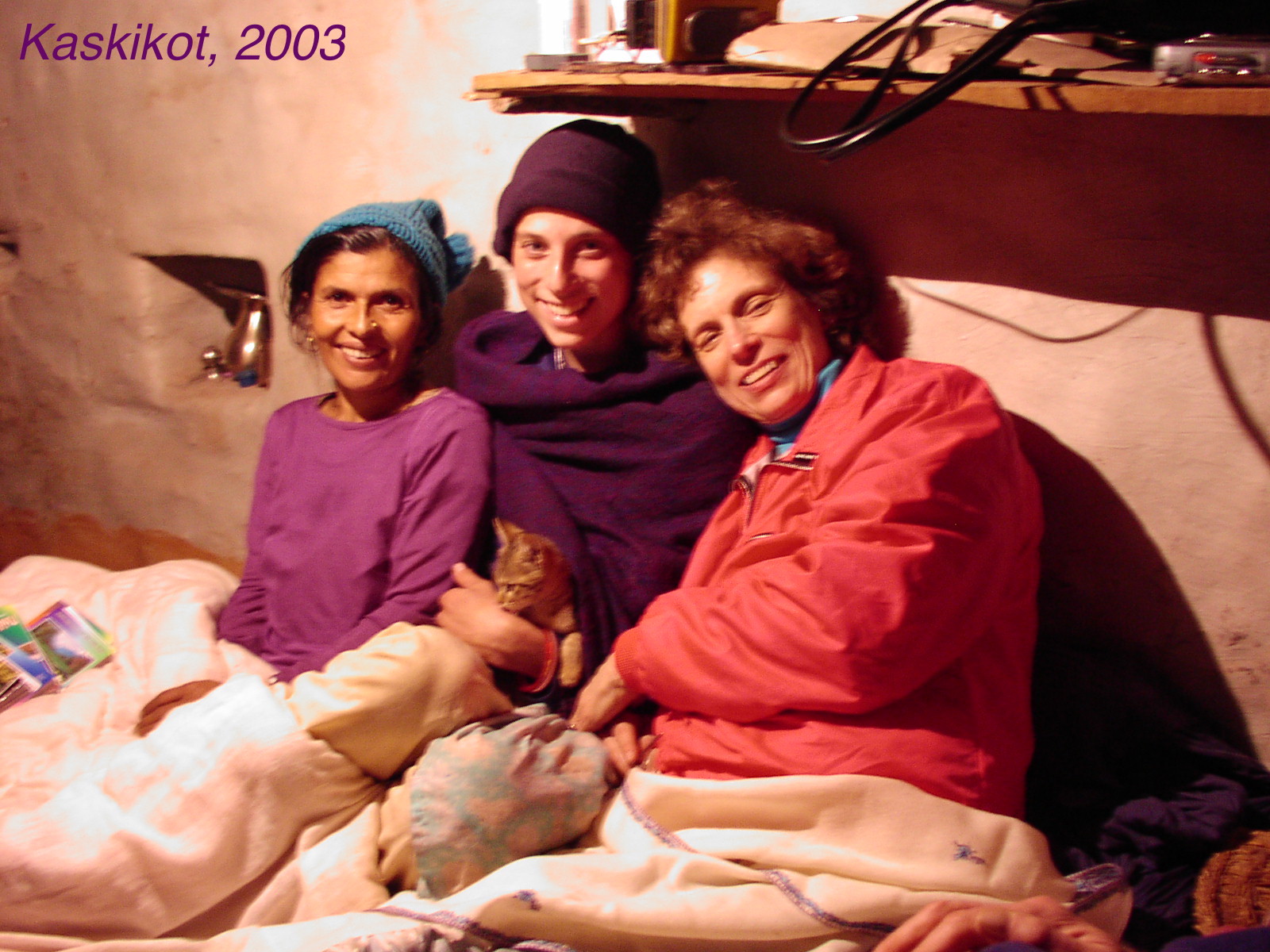
When last I left you, Aamaa had buckled herself in to my friend Catherine’s Mini-Coop and rolled out from my house in Connecticut with Bishnu to shift to my parent’s house in Maryland. My parents, for their part, have been to Kaskikot in 2003 and 2010.  And Bishnu has been in the US since the start of 2009. Which means that since our early twenties, Bishnu and I have slept in each other’s childhood beds and grown up a second time in one another’s families, learning a new language over dinner plates on each other’s tables (or kitchen floors, as it were), gaining autonomy over time, absorbing the values and habits of one another’s households.  So even though my folks and Aamaa have only met twice, they share a peculiar confidence, forged in a wormhole that compressed an enormous distance in to the finest intimacy—parenthood.

This has manifested in odd bits of cross-pollination. For example, the first time my parents and brother came to Kaskikot, which was well before cell phones or Internet, they stayed for a week. When they were leaving, Aamaa came out to the road to see them off. She stood up on a high terrace near Butu boujou’s house and waved her arms back and forth like one of those people with the reflective orange vests who directs airplanes on a tarmac. In the absence of another common language, my parents lingered in the road and returned the movement, swinging their palms back and forth over their heads dramatically: TEN-FOUR AAMAA, COPY, WE HAVE REACHED THE ROAD, WE ARE CLEARED FOR WALKING TO NAUDANDA. This gesture was then adopted in to our family lexicon for momentous goodbyes. For example, when I back out of the driveway in Bethesda to go to Connecticut, my mother stands in front of the garage and waves both arms back and forth over her head: FAREWELL, DAUGHTER, OFF YOU GO TO A FAR AWAY PLACE CALLED CONNECTICUT.

It was hard to picture Bishnu and Aamaa turning in to my parents driveway in Catherine’s Mini-Coop. Bishnu and I are like zipliners, swinging between two distant worlds connected by a suspiciously unbreakable cable. For me Aamaa’s arrival had the feel of an asteroid collision, primal, made inevitable a long time ago by gravitational forces in a distant solar system. And it happened. Our planets crashed together. Bishnu sent this wonderful piece of documentation, complete with garage:

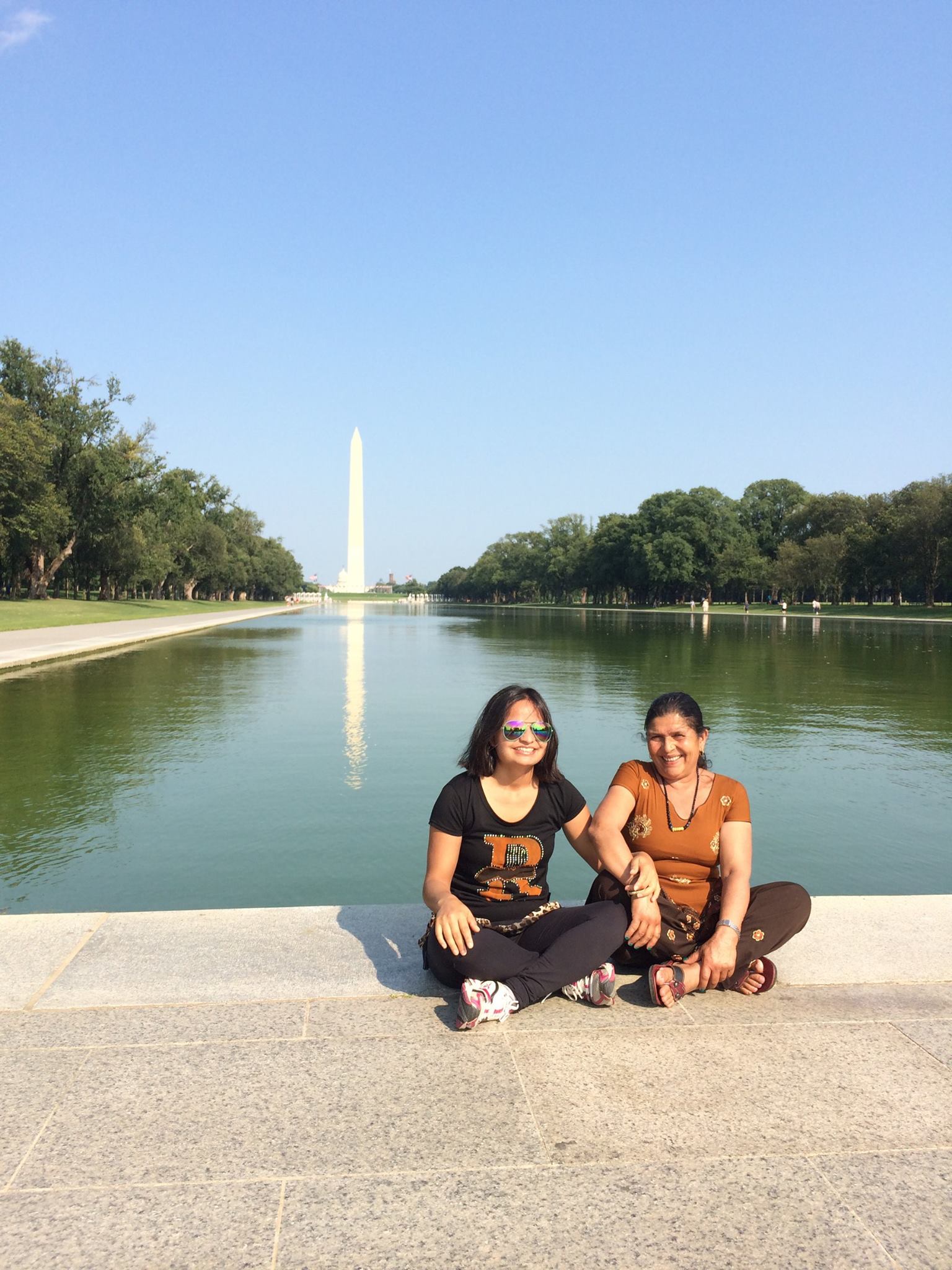
Over the next few days, Bishnu took Aamaa to the National Zoo, to McDonalds, to her office, and to monuments all over Washington D.C. In the evenings, we would video-chat over dinner in my parents recently renovated kitchen, where Aamaa was eating all sorts of new foods cooked in a variety of contraptions such as the oven or on the electric stove in nonstick pots. And it quickly became apparent that if Bishnu and I thought we were running this show, our mothers were going to overtake us in imminently.

By the time I came to town a week later, my Mom and Aamaa had built a solid telepathic bond over topics such as whether Bishnu and I are eating enough, why we live so far away from them, and how unmarried we are. It didn’t matter what language these topics came up in (which they did extremely frequently) or which mother started it. The other mother would just inexplicably pipe up in her own language with reinforcing material. Since to our knowledge Aamaa only knew how to say “light” and “good morning” in English, and my Mom’s Nepali vocabulary consists solely of “chicken,” “buffalo,” “rice,” and “delicious,” this was confounding. It would go something like this:

Me (using both languages): Anyone want more pasta? Pasta khannu hunchha Aamaa?

Aamaa (in Nepali): I just want you and Bishnu to bring me some grandchildren.

Bishnu: Ok, ok.

Aamaa (Nepali): When’s there going to be a wedding? All I want is some grandchildren from you before I die, happy.

Mom (English): I keep telling them to get out there! Krishna over at the Nepali restaurant could be my son-in-law.

Bishnu: Ok, Mom.

Me: What the hell Mom, how do you even know what we’re talking about?

Aamaa (Nepali): See, Mom agrees with me. We’re getting old. You’re getting old. You’re both old.  Soon we’ll be dead.

Bishnu: Starting to giggle.

Me: Can somebody please have some more pasta?

Mom (English): I think Laura needs to get fatter. Her face looks too small.

Aamaa (Nepali): Laura, you go out in the morning without even eating rice! Walking all day! You’re just a nose!

Bishnu (giggling hysterically): Mom, Aamaa says Laura is just a nose.

Me: Thanks Bishnu—

Mom: I remember when she used to row and she was big and strong! Now she’s too skinny!

Aamaa (Nepali): And only eats THIS MUCH rice!

Mom (English): Aamaa, Bishnu cooks Dad and me delicious Nepali food. Bhaat. Mitho! Bishnu!! 

Aamaa: Oooohhh! Mitho bhaat.

Bishnu: How are they talking to each other?

Me: It’s a hostile takeover.

Mom: Bhaat. RIIIIICEEE!

Aamaa: RRRRRRIIIICE! BHAAT!

Me: Dad, do you want more pasta?

The day I arrived, Bishnu was out with Aamaa most of the day, and I confess now that I was in a high-stress state. I’d only been home from Nepal for about a week, my graduate program was starting again in a few days along with a 25-hour-a-week internship, and a Situation came up that set off a fluorescent, strobing life-anxiety. My head hurt, my heart was racing, I demoralized and tired. All day, I dealt with The Situation while Bishnu took Aamaa to the Washington Monument.


That evening Aamaa and Bishnu arrived home. They had already been in Maryland for a week, but with my arrival that morning it was the first time we were all together in my parents’ house, and instead of being totally in to the momentous occasion I was exasperated and upset about The Situation. I went upstairs to my childhood bedroom and found Aamaa lying in bed with Bishnu, resting in the fading light after their long day of adventuring. I flopped down with them, and they asked after The Situation, and I filled them in, and they told me not to worry and reassured me that of course I was right and the world was wrong, and all would be okay. Bishnu reported that, unexpectedly, Aamaa had rather taken to McDonalds.  Then the door creaked open, a bar of light fell in from the hallway, and my Mom poked her head through it.

We scooted over and my Mom wrangled bum-first on to the bed with us. The four of us arranged our entangled limbs on the puffy comforter. Night edged in. Without ceremony, the outside world fell away and I felt the collapse of time and space that is unique to parents and children and to long, long distances completed. And then a blossoming awe. How were we here together, like this?  Nobody can sit at one end of a road and plan a route that ends in this place. We were somewhere that can’t be reached using the mind.  With a jolt of clarity I saw the whole geography of it, like a continent, a huge swath of my life that is navigated only by the heart, which brought me to this shore. I felt us safely encompassed by an endless higher wisdom.

It was dark now, save for the bar of light from the hallway. The Situation shrank and became a hard, rocky thing shooting pain in to my foot, low and dense and false. It was not the real thing.

“Can you imagine,” Aamaa said in Nepali, “how nice it will be when there are more grandchildren? Like Ricky’s.”

“They’re always going and living far away, ” Mom added in English. “They should stay near their mothers.”

*

(Photo credit: Bishnu)

Bonus reel:

Afternoons


First Saturday of Summer  

our hands sweat in the grass until

plateaus and peaks draw in their woolen covers.

Fried fresh corn kernels from the fire

salt.  

Each drop on tin, a world

An hour, or so

maybe more or less

to talk about, so

We gaze out the door

where slick leaves are dripping

lick our salty fingers

and pass the minutes

…or so they pass us

listening to the rain.

*

Borders


It’s another newsletter repost, so please forgive me if you get both….

Dear Friends,

It is the first day after the solstice and the monsoon is is still trapped up in the clouds, pressing the heat heavy on to our heads. In a few weeks the sky will break and we will be deliciously soaked for weeks and weeks.

I arrived in Nepal a few days ago after graduating from my Master’s in Social Work this spring, and it is a pretty interesting point in time to be here.  Over the course of the last year, the government of Nepal has gone through a major restructuring, with power being distributed from the central level out to newly-formed provinces.

We have a front-row seat to this transition: working with local level governments in rural areas.  Our big goal is to impact policy and establish oral health services at the community level throughout the public health system in Nepal, so we are constantly getting new footing based on changes in Nepal’s ever-shifting government. The fiscal year ends in mid-july, so during this season our tiny staff of four is busy riding around on motorbikes and variously getting out to the villages we work in to meet with local leaders who are planning their health budgets for next year.  The key mission of course is to make sure that funding gets allocated to sustain the dental clinics we’ve set up in rural government health posts.

The twist is that at the moment, with the entire Ministry of Health changing, all the rules are up in the air.  Who is responsible for allocating funding from the federal to provincial governments?  What are the budget headings?  When will funds be provided to provincial governments?  Will the District Public Health Office still exist in the second quarter of next year?

Nobody is entirely sure.

So anyway, that’s what we’ll be working on this summer.

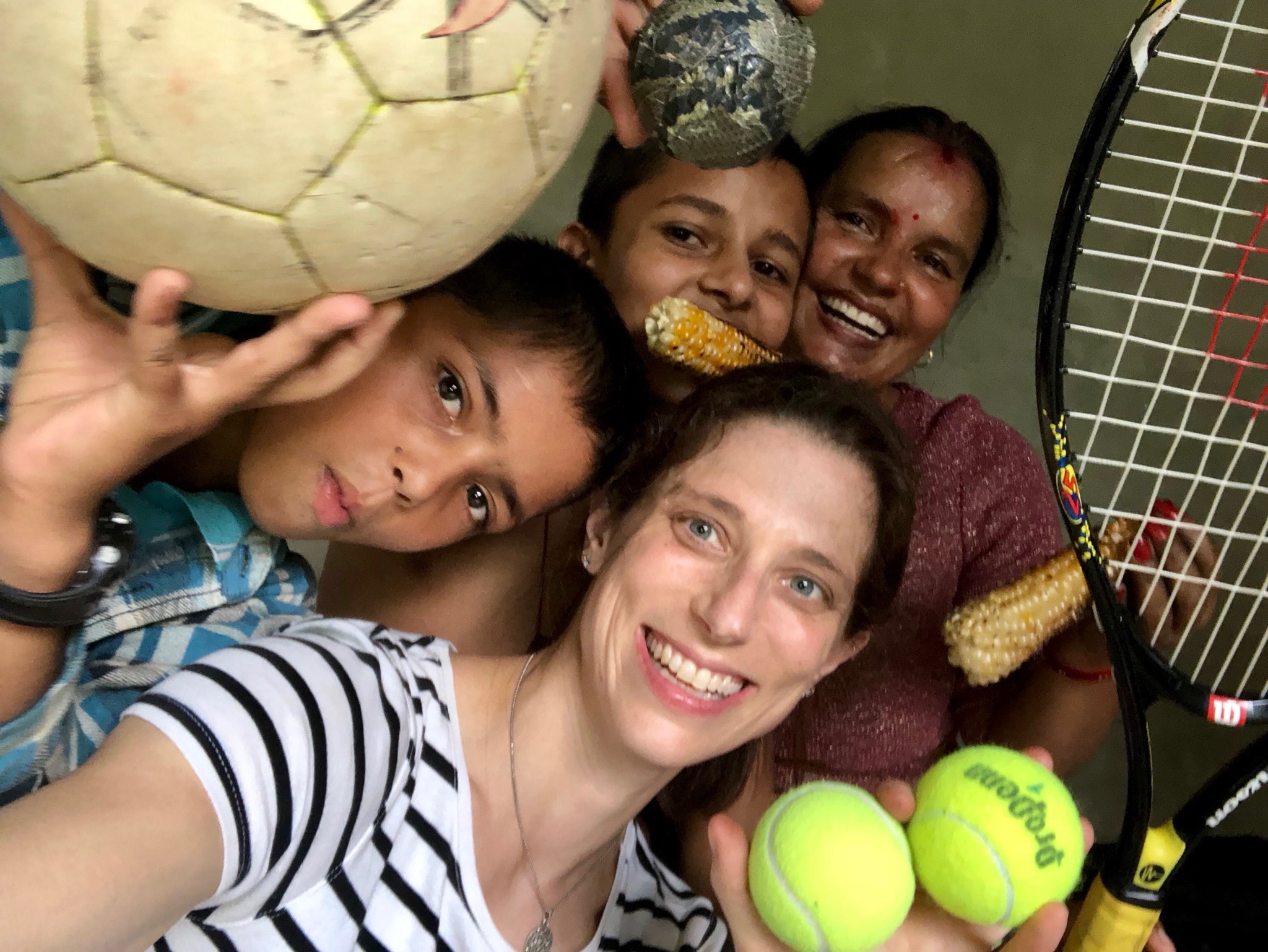
From my side, today was the first day I arrived at our office in Pokhara, and we had a long jam session trying to predict how political forces in the country will affect health care in rural villages.  Then it was time for the main show- heading home with some tennis rackets, DVDs, and a lot of candy.  My first order of business was getting Aidan and Pascal to play tennis inside the house, because I can be relied upon to help with childcare, and then we went to play frisbee in the square and eat ice cream.  We’ll go up to Kaskikot tomorrow.

It has to be said that as I re-enter beautiful country that has welcomed me as a daughter without asking any questions, the borders of the U.S. are heavy on my heart.  As always, I casually purchased my visa upon arrival in the Kathmandu airport.  At our office, everyone wanted to know what on earth is going on in America. The papers say that New York is receiving many stranded children, including in Harlem just a stone’s throw from where I lived and taught art in schools for many years. I find myself thinking about the years I have spent in Nepal, and how they began one afternoon when I arrived at two-room plastered mud home and Didi was standing by the sewing machine and I asked if I could move in to the house. The best spaces were cleared out for me. The tiny rice pot went from thirds to quarters. I could have been anywhere on the planet, I wasn’t running from anything, I had alI needed and nobody asked why I presumed to eat out of that little pot, which was filled with food that had been laboriously cultivated from the ground.  I had nothing to offer except my curiosity.
It is particularly jarring to look back across the ocean at the news from here; in a way, the politics blur with distance.  But the shame is crushing.  This world is so very magical when its doors are open.

The summer has begun…stay tuned.

Laura, Aidan, Pascal, Didi, Prem, and the Jevaia Foundation Posse on Soon-to-be-muddy-bikes

*

At the Base of a Tree


The cicadas came when I was five
behind the school yard.
I put my finger on one
and then I picked it up
it was like a fig, dark and rough.

At five cicadas were interesting, like figs.

Now I am much bigger
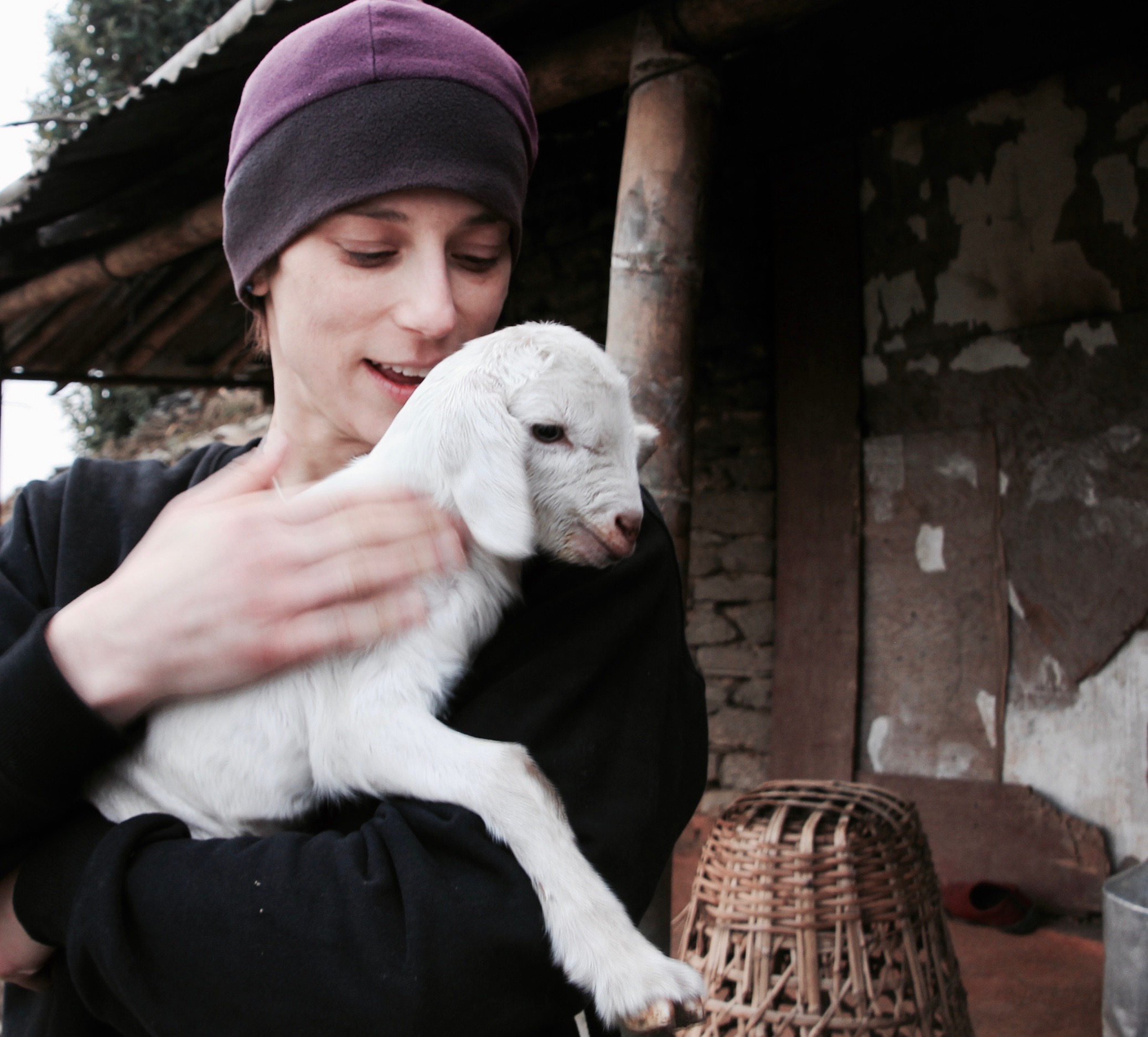
friendly, the little goat nuzzles my shoulder with his warm snout
soft, we are alive, together easily.
And then I press my eyes shut
as I capture the insect that has invaded this carpet, which is mine
because I own it.

Sometimes I wonder how I can find my way back
from the pliant kid to the figs to the cicadas, captivated
with all their legs, their slick ribbed shells, all their songs enchanting
the school yard
all chirping and chirping tickling my ears until my ears overflowed with music
amid the crunching leaves and delicate wings
a symphony, a society, a universe blossom
after seventeen years of silence.

Sometimes I wonder
what we are afraid of
why we crush things, bugs and leaves and oceans and people
when I was five, I used
just one tiny finger
to say hello.

*


The Idea of the Mountain


I started searching for Mt. Everest abstractly.  It wasn’t exactly about the mountain; it was about the idea of the mountain.  With my college books lying next to the bottom bunk, I would retreat in to stories about mountaineering and daydream about exploration. I collected pieces of Asian culture without dwelling on their origins or innate meanings.  These articles and wanderings were satellites of the idea of the mountain, which I assigned to Mt. Everest, and the idea of the mountain was in Nepal, and therefore going to Nepal became inevitable.  But I didn’t even really aim at Mt. Everest. I just got out of bed and aimed at Nepal.

This is how, on a hazy August morning in 2001, I found myself in Kathmandu with a group of foreigners, looking for things to do.  For two weeks we had been traveling to different parts of the country learning about medicinal plants. This was long before I would develop a focused interest in natural medicine, so that detail was just a bonus. Actually, the trip was the result of me Googling “Go to Nepal, August 9 – 22,” which was when I had a window available to travel after the competitive summer rowing season.  But I had not accounted for the little-known and unlikely fact of summer. The monsoon fog, as it does, had blanketed the sky for two weeks, perpetually pressing heat and moisture against our bodies and blotting out the entire horizon.  Now we had a few days to entertain ourselves at the end of the trip.

“I want to see mountains,” I suggested.  We were really so close.

The travel agent brought my new friends and me tea and told us we had options.  Theoretically, the options involved flights.  However, the airplanes might or might not end up taking off, the travel agent cautioned, what with the blanket of clouds obscuring the whole atmosphere.  My friends and I tried to sort out the weather, and things.

There was a tower in Nagarkot, said the travel agent.  A lookout tower.  I inspected my guide book, and my guide book said I could bike to the lookout tower in Nagarkot.

“I’m going to bike to the lookout tower in Nagarkot,” I announced.

At the suggestion of the travel agent, my friends and I refined the plan further.  We would first bike to the old city of Bhaktapur about an hour away, and from there, I would continue biking up to the lookout tower in Nagarkot.  This plan made sense to me because a) it was in my guidebook and b) the travel agent was able to rent us some bikes.  Nepal-bikes, if you will.  They had wheels and gears and hand-brakes and they were heavy as hell.

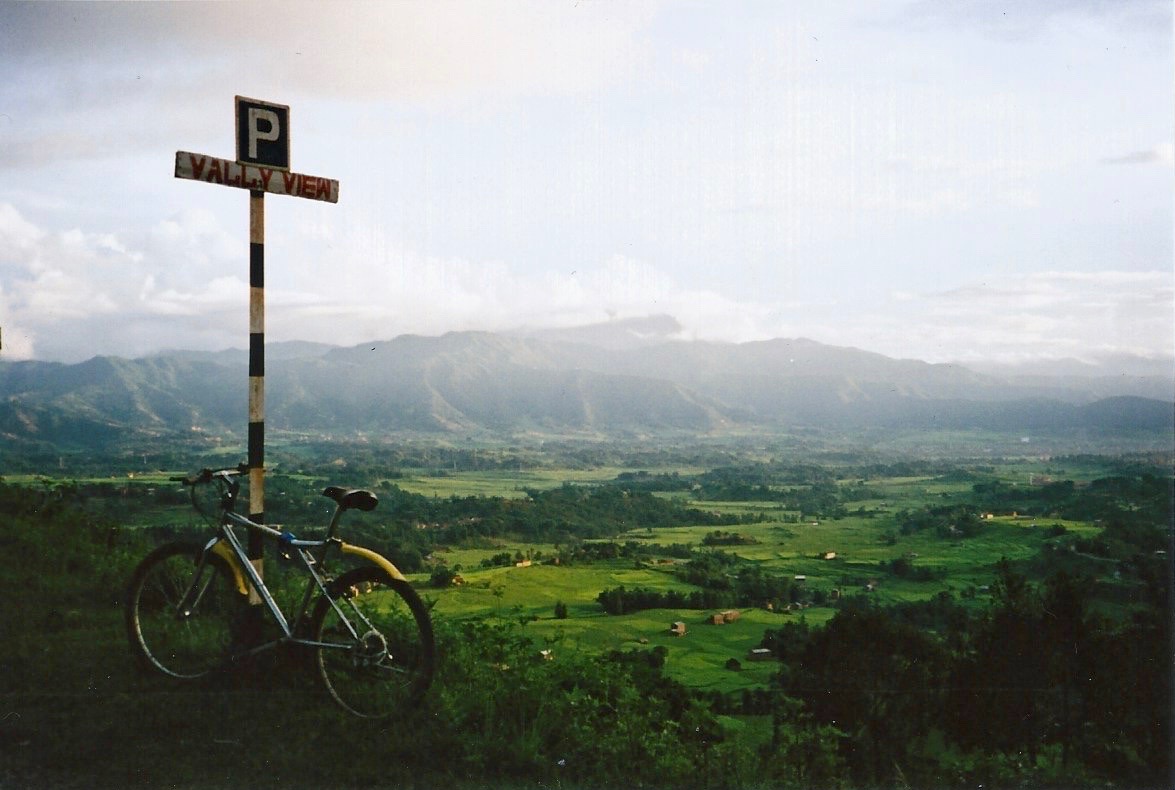
We woke early the next morning and set off for Bhaktapur.  As I clicked along the road, I felt a swell of freedom.  It reminded me of the first solo drive I had made, to the ice rink, after obtaining my drivers license.  The past two weeks had had various ups and downs and dramas and mishaps, but the main thing was that I’d been packed in with a group of other foreigners and we’d been on a schedule and somebody else was in charge.  Suddenly here I was on two wheels being powered by my own legs, on a road that led to the idea of the mountain.

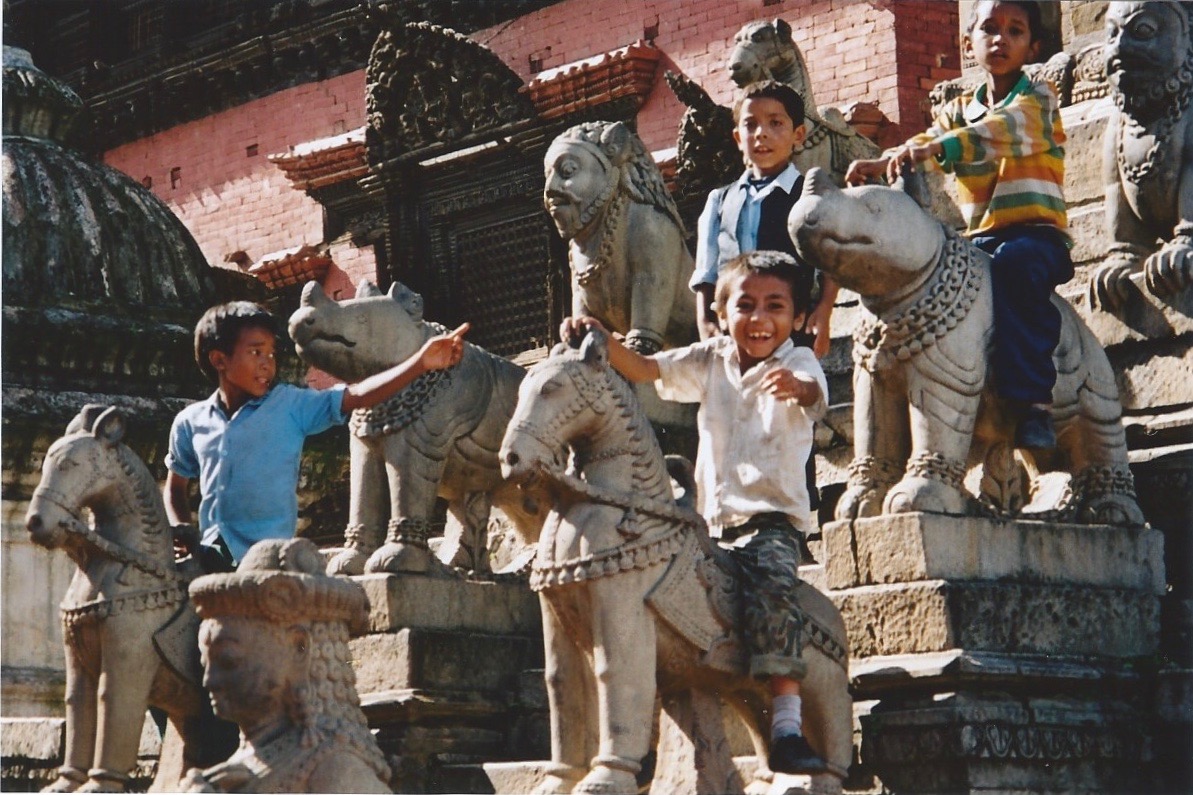
If you ever get to visit Nepal, you must visit Bhaktapur.  Its name means “the place of devotees.”  The area is located on a historic trade route between India and Tibet, and is jammed full of gorgeous architecture, art and cultural life dating back to the 1400s. Wonderfully preserved temples and stupas surround a tidy public square, whose graceful wooden carvings curl up like a garden that sweeps the gaze from one frozen deity to the next.  It is a place that makes you want to bow your head for a moment to whatever all this is…not because it’s religious exactly, but because it feels bigger than you. Because it is old, and earnest, and fully itself.

We took photos.

My friends left.

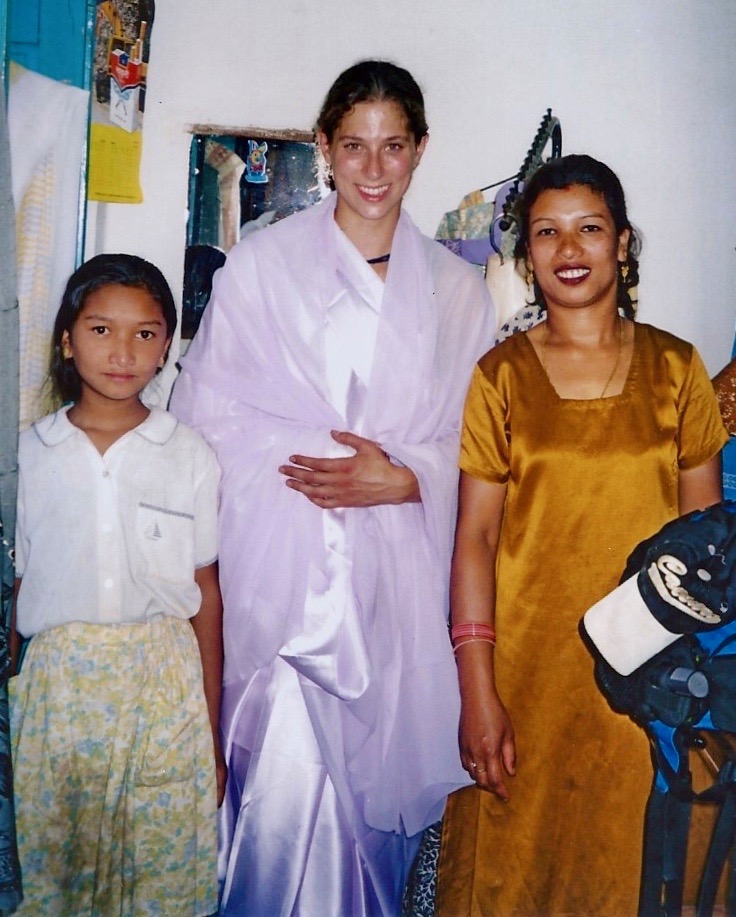
I clicked over to a small shop, parked my bike, and met a woman and her daughter.  Something had caught my eye…a sheaf of heavy lavender silk.  I asked to hold it, and it slid cool over my hands, a whisper of winter hiding under the heavy roof of summer.  I turned it over and moved it from one arm to the other.  The mother and daughter draped it over my shoulders and wrapped it around and around my waist to show how it would be worn.  I asked the price.

The material was intended to be made in to a sari, which, needless to say, was something I would never put on.  I set it down, and picked it up.  Eventually, I reached for my guidebook, checked the route, and left without the lavender silk.  Now I was fully alone.  I rode down a long hill and pedaled laboriously up another.  As the heavy biked clicked toward Nagarkot, Bhaktapur began to disappear behind me.

I stopped the bike.  I turned around and biked all the way back to Bhaktapur and bought the lavender silk from the mother and daughter.  I folded it carefully in to my backpack and set off again for Nagarkot.

Beginning early in the day, we had not been particularly focused on the schedule.  It was now about 2:00.  And something else I ought to mention is that only about ten weeks prior, on June 1, 2001, nearly the entire royal family of Nepal had been massacred by the crown prince, and a stunned hush lay over everything.  A Maoist insurgency that had started in 1996 was also gathering force.  It would crescendo around 2004 and topple the monarchy in 2006.  But in August of 2001, while I was biking alone from Bhaktapur to Nagarkot at 2:03pm, everything was humid, and pregnant, and subdued.  It is only now, looking back fifteen years later, that I feel the uncertainty of that stillness, stretching out across the emerald for miles and miles around me on my tiny bike.

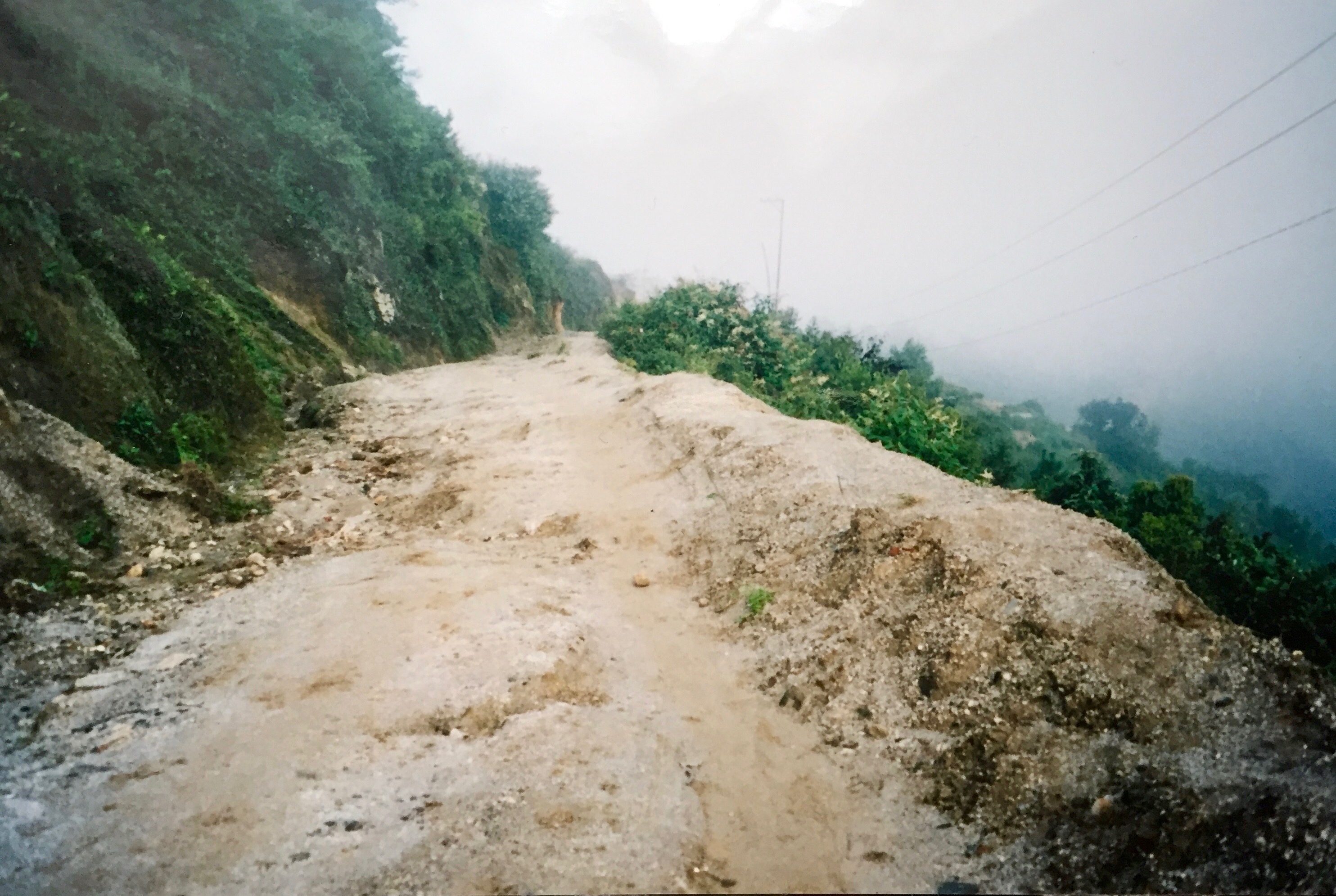
As the afternoon progressed, the pavement ended and the switchbacks started.  The heavy-as-hell bike was now clicking over the back of a dragon, lumpy and steep, the first of what would be many, many, many Nepal Road Experiences (NREs) in my future.  With increasing frequency, I had to dismount completely and haul the heavy bike uphill with my arms.  In addition to unfortunate lack of planning around time, I had only two granola bars for food.  I might have bought some snacks in Bhaktapur, but now I was in the middle of nowhere.  This was also before cell phones, and in fact and even land lines in 2001 were commodities mainly rented by the minute at shops or small businesses, most of which were in cities.  So, to recap, I was in a completely foreign country on a rural road with a guidebook and a heavy bike and no food during an insurgency, a few weeks after a royal massacre, in a place I knew nothing about except for stories of Mt. Everest written by North Americans and Europeans.

“Tower,” I thought contentedly, and clicked over another crater in the road.

I look back now and the little part of me that the world has worn down scolds her for this.  For the presumptuousness and irresponsibleness.  But even now, most of me is still enchanted by the idea of the mountain.  That is who she is, even all alone on a road.  She doesn’t realize she’s going to write this story later, and she is not performing.  She is biking on a road because she is on it and there is a lookout tower at the other end.  Hopefully.

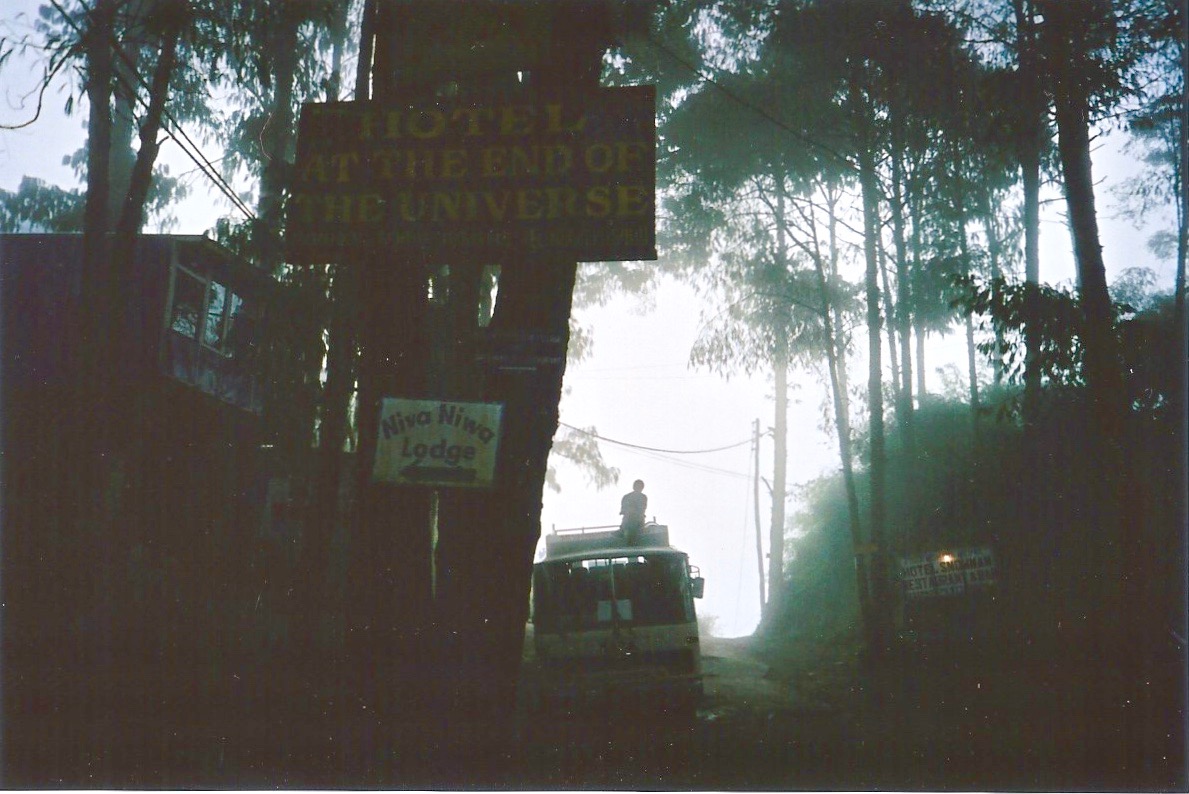
As dusk began to fall, I checked my guidebook more frequently.  It did seem mildly alarming that I had no idea how far I was from civilization.  What to do?  Well there was, after all, only one road, so if I had taken a wrong turn I had inevitably biked to a different district altogether, which was a problem far outside the reaches of my ability to solve by worrying.  No use mulling over that.  Soon buildings started appearing at the roadside and it looked like, possibly, I was somewhere.  Just as darkness was confirming its authority over my climb, I came upon – true story – The Hotel at the End of the Universe.

However, the Hotel at the End of the Universe was not near the lookout tower, and my guide book said there was a hotel near the lookout tower.  So, and don’t ever ask me to explain this, I biked past the Hotel at the End of the Universe in to full-fledged night.  Uphill.

It was after 9pm when I found it.  In rural Nepal in 2001, 9pm is the middle of the night.  I walked in to the hotel that my guidebook had suggested, sweating and with every muscle in my body limp.  Two young men emerged behind the hotel counter and they assigned me a room.  The kitchen was closed for the night and it was too late to make dinner.  Oh well.  I had some of a granola bar.

“Please wake me at 5am so I can go to the lookout tower,” I said.

“If the weather is good, we’ll wake you, miss,” the hotel guys said.  “But it’s usually cloudy.”

Nope.  “I want to go either way.  Will you make sure to wake me at 5am?”  (Besides, maybe it wouldn’t be cloudy.)

“Of course, miss,” the hotel guys said.

I woke up at 5:15am.  No hotel guys.

I jumped out of bed, paid for my room, and got back on the heavy-as-hell bike.  I followed the directions in the guide book, and just as the sun was creeping over the horizon, I came upon…THE TOWER.

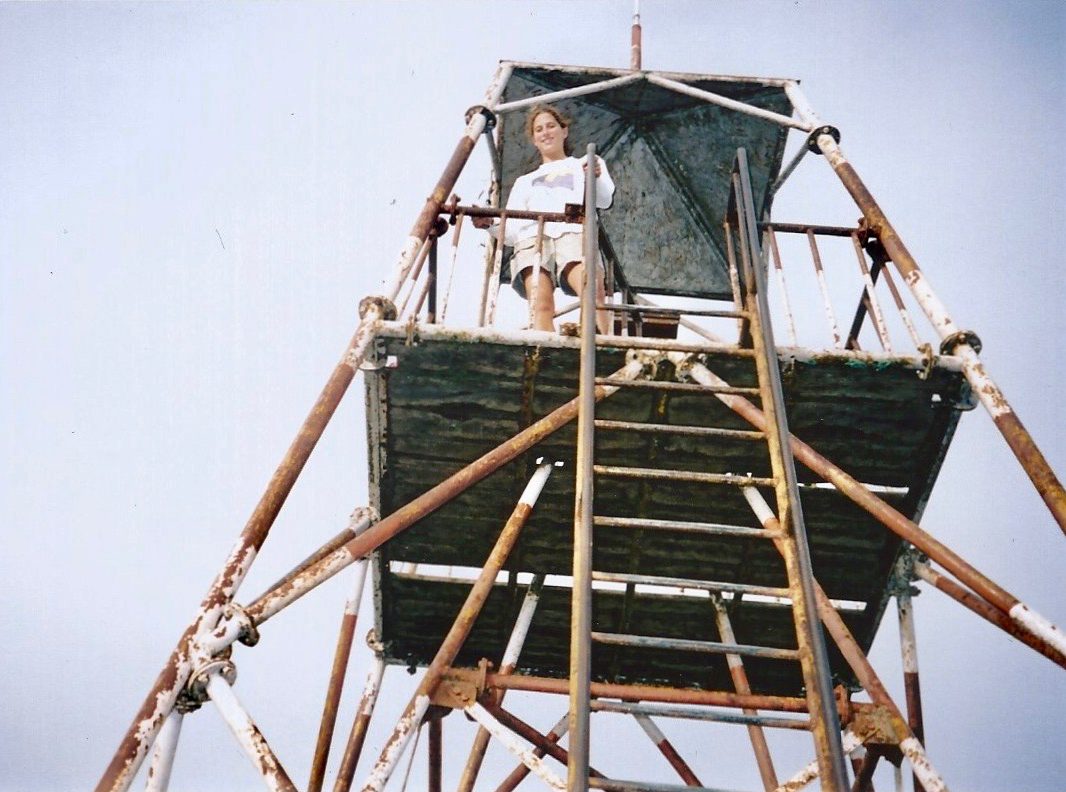
LOOK AT THIS TOWER.

Yes, this is a lookout tower made of sticks.

Which only strikes me as incredible now, much later, on behalf of the little part of me has been chastened and worn down.  At the time, I thought, quite happily, “This is a lookout tower.”

I climbed up the lookout tower, which was advertised in the guide book to offer a panoramic view of the Himalayas surrounding the Kathmandu valley, sweeping giants, famous the world over, visible from THIS STICK TOWER that I am climbing.  The top of the structure was rickety, like a platform treehouse.  I stand up.

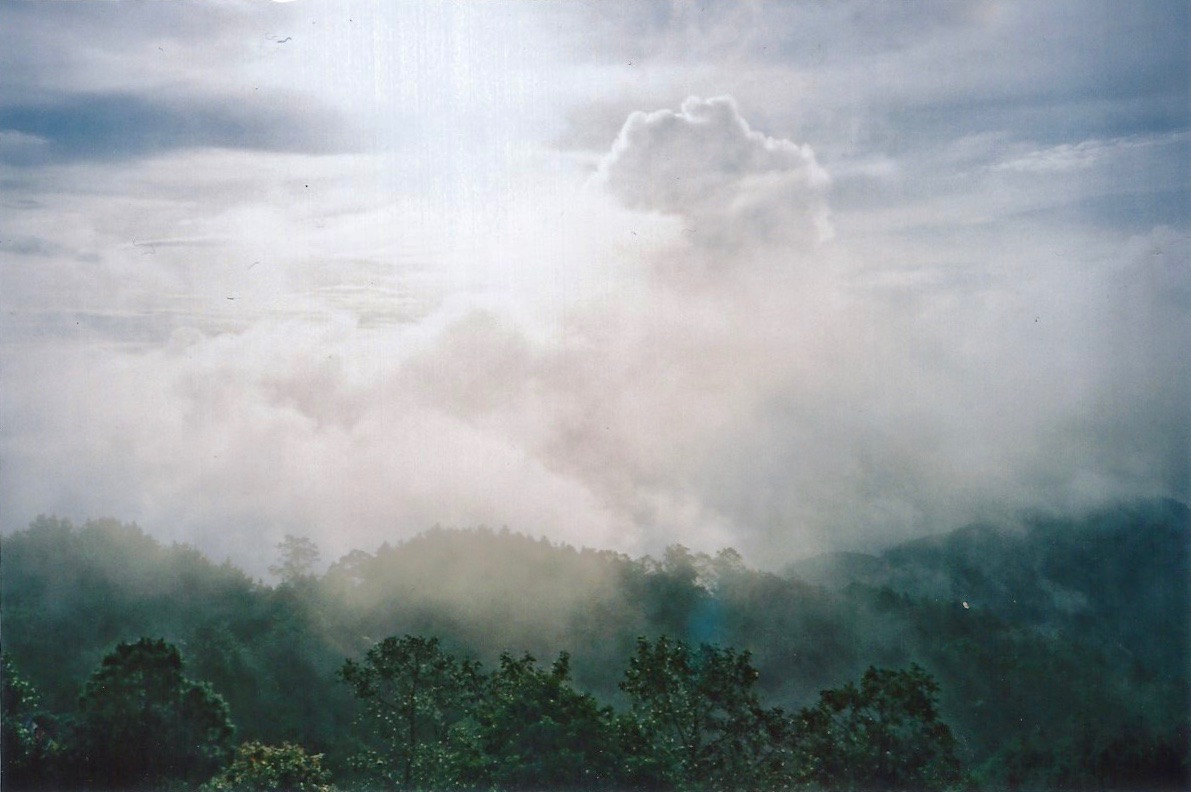
There are clouds as far as I can see.  Not a mountain to be seen anywhere.  Silence for miles and miles and miles.  I sit down on the tree-house platform.  I am here.  I float out over the clouds, newly lit by morning, silky and cool, endless.  I take a photo.  For a few minutes, these are my clouds.

“This is going to be a good story,” it occurs to me vaguely.

Then some Nepalese tourists turn up, and they take my photo.  It will be a prized possession.  But soon the platform is crowded, and the floating is over.

Now all I have to next do is get back to Kathmandu.

I climb down the tree-house-lookout-at-clouds-tower.

We are going downhill.  I run my finger down a page where my guide book says that up ahead I can either take a normal road, or another road that is a bit less organized but somewhat shorter and “good fun.”  And so help me God, nobody will ever no why, but I decide it is a good idea to take the Good Fun Road.

The Good Fun Road is the dragon’s back I climbed up, now with measles and more speed.  So basically, I can barely ride on it at all.  Every time I try to get the heavy bike going, a terrifying hole in the dirt screeches in front of my tire and I have to slam on the hand breaks and I nearly topple over.  I end up walking my bike for most of the Good Fun Road.  “This is good fun,” I think, “and I should write my own guide book.”

I eat the last remaining bite of granola bar.

After what seems like forever, I come to the valley floor.  It is hot again and I am drenched in sweat. As I bike through the valley in what I certainly do hope is the direction towards the tourist area of Kathmandu where my friends are waiting, I pass a school and the Headmaster flags me down.

I end up spending about an hour at the random school in the Kathmandu valley.  I play with the kids and talk with the Headmaster.  I am oblivious at the time to the certainty that the Headmaster is hoping to make a connection and cultivate me as a patron, and this works to my advantage because I am not resistant or cynical.  I am playing with kids at a school in Nepal because it is on the road associated with the idea of the mountain.

For many hours afterwards, I am not one hundred percent sure that I am on the correct route back, although I do know that I’m overall aiming at Kathmandu.  Gradually, around 4pm, the streets start to narrow into corridors, clustering together in the traditional Newar style of Kathmandu, and then, miraculously, like an actual fuck-all miracle, I recognize where I am, back in the middle of Thamel. Vendors are selling tiger balm in the streets, tourists with dreadlocks and tie-dye are browsing knockoff North Face gear.  My friends are near here somewhere.  We have a hotel we are staying in.  I bike to it.  It is 5pm.  I’ve been gone for about 36 hours.

I unpack the lavender silk.  Sixteen years later, it is still carefully stored in wait of a special occasion.

“How was the tower?” everyone asks.

“Cloudy,” I answer. “There were a lot of clouds.”

Outside, night is falling fast.

“So when is dinner?”

*


The Other Side of Democracy

Today women all over the U.S. – and the globe – are marching again on the 1-year anniversary of the 2017 Women’s March that overshadowed the inauguration of our current celebrity President.

I had half-written this post last January, and then my spring semester of graduate school took over.  I almost completed the entry in June, and then my summer in Nepal took over, followed by my fall semester.  So today, as women walk by on the other side of this glass café window wearing their pink hats for a second time, seems like a good time to finally post it.

 – – – – –

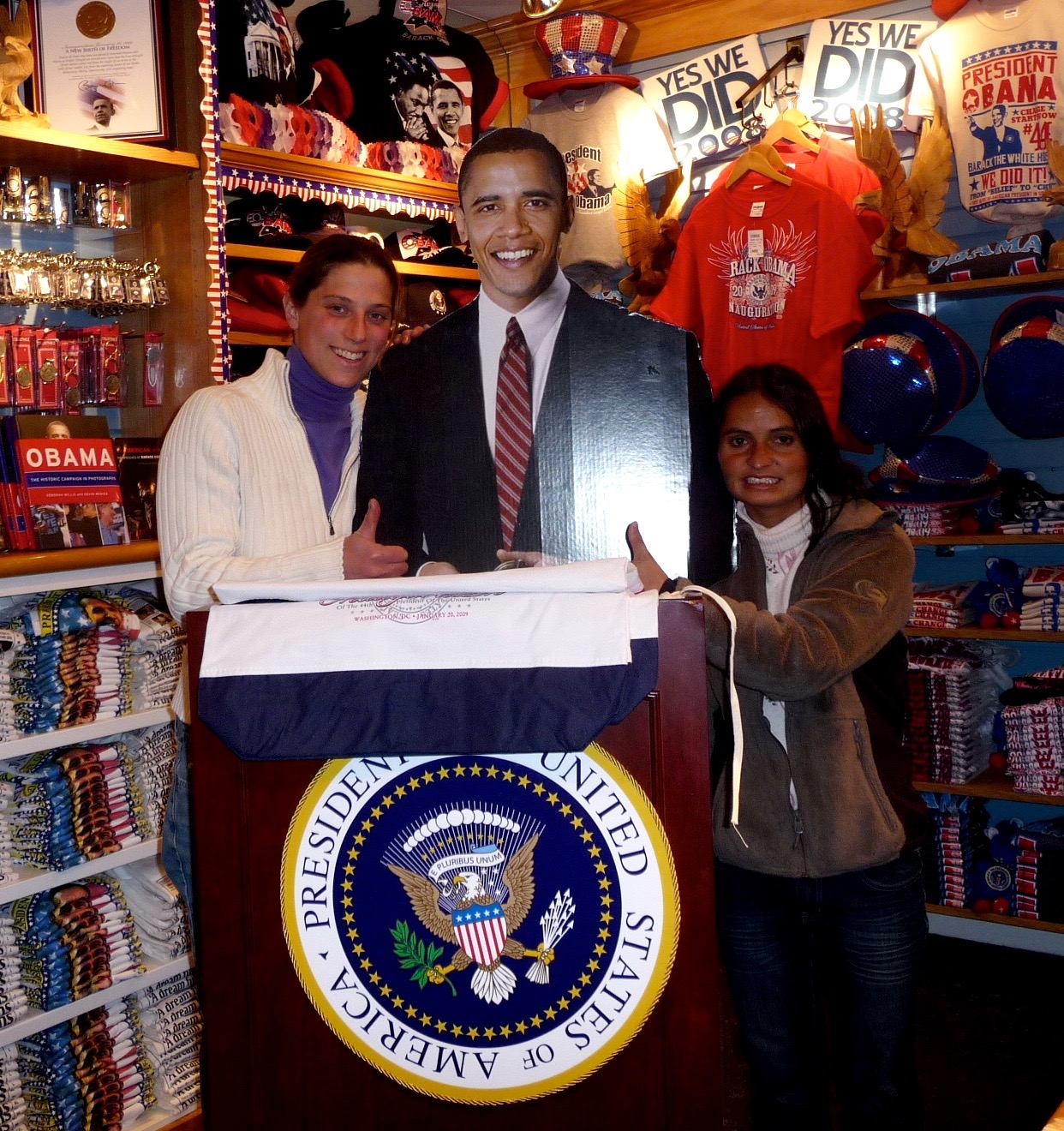
The day that Bishnu arrived in the US for the first time was January 18, 2009. We flew in to JFK and took a cab to my apartment on the Upper West Side. The next morning we got up to find snowflakes drifting past my fifth floor windows, and ran outside with our palms open. Bishnu had never touched snow. We got bagels at Lenny’s and took the train to Washington DC. When we got out in Union Station, the place was exuberantly decked out for President Obama’s inauguration.

“Union Station doesn’t always look like this,” I said. “This is an incredible moment in our history.”

President Obama’s Inauguration

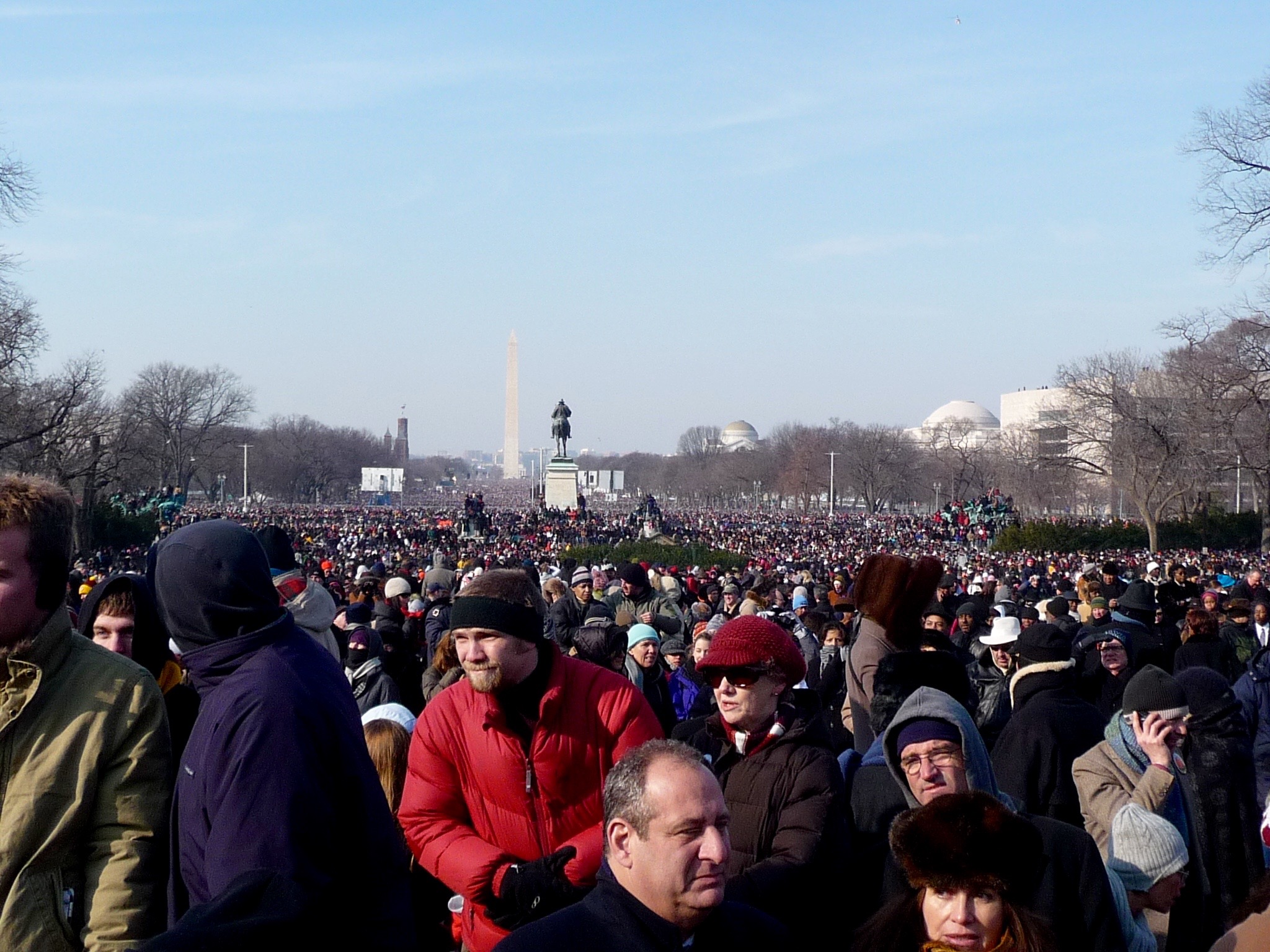
We woke up to President Obama’s inauguration a few days later. While Bishnu went to register for her first college classes in the United States, my mom and I got in the subway and went down to the National Mall.  We’d been able to get seats at the Inauguration through a family friend who is a former member of Congress, which allowed us special access to a maze of hallways under the capitol building itself. Wearing our winter coats and hats, we ran through mysterious marbled corridors, dragging our gloved fingers along the polished walls, and then emerged dizzy in to an ecstatic crowd of tens thousands. It was only a week after Bishnu arrived in this country, and everything seemed enchanted.


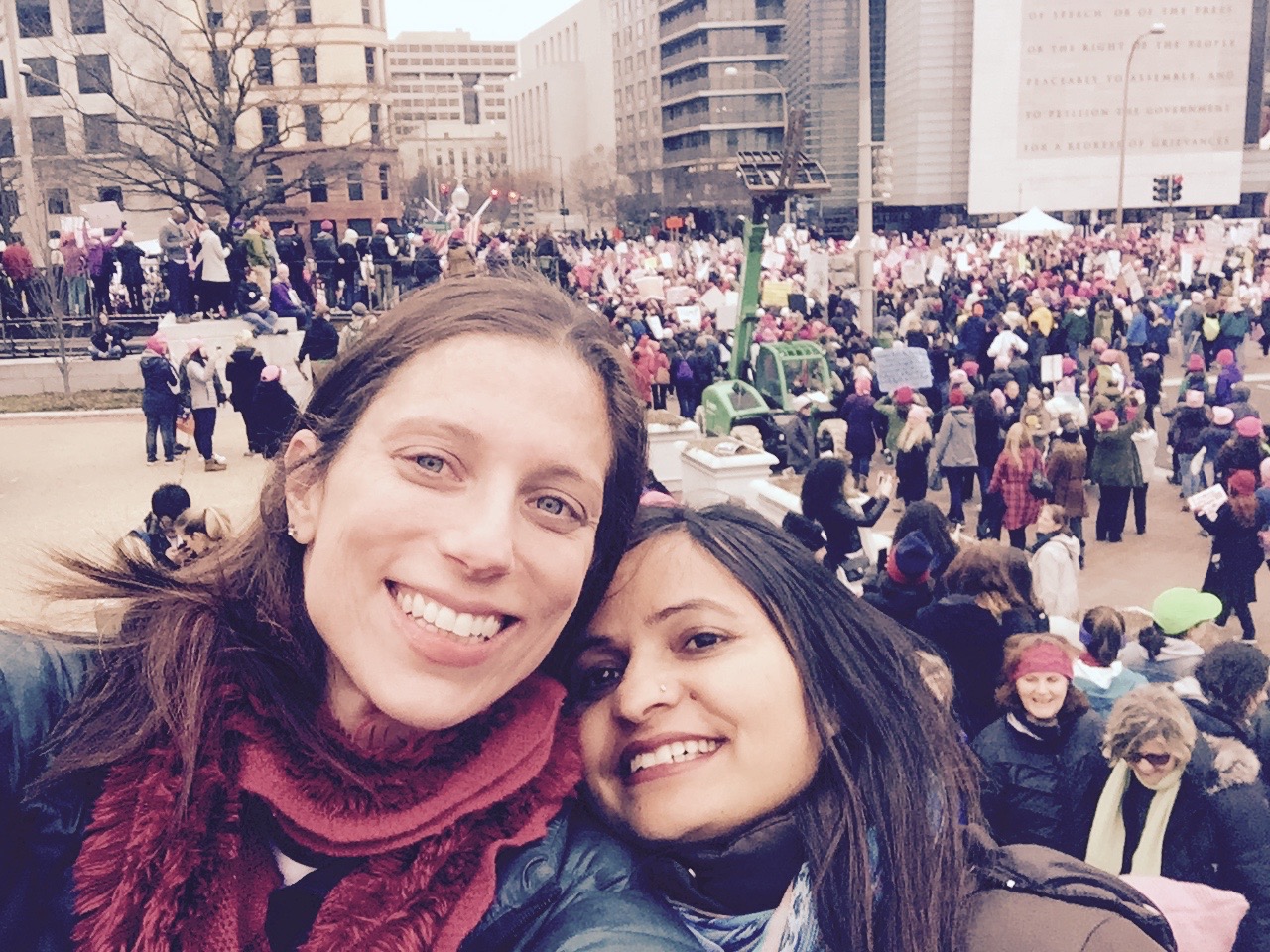
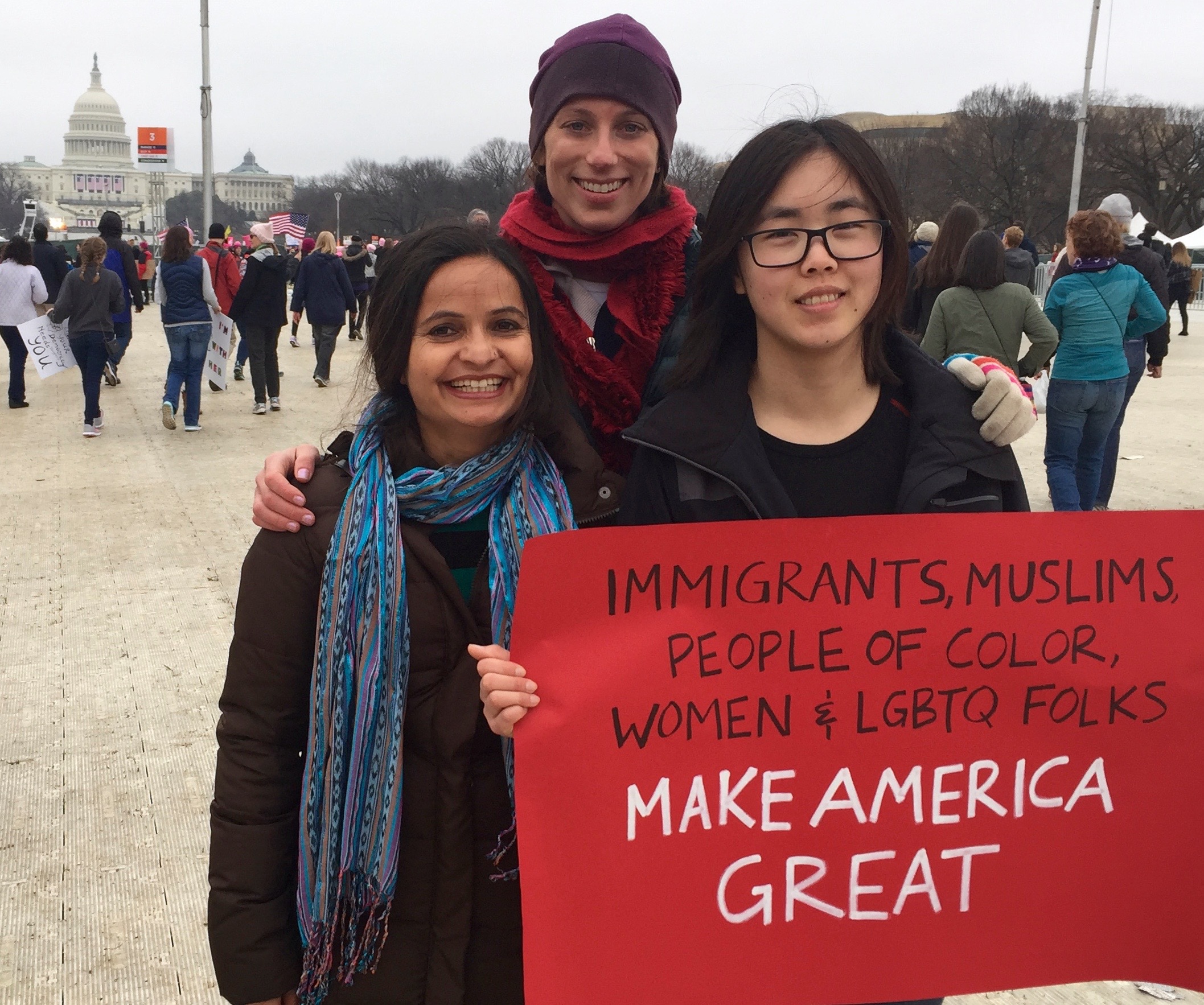
Almost a decade later, on Jan 21, 2017, my family woke up in Bethesda and once again put on our warm clothes to go down to the capitol. This time, to protest. For women’s rights, immigrant rights, tolerance and celebration of diversity and equal opportunity. The previous day had felt…how can I describe it?  The somberness of President Trump’s Inauguration had been additionally weighted down the tug of that marvelous day eight years ago, which, in addition to the pain and sadness we all felt, created a kind of suction, a vacuum of joy.

It seems like Bishnu and I live our lives at bookends. Here we are again. The other side of democracy, the other side of celebration, the other side of the freedom to gather in America.  Outrage.

Under my winter jacket I put on my #6 Red Hots jersey, which I wore from age 12 to 17 on my youth soccer team. A group of us started playing together as girls, made up the core of the varsity soccer team at our high school, and won my high school’s first ever Independent School League championship in women’s soccer. Our Red Hots coach Chris was on the Jamaican National Team and he was also God.  When we were on the road to tournaments in Virginia Beach or wherever, he passed the time by testing us on our ability to understand pidgin Jamaican English. We adored him and he taught us that “anybody can teach a donkey to kick a ball,” but we were going to be “brilliant.” In my Red Hots jersey, I had superpowers.

Bishnu, my mom, and my two of my friends and I crammed in to the Metro at Bethesda station just as we had eight years prior. We came up above ground near Pennsylvania Avenue. As we rounded the top of a hill, a sea of people came in to view ahead of us. Immediately, our anger and resentment rose up on a tidal wave of protesters marching toward the capitol. Thousands and thousands and thousands pulling us in with a thrill of momentum.  Bishnu and I floated in to the river like two leaves.The events of these past weeks have forced my mind in to new contortions. I have had an easy life. It is easy for me to go to Nepal on a grand adventure, with no idea what I am doing, take my time figuring it out, and be falsely credited with kindness or courage. I can indulge in experiments of curiosity and empathy and generosity, and it doesn’t cost me anything except for the pain, later, of confronting that as a luxury. This is something I have recognized for a good while now. But in the climate of our recent election, the sting is fresh and hot. What kind of world do we live in where empathy is a privilege assumed only after survival? As long as my survival remains easy, what is my responsibility? I waffle between rage at the outpouring of ignorance and bigotry happening here in the United States, and shame at the helium balloon I live on. From up there, it is easy to take the high road.

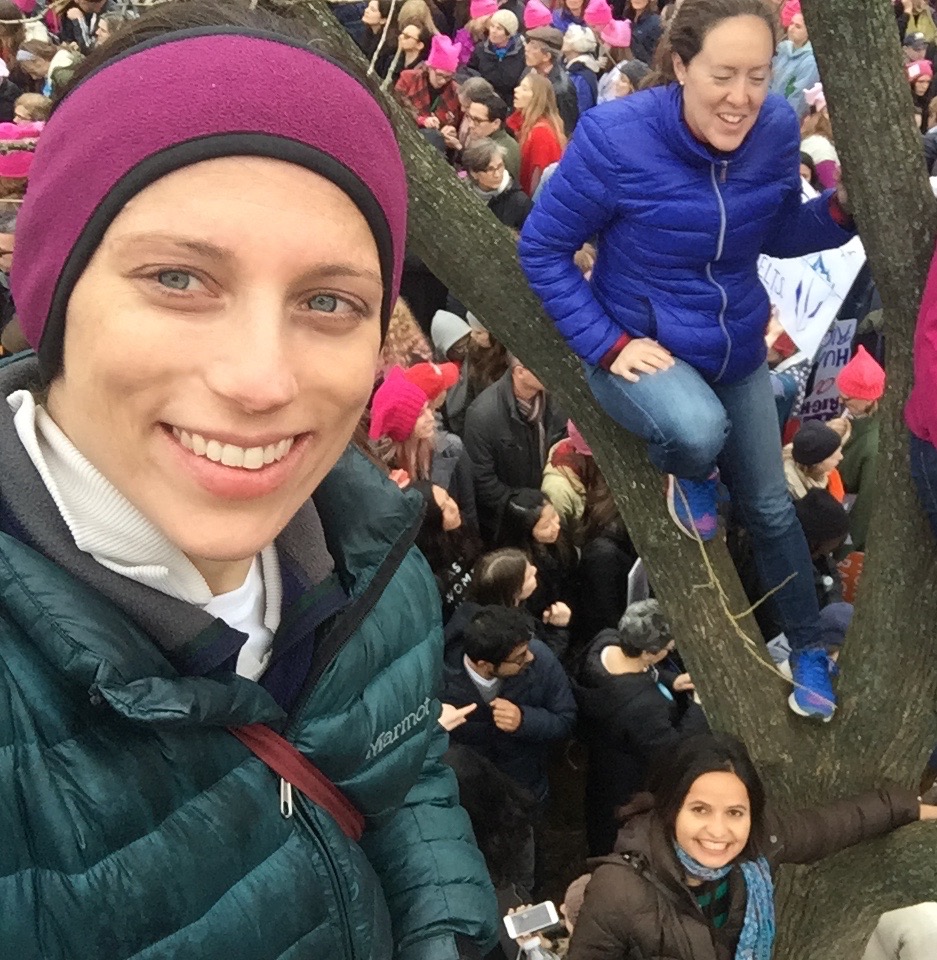
The Women’s March provokes this disquiet, luring it back in from around the edges to the center of my attention. With my mom and our friends, Bishnu and I drift through currents and eddies of elation, passion, and indignation – not all that different from the torrent that welcomed the nation’s first black president, right here where I now stand. But this river swells with anger rather than euphoria. When the speeches start, I climb a tree (for the record, some ladies ahead of me try but can’t scale the long trunk to reach a perch higher up; thanks for help with tree-climbing, Nepal). Bishnu sits on a ledge at the base of the tree. From my location, I can see a vast ocean of people stretching out in all directions, and it is breathtaking. I also can’t help noticing, and being surprised, that it is a predominantly white ocean.

Later, the critiques will roll in from feminist advocates, and especially from those who have spent lifetimes advocating on behalf of people of color, of all those in this country marginalized by class or race or sexuality. What will happen after all of this? Will we march, feel better, and then go home? What about those who have been railing against injustice for decades, centuries?  Where were we then?  This sea of whiteness is angry and disappointed and embarrassed, but we are not being profiled and shot. Our sons are not wasting in jail because they cannot pay bail on an arrest for marijuana possession (but our sons are high, I’ll tell you that). Our daughters are not making sixty cents on a dollar, not spit at, welfare queens, baby mamas, you bought that hand-bag and you’re on stamps, learn English bitch, lazy—

Maybe, after today, we’ll feel better, and then we’ll be…you know, busy.

Maybe we have a lot of nerve showing up here at all.

I cling to the tree branch as words fly past me, originating from massive speakers many blocks away.  At the base of the tree, I can see Bishnu looking a little bored, although she is a great sport. I don’t know what she will make of all of this. In the world Bishnu is from, it doesn’t matter what you are doing here in America: if you can get your feet on U.S. soil, you’ve won the golden ticket. Period.  Or so it is perceived, for better or worse.  You hang on and don’t let go.

This thing happens sometimes where I zoom out and I feel I am seeing us from far above. Little me and little Bishnu, like neon dots of radar in an anonymous expanse of blue-gray nothingness, moving in some configuration that must have meaning to it I do not understand. What are they doing? Where are they going?  These two little dots…what is their story?  Can they explain anything about the topography around them?

After all this time, I am no closer to an answer. There we are, leaning on a tree, just as far from something that holds together as when we started.  But in the decade and a half we’ve mucked around in each other’s worlds, there is one I thing never stop coming back to.  It is always better to show up.  Be a little blip of radar.  Even if you screwed up the first two centuries.  Even if you don’t know what you’re going to do about it next.

*