The Obvious Practicalities


The other day I came across a dazzling, haunting article in the New York Times. The Lonely Death of George Bell opens with a chaotic photo of George Bell’s apartment. He was a hoarder, and until you look at the photo directly, it meets you more like a cubist painting than a photo of an apartment: an angular, colorful, dump.

Screen Shot 2015-12-30 at 10.30.57 PM

The story follows a public administrator in a bleak office in Queens as he searches for George Bell’s next of kin, distributes George Bell’s assets, makes arrangements for George Bell’s cremation and burial. These tasks unfold in unceremonious anonymity – in fact, a significant amount of procedure is devoted to proving George Bell’s body is George Bell. No friends or relatives come forward to identify him. He was discovered in his apartment only after neighbors called to report the stench of his lonely end. This is the story of thousands of deaths in New York City every year.

To me, the article itself serves to witness and exalt George Bell’s silent passing, as well as what might have been among the most authentic feature of his life: isolation. In a way it is a glorious tribute, nearly impossible to look away from.

As you will see from the letters at the bottom, not everyone agrees.  But I was taken with this rare and unapologetically voyeuristic look at the mechanics of death in its most cold and undignified form.  In Western culture, we rarely visit death undressed. Jobs that in other parts of the world – certainly in Nepal – fall to the community in an old and well-traced set of patterns fall for George Bell to the Queens County Public Administrator.

George Bell’s situation is extreme, but it in other ways it simply exposes a shared fear and denial of death in the West: how the body, sacred in many cultures, is foreign and terrifying to us once it is dead.  It must be managed by professionals, or at the very least, out of sight, and as a society we treat any honoring of the spirit as a bonus round after the paperwork has been completed. We take this for granted, as if it is obvious because it is practical.

When I happened upon The Lonely Death of George Bell this week, I was editing a radio story about young widows in Nepal. The piece is about how widowhood rituals are changing for young women, and features 21-year Bishnu Pande, whose young husband died while working in Qatar. He never met their six month old daughter.
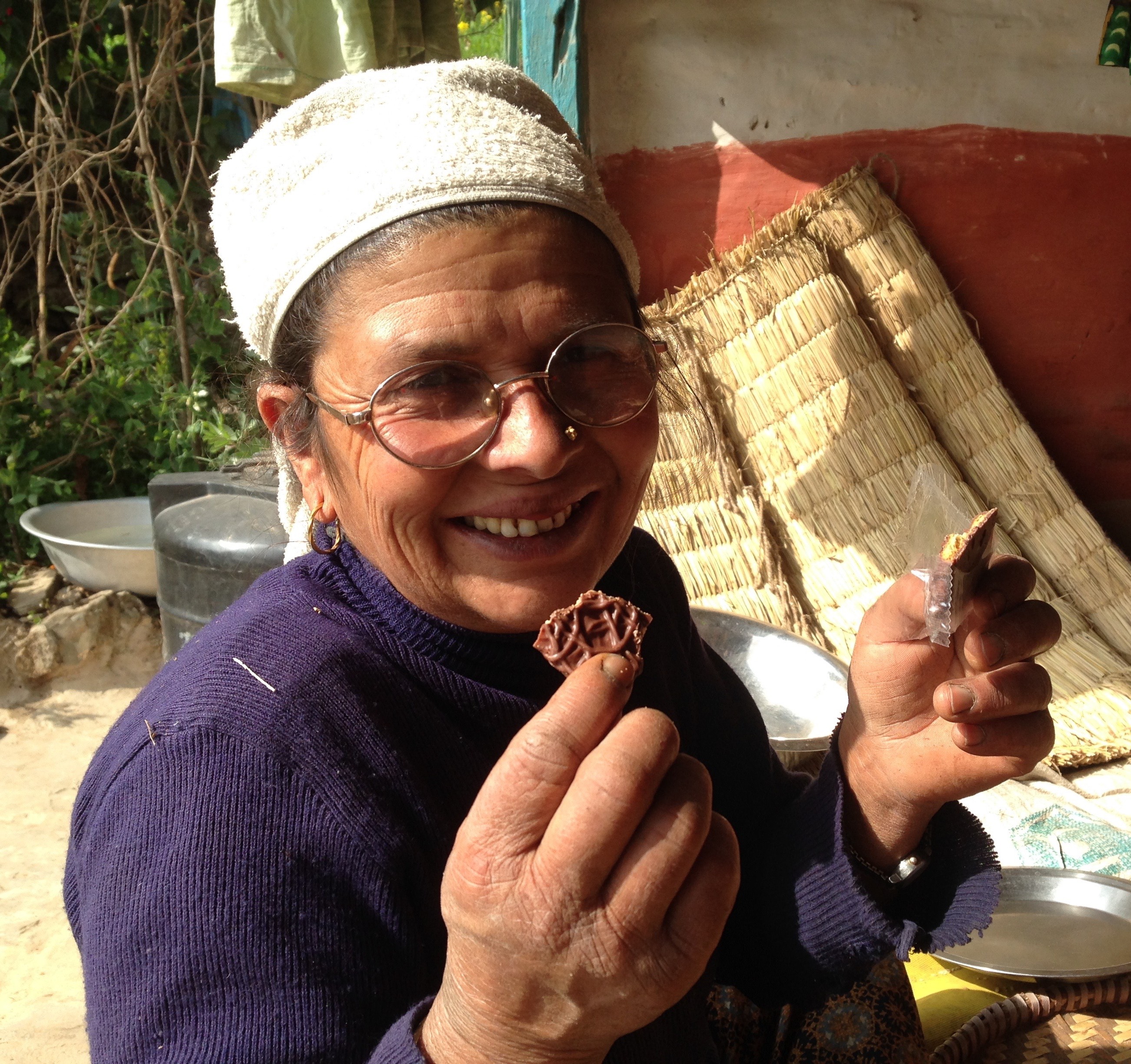
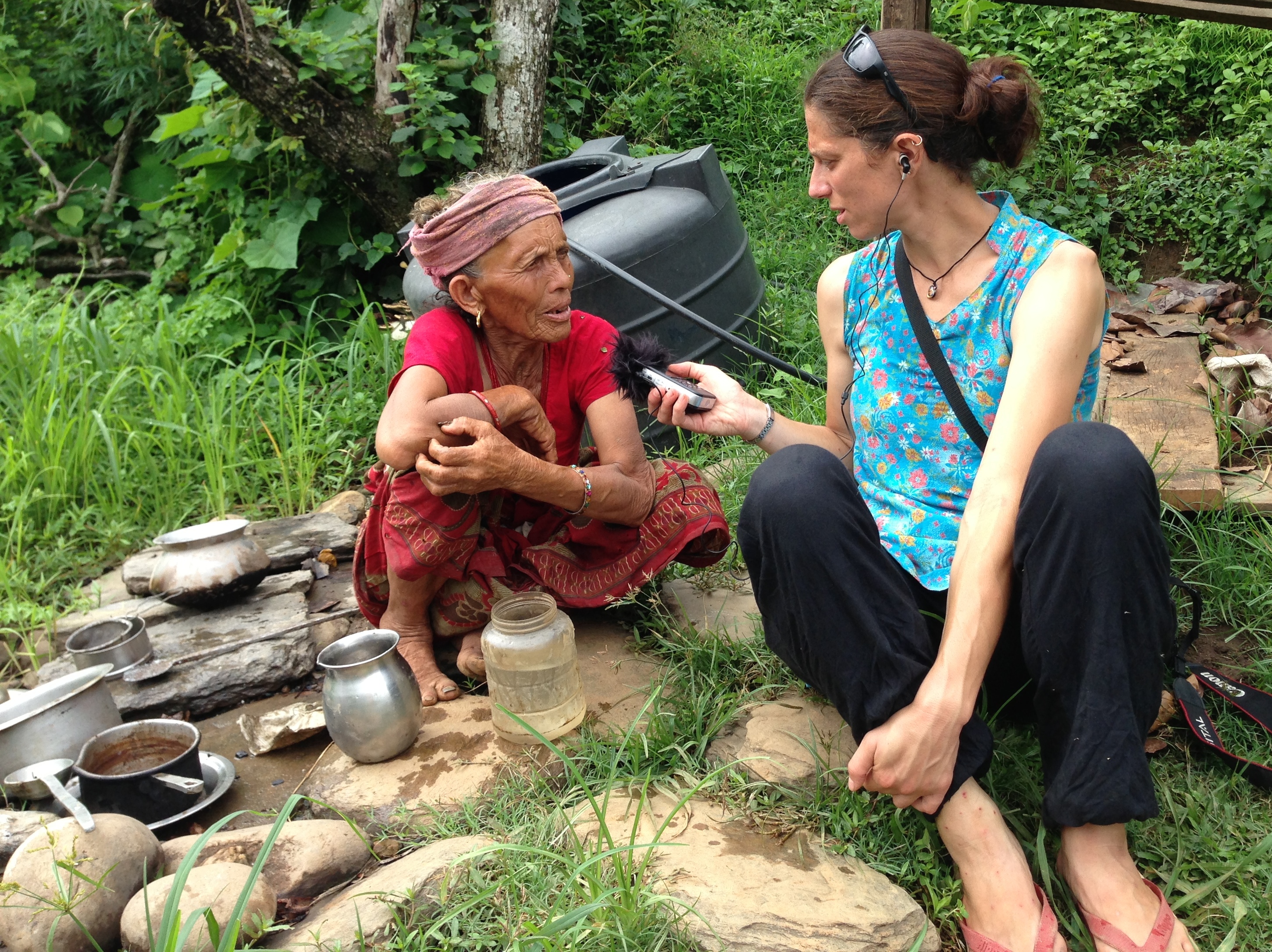
This topic is close to my heart, because historically, young women who lost their husbands have been forced to live out lives of ritual mourning, and Aamaa is a direct result of these traditions. She hasn’t worn the color red in 35 years. There was never any question of remarrying. Her husband’s family didn’t entirely abandon her, but they’ve done little to help her. When I arrived in Aamaa’s life, her daughters were in their early twenties, and her identity as a widow had long since blended in to the larger idea of her. I have always known Aamaa just as who she is, not as a woman bereaved. She has good friends, and people to look out for her, and she goes to weddings and dances.

And yet, for all practical purposes, Aamaa has lived a life of ritual widowhood. She is alone. Dancing is on limits, but ritual celebration – wearing sindur powder, receiving celebratory tikka, red clothing – are forever out. Moving back to the home where she grew up is out. A new marriage is definitely out. Her role in society is that of a woman who lost her husband, and has been since she was a 23 year old girl.

That will not be Bishnu Pande’s story.  But something will be.

So today I come across George Bell while editing a piece about Bishnu, having spent over a decade as part of Aamaa’s life. And it’s clear that what is obvious is not just what is practical. And neither is the ritual discipline that Aamaa observes. The obvious is just what we’re used to. Our treatment of death seems inevitable because it stems directly from our collective, subconscious attitude toward life, toward the nature of existing. Which can span the range of possibilities from Aamaa to the Queens County Public Administrator.

I feel like these hours I am spending with Bishnu Pande in my ear come at a time when  she and I are both somewhere in the middle. We’ve approached this crossroads from opposite sides: I from New York, where George Bell died, and Bishnu from Kaskikot, where Aamaa’s husband died. Her culture is learning to shed ritual, and I feel that mine has lost something vital and is scrambling to get it back. It’s like we’ve bumped in to each other in the middle of some misty dreamscape, each of us missing someone and renegotiating the collective attitude we’ve been taught.

Some letters to the editor have already been posted the article on George Bell. One says:

At first I wondered why “The Lonely Death of George Bell” was on Sunday’s front page above the fold. As I got into the article, I couldn’t put it down…Mr. Bell’s sad experience reinforced for me the importance of reaching out to relatives, friends and all those in a situation similar to Mr. Bell’s so that they have dignity in their final days. He deserved better.

And then another:

What could possibly justify this callous violation of George Bell’s privacy?…Mr. Bell could not have made his wish for privacy any clearer if he had specified it in his will, and no decent purpose is served by inviting us all in to trespass on his home….With this article The New York Times inflicted on Mr. Bell a final indignity.

     *
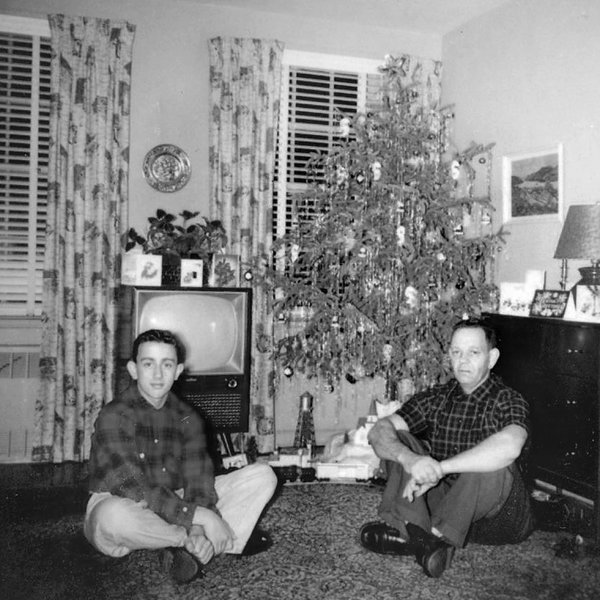
George Bell in 1956. / The New York Times

George Bell (L) in 1956. / The New York Times
 

Fall


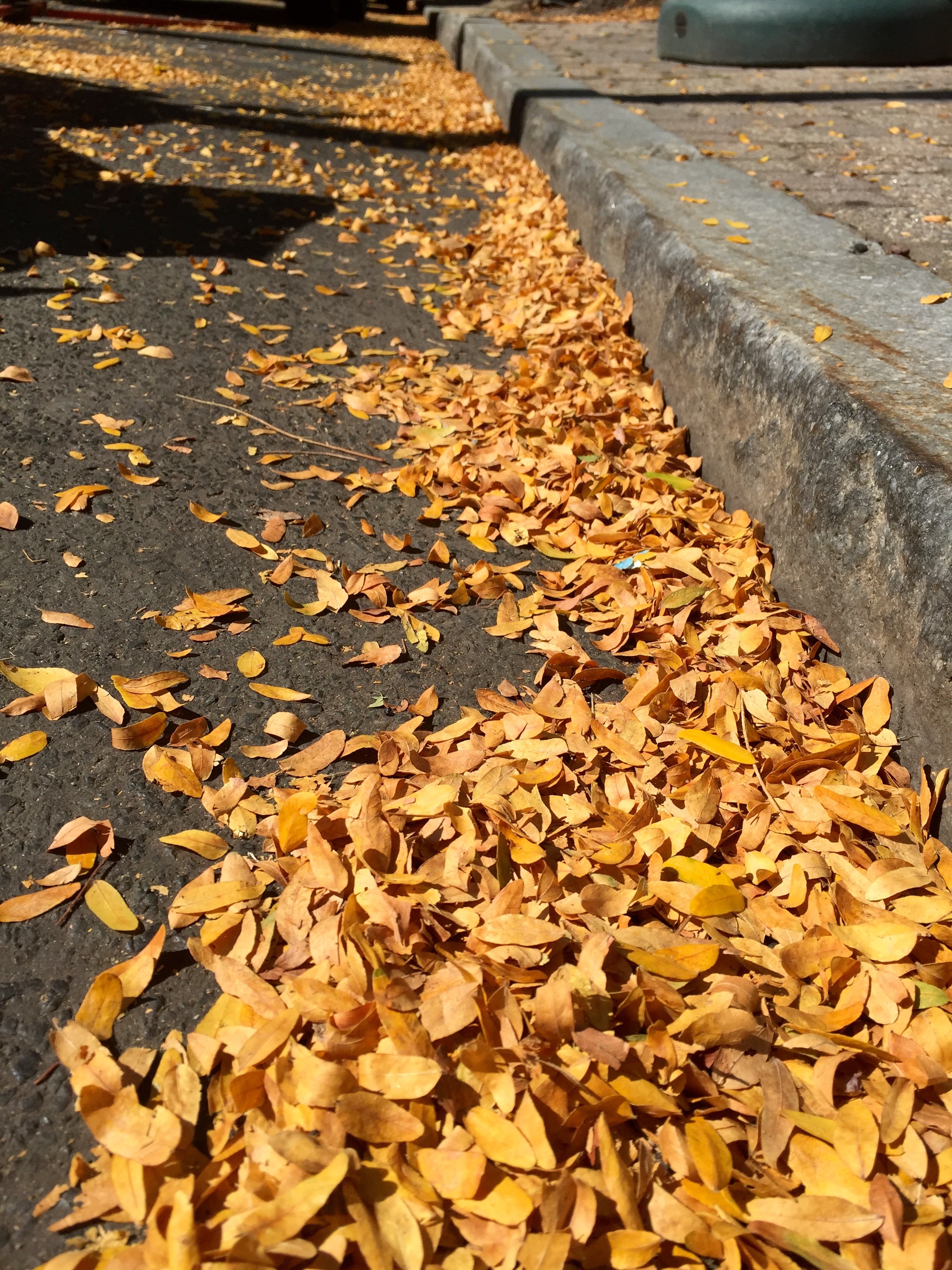
Tiny yellow petals have started collecting in the right angle between the sidewalk and the street. They are huddled there like a paper river, jumping around and changing places ever so slightly as the cars drive by. It is fall.

It was the end of summer before I started to feel like I had arrived here in Connecticut. Even though I’ve been moving between these two very different worlds for twelve years, it has been over a decade since I was abroad for so long at once – nearly seven months, with a brief six weeks back in the U.S. in April, which is when the earthquake hit in Nepal.

I’ve always felt that the gift of living in two worlds, if I am open to it, is the chance to deepen my appreciation of multiple realities. Certain particularities, like the soft muffle of people arriving to temple during the High Holidays, or the rustle of fall and how it smells like apples and makes me think of being outside with my dad, the amazing fact of the New York bagel, a spectacular city skyline twinkling at night, the miraculous convenience of speedy internet – these gifts and many more have been imbued with a resonance that comes only from heightened gratitude. What a tremendous blessing that this is my world, my life, my palette of choices.

Besides being near friends and family, it’s this intensifying of senses that makes me look forward to returning to the States when I’ve been in Nepal. Whatever the tradeoffs, they come with the euphoric feeling of appreciation. Maybe this is why I’ve come to realize that in some way my role on the planet will always be to move between disparate worlds, rather than settle comfortably in one and become stagnant.

This last arrival, however, has been different. It’s been harder for me to access the joys of this plentiful environment. Maybe we are in a new season in America, and maybe I am different, or maybe some of both. I arrived back to the U.S. during the week of Sandra Bland, just as Donald Trump was taking center stage. Everybody seemed so angry and so loud. Among the significant, real outrages and pathologies happening at our doorsteps – Sandra Bland! – precious few were garnering a majority of the words being expended in mainstream discussion. Outside my house, everybody was disconnected from each other, and inside, I couldn’t hear the wind blowing.

It was like being in solitary confinement and being assaulted at the same time.

I’ve started and stopped this post many times, wondering how to write about this season of being between realities without resorting to clichés. I was in rural Nepal working with people to rebuild their houses after an earthquake, sleeping under tin roofs while the early summer monsoon pounded the hills.  Now I’m in Connecticut listening to the Republican debate in my living room. It’s totally cliché.

And yet it’s not these visible differences that constituted the turbulent vacuum between my worlds this summer. Mostly the last two months have been an exercise in putting up barriers. Between myself and the pavement. Between myself and indifferent crowds. Between myself and a certain nothing that creeps in between the activities and compartments of cars and apartments. Between myself and a hailstorm of unmourned and even unacknowledged injury. Between my ears and the fantastic amount of noise, all the talking and procedure that is not about anything.  Between myself and the precious narcissism of our public discourse.

I realize that these barriers have their value. But it feels like a loss. I’m more aware than ever before how many ways American culture forces us to reduce our perceptiveness in order to survive. It’s true that the catastrophe of the earthquake created an especially unique doorway to a productive social consciousness: there was a gigantic and terrible event, but it was fairly concrete – at least on the surface – and I located myself and my community within it. I was one of many people who looked destruction in the face and began rebuilding with patience and humility and a willful connection with others.

But I didn’t really realize how much my sense of my self in the world and in society had swelled out beyond me in these last seven months – even to the earth and its power, to the inevitability of the monsoon, to the practical absurdity of dirt roads going up mountains – until I was back here, and my world became a cacophony of conflicting radio stations, all purporting to be of critical importance.

The summer has been an exercise in shutting down one channel after another, and then re-learning how to decide which ones to turn back on for brief and highly monitored periods of time.

The summer has been an exercise in dodging the frustration, despondency, and aggression that billows about on the street, unchecked, like car exhaust. Then re-learning how to locate and selectively engage sources of collaboration and joy. After all, it is still a blessing to have this palette of choices, whether or not we see it, whether or not anybody sees it. Gratitude is not something that can be faked – it comes directly from a place of knowing.

The summer has been an exercise in observing our political system, our environmental system, and our media, with the surprised naiveté of a newcomer, and hearing the same story repeated in different packages: in how we describe ourselves, our problems, our economic and racial tensions, the rest of the planet.  In the way we talk about the earthquake in Nepal and the victimized people of the third world.  It is a story of detachment, silence, and frustration transmuted in to righteousness.  And yet the power of our systems is tremendous, if only we could see them.  If only we could hear ourselves.

Our narcissism isn’t that we’re a bad society or a bad people.  We just can’t see it.

I have spent a great deal of time sitting quietly in my living room, wondering how we get outside of ourselves without leaving.  I think it is human nature to cling to anything that tells us what we already know about ourselves.  I’m no different than anyone else.  I’ve just spent a lot of time in situations where there wasn’t much to cling to, so there was no choice but to adjust.  We are much more arbitrary than we think we are.

I think about my dear friend Mary every day and I miss her.  I would like to tell her about these things, so she can remind me without saying so that I am just one more well-meaning narcissist, and we are all going to the same place, so we might as well be good to each other and enjoy the scenery.

Now it’s September and the brittle yellow leaves are collecting in the gutter.  They dance around when the cars and people rush by, but they could care less for the hurry that makes them play like that.  It’s just their season to fall from green branches, and become a river in the street.

.      .      .

IMG_5462


On Fractured Temples

IMG_0974

Normally when I leave Nepal, there is an extended process of departure – physical, psychological, emotional. But after being here for most of the last six months, minus six weeks in the middle, I ended up leaving with no procedure at all.

Actually I should amend that a little, since the morning of my flight from Pokhara to Kathmandu, I badgered this hairdresser lady – a friend of a friend – into showing up at 5:30am in her salon to straighten my hair for three and a half hours. That’s right! For two months I’ve been hauling around the hills of Nepal in the hot sun in my flip flops, renting tractors and sleeping under tarps and tin, carrying gurneys of rock with old ladies and filling up rice sacks with dirt to build an earth-bag house, sitting in hot stuffy buses for 5 hours and getting stuck in the mud and walking the last hour in the rain…and the one thing I HAD to do before I suddenly left Nepal to fly home for a funeral was get my hair permanently straightened. Why, you want to know? Because in the U.S. it costs $250 and in Nepal it costs $20. A deal is a deal. And besides, there’s nothing like a good hair day to lift a girl’s spirits.

IMG_5188So in the middle of everything – the whirlwind of our new office setup, the excel sheet full of names and bundles of tin and numbers of people, the scheduling of a planning workshop for our staff, setting up a new financial system – I dropped it all for my last three hours in town and had my hair straightened at 5:30 am. Then I said goodbye to Aidan and Pascal on their way to school, and then to Didi and Bhinaju, who took me to the airport. I didn’t get to say bye to the kids at the children’s home so I bought them some treats and told Ranjita to say how sorry I was I’d missed them, but I’ll be back in 6 months. I’d said goodbye to Aamaa and Hadjur Aama the night before, in Kaski.

And the next thing I knew, I was flying back to Kathmandu, in that reverse warp that happens when I leave Nepal. Except about six times faster. Normally on my way out I have a few days in Kathmandu and they are mostly filled with meetings. This time I had just a few hours between my flight from Pokhara and my flight home.

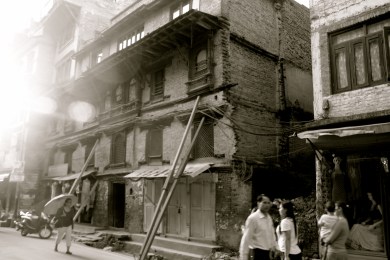
Everything looks different in Kathmandu than it did when I arrived on May 13, less than 48 hours after the second earthquake (remember the second earthquake???), when the city was filled with bright blue and orange tents clustered at intersections, and all the people were quivering like leaves, waiting for another hit. Things seem to have settled in to a process that is serving as the new norm. IMG_0904And the truth is that if you landed here now, from anywhere, you’d be amazed to find that the apocalyptic situation that’s on the TV is not how things look. That’s because the collapsed buildings that the photographers zoomed in on aren’t the whole story. In fact, they were the tremor after the earthquake of poverty and poor governance, which is too chronic and undramatic to capture our attention, but remains most of the problem.
But the real difference is me.

When I arrived here two months ago, this situation felt vast and unknowable and as tragic as my imagination could make it. Now I can locate myself within it. Our piece, which will ultimately total around 150 homes and piles of stories, was small but meaningful. I have a sense of how people are moving forward with their lives one step at a time (although I should add that during these months, I met only one family that had lost people in the earthquake). Which is not to trivialize what’s been destroyed – only to say that, in the beginning, when everything collapses, it’s impossible to imagine a different future.   All the unseen things are terrible and insurmountable in your mind’s eye, and you can’t conceive of the steps between here and there. I couldn’t even visualize “there.” Now I feel like can at least be at peace with a changing target, because that shifty feeling of uncertainty and failure is a known thing, not a shadow. And so far, we’ve done our part despite it.

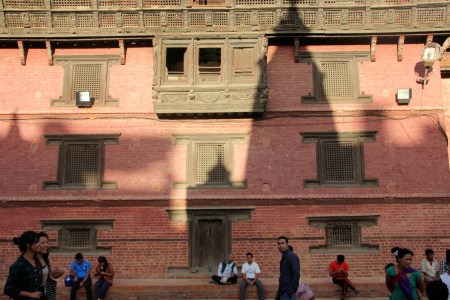
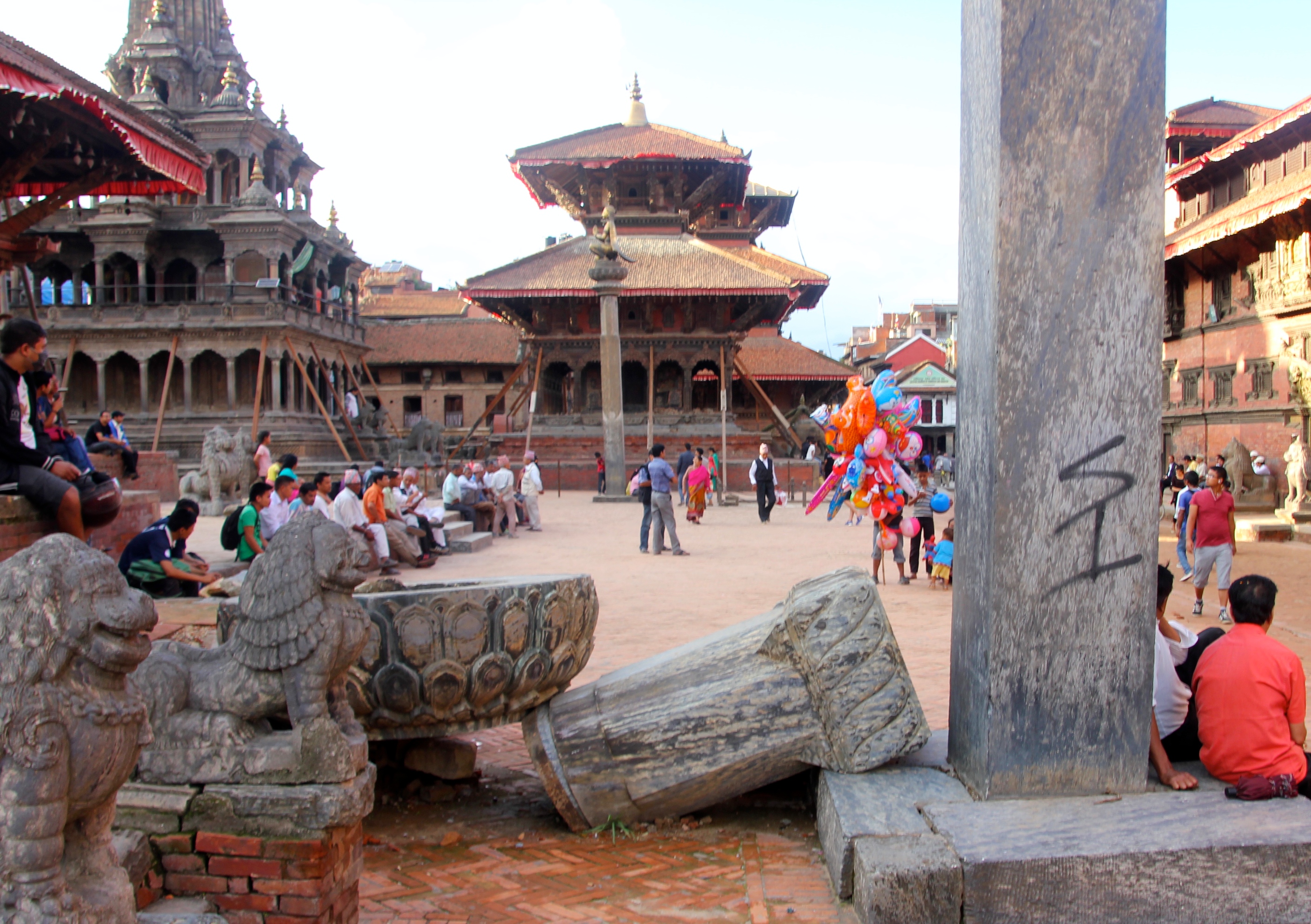
My last few hours in Nepal were perfect. I met up with two friends from the U.S., both doing doctoral work in Nepal, both fluent in Nepali. We walked down to Patan Durbar Square, my favorite section of old city, known not only for its temples but also its artisans and craftsmen. Patan is one of the areas that was featured heavily in the days after the earthquake, when the only photos of villages were from the air.

On this last afternoon, the rains held off, making way for a cool golden evening, the light waving in the folds of cloth that ripple along the edges of the temples. We sat high up on the foundation of what used to be a temple, observing the courtyards that were filled with people eating ice cream, buying balloons, whispering on dates, playing. Between the scaffolding that surrounds the damaged buildings, people were busy living in the very space that, I know full well, much of the world sees in its own mind as a pile of dust and despair.

IMG_0977

My thoughts drifted to conversations that Anne and I have had about the beauty and strangeness of Pashupathi Temple, Nepal’s holiest cremation site, where passers-by sit across the river and watch pyres burn during the day and night. Sometimes there are kids playing soccer, or folks out enjoying the sun or the beauty of this thousands-year-old place of pilgrimage. What’s always amazed us about this is that people can play soccer near death. Or go on dates near death. Or just gaze, for no reason at all, at death.

Of course, it’s there anyway, even if you’re not looking at it. And once you get used to the idea that you do not have to avert your gaze from a pyre, or from a mother wailing over a pyre, everything else looks different too. Suddenly that moment belongs, in some way, to everyone.

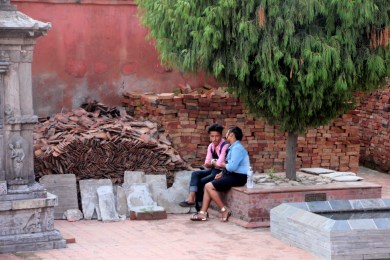
IMG_0956There is no caution tape around Patan Durbar Square, or even around the base of this foundation that used to have a temple on it. The reconstruction is public and unbashful, but it’s also not desperate. In a courtyard tucked away to the left, bricks are patiently stacked up and a young couple is talking furtively under a tree.
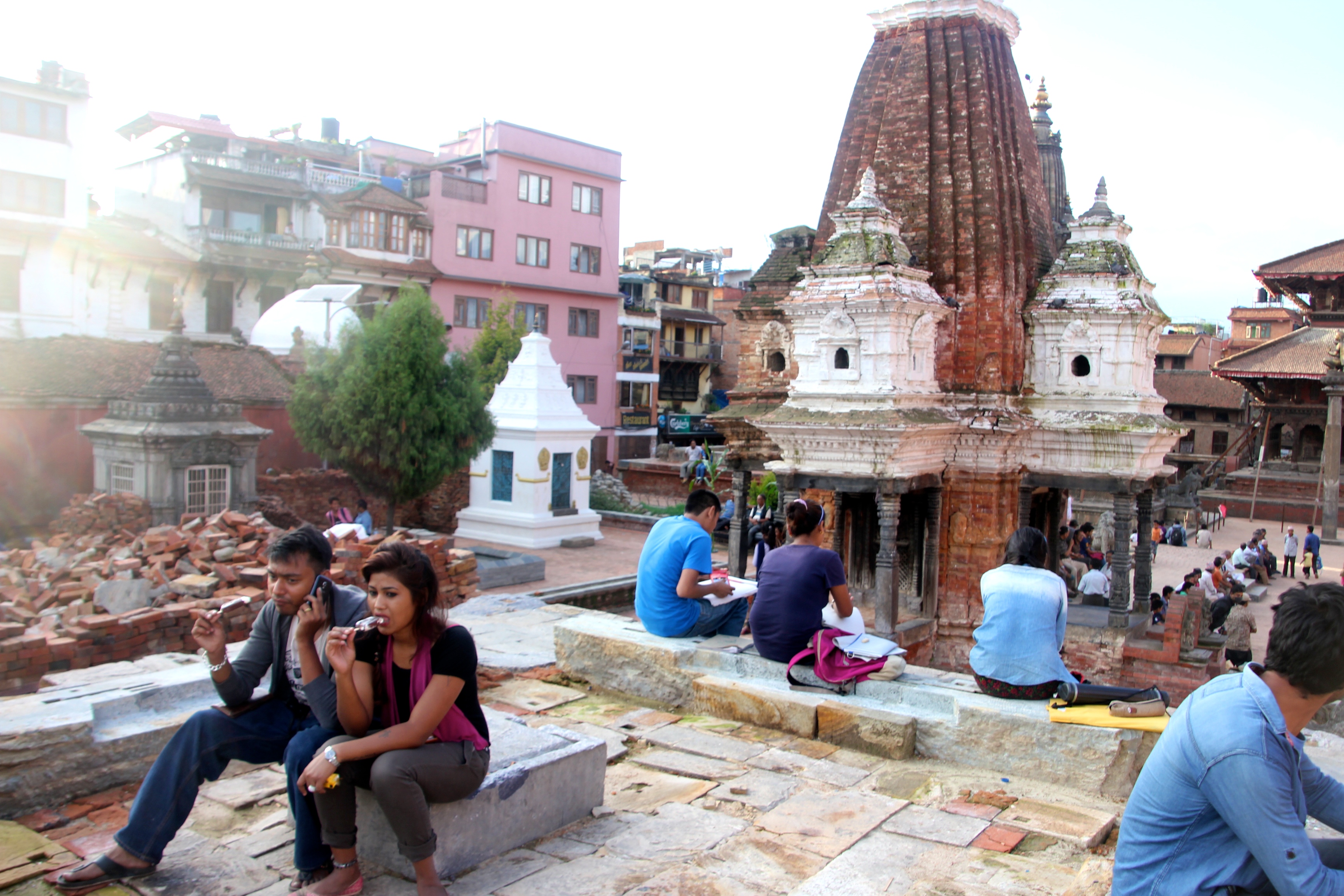
But who would think to take their picture for the news?

I think maybe, in the sterilized West, it is hard to believe in loss unless it looks like something we wouldn’t feel right resting our gaze upon in person. We see the spectacle and only the spectacle, because cracks don’t mean much, but the un-witnessable speaks to our understanding of destruction, and insulates it from the safe and organized world we know. But that’s impossible in this part of the world. Things are lost so often, so publicly, and with so little fanfare. All the falling and building is mixed up together with the balloons and scaffolding; the moment belongs to everyone.  So it is still okay to play.

We sat for two hours with all the other people doing normal things on the bald foundation of this temple, looking out over the square, talking in the warm breeze, and watching the balloons and ice cream and couples and pilgrims swirling around these fractured structures, which are on to the next chapter of their lives with minimal complaint or ceremony.

IMG_0940

When I boarded the plane to come home, my pants still had thorns in them from Tripureswor, Ward #6. These feisty little guys are so hard to get out you have to either pluck them one by one, or have a couple of ladies grooming them off you with a sickle like a baby chimpanzee.  I’ve been groomed a few times in the course of these last weeks, but I just kept walking through the thorns and re-collecting them, and now I’m taking them back to America.

Classy, right?

Hey, my hair looked good.

.      .      .

IMG_5191


Day Thirteen


Today is the thirteenth day after my friend Mary’s passing.  As I’ve written about before, this day marks the end of the initial kriya period, where the immediate family of the deceased observe two weeks of purification and austere ritual that instructs their food, bathing, clothing, sleeping, movement and prayer.  It is during this time that the spirit wanders in its new world, perhaps hovering about in this one, finding its way.  On the thirteenth day, a large meal is cooked, the family and community drink purifying bitter gaun, and life begins again.

I have decided to go back to Connecticut a week early for Mary’s memorial service.  But I wanted nothing more than to observe this thirteenth day in my own way, here in Nepal, where I feel close to the sky.

In addition, there’s the baby buffalo.

Two weeks ago, on friday morning, I woke up to a misty dawn with my phone near my head, and rolled over to see how my friend had fared since some bad news had arrived in my email the prior night. There was nothing yet – it was now night time in the U.S. – but I had a bad feeling.  And when I walked outside to wash my face, our very, very, very pregnant buffalo Lulu was shifting about uncomfortably in her shed.  She was due any moment.  Since I’ve arrived in Nepal this summer, I’ve been hoping to be at the house when Lulu has her baby – a phenomenon I’ve witnessed only once in twelve years, and will never forget.

For anyone who’s never seen a large animal like a buffalo very pregnant and approaching their moment, it’s hard to describe.  You can feel, like a physical entity, the pent up power of nature, the imminent violence and miracle of birth.  This animal that is normally so much bigger than you is so much smaller than what’s about to happen.

I left that morning for a meeting in Pokhara, already crying on the bus, where another little blue dot popped up on my phone – a new message saying things had not improved, that Mary was probably in her last hours back in New York.  And I was on this strange road in Nepal, on a mountain, the mist close and threatening rain, and the buffalo shifting around uncomfortably in her shed under Aamaa’s watchful gaze.

I spent a surreal day in Pokhara, and called Aamaa late in the afternoon.  The baby buffalo had been born and everyone was doing fine – the marvel of life.  Twenty minutes later, I got a message saying that Mary had died.

IMG_0450

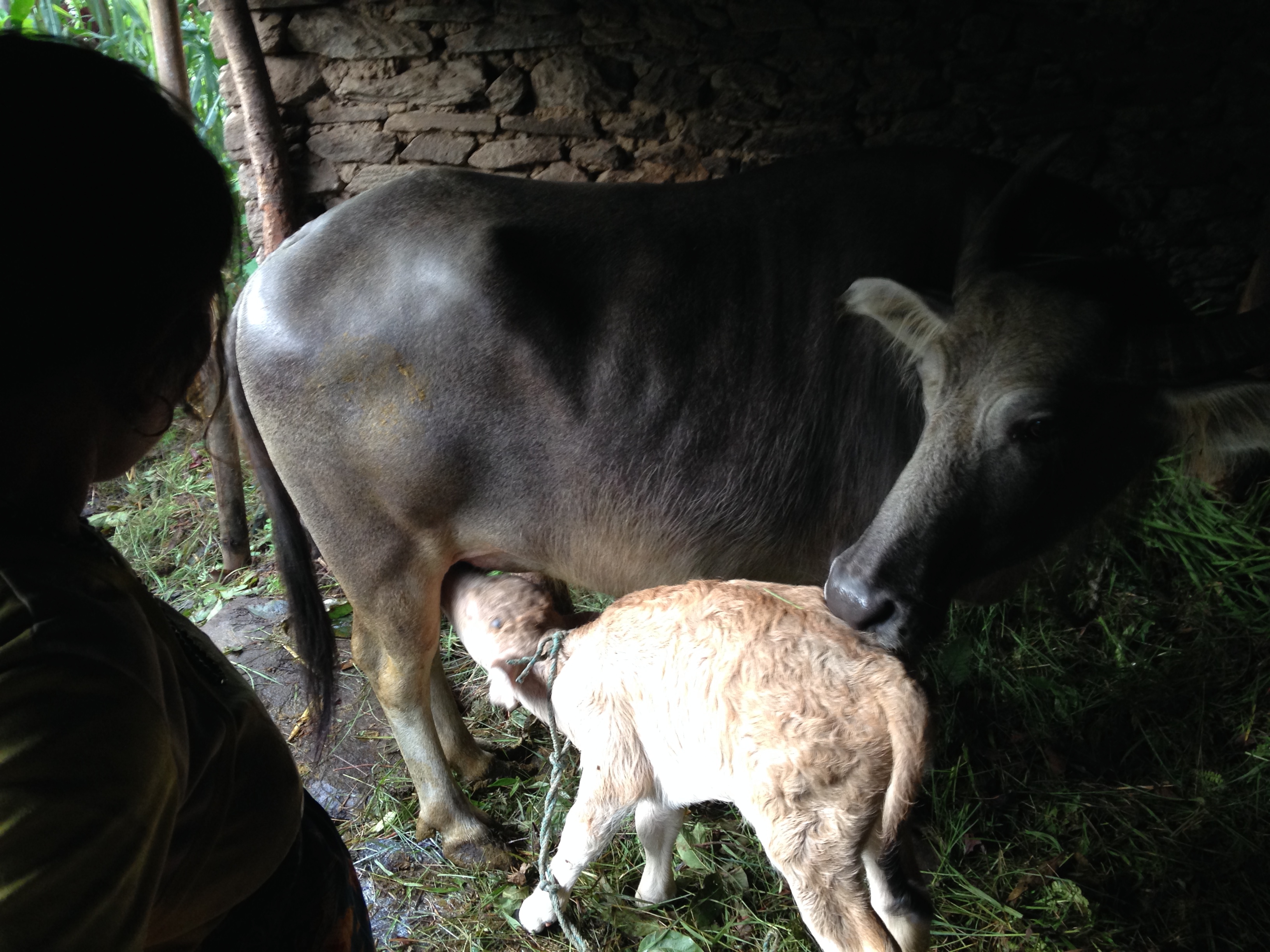
So this little baby buffalo has been a source of wonder and comfort to me.  I named named her O’Neil. When I came up to Kaski a few days later, Aamaa pumped me full of the nutrient-dense, sacred milk that the mother buffalo makes in the first few days after giving birth, because she wanted me to be nourished.

The birth of a buffalo is a ritualized affair that is, in some ways, the inverse of a death.  For eleven days, we are not to eat the milk with food, or wash cups and bowls used for the virgin milk in the same impure space as the rest of the dishes.  When I took a little burnt piece of something out of my milk one day and tossed it on the ground in the yard, Aamaa went and picked it up, lest it touch the bottom of someone’s foot.  It is, essentially, an eleven day observance of the fragility of life and the gift of the milk that our Lulu will provide to her baby, and to us.  Then on the eleventh day there is a puja, with a priest and everything, and on that day we cook rice pudding, putting the milk into our own “bread” and bodies.  And the cycle goes on.

P1020891

Kalika Hill

I had missed O’Neil’s birth puja because I was out in Dhading.  So today was the first chance that Aamaa had to make rice pudding for me with O’Neil’s milk.  And that’s how Day Thirteen began, with a rich and delicious celebration of the life of our little baby buffalo who was born almost the same hour that Mary died.

Then I climbed up to my favorite place in all of Nepal, a spot along the hilltop that leads to the Kalika Temple, for which Kaskikot is named.  First I went to the temple, with flowers and incense from our house.  I made my offering and rang the bell.  Before heading back to my favorite spot along the crest of the hill to do my qigong, something made me think I should look around for some sign, something that would make me feel like Mary was here with me, and I was here with her.  From the Kalika Temple, you can see everything, the valley on all sides, the lake to the southeast, the stretching falling foothills reaching to the horizon, and the soaring Annapurna range to the North, towering halfway up your field of vision.  It is spectacular.

But the direction I decided to look was up.

IMG_5176

I have taken hundreds – literally hundreds – of photos of rainbows in this village.  I know where they show up and in what kind of weather.  But I have never seen a rainbow like this anywhere on the whole planet.

I left the temple gates and ran through the grass in my flip flops, following the hilltop to my favorite rock.  I kept checking behind me to see if this amazing rainbow was still there, and it just kept getting brighter and more extraordinary.

When I found my favorite rock, I lit incense and placed more flowers I’d brought from our house.  I am so close to the clouds on this three feet of rock.  I can see my little house looking like a toy in the hillside.  Everything is far away and whole.  I closed my eyes.

When I opened them forty five minutes later, the rainbow was gone.

.      .      .

Mama Lulu and Baby O'Neil

Mama Lulu and Baby O’Neil under Aamaa’s watchful gaze


The Merit of Stories


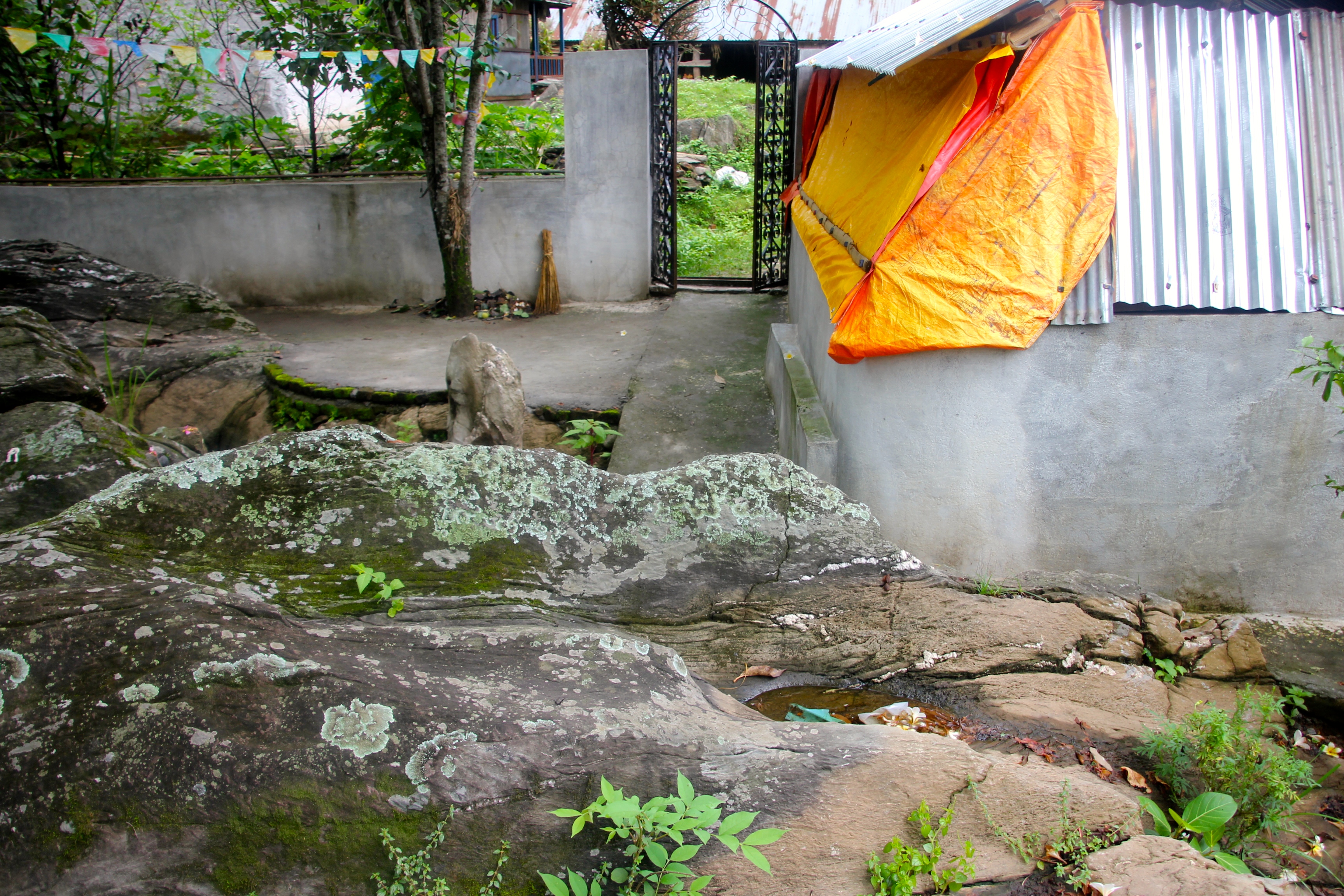
Last night in Tripureswor, Anne and Dilmaya and I slept in a makeshift tin cottage with the sound of the river rushing by outside. When we got up in the morning, we were astonished to find that the shelter was buttressed up against this stunning prayer site.

This slideshow requires JavaScript.

It is hard to capture the beauty of this place in a photo: river-worn, looping rock formations swirling around the base of this strong and humble tree. It is maintained daily and with great joy by our host, Krishna Man Shrestha, known by everyone here as Saila Dai.

He took us in to this wonderful garden and proudly went around showing Anne and I where each of the Gods sleeps in it. Below is the bed for Shiva, king of the Hindu gods. I missed a brilliant moment where Saila Dai lay down in this nook in his shorts and Nepali hat with a blissful smile, eyes closed, hands clasped in a Namaste over his head, to demonstrate how Shiva sleeps here.

IMG_0672


Yesterday, as soon as we met Anne and crammed in to a hot bus with tiny seats to drive to Dhading, I told her about my friend Mary, who died a week ago. I’ve been missing her terribly and I feel myself trying to sort out where she is in this strange journey I am on in post-earthquake Nepal. Even today, I’m not sure why we’re headed out to Dhading. Because Anne is an expert on ritual, I knew she’d have some ideas of ways we could connect with Mary on our impending adventure in Tripureswor. While we bounced along in the bus, Anne told me about the Buddhist ritual of cultivating and offering merit to a departed soul, to help them along on their transition from this world to the next. I knew that was the perfect thing to take with me into our undiscovered story in Ward #6.

Saila Dai

Saila Dai

So Saila Dai’s gorgeous prayer site was an auspicious beginning to our day. After tea, we left with Bishnu to explore his village. I brought along my recorder and camera. With no clear plan and full day from Pokhara, it is safe to say we were winging it.

What we ended up doing was sitting down at house after house talking with the owners. We asked about their families and where they were when the earthquake hit; how they’d rebuilt and what they thought the future held. When asked what we were doing there, we were honest: we said we weren’t sure. We admitted don’t have the capability to do a complicated or expensive project so far from our base in Pokhara, but we were interested in understanding what people are experiencing in Tripureswor.

IMG_2357To our great surprise, person after person told us that we were doing a great service by taking time to talk with them. One person said, “by coming here and looking us in the eye.” Anne and I were both amazed by how many people said things like this. People’s lives are pretty shaken up in Tripureswor. But of course, it’s not just the talking, it’s the sitting, the cup of tea or slice of cucumber, the story of the prized son who is studying college in Kathmandu, the unwritten story of getting old in this place. It’s the lack of an agenda. That’s how most of the things that have mattered in the end have started for me in Nepal.

And then there was the water. The main focus of the iNGO community right now is shelter, but no matter who we asked, everybody told us that the biggest problem in Ward #6 is water. The earthquake damaged the water tank that supplies this whole ward, so they’ve been piping water in from neighboring wards, but that sharing won’t last. And even so, people have to walk very long distances to fetch water. Having done plenty of that myself, I can tell you it’s no picnic. The community has already located a new spring, and all that’s needed is infrastructure to collect and distribute. But in addition to some simple concrete tanks and many kilometers of pipe that they need – which is something we could provide – there are some complicated engineering factors, one of which is that the water source is on the other side of the river, so pipes need to be slung across it like electric wires.

Ward #6’s water pipes will have to be slung over this river.

Ward #6’s water pipes will have to be slung over this river.

As the day went on, it became clear that the water project also is too complicated for us. However, Dilmaya and I did feel like we’re capable of advocating for it. I can contact Oxfam, the major iNGO doing recovery this village, and my contacts at United Mission to Nepal, who are also involved with relief in Dhading district. We decided that Anne would stay for the week and help get together enough details for a proper proposal. Late in the afternoon, we all went in to town to meet with the Village Chairman and run this all by him.

The last thing to come out of our day was that Anne, who’s spent many years doing cultural and sociological research in Nepal, came up with a beautiful project for her upcoming week. There is a Japanese tradition whereby people write prayers or wishes on small pieces of paper, tie them to strings, and then hang the strings in the air, sort of like prayer flags. She plans to have tea with all sixty families in Ward #6, look people in the eye, and write their worries and prayers with them. She bought the paper and string while we were in town meeting the chairman.

I also did a lot of recording and hope to produce an audio slideshow about Tripureswor, as well as a radio story about the effect of the earthquake on animals. So if that works out, I’ll have a concrete reason to point to that we schlepped – and I mean SCHLEPPED – all the way out to this village. And if the water project actually comes around, that will be really amazing.

But on some level, I understand that this expedition was not about something concrete anyway.

Late in the evening, I went up to a high hill behind the house, overlooking the valley and emerald hills that are glistening with humidity and rain. I did my qigong practice and offered the merit of our day to Mary, to guide her on her way. I offered the merit of Saila Dai and the humility and joy he gives to his enchanted prayer site, and which he had in turn offered freely to us. I offered the merit of looking people in the eye, of meeting Janet for twenty minutes in a coffee shop and connecting her good heart to mine and following the road out to Tripureswor Ward #6, with no agenda but to listen to stories and return them to Janet, whom I don’t know at all. I got started late, so by the time I was finished with my practice, it was nighttime on the unlit hill, nothing but moonlight reflecting off the river in the valley and the spare lights of the bazaar down below. Which seemed right. The merit of stories is how they linger past sunset, into the darkness, when all the people have gone to bed.

.      .      .

IMG_0835

A Bamboo Village

I am so excited about this post. I started hoping I’d get to write that title a few weeks ago, and now here it is.

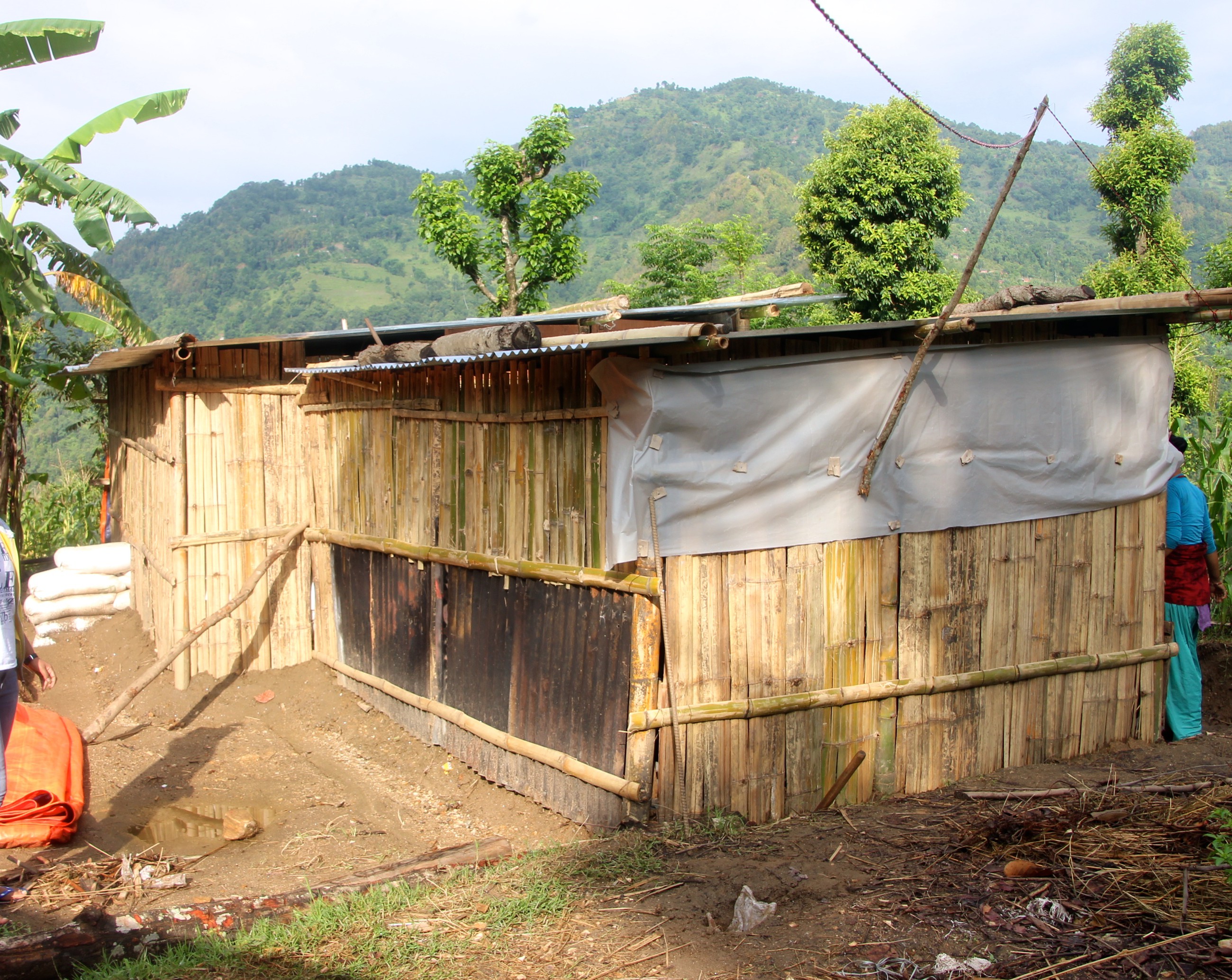
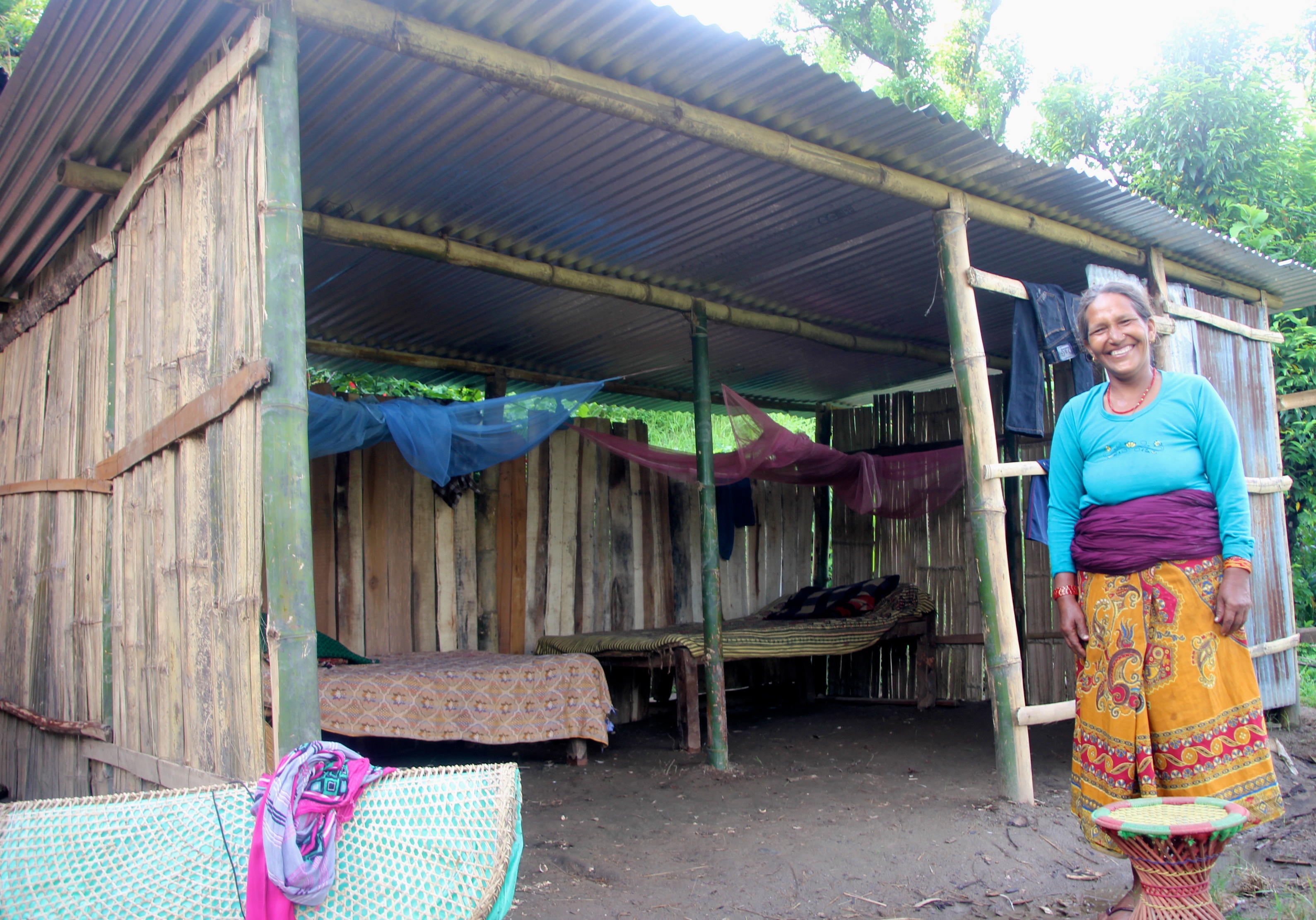
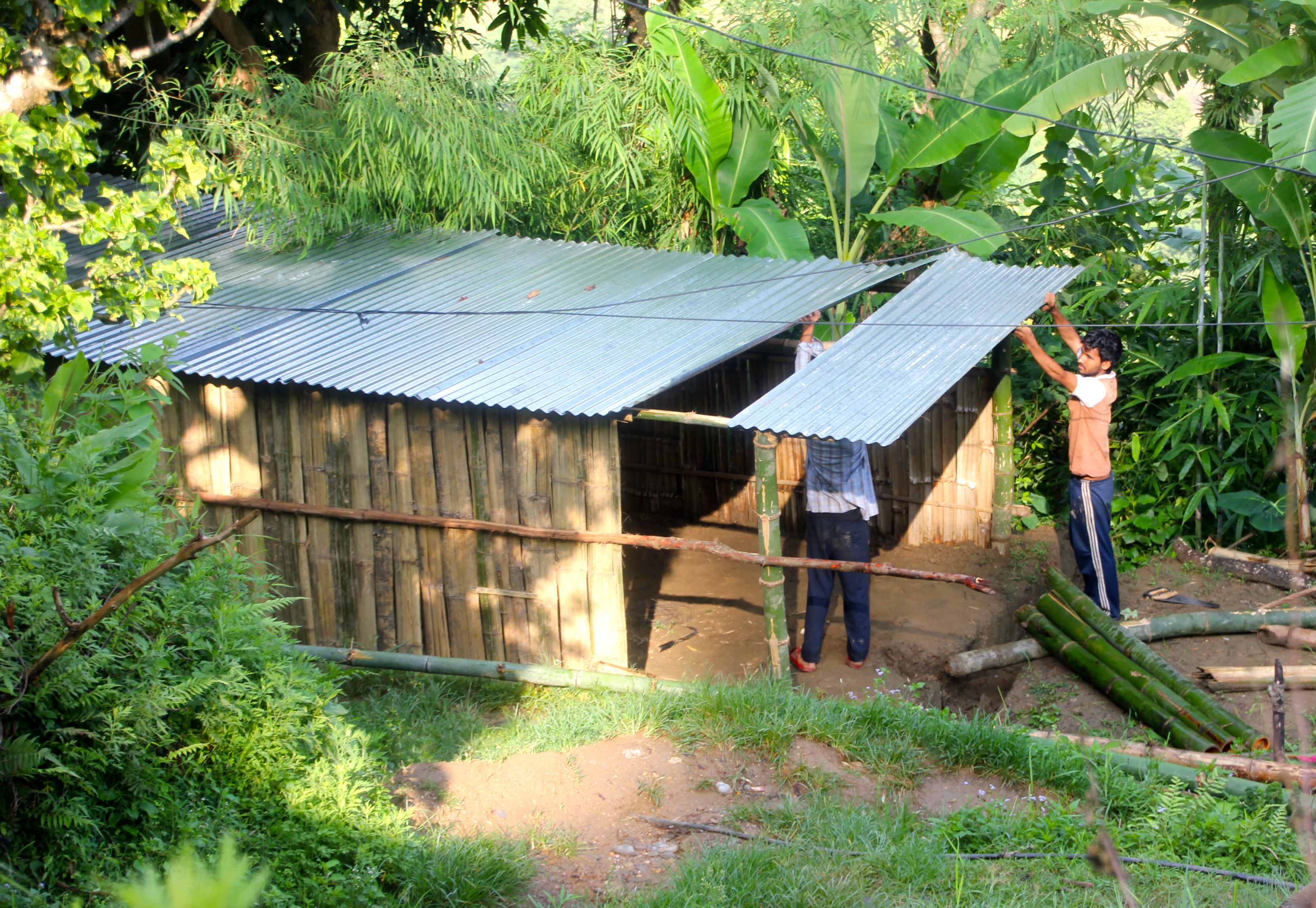
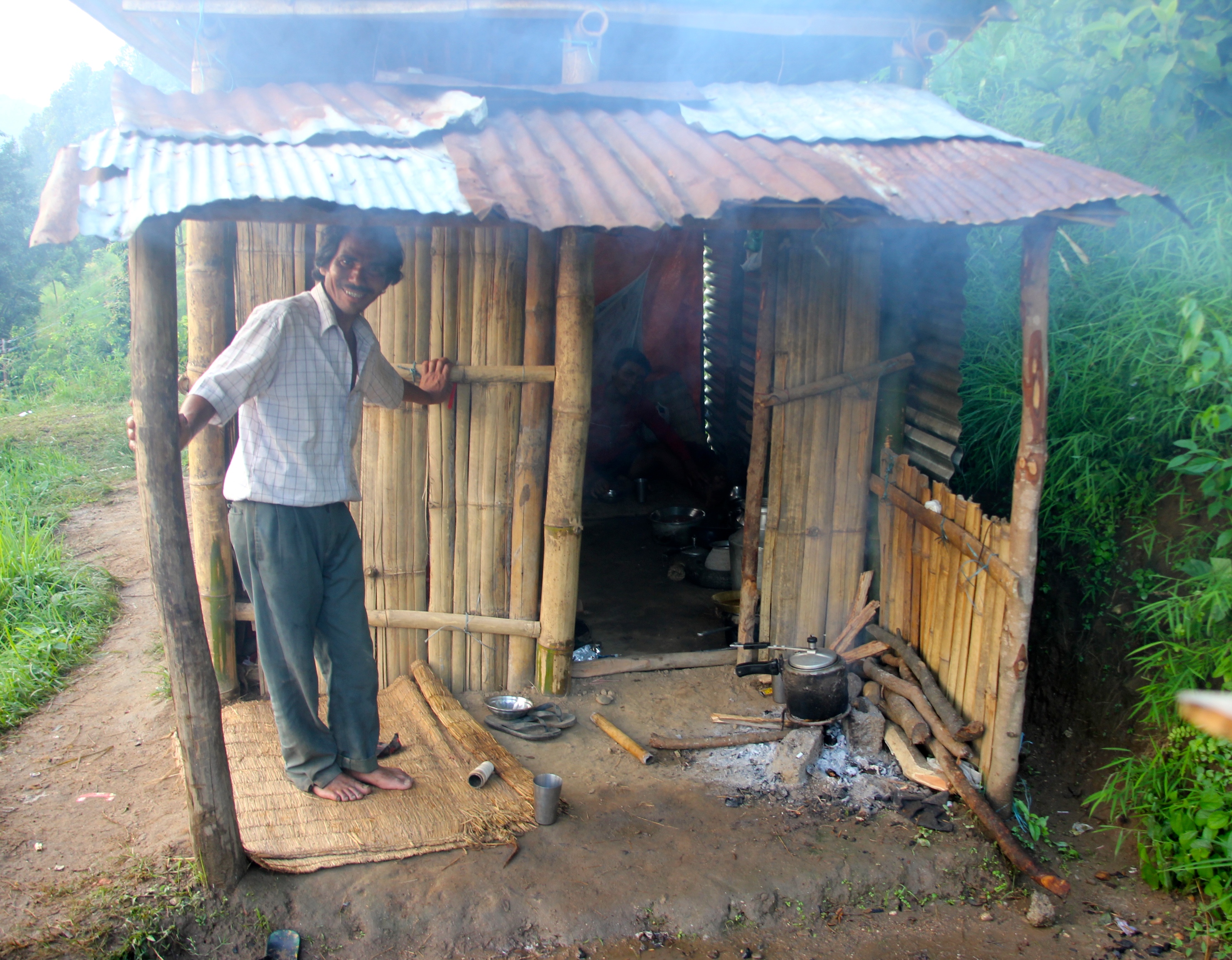
We went back to Archalbot today to see how things had progressed since our tin delivery about a week ago. In contrast to our first shelter outreach effort, where we left not knowing how many heads we’d actually covered, in Archalbot we found a village of new bamboo houses. Some of them are still in progress, for a few reasons. One is that the houses in Archalbot didn’t fall completely; most people still have homes that are dangerous, but not technically unlivable, which slows down the shelter construction. The second is that it’s planting season, so people kind of got something up as quick as they could, and plan to do their plastering and finishing in about a month.

Still…this was a pretty great sight to see. Let’s start with the earthbag house. It’s been covered in a bamboo frame and turned in to a pretty sweet little cottage with electricity and everything hooked up, and a neighboring home built right next to it, much like the attached houses they are temporarily replacing.

IMG_0513


Next up, remember Kushal? Here is a photo from the tour he gave me of his original house, and here he is in his new bamboo home.


The site we glamped at in Kripa’s yard, which was previously the buffalo shed, is now a bamboo outdoor hotel (which unfortunately, I seem not to have taken photo of!) And this lady, Kripa’s neighbor, was seriously so happy about her bamboo cabin that she absolutely insisted we come back again after the planting season, when it’s all plastered and everything, to stay the night.

IMG_0494

I could post another load of these photos. They were just great, one after another.

IMG_0497

For the sake of transparency, I should admit that there was one woman who hadn’t built a thing; her tin was sitting on the buffalo shed waiting to be used. In the end, we didn’t pre-check all the frames or original houses in Archalbot, because we’d spent so much time there and the homes were so concentrated that we relied on the community to police itself (and in fact, it was a neighbor who brought us over there). This house is one of those that is ambigiously unsafe; cracks in the walls, but generally a more appealing place to live than a temporary house, so it’s kind of up to the owner whether or when they’re going to bit the bullet, move out, and rebuild.

We had an awkward interaction where I politely explained that she didn’t really need a roof – which I could see from looking in her house – so we’d be giving it to another family in the morning. I said we’d welcome do our best to provide anything else she could think of for something she actually needed. That was at 7:30pm. When we came to pick up the tin the next morning at 9:30am, we found the following:

IMG_0549

Well, that worked. For something.

So we have the successful, the more successful than we actually we wanted…and Uttam. Of all the houses in Archalbot, Uttam’s family’s are my favorite. Unfortunately they’re on borrowed land and in the last week and a half, the landowner said they can’t stay, so in theory they’re going to have to relocate this whole operation to their own land, where their ruined house is still taking up a lot of space. As a result they didn’t bother building the front wall. But I still give this house an A- overall, and an A+ for improvement from starting point.

IMG_0555

IMG_9442

However the trophy goes to Uttam’s older brother, whose home is quite smaller. Remember when I this family didn’t want to go cut bamboo because they said nobody would help them? When Uttam’s older brother and his wife left for the woods with their tape measure, and when he showed me where he’d planned the guest area? This guy and his wife looked so proud of their house and so grateful that something in this world hadn’t proved to be a sham.

IMG_0471

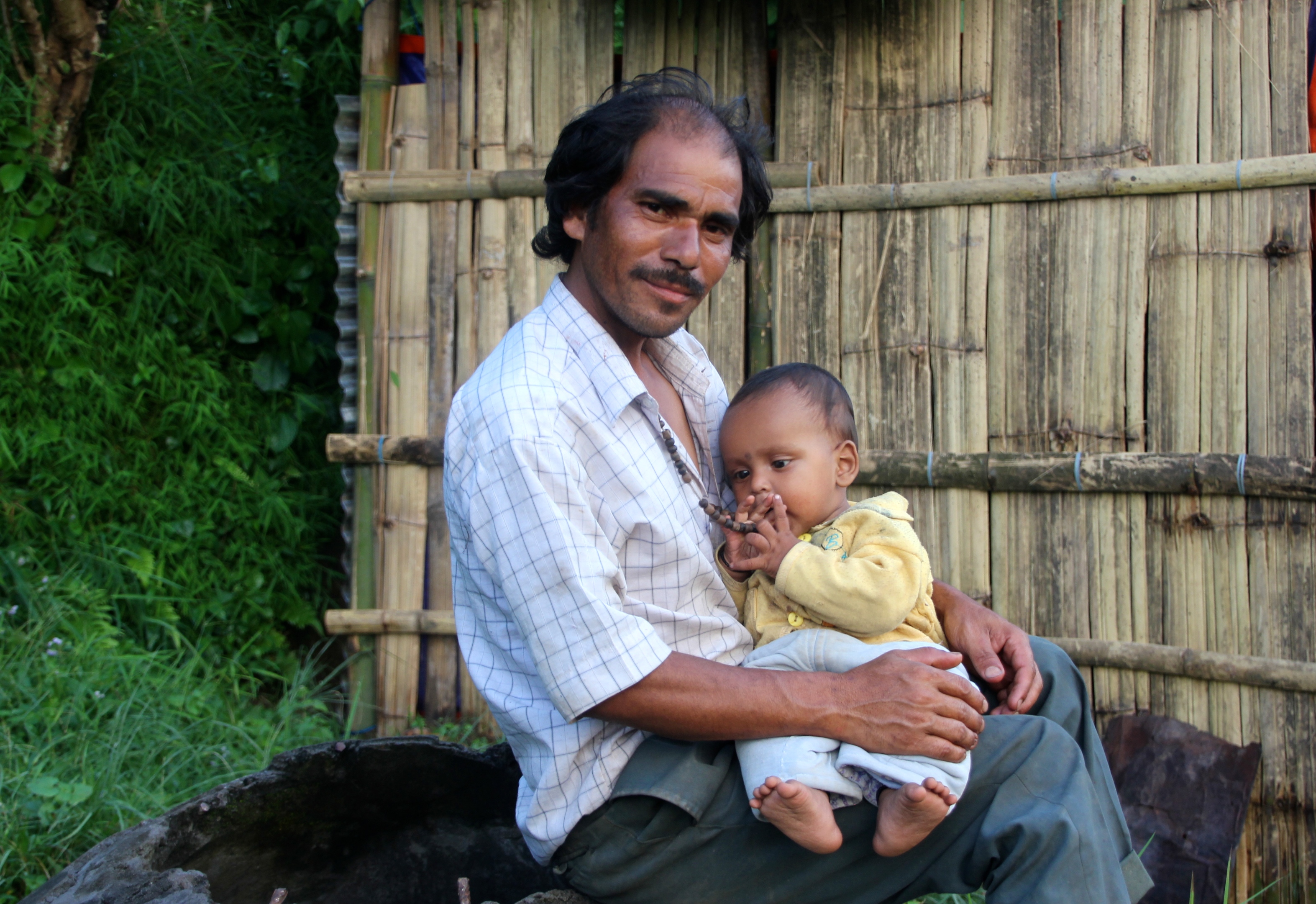
When I took this photo of Uttam’s brother outside his house with his grandson, he called me over and pointed to the camera, and I knew he was going to say what people always say: “Please send me a copy of this picture.”

But he wanted something else.

“Show this photo to the world, ok?” he said. ”You know, something for people out there to remember me by.”

.      .      .

IMG_0483

Beautiful Things

We are building houses of many kinds around here, one of which is our own. In between trips out to Lamjung, I’ve been slowly setting up our new office. We’re moving from a one-room office to a four-room office, and anybody who knows me will know that I can labor for weeks or months over small decisions, and filling up a new space requires an infinite amount of decision-making. It took me three weeks to choose carpet, and then the people who came to lay down the carpet did a really bad job, cutting jagged lines and making a mess of it. I had the store send them back and then stood there while they cut everything in straight lines. As they left we were chatting, and I asked them not to take it too hard. Americans, you know?

If I’m honest, my obsession over our new office setup isn’t just about an neurotic issue with straight lines. These walls are going to be ours for some time to come, I hope, and a home where we chase a vision of some kind. And after over a decade of sharing spaces – from dressers to offices – there is a part of me that feels the slightly daunting emptiness and possibility of this unfinished office. The prospect that it will be a space I designed, and that when we walk in, it will feel like it has something of me in it. I realize this is pretty indulgent, but the compulsion is real. 

Anyone who’s ever worked with a contractor knows that anyone in any country can obsess endlessly over both important and insignificant issues of build, and contractors can correspondingly obsess not enough over these things. But I do feel confident saying that Nepal takes certain aspects of haphazard interior design to a new level. The kind of care people put in to their planting, or their outfits when taking a photo, or cooking, or weaving mats, just doesn’t get put in to home decoration. Modern housing in Nepal is quite compatible with leaky faucets and doors that don’t quite fit their frames and paint assortments of ecstatic colors that overlap lazily from one feature to the next. So for better or worse, I’ve begun to lord over each poor unlucky soul who comes here to put something together, just to make sure our work space doesn’t become an accumulation of unloved creations.

IMG_5081So it’s not exactly going fast, but it’s going.
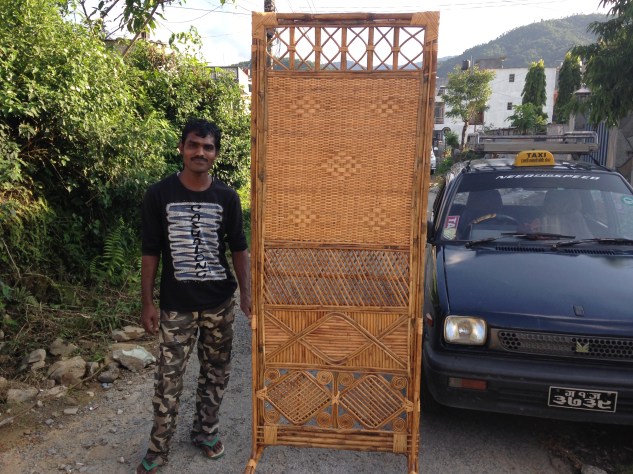
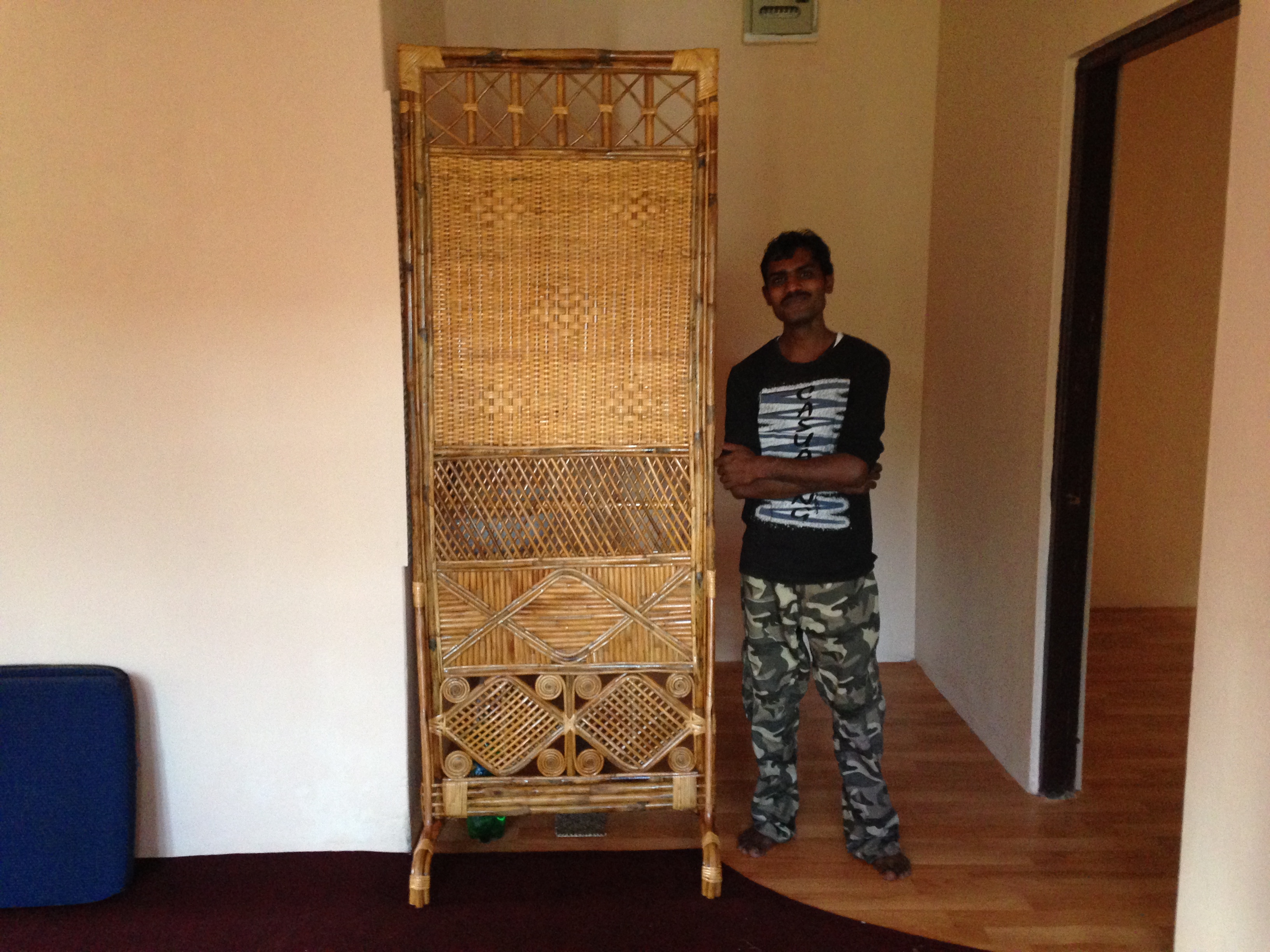
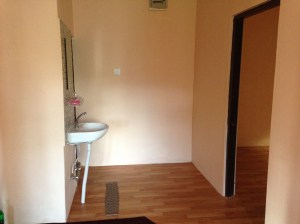
One funny quirk of our new space is this sink outside the bathroom, which is just hanging out in full view of the rest of the office. Someone suggested that I get a local bamboo artisan to create a simple screen to put here, so that people coming out of the bathroom would have some privacy while using the sink.

So last week I asked Shiva to go to Mahendrapul with me and stop in at one of the bamboo furniture places. He pulled his bike over at the first one we happened to see, where there was a young man named Umesh.

Off all the things we need to set up in the office, the bathroom screen isn’t the one I was most concerned about. But when I set about explaining what we needed, Umesh began leading me around his shop to examine various handmade bamboo chairs and tables and hangers, cataloging designs I liked. He was extremely attentive and enthusiastic, and as our conversation went on, he couldn’t help himself from admitting that he’d opened his shop just two weeks ago, after fifteen years of working for someone else.

“I told them, I can make anything,” he said, looking like he’d been bursting to tell somebody this. “My hands are full of skills. I said, ‘Why are you keeping me down here?’ And I left and opened this shop.”

Being the choosy perfectionist that I am, I could easily have told Umesh thank you very much and moved on to the next place so he could get his new business going with a less high-maintenance customer. He quoted me $90 for the screen – as expensive as one of our desks, three times as much as the chairs he sells. Very enterprising, I thought. Good on ya.

Instead of going to the next shop, I went with Umesh to our office so he could look at the extraneous bathroom sink area himself. And after all the discussing we’d done, I waved my hands and said, “Ok, the main thing is it has to be opaque from here to here. Other than that, do whatever you think will look nice. Make it your own style–a ‘By Umesh’ bathroom screen.”

“I’m going to make you a beautiful screen,” Umesh proclaimed. “This is a very new idea – it will be first of its kind in Nepal.”

Four days later he called to tell me it was ready. He put in in a taxi at his own cost and brought it to our office, and when I arrived to meet him, he was already standing in the road with the screen next to him, trying to hold his smile in.

IMG_5076

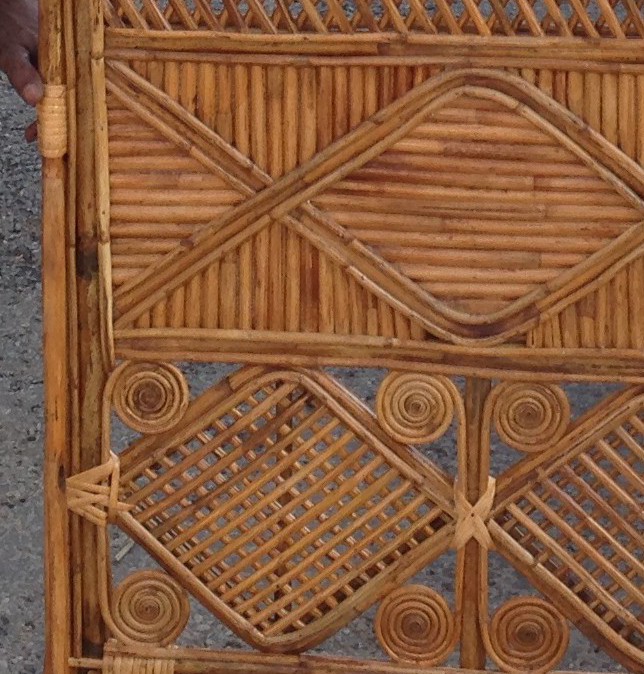
This exquisite bamboo sink screen is no doubt my single favorite thing in our new office. It is absolutely gorgeous and in the U.S. would sell for a few hundred dollars. It has the charming quality of being made from bamboo during a period of months where I’ve been, oddly enough, spending inordinate amounts of time in the hot sun encouraging and supporting the creation of bamboo homes in post-earthquake Nepal. But most importantly, it was created with a great deal of pride and love. One side is bent a little, the natural curvature of the bamboo, a perfect imperfection. What started off as a temporary wall to enclose a bathroom became this magnificent piece of artwork.  And as we were all discussing later, you should have some things that you keep around just because they are beautiful.

IMG_5080

Before Umesh left, he couldn’t help admitting another thing, which was that, actually, I’d been his very first customer. I said he was our very first artisian in our first professional office, and that I expected his career was going to go quite well.

“I’m never going to forget you,” he said as he left.  And I said, “I’m pretty sure I won’t forget you either.”

.      .      .

IMG_5076

Glamping and Magic Cake Houses


Reading over my blog entries, I’m realizing I’ve left out some of the nicest details of the hospitality we’ve received in Archalbot this week. So let’s just put them all together.

Detail #1: Glamping

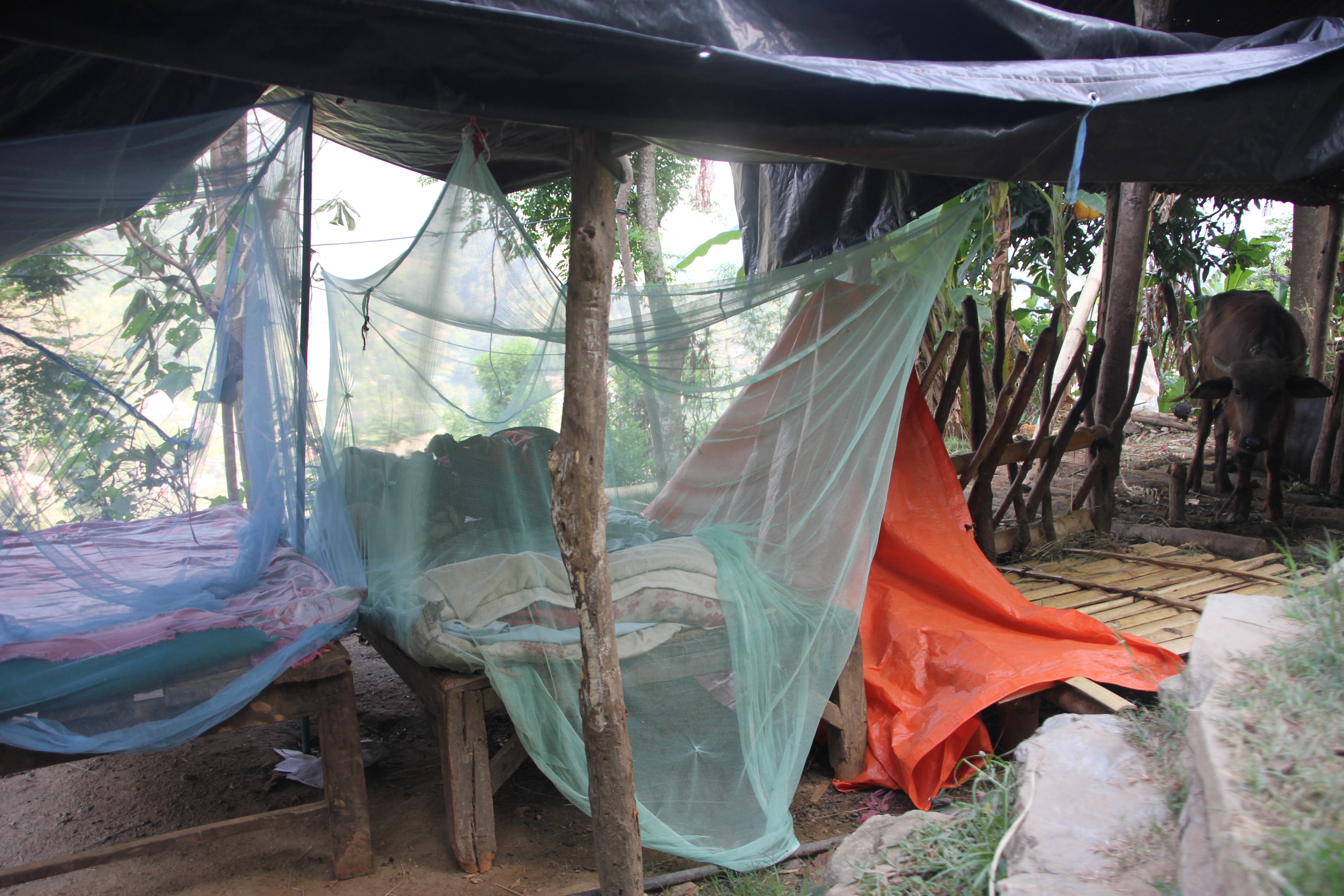
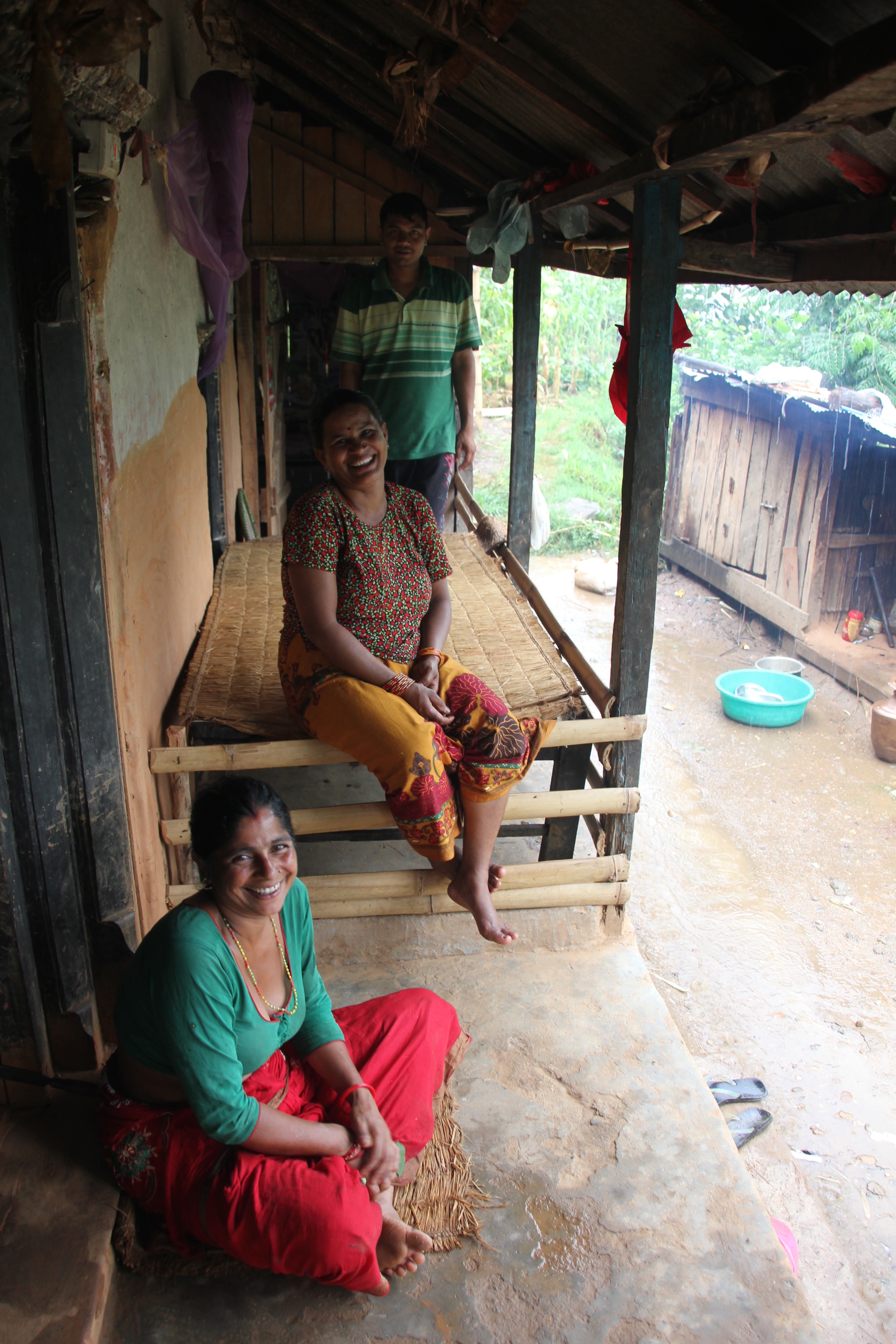
IMG_9481Dilmaya and I stayed at Kripa’s house. It’s standing, but unstable, so we’re all sleeping outside or in small rooms on the edges of the house. For years I’ve joked with Aamaa about going to sleep with the buffalo, or sending Pascal and Aidan to sleep with the buffalo when they’re being cheeky. Now, I can say I’ve actually slept with the buffalo. This glamping site (a phrase I learned this winter when a new “glamorous camping” hotel was going up in Pokhara) was one of the best places I’ve ever gotten to sleep. I loved dozing off each night in the open air and waking up slowly each morning to a cool breeze rustling over the corn, the green hills coming in to focus through the mosquito net.

Later in the week it started raining, so Kripa’s mother moved the bed to the porch. Cute, right? Our last night in Archalbot it rained heavily all night and all morning, and I lay on this cot listening blissfully to the tap-tap-tap-tap on the tin roof.

IMG_9726


Detail #2: Dancing

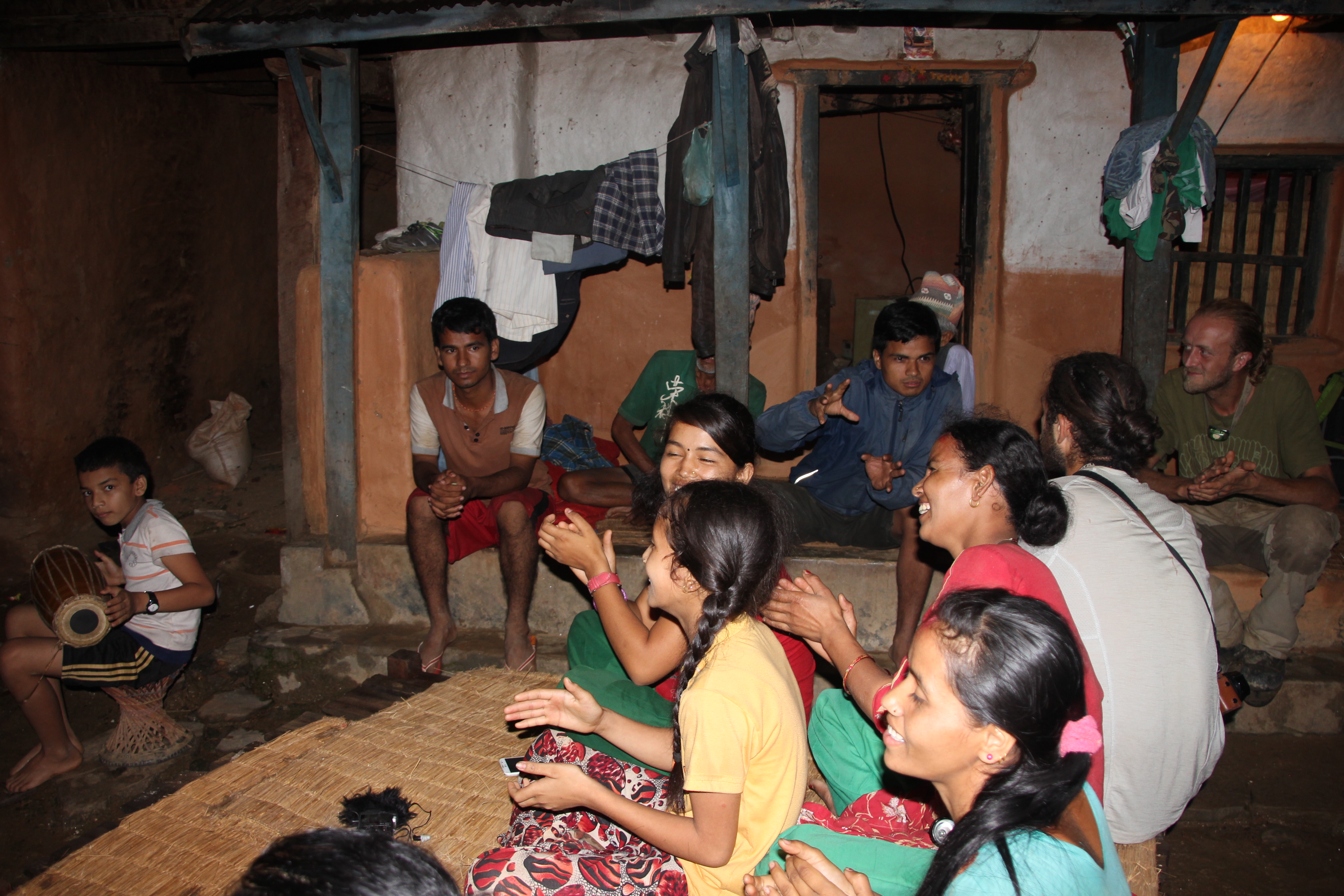
The night before Robin and Colin left Archalbot, we had a dance party at Kushal’s house, in the same yard where we first met this whole community just a short week and a half ago. It was so much fun. All the uncertainty and worry that the earth bag house hadn’t been finished, who had and hadn’t fulfilled what responsibility, what would be done next and who’d been let down or left out…everyone just kicked back and had a big old dance of it.  Which is how we handle potentially stressful situations in Nepal.

IMG_9741


Detail #3: This Grandma

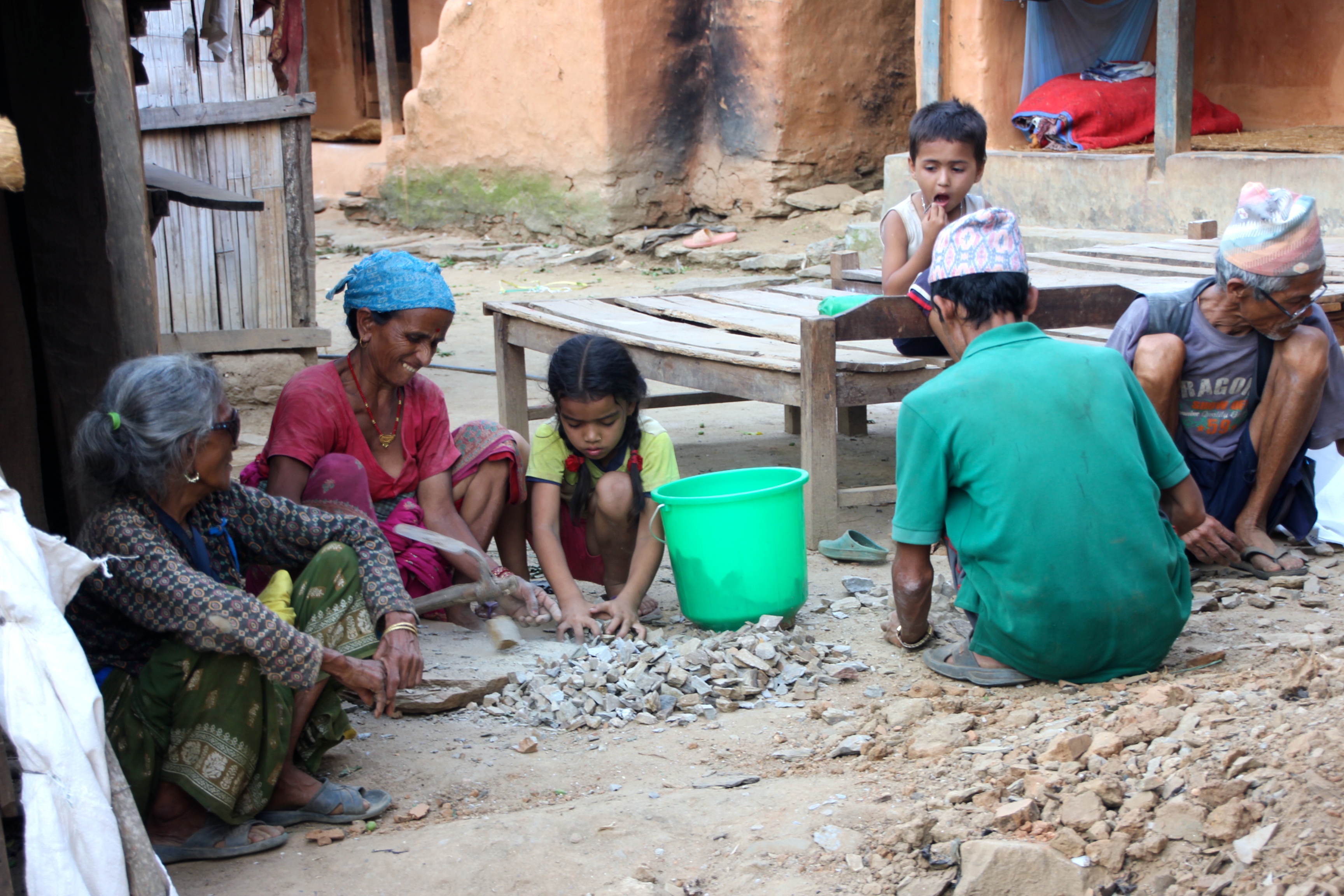
For the days when we had lots of help with the earth bag house, everybody, and I mean everybody, pitched in. You just couldn’t miss this grandma, who unfailingly monitored the scene all day, and during stone-breaking, sat with her legs in a perfect South Asian squat, clicking stones in to pebbles.  One day, I was loading rocks on to our makeshift carriers, and she came over and carefully began placing stones one at a time on to the tarp, with this kind of tentative body language that said, “I mean why not? It’s the thing to do.  Let’s see about it.”  After I got too excited and overloaded one bundle, we made the next one a little lighter so she could carry it with me. I couldn’t choose between these two amazing photos so you’re getting both of them.

IMG_9608

IMG_9611


Detail #4: Breaking stones

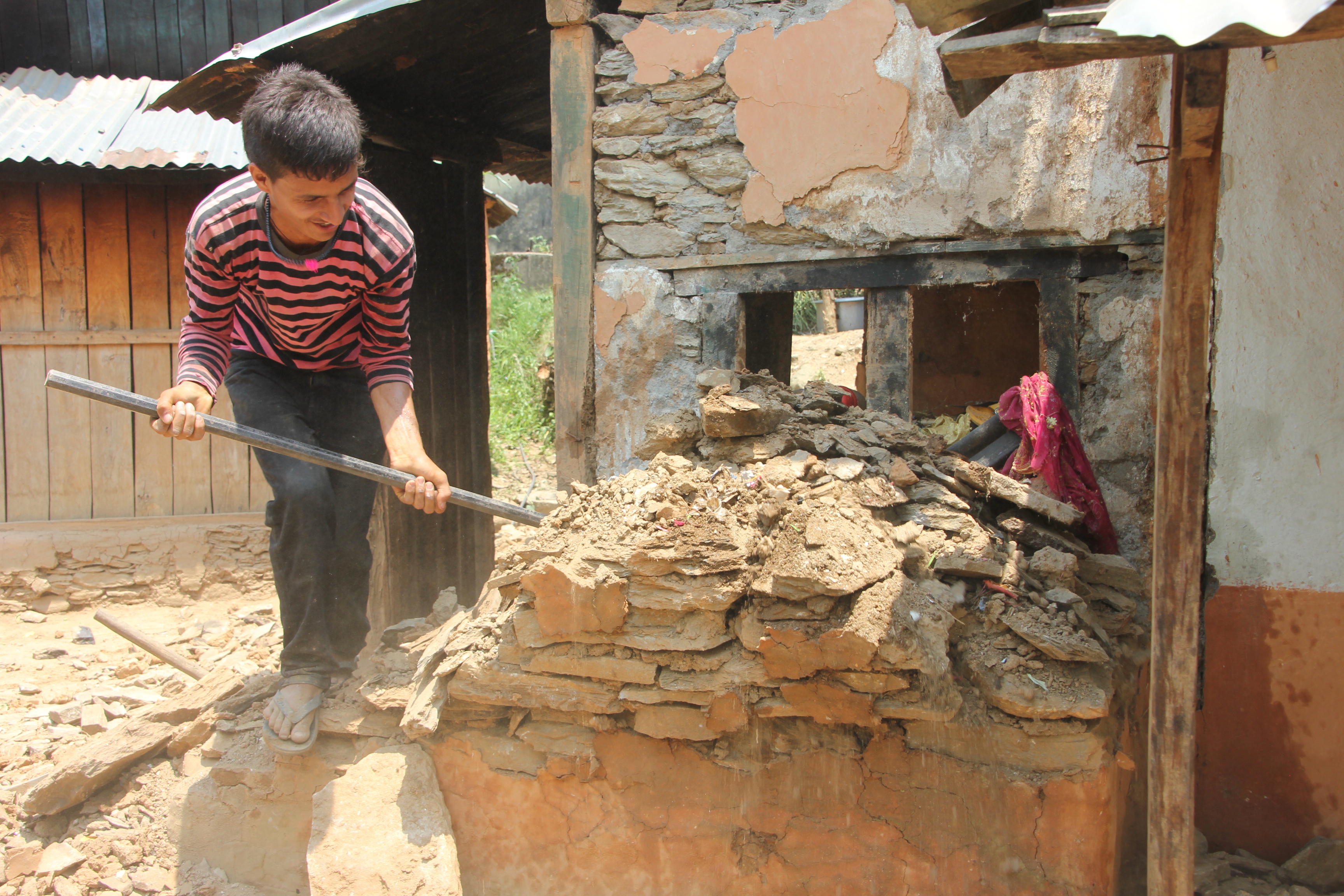
IMG_9624The foundation of the earth bag house is made of alternating layers of stone and packed dirt, and the first two layers of the house itself are made from sacks filled with little stones, which I now know to be called giti. In order to get enough stones, Mahendra’s family demolished one of the unstable rooms of their house, which was highly satisfying since the house will eventually need to be taken down anyway. Then, for days, there were all these people just sitting around clinking away at stones. A lot of the women and kids worked incredibly hard on this.

I’ve always had an association between stone-breaking and the awful child labor that you often see in the river bed: poor families breaking stones all day in the hot sun, children out of school. But this scene was totally different. It was like some kind of anti-submission-to-earthquake factory. It felt defiant and exhilarating having all these people in the community dismantling their own home in order to put the pieces in to the heavy foundation of a new house.

IMG_9603


Detail #5: Flour

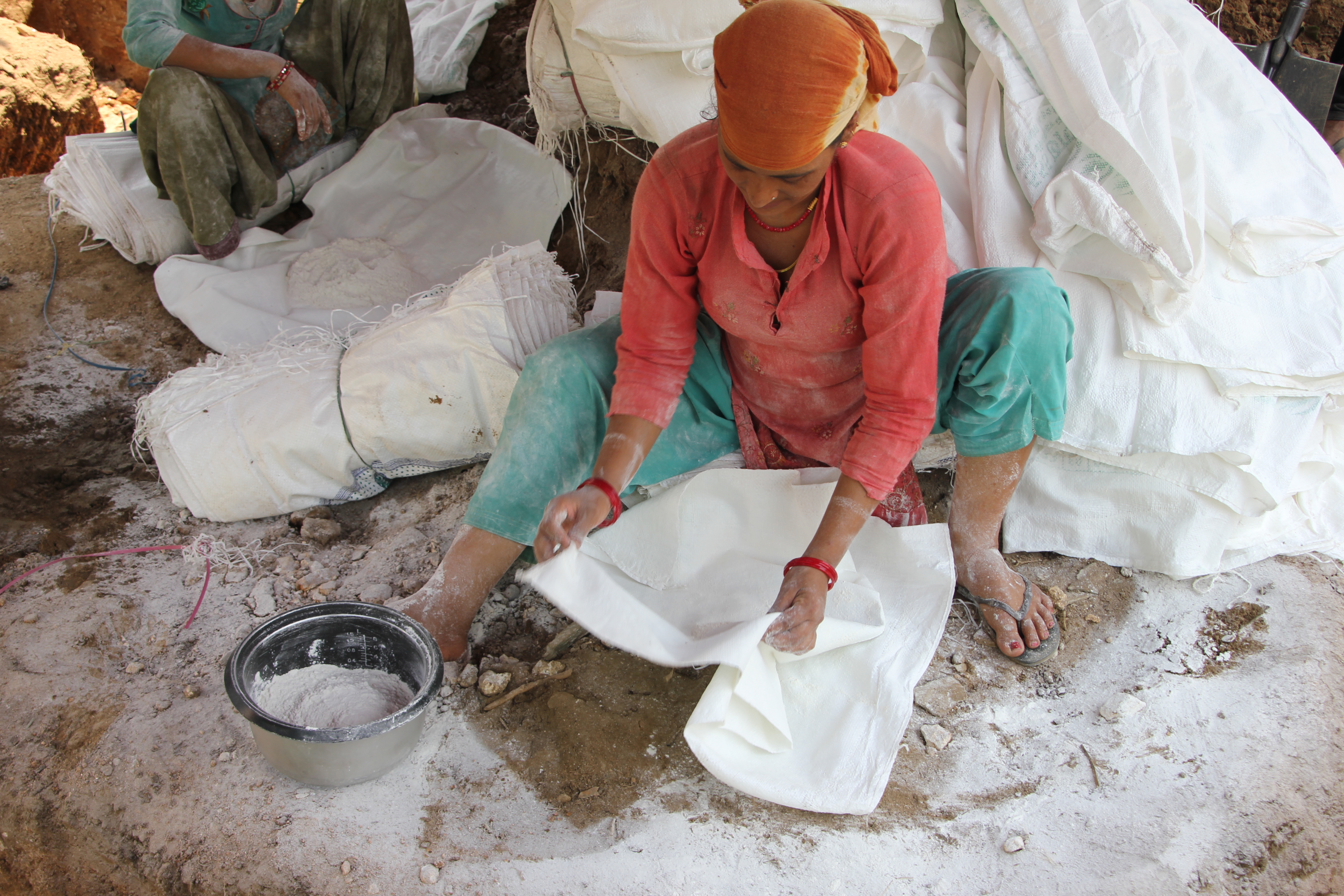
We used recycled sacks for the earth bag house, and they had previously contained flour. A team of two to three people was fully devoted to shaking out each and every sack to gather the palmfuls of flour remaining in each bag. Over the course of hundreds of sacks, the flour piled up like so. And, as Mariah pointed out, our earth-bag house was also something of a cake-house, and our team looked like a bakery.

IMG_9594


Detail #6: Kushal

I interviewed Kushal twice. Once, so he could show me around his house (look for him in an upcoming radio piece for BBC’s The World). The second time, to ask him what he thought about this whole housing thing, and what his perfect house looks like in his imagination. He talked to me about magic, in english, and I recorded it:

“Everything is magic. I walk, you walk, it is a magic. We can jump, we can speak, anything is magic. This is a house, it is also a magic. In the stone age, there was nothing like this house. In the stone age people lived in caves and they didn’t feel safe because animals can any time harm them. But we can feel safe here. There are many inventions like radio, microphone, camera, and DVD, laptop, computer and radio, it is also a magic. The people are developing magic. I don’t know surely, but I want to do some magic in my life. My life is also a magic that someone has gifted me, and your life is also a magic that someone has gifted you.”

.      .      .

IMG_9437

You Win Some, You Delay Some Wins


Well the earth bag house was coming along pretty well, but this week the rain started, which means planting season has begun. Colin has been working incredibly hard for hours a day in the heat, along with Moriah, an American volunteer who found out about the project on the facebook page that’s being used to coordinate earth bag building projects in Nepal. But completing an earth bag house in a week requires 8-10 people working all day, and we’ve had trouble getting consistent manpower from Archalbot.

I also have to confess that my part in the collaboration with the earth bag project went differently than I expected. After our experience in Parbat, I thought our main housing challenge was motivating people to gather bamboo (or other natural materials from the environment or their damaged homes) and build good quality shelters for us to provide tin roofing for. I expected, at the start of this week, that the earth bag project would be leverage for other local building projects, starting with Uttam’s bamboo house – in other words, that people’s interest in seeing the earth bag home completed would motivate them to fulfill our requirement that they also build a bamboo home for another especially needy family. I also expected that not everyone in Archalbot needed or wanted to move out of their cracked homes and live in bamboo houses. We thought we’d end up with be two high-quality sample homes in Archalbot – one earth bag, one bamboo – and residents would choose to one or the other them if they desired.

Instead, what happened is that once Uttam’s bamboo house started getting built, everyone became extremely motivated to go cut bamboo and make similar homes. It was much more successful than I ever imagined. And the earth bag house, while a brilliant long-term building solution, is extremely labor and resource intensive compared to familiar local building methods such as bamboo. With time and money scarce, everyone quickly became pre-occupied with the solution that met their needs and existing skills most efficiently. By mid-week, the strategy had reversed: we were pushing people to finish the earth bag home as a requirement for further tin distribution for bamboo houses.

IMG_9716

Uttam’s family’s two bamboo houses under construction

I realize maybe this is starting to sound a little weird – us putting these conditions in place for aid distribution, leveraging one community project against another. But that’s often the best way to collaborate as well as introduce new concepts or infrastructure in a place where people are used to doing things a certain way, and where the hierarchy of priorities is a well-entrenched survival system. We use this principle all the time when we do dental care. We have to put conditions in place that wedge new priorities in to this hierarchy: providing treatment only at the clinic and requiring people to go there to access it; charging nominal fees; making sure local shopkeepers sell toothpaste, but not giving the toothpaste out for free, so that people have to buy it themselves from the same place they buy sugar and soap. The reason for this isn’t for our benefit, it’s that the goal of our dental project is not to distribute toothpaste or provide one-off treatments, but to elevate the overall level of long term, sustainable oral health care in the places we work.  That only happens when people reorder their own priorities and behaviors, no matter what country or situation they live in.

Similarly, the purpose of the earth bag house is to train people in an earthquake-safe, affordable building method. But at first, it’s just a weird performance using rice sacks and dirt, so you can’t blame IMG_9549people for wondering if it’s really worth their time. It’s important to leverage the attractive elements of the project: the creation of a new structure, the intrigue of a new idea brought by foreigners, the incentive that we’ll provide materials to trainees for building one of these houses themselves. If we can capture participation based on these points, we can hopefully keep people’s attention long enough to teach the skills we want to transfer.  Like our dental clinics, the point is to see people absorb this safe-building technique over the long term because they realize it has value.

So leveraging earth bags and bamboo against each other was a great idea, but the thing I didn’t anticipate was that the time of year and the urgent need for shelter would make the one of the two so much more attractive. So for anyone out there doing earth bag building, my suggestion is, wait until about late September, just before the harvest time. Better yet, the best time of year would be December or January, the only season when there’s any semblance of a real break from field work. While earth bagging is a fast, democratic construction method compared to a block or large mud and stone house, it does require a lot of city-based resources and labor compared to other readily available options. There are almost no families that have 8-10 people in their household who can work intensively for 8 hours a day for a week, and definitely not during rice planting season. That means that families will have to hire labor, and that means other people need to have time.

IMG_9720In the end, Colin and Robin decided to have Archalbot build a bamboo shelter around the half-finished earth bag home, with the goal of returning to finish it up in the fall. So here is a photo of our nepal’s first earth-bag-bamboo-tarp home. Tarp soon to be replaced by bamboo.

In the evening, the community had another meeting about why the earth bag house hadn’t been completed. There was quite a bit of contrition – people hadn’t fulfilled their promises to help out. But there was still confusion over the concept that the earth bag house was a training opportunity, not a private building project. No matter how many times we explained this – and I speak pretty fluent Nepali, and Dilmaya is Nepali – the tendancy has been for people to think of the earth bag project as “Mahendra’s house.”

In any case, there was this slightly downer of a meeting, and everyone vowed that when Robin returns in the fall they will all be totally ready to devote time to completing the training. Then we went home to eat dinner, and I got a phone call from little Kushal.

A speaker system had been set up in the yard, and we had a rocking dance party. And why not, man. You win some, you delay some wins. When I left in the morning, there was cut bamboo lying around all over the place, ready for construction.

.      .      .

IMG_9755